
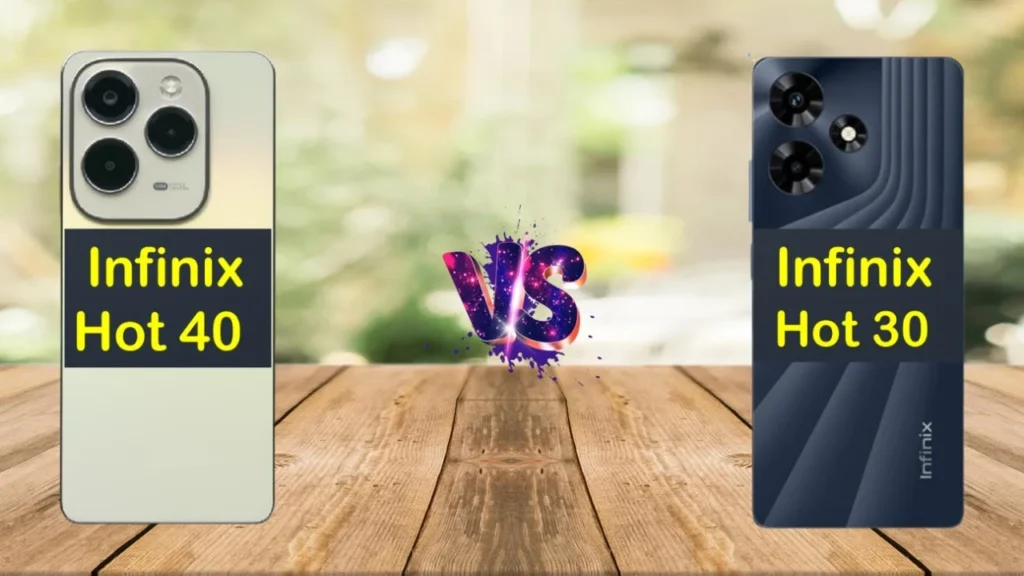
Infinix Hot 30 vs Hot 40
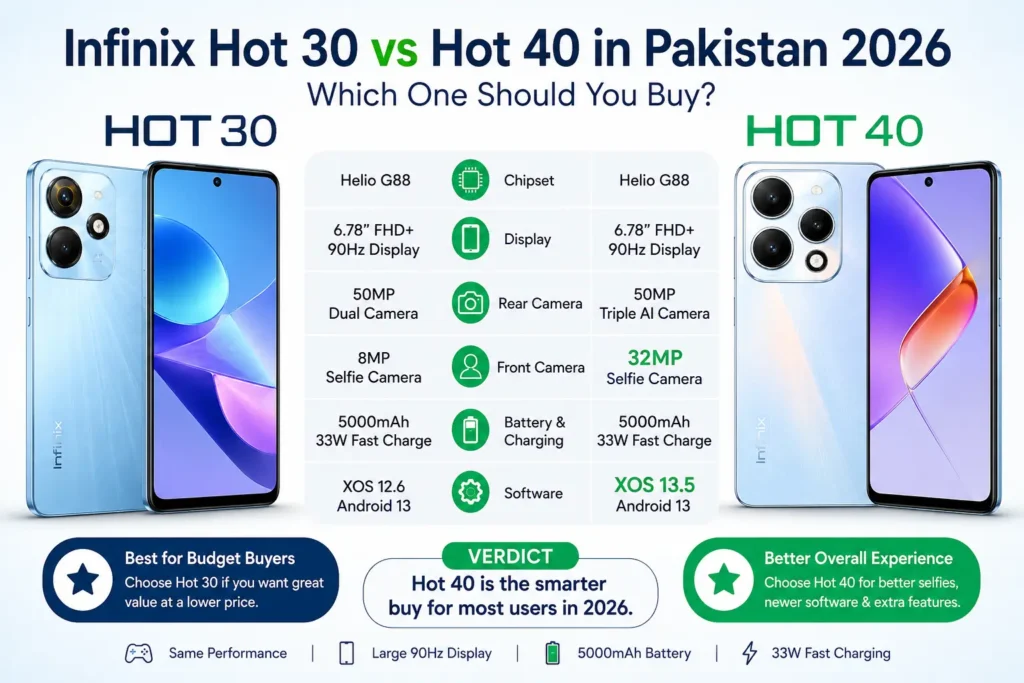
If you are comparing Infinix Hot 30 vs Hot 40, the most useful way to read the market is not through a raw specification lens, but through a buyer-intent lens. On paper, these two smartphones sit in almost the same performance class. Both are built around the MediaTek Helio G88 platform, both offer a 6.78-inch 90Hz FHD-class display, both carry a 5000mAh battery, and both support 33W fast charging. That alone tells you one important thing: this is not a major generational jump in speed, battery endurance, or core daily responsiveness.
The real distinction is more subtle, but more meaningful in actual use. Hot 40 gives you a noticeably more attractive 32MP selfie camera, a more polished Triple AI camera identity, and a newer-feeling software layer. Hot 30, by contrast, remains the more straightforward option, especially when the price difference becomes wide enough to matter. In a market like Pakistan, where prices shift, variants differ, and stock status changes quickly, the best choice is not always the newer device. The best choice is the one that offers the best value-to-need alignment.
So let us make the buying answer simple:
- If you want a better selfie phone, choose the Hot 40.
- If you want the cheaper large-screen budget phone, choose the Hot 30 only when the price gap is clearly worth it.
- If the price difference is small, Hot 40 is the safer, smarter, and more future-friendly pick.
Quick verdict
Infinix Hot 40 is the better buy for most people in Pakistan because it offers a more useful 32MP selfie camera, a cleaner Triple AI camera setup, and a slightly newer software experience, while the core hardware remains nearly identical to Hot 30. Both phones still share the same basic performance foundation: Helio G88, 6.78-inch 90Hz FHD-class display, 5000mAh battery, and 33W charging. That means this is not a massive speed upgrade; it is a refinement upgrade, and the refinement mostly shows up in the camera and software experience.
Infinix Hot 30 vs Hot 40
When you evaluate Infinix Hot 30 vs Hot 40 in Pakistan, the smartest framework is to think in terms of incremental value, not hype. These phones are siblings, not strangers. They are close enough that casual users will not feel like they are moving from one universe to another. In everyday tasks such as WhatsApp, YouTube, Facebook, TikTok, browsing, calls, and light gaming, both phones operate in the same practical tier.
The underlying architecture is what makes this matchup so close. The Helio G88 chipset is a budget-friendly platform that is competent for routine tasks and light gaming, but it is not a powerhouse. The display is large and smooth, but not a dramatic leap over its sibling. The battery is solid, but again, not a separator. This leaves camera quality, software polish, and market availability as the main discriminators.
Specs comparison
| Spec | Infinix Hot 30 | Infinix Hot 40 | What it means for buyers |
| Chipset | MediaTek Helio G88 | MediaTek Helio G88 | No major performance class jump |
| Display | 6.78-inch IPS/TFT LCD, 90Hz, FHD-class | 6.78-inch IPS LCD, 90Hz, FHD-class | Very similar daily viewing experience |
| Rear camera | 50MP main, dual-camera style in retailer listings | 50MP Triple AI Cam | Hot 40 has a stronger camera presentation |
| Selfie camera | 8MP front camera | 32MP front camera | Hot 40 is clearly better for selfies |
| Battery | 5000mAh | 5000mAh | Similar endurance |
| Charging | 33W | 33W | Similar charging speed |
| Software | Android 13, XOS 12.6 | Android 13, XOS 13.5 | Hot 40 feels newer |
| RAM/storage options in Pakistan | 128GB with 4GB or 8GB RAM | 128GB and 256GB variants with 8GB RAM | Variant choice changes value |
This table tells a very clear story: the platform is nearly the same, but the presentation and front-camera experience are stronger on Hot 40. That is important because many buyers in Pakistan use the front camera more than they think. Selfies, video calls, WhatsApp status uploads, TikTok clips, and social sharing all make the selfie camera more valuable than a spec sheet might suggest.
Display comparison
The display story is one of the most even parts of this comparison. Both phones sit in the same general class: large, smooth, budget-friendly panels with 90Hz refresh rate and FHD-class resolution. That means neither phone is going to feel cramped or outdated in routine use. Whether you are watching videos, scrolling social feeds, reading articles, or playing casual games, the screen experience should remain comfortable on both.
There are minor differences in how different sources describe the panel. Some listings frame Hot 30 as an IPS/TFT LCD with a sharp 1080-class resolution and moderately bright output, while Hot 40 is often described as having a similar-size IPS LCD with “sunlight readable” branding and display enhancement features. But for a normal buyer, the practical takeaway is simple: the screen is not the main reason to choose one over the other.
So the display section is not where the battle is won. It is where the result is narrowed to a draw.
If your buying priority is screen quality alone, neither phone offers a Dramatic Edge. That is good news in one sense, because it means you are not losing much with either choice. But it also means you should focus your attention elsewhere, particularly on selfie camera performance, software polish, and price.
Performance and gaming
This is where many comparison pages create unnecessary confusion. On the surface, a buyer sees a newer model and assumes faster performance. But in this case, the reality is much more restrained. Both phones are powered by the same Helio G88 chipset, and both use the Mali-G52 MC2 GPU. That means the phone-to-phone difference in day-to-day speed is relatively small.
In practical terms, this translates into similar behavior in:
- app opening speed,
- multitasking for light to moderate workloads,
- video streaming,
- social media use,
- messaging,
- and budget-level gaming.
For gaming, the most useful expectation is realism. This is not a powerhouse gaming phone, and it should not be treated like one. If you play titles such as Free Fire, PUBG Mobile/BGMI, or similar popular games at sensible settings, both phones can handle the experience in a decent budget phone way. They are usable, stable enough for casual play, and good enough for most non-competitive users. But neither device belongs in a class that would satisfy someone looking for a serious performance machine.
Camera comparison
This is the strongest argument for Hot 40.
The front camera is where the difference becomes immediately obvious. Hot 30 uses an 8MP selfie camera, which is fine for basic video calling and occasional front-camera shots, but it is not a standout feature. Hot 40, on the other hand, comes with a 32MP selfie camera, and that changes the entire personality of the phone. It is not just a numeric upgrade. It is a real-world upgrade in how the phone positions itself for modern social use.
The rear camera story is also stronger on Hot 40, at least in terms of camera identity and feature presentation. Hot 40 is pushed as a Triple AI Cam device, which gives it a more complete, more current imaging profile. Hot 30’s rear camera setup is simpler and more utilitarian. It can still take acceptable everyday photos, but it does not carry the same emphasis on a richer camera experience.
What this means in practical language is easy to understand:
- Hot 30 is enough if you just need a functional camera.
- Hot 40 is better if you care about selfies, portraits, and a more modern all-around imaging package.
Battery and charging
Battery life is one of the least controversial aspects of this comparison. Both phones come with a 5000mAh battery, and both support 33W charging. That means the real-world endurance should be very close.
For typical users, this should translate to a full day of comfortable use under ordinary conditions. If your routine includes calls, browsing, social media, video streaming, and messaging, both devices should be capable of handling the load without constant anxiety about battery percentage. Of course, heavier use, such as extended gaming, hotspot use, or prolonged video recording,g will drain faster, but that is true for almost any budget phone in this class.
The charging experience is similarly comparable. Since both models support 33W, you are not getting a major charging advantage by choosing one over the other. That means battery and charging are not meaningful differentiators here. They are support pillars, not deciding pillars.
This matters because it prevents the buyer from overthinking the battery section. Many people assume the newer phone must be better in everything, but that is not the case here. The battery class is effectively shared. Hot 40 does not outclass Hot 30 in endurance, and Hot 30 does not significantly outlast Hot 40 in a way that should drive the decision.
So when you are choosing between these phones, treat the battery section as a tie.
Design, software, and extra features
The design and software section is where Hot 40 begins to feel more modern, even though the physical hardware gap is not huge.
Hot 40 arrives with a newer software identity and a more feature-rich presentation. In branding terms, it often highlights things like Magic Ring, Folax, Lightning Multi-Window, stereo DTS speakers, NFC, and a side-mounted fingerprint scanner. These do not necessarily make the phone faster, but they do create a more premium-feeling user experience.
Hot 30 is simpler. It has the fundamentals in place: a big battery, a competent chipset, decent charging, and practical daily usability. But it does not project the same sense of polish. The software version is older, and that difference matters even if it does not sound dramatic on paper. A newer software layer can improve the feeling of freshness, system flow, and feature depth.
This is where the phrase user experience becomes more important than raw specifications. A phone is not only a processor and a battery. It is also the way menus respond, the way multitasking behaves, the way the camera app feels, and how the system supports everyday convenience. Hot 40 is the more refined package in that broader sense.
Price and value
This is the part that truly settles the contest.
In Pakistan, phone prices are not always stable across retail sources. A comparison page may show one price, a retail store may show another, and a product page may even show a discontinued label for one model while another source still lists it. That is why the value judgment must be made carefully.
The important pattern is this: Hot 30 is increasingly treated like the older, less available option, while Hot 40 is the more current retail-facing choice. In some live listings, Hot 30 appears as discontinued or harder to source. That matters because availability itself affects value. A phone is not valuable just because it has decent specs; it is valuable when it can be bought easily from a trustworthy seller at a fair price.
Here is the logic that matters for Pakistani buyers:
- If Hot 40 is only slightly more expensive, it is the better deal because it gives you the 32MP selfie camera and the newer software experience.
- If Hot 30 is significantly cheaper, it can be a better bargain for budget-conscious buyers who do not care about front-camera quality.
- If Hot 30 is discontinued or only available in less reliable stock, that weakens its value further, because the savings have to outweigh the availability risk.
And in most cases, when the gap is modest, Hot 40 wins on value.
Who should buy Hot 30?
Buy the Infinix Hot 30 only if the price is clearly lower and you are a basic user. That is the cleanest recommendation.
Hot 30 makes sense for someone who wants:
- a large display,
- decent battery life,
- normal app performance,
- and a lower upfront cost.
It is a reasonable phone for users who mostly browse, call, message, watch videos, and use social apps without caring too much about camera quality. It also remains attractive for buyers who simply want a no-drama budget phone and are not interested in newer feature layers or more advanced selfie capability.
Hot 30 can also make sense when stock and trust align. If you find a reliable seller, a proper warranty, and a price that is clearly lower than Hot 40, then the savings can justify choosing the older model. The key phrase here is clearly lower. A tiny price difference is not enough. You need a meaningful discount to make Hot 30 a better deal.
In short, Hot 30 is the phone for the buyer who says: “I want the essentials, I do not need extras, and I want to spend as little as possible.”
Who should buy Hot 40?
Buy the Infinix Hot 40 if you want a better everyday experience and a better selfie phone.
That is the most practical recommendation.
Hot 40 is a more persuasive purchase because it gives you the improvements that matter in daily life:
- a much better 32MP selfie camera,
- a more modern Triple AI camera setup,
- a newer software feel with XOS 13.5,
- and extra polish in the overall user experience.
What makes Hot 40 compelling is not raw speed. It is the combination of better front-camera performance and a more contemporary package. That is the kind of improvement you notice when you use the phone every day. It is especially relevant for users who post photos, make video calls, or simply care about a more balanced imaging experience.
Hot 40 is also the safer recommendation when the price difference is not large. If you only need to pay a little extra to get the stronger selfie camera and fresher software, then the upgrade is easy to justify. In that scenario, Hot 40 is the better value because it gives you more of what modern buyers actually care about.
So if you are choosing for 2026 and want the phone that feels more complete, Hot 40 is the default pick.
FAQs
For most people, the Infinix Hot 40 is better because it has a stronger 32MP selfie camera, a more complete Triple AI camera setup, and a newer software layer, while the core performance remains almost the same as Hot 30.
No. Both phones use Helio G88 and Mali-G52 MC2, so the performance gap is small. In practical use, they belong to the same budget performance class, and the upgrade from Hot 30 to Hot 40 is not dramatic in speed.
Hot 40 is much better for selfies because it has a 32MP front camera, while Hot 30 uses an 8MP front camera. That difference is large enough to matter for video calls, social media, and front-camera photos.
Neither phone is a gaming monster, but both are fine for budget gaming. Since they share the same Helio G88 platform, the gaming experience is broadly similar. Hot 40 may feel a little newer, but the difference is not enough to call it a gaming-focused upgrade.
Hot 40 is a better value when the price gap is small. Hot 30 only becomes the smarter choice when it is clearly cheaper and available from a trusted seller with a proper warranty. If the price difference is minor, Hot 40 gives more practical value.
Final verdict
The reason is not that it is much faster. It is not. The reason is that it improves the parts of the experience that actually matter in real life: camera quality, selfie quality, software freshness, and overall perceived polish. Meanwhile, the core hardware foundation stays almost the same as Hot 30. That is why this matchup is close, but still not ambiguous.
If you are a basic user and find Hot 30 at a clearly lower price from a trusted seller, it can still be a smart, economical buy. But when the difference is small, the newer model is the better decision because the extra cost buys visible value rather than invisible fluff.
So the clean Pakistan-first answer is this:
- Hot 30 = buy only when it is noticeably cheaper.
- Hot 40 = buy when you want the better overall package and better selfies.
