
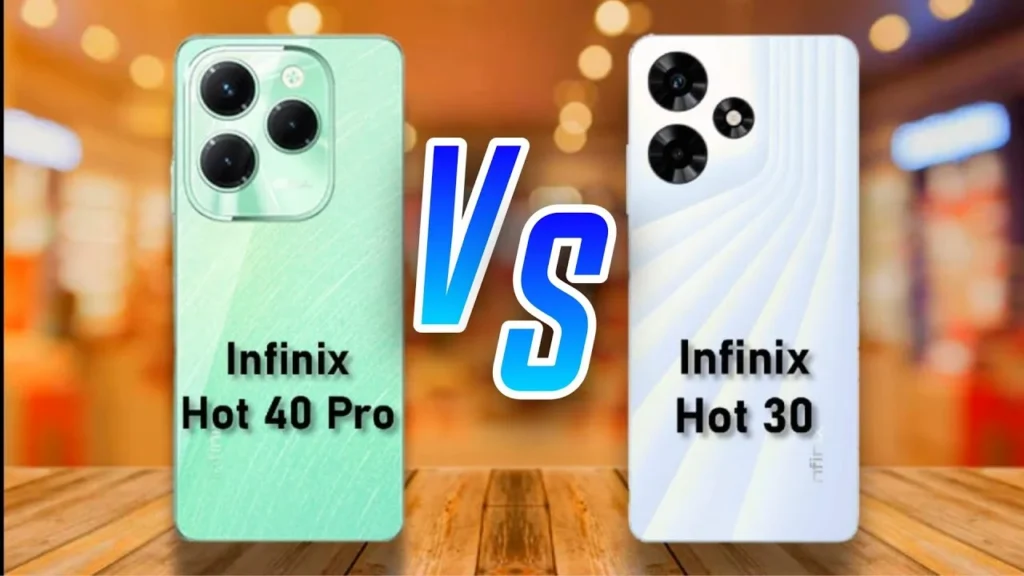
Introduction of Infinix Hot 30 Play vs Hot 40 Pro
If your search is Infinix Hot 30 Play vs Hot 40 Pro, the real question is simple: do you want the phone that stretches every rupee through a huge battery and a lower entry price, or do you want the one that delivers a more complete everyday experience with better speed, a sharper display, stronger cameras, and faster charging?
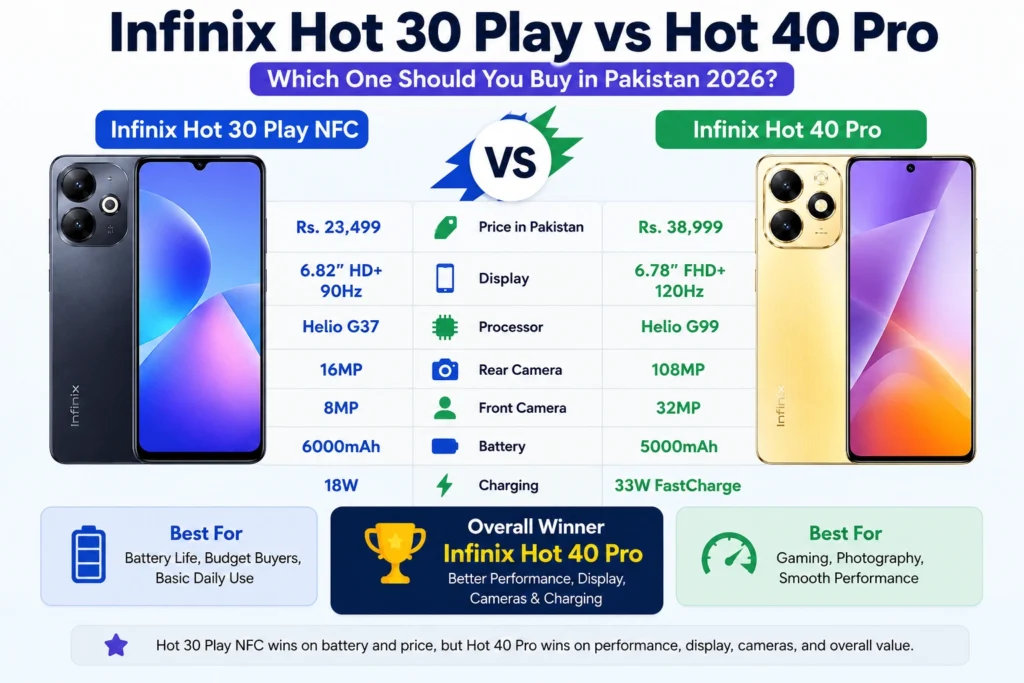
That is where these two Infinix phones split apart. The Hot 30 Play NFC is built for endurance-first users. Official Infinix specs show a 6000mAh battery, 18W charging, a 6.82-inch HD+ display, and a 90Hz refresh rate, along with a Helio G37 chipset and a 16MP rear camera + 8MP front camera setup.
The Hot 40 Pro pushes much harder into the all-rounder category. Infinix lists a Helio G99 chipset, a 6.78-inch 1080P / FHD+ display with 120Hz refresh rate, a 108MP rear camera, a 32MP selfie camera, 33W FastCharge, and a 5000mAh battery.
So the comparison is not just “cheap phone versus expensive phone.” It is really about user priorities: battery life versus balance, basic use versus smoother daily performance, and low upfront cost versus better long-term satisfaction.
Quick Verdict
Here is the clean, practical answer.
Choose Infinix Hot 30 Play NFC if your top priority is the lowest possible budget, maximum battery endurance, and simple everyday use. Its official identity is very clear: big battery, 90Hz screen, and a modest Helio G37 platform designed for light tasks.
Choose Infinix Hot 40 Pro if you want the phone that feels stronger in almost every meaningful daily category: speed, display smoothness, camera quality, charging speed, and gaming comfort. Officially, it is the more powerful and more polished device.
Best Choice by User Type
If you prefer a fast decision, this is the easiest way to see it:
Budget buyer: Hot 30 Play NFC, because it is usually the cheaper option in live Pakistan listings.
Heavy gamer: Hot 40 Pro, because the Helio G99 is substantially more capable than Helio G37.
Camera-focused user: Hot 40 Pro, because the 108MP rear camera and 32MP selfie camera are far more ambitious than the Hot 30 Play NFC setup.
Video watcher: Hot 40 Pro, because its FHD+ 120Hz panel is noticeably sharper and smoother than HD+ 90Hz.
Battery-first user: Hot 30 Play NFC, because the 6000mAh cell is the larger one.
Long-term value buyer: Hot 40 Pro, because its hardware package is more balanced and more future-friendly.
Pricing
Price is often the first filter for Pakistani buyers, and that is exactly where these two phones separate the audience.
Live retail listings show the Infinix Hot 30 Play NFC around Rs. 23,499 on PriceOye, while the Infinix Hot 40 Pro appears around Rs. 38,999 on PriceOye and Rs. 44,999 on WhatMobile. That gap is large enough to matter, especially if you are working within a tight budget.
That said, phone prices in Pakistan can vary by store, stock, color, warranty status, and timing of the listing. A phone that is “available” today may be marked differently tomorrow, and the same model can appear with different retail values depending on the seller.
From a buyer’s point of view, the price logic is straightforward:
The Hot 30 Play NFC is the safer pick when affordability matters most.
The Hot 40 Pro costs more, but the extra money buys a lot more phone: a much stronger processor, a better screen, stronger cameras, and faster charging.
Full Spec Comparison
Here is the practical difference in plain language.
The Hot 30 Play NFC focuses on basics done well enough: a large 6.82-inch HD+ panel, 90Hz refresh rate, Helio G37 chipset, 6000mAh battery, 18W charging, 16MP rear camera, and 8MP selfie camera.
The Hot 40 Pro is built as the stronger everyday machine: a 6.78-inch FHD+ 120Hz display, Helio G99 processor, 108MP rear camera system, 32MP front camera, 5000mAh battery, and 33W fast charging.
That means the Hot 30 Play NFC leans toward endurance and entry-level value, while the Hot 40 Pro leans toward a richer experience that will matter every single day.
Display Comparison
The display difference is one of the biggest reasons people move up from the Hot 30 Play NFC to the Hot 40 Pro.
The Hot 30 Play NFC gives you a 6.82-inch HD+ display with a 90Hz refresh rate. That is perfectly fine for calls, browsing, WhatsApp, social media, and casual video use. It still feels smoother than an old 60Hz screen, and its bigger size is friendly for users who like large text and easy viewing.
The downside is resolution. HD+ is acceptable, but it is not crisp in the same way an FHD+ panel is. Text edges, video detail, and fine graphics are simply not as sharp.
The Hot 40 Pro moves into a much better class with a 120Hz FHD+ display. Infinix describes it as a 6.78-inch punch-hole display with 1080P resolution and a high-refresh feel. That translates into smoother scrolling, cleaner text, better visual clarity in videos, and a more premium touch response.
If you use your phone heavily for YouTube, reels, short-form video, reading, gaming, or social media, the Hot 40 Pro display will feel more satisfying almost immediately. If your screen use is light and you mainly value size over sharpness, the Hot 30 Play NFC still gets the job done.
Display winner: Hot 40 Pro. It is sharper, smoother, and more pleasant in daily use.
Performance and Gaming
This is the clearest technical gap in the entire comparison.
The Hot 30 Play NFC uses the MediaTek Helio G37. Official Infinix specs place it firmly in the basic-use category. It can handle routine work like calls, messaging, browsing, and casual apps, but it is not a chip built for serious multitasking or sustained gaming performance.
The Hot 40 Pro, on the other hand, uses the MediaTek Helio G99, which is a far stronger platform. Infinix positions it as the performance engine of the phone, and that shows in everyday responsiveness, app switching, and gaming stability.
In real life, this difference matters more than people expect. The phone that feels “fast enough” on day one can start feeling cramped later if the processor is weak. Helio G99 simply gives the Hot 40 Pro more breathing room for modern apps, heavier browsing, and more demanding use.
For gaming, the split is even more obvious. Lightweight titles may run on both, but if you play games such as PUBG Mobile, Free Fire, Mobile Legends, or similar mainstream titles, the Hot 40 Pro has the stronger foundation and the smoother headroom. The Hot 30 Play NFC is better seen as a casual gaming phone, not a performance phone.
If you care about app load times, stability, and comfort over the next couple of years, the Hot 40 Pro is the smarter buy. If you only need basic speed for basic work, the Hot 30 Play NFC is acceptable.
Performance winner: Hot 40 Pro. The gap is too large to ignore.
Camera Comparison
Camera quality is another area where the Hot 40 Pro clearly pulls ahead.
The Hot 30 Play NFC uses a 16MP rear camera with AI support and an 8MP front camera. That setup is enough for everyday snapshots, Document Captures, quick social posts, and straightforward video calls. It is not trying to be a creator’s tool; it is trying to be a reliable budget shooter.
The Hot 40 Pro goes much further. Official Infinix specs list a 108MP rear camera system with an additional macro/AI configuration and a 32MP front camera. That means more detail in good light, a more capable portrait experience, much better selfie output, and a more confident social-media-ready camera package.
In everyday language, the Hot 30 Play NFC is fine for “I need a picture now,” while the Hot 40 Pro is built for “I want that picture to look good.” The second phone has a stronger chance of producing sharper, more shareable results, especially for selfies and daylight photography.
If you take photos often, post frequently, or use your phone camera for content work, the Hot 40 Pro is the obvious choice. If your camera use is light and occasional, the Hot 30 Play NFC is adequate, but no more than that.
Camera winner: Hot 40 Pro. The specification advantage is substantial.
Battery and Charging
Battery is the area where the Hot 30 Play NFC earns its place in the market.
The Hot 30 Play NFC carries a 6000mAh battery, and that is a very strong number for users who want long backup, fewer charging interruptions, and dependable endurance across a full day or more. Infinix literally markets it as a “Battery King,” which tells you what the phone is designed to prioritize.
The downside is the charging speed. It supports 18W fast charging, which is serviceable but not especially quick by modern standards. A bigger battery plus slower charging means the phone is optimized for staying away from the charger, not for bouncing back rapidly when it finally does need power.
The Hot 40 Pro has a smaller 5000mAh battery, but it compensates with 33W FastCharge. That gives it a more contemporary balance: still enough battery for a full day of normal use, but much better recharging convenience when time matters.
Design and Feel
These two phones are not only different on paper; they also target different emotions when you hold and use them.
The Hot 30 Play NFC is built around practicality. It is the kind of phone that says, “I need a phone that lasts long and costs less.” Its larger battery, bigger body, and simple feature set make it a utility-first device rather than a style-first device. Official Infinix marketing highlights the slim-and-light glass-feel design, but the overall mission remains endurance and accessibility.
The Hot 40 Pro feels more polished because its priorities are more balanced. The screen is sharper, the refresh rate is higher, the camera system is stronger, and charging is quicker. That combination creates a more premium day-to-day impression even before you think about benchmark numbers.
A lot of people underestimate “feel.” A phone can be technically functional but still feel limited, especially if the display is soft, the charging is slow, and the camera is basic. That is exactly the sort of friction the Hot 40 Pro reduces.
Design and everyday feel winner: Hot 40 Pro. It simply comes across as the more complete package.
Software and Everyday Use
Both phones run on Infinix’s Android-based experience, but software does not exist in a vacuum. It feels different depending on the hardware underneath it.
On the Hot 30 Play NFC, everyday tasks are fine as long as you keep expectations realistic. It is well-suited for calling, WhatsApp, YouTube, light browsing, and basic social media. The experience is centered on stability and battery comfort rather than speed or advanced responsiveness.
On the Hot 40 Pro, the software experience feels less constrained because the hardware is stronger. App switching is more comfortable, animations are easier to enjoy on the 120Hz display, and the phone has more margin for heavier multitasking and gaming.
That difference is important over time. A phone that feels “just okay” in month one can become annoying in month ten if it is constantly on the edge of its limits. The Hot 40 Pro is better protected against that feeling because it has more horsepower and a better screen to back it up.
Everyday use winner: Hot 40 Pro. It is simply easier to live with for a broader range of users.
Who Should Buy the Infinix Hot 30 Play NFC?
The Infinix Hot 30 Play NFC is not a bad phone. It is a phone with a very specific mission.
Buy it if you want:
- the lowest practical price in this comparison,
- very strong battery life,
- a simple phone for calls, chats, browsing, and YouTube,
- a device for light use rather than heavy gaming,
- or a backup phone that does not demand constant charging.
It makes sense for students who mainly need a dependable communication device, parents who care more about battery than camera flair, and buyers who simply want an affordable Infinix phone that stays alive for a long time.
The Hot 30 Play NFC becomes less attractive when you expect too much from it. If your habits include heavy gaming, content creation, lots of camera use, or frequent multitasking, the phone will feel limited sooner rather than later.
Who Should Buy the Infinix Hot 40 Pro?
The Infinix Hot 40 Pro is the better choice for most people.
Buy it if you want:
- a much stronger processor,
- a sharper and smoother display,
- better photos and selfies,
- faster charging,
- better gaming performance,
- and stronger long-term value.
It fits social media users, students with active app usage, mobile gamers, and buyers upgrading from an older or weaker phone. It also makes sense if you do not want to feel locked into only “basic” use.
In simple terms, the Hot 40 Pro is the model you buy when you want your phone to feel capable rather than merely functional.
Pros and Cons
Pros Infinix Hot 30 Play NFC
It offers a very large 6000mAh battery, a lower price point, a 90Hz screen, and a practical design philosophy that suits light users well.
Cons: Infinix Hot 30 Play NFC
Its Helio G37 chipset is entry-level, the display is only HD+, charging is slower at 18W, and the cameras are basic rather than exciting.
Pros Infinix Hot 40 Pro
It brings a much stronger Helio G99 chip, a 120Hz FHD+ display, a 108MP rear camera, a 32MP selfie camera, and 33W charging that feels more modern and more convenient.
Cons: Infinix Hot 40 Pro
It costs more, and its 5000mAh battery is smaller than the Hot 30 Play NFC’s huge 6000mAh cell. For users who only want a simple phone, some of the extra power may be unnecessary.
Should You Buy the Hot 30 Play NFC in 2026?
Yes, but only if your needs are limited and your budget is tight.
The Hot 30 Play NFC still makes sense for people who mostly call, message, browse casually, and care most about battery backup. The official spec sheet supports that identity very clearly: 6000mAh battery, 90Hz HD+ display, Helio G37, and 18W charging.
It is not the phone you choose if you expect gaming power, impressive cameras, or a crisp visual experience. In 2026, it is best understood as an endurance-focused budget choice rather than a broad, future-ready performer.
Should You Buy the Hot 40 Pro in 2026?
Yes. For most buyers, the Hot 40 Pro is the better investment.
It has the kind of spec stack that still feels relevant: Helio G99, 120Hz FHD+ display, 108MP rear camera, 32MP selfie camera, 5000mAh battery, and 33W FastCharge. That combination gives it a stronger all-around profile than the Hot 30 Play NFC.
It is the better fit if you want a phone that handles more tasks with less friction. Even when the upfront cost is higher, the improved daily experience is usually worth it.
FAQs
The Infinix Hot 40 Pro is better overall because it offers a stronger processor, a sharper display, better cameras, and faster charging. The Hot 30 Play NFC is mainly for battery-first, budget-conscious users.
The Hot 30 Play NFC has the larger battery at 6000mAh. The Hot 40 Pro has a smaller 5000mAh battery but compensates with faster 33W charging.
Yes. The Helio G99 makes the Hot 40 Pro much better for gaming than the Hot 30 Play NFC, which uses the weaker Helio G37.
Yes, it is good for basic daily tasks like calls, chats, browsing, and YouTube. It is best for light users who value battery life more than raw speed.
The Hot 40 Pro has the better camera because it offers a 108MP main camera and a 32MP selfie camera, while the Hot 30 Play NFC has a more modest 16MP rear camera and 8MP front camera.
Final Verdict
The final call is clear.
The Infinix Hot 30 Play NFC is the better choice for battery-first users and people with a tight budget. It is simple, functional, and dependable, especially if your phone use stays on the lighter side.
The Infinix Hot 40 Pro is the better choice overall. It wins on performance, display quality, camera capability, charging speed, and long-term usability. It is the smarter phone for most people because it gives a more satisfying experience in the places that matter most.
Final Recommendation
Choose Hot 30 Play NFC if saving money and getting the biggest battery are your main goals.
Choose Hot 40 Pro if you want a better all-around phone for daily use, gaming, photos, and future value.
