
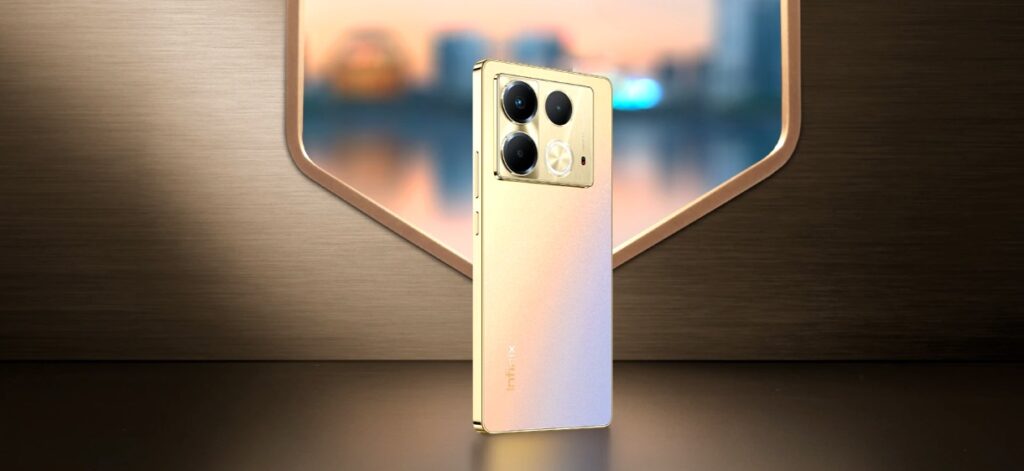
Introduction of Infinix Note 40
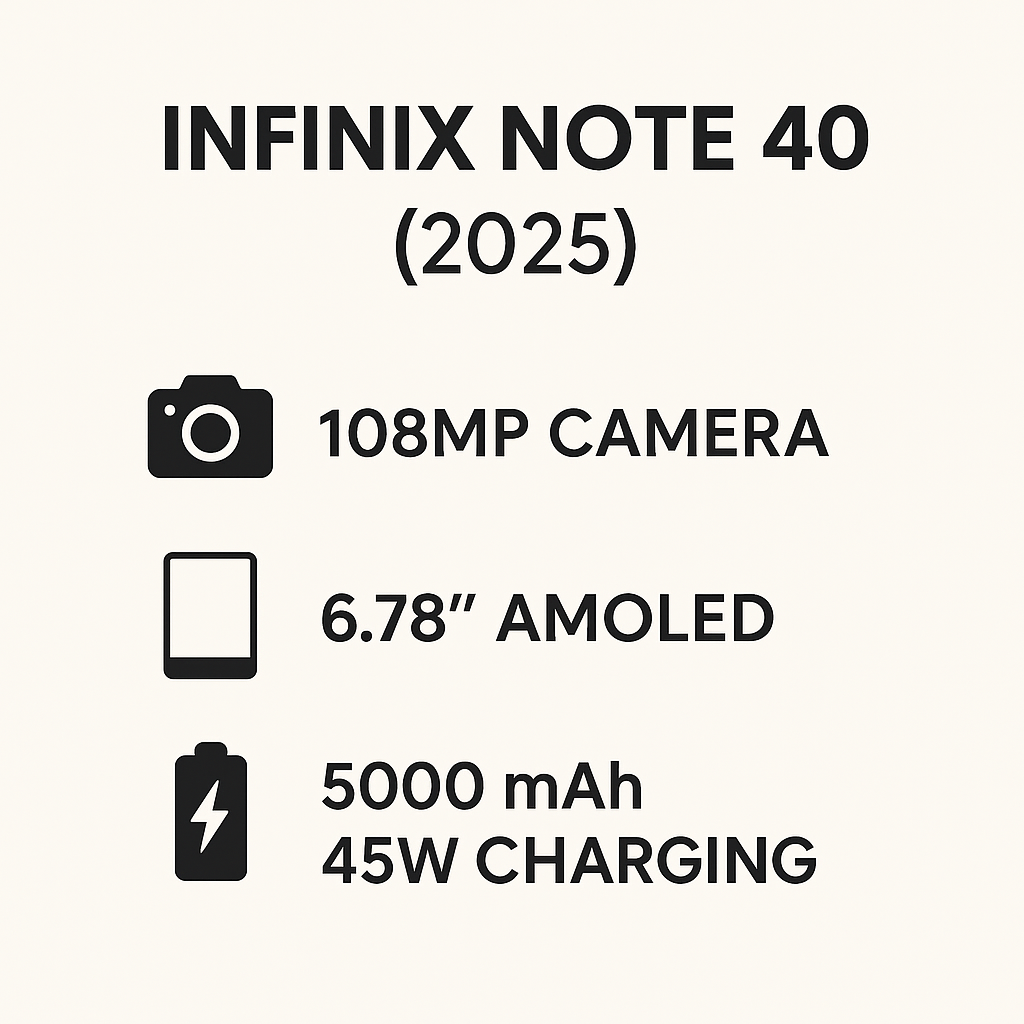
The Infinix Note 40 is a compelling mid-range contender: a 108MP primary camera, 6.78″ 120Hz AMOLED, 5,000 mAh battery, 45W wired charging, and 20W MagCharge magnetic wireless. Excellent value for photography-first buyers and media consumers. Verify your region’s SoC and band support before purchase — performance and 5G vary by SKU.
This Infinix Note 40 review deep-dives into the 108MP camera, 120Hz AMOLED, 45W wired + 20W MagCharge wireless charging, battery benchmarking, real photo samples, and buying guidance tailored for 2025 shoppers.
Quick specs
| Item | What to expect |
| Display | 6.78″ 120Hz AMOLED, ~1080×2436, HDR-capable |
| SoC | Helio G99 Ultimate for many SKUs; Pro/5G trims may ship with Dimensity chips in select markets |
| RAM / Storage | 8GB / 128GB or 8GB / 256GB typical (some SKUs expandable via microSD) |
| Main camera | 108MP primary (pixel-binned outputs by default); ultrawide / macro vary by SKU |
| Selfie | 32MP (typical) |
| Battery | 5,000 mAh |
| Wired charging | 45W All-Round FastCharge 2.0 |
| Wireless charging | 20W MagCharge (magnetic; requires MagCase & MagPad) |
| OS | Android 14 with XOS 14 skin |
| Extras | In-display fingerprint, stereo speakers, MagCharge ecosystem |
| Weight / Size | ~190 g; ~7.5–8 mm thickness (varies by model) |
Design & build — how it feels
Visual and tactile impression
The Note 40 follows a contemporary aesthetic: a broad camera island, minimalist lines, and a slim profile that emphasizes screen real estate. While the frame is polymer rather than full metal, the finish is refined and comfortable in the hand.
Strengths
- Lightweight for its size — great for long-form reading or streaming sessions.
- Thin bezels and a large display create an immersive viewing canvas.
- In-display fingerprint is fast and reliable in daily use.
Trade-offs
- Plastic frame (not aluminum) reduces perceived premium but helps keep weight down.
- Finish varies across colorways; Pro models sometimes show a more elaborate camera halo.
- IP rating across markets tends to be splash-resistant (e.g., IP54 in select regions) — don’t assume submersion tolerance.
Display — bright, fast, and smooth
The 120Hz AMOLED display is one of the Note 40’s most persuasive selling points. It delivers smooth motion, saturated color, deep blacks, and credible HDR highlights when source material supports it.
Practical display tests to include
- Peak brightness (nits) by APL (2% highlights and 100% white).
- Color gamut coverage (sRGB / DCI-P3) and Delta-E for color accuracy.
- PWM/flicker check to identify potential eye-strain for sensitive users.
- HDR playback verification for YouTube / Netflix streams (check DRM level if you need HD).
- Side-by-side photographic comparison vs a Redmi Note 13 or Galaxy A-series to show color tuning and white balance.
Performance — daily use and gaming
Performance is contingent on the SoC variant. Many units ship with MediaTek Helio G99 Ultimate — a solid mid-range performer — while Pro/5G trims in some territories may use Dimensity chips, giving better single-core and 5G connectivity.
Everyday experience
- Smooth UI, rapid app launches, and reliable multitasking for typical workloads.
- System animations and biometric unlocking feel snappy on 120Hz.
Gaming & sustained load
- Casual and many competitive titles run fine at medium settings. Expect 30–60 minute sessions at stable fps for titles like PUBG Mobile and Call of Duty Mobile on medium-to-high settings.
- Heavier titles at max settings may encounter thermal throttling; include surface temperature readings and throttling graphs in your review..
Camera deep-dive — samples, crops, and advice
This is the high-impact section. The 108MP headline generates clicks — but meaningful buying decisions hinge on how Infinix processes and delivers those pixels.
Hardware fundamentals
- 108MP sensor (some listings name GalaxyCore GC32E1 for certain SKUs).
- Pixel-binning to produce default 12MP/27MP outputs for better low-light performance and acceptable file sizes.
- Ultrawide / tele / macro configurations differ by market — always verify your unit.
Testing methodology
- Capture in Auto and Pro modes; save RAW where possible.
- Use a tripod for night and Pro exposure frames.
- Maintain identical framing for cross-phone 1:1 crops.
- Export EXIF metadata for each sample (ISO, shutter, aperture, lens crop/zoom).
Daylight (1×) expectations
- Excellent fine detail in good lighting courtesy of the high-resolution sensor.
- Default JPEGs may show contrasty sharpening — attractive on social, but examine 1:1 crops for artifacting.
- Dynamic range is competent but can clip highlights in very high-contrast scenes — HDR helps.
Zoom performance
- 2× digital often yields usable detail; beyond 5×–10× images degrade noticeably.
- Recommended: show 1×, 2×, 5× crops to illustrate the graduated loss in fidelity.
Night & low-light
- Night Auto vs Night Pro (tripod): Night Pro offers longer exposures and can preserve texture better while reducing noise.
- Expect noise reduction to sometimes wipe out delicate textures in favor of cleaner-looking results.
Portrait & selfie
- Selfie processing tends to smooth skin — favorable for social audiences.
- Portrait mode provides decent subject separation but can be aggressive at times.
Video
- Typical recording modes: 1080p@60; some SKUs may support 2K or 4K at 30fps.
- Stabilization (EIS) does a fair job while walking; test on a bike or running for real-world stabilization behavior.
Battery & charging — wired vs MagCharge wireless
Battery life and charging behavior are central to the user experience. The Note 40 ships with a 5,000 mAh cell, 45W wired charging, and 20W MagCharge magnetic wireless.
Wired (45W)
- Real-world expectation: 0→~50% in roughly 20–30 minutes, depending on starting temperature and A/C conditions. Wired is ideal for rapid top-ups.
MagCharge wireless (20W)
- Magnetic wireless charging that requires MagCase and MagPad / MagPower accessories.
- Slower than wired but offers a tidy, cable-free experience for desk or car top-ups. Secondary benefit: convenient alignment via magnets.
Recommended battery tests
- 0→100 wired and 0→100 MagCharge wireless curves with timestamps (every 5–10 minutes).
- YouTube 1080p loop endurance at fixed brightness to compare streaming drain.
- 30-minute gaming drain (FPS logged) to show gaming battery impact.
- 24-hour standby test to compare idle drain patterns.
Software, updates & bloat
The phone runs Android 14 layered with XOS 14. XOS brings features and customization, but ships with a regional preinstalled app that some users will consider bloat.
What to look out for
- Region-specific apps and shortcuts on first boot.
- Update cadence for Infinix is historically less generous than major global brands — verify the local guarantee for Android upgrades and security patches.
Connectivity, ports & accessories
Connectivity
- Band support differs by SKU — confirm the exact bands if you rely on specific carrier frequencies (especially for 5G).
- NFC availability is market-dependent — essential for contactless payments in some regions.
Accessories
- MagCase, MagPad, MagPower: describe each’s function and expected cost (or advise to check the official store).
- A wired charger is typically included; MagPad is usually sold separately.
Price, variants & where to buy
Prices fluctuate by market and SKU. Always do a live price check before publishing. Recommended process:
- Confirm SKU (SoC, RAM, storage).
- Pull price from Official stores and major e-tailers (Amazon, Flipkart, Daraz, Noon, Jumia).
- Note launch price vs current street price and date checked.
Alternatives & comparisons
If considering the Note 40, parallel options to evaluate:
- Redmi Note 13: often stronger software polish and longer support for Windows.
- Samsung Galaxy A-series: more consistent update policy and brand trust.
- POCO mid-range: frequently delivers better raw performance for the price.
Comparison table idea
| Phone | Display | SoC | Camera | Battery | Charging |
| Infinix Note 40 | 6.78″ 120Hz AMOLED | G99 / Dimensity (varies) | 108MP | 5,000 mAh | 45W wired / 20W MagCharge |
| Redmi Note 13 | 6.67″ 120Hz | Snapdragon / Helio | 108MP | 5,000 mAh | 67W wired |
| Galaxy A-series | 6.5″ AMOLED | Exynos / Snapdragon | 50–108MP | 4,500–5,000 mAh | 25–45W wired |
Final verdict — who should buy it?
Buy it if:
- You want a large, bright 120Hz AMOLED for videos and games.
- You value a high-resolution 108MP primary camera and plan to use RAW/JPEG workflows.
- You appreciate the convenience and novelty of magnetic wireless (MagCharge) and plan to buy the MagCase/MagPad.
Don’t buy if:
- You need a robust multi-year Android version and security updates.
- You demand flagship-grade sustained gaming performance.
- You dislike accessory dependency for wireless charging.
Short verdict:
The Infinix Note 40 is a strong value mid-ranger for photography-first users and media watchers, especially where local price and accessory availability make the package compelling.
FAQs
Ans: It supports 20W MagCharge wireless, but you need the official MagCase and MagPad accessory to use it. MagCharge is magnetic and convenient for desk charging, but it’s slower and may run slightly warmer than wired 45W charging.
Ans: Yes. The 108MP main sensor captures high detail in daylight and yields versatile results when you use the phone’s Pro mode or save RAW files. In bright conditions, you’ll get crisp results; low-light improves a lot with Night mode and tripod exposures, though heavy post-processing (aggressive NR/sharpening) can occasionally flatten fine texture. Always compare your specific SKU because lens optics and ISP can differ by region.
A: Many SKUs use MediaTek Helio G99 Ultimate. Some markets receive Pro or 5G variants with Dimensity-class chips. Confirm the SKU before buying, as this affects performance and 5G compatibility.
A: Wired charging is 45W, which is fast and considerably quicker than the 20W wireless option. Expect a much shorter top-up time with the included wired charger versus MagCharge.
A: It ships with Android 14 + XOS 14. Infinix historically offers fewer major Android version updates than premium brands; check local support pages for the official update policy for your market.
Conclusion
The Infinix Note 40 (2025) stands out as one of the most value-packed mid-range smartphones this year. With its elegant AMOLED Display, a sharp 108MP camera, fast 45W charging, and a reliable 5000mAh battery, it balances power and practicality impressively. While it may not rival premium flagships in gaming or low-light photography, it delivers far more than expected for its price segment. If you’re looking for a stylish, performance-driven phone with long battery life and fast charging, the Infinix Note 40 is absolutely worth considering in 2025.
