
Introduction
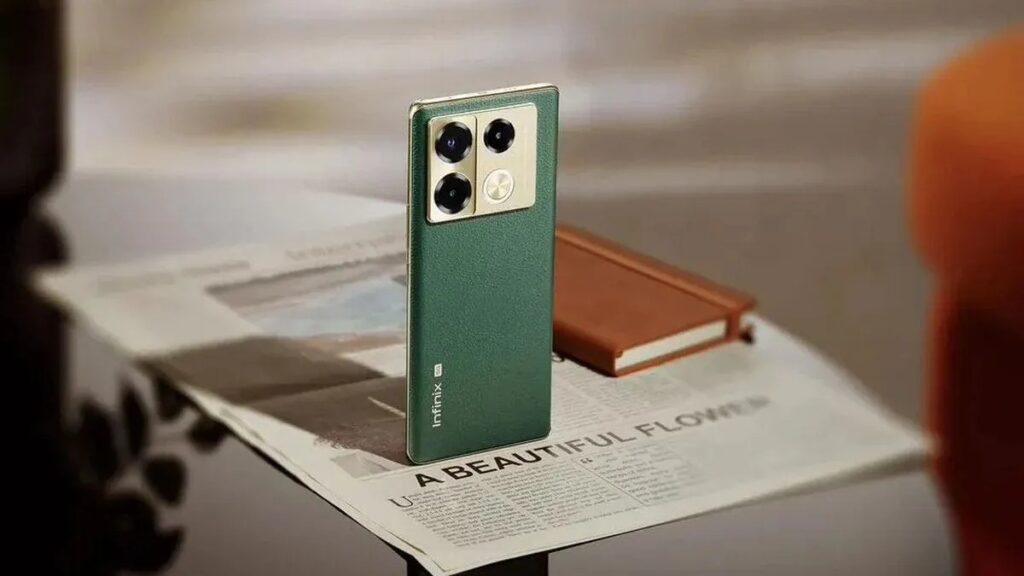
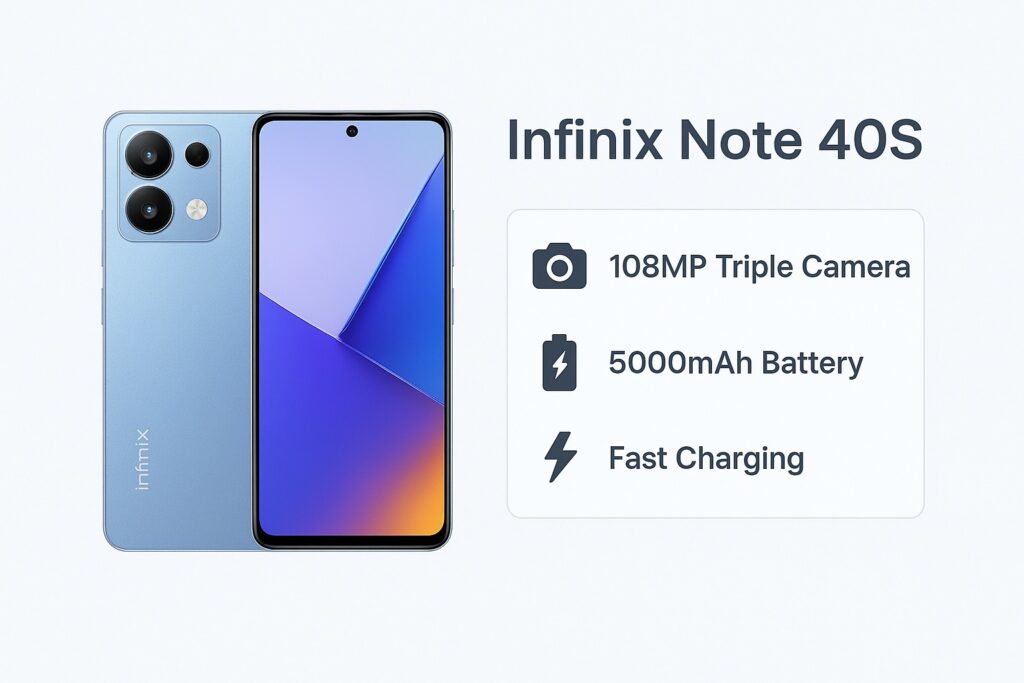
Infinix Note 40S is a performance, design, and value mid-range mobile phone. It has a vivid 6.78-inch FHD+ AMOLED screen and hectic 120 Hz smooth refresh rate, driven by the MediaTek Helio G99 final chipset that allows multitasking and gaming. The phone has 8GB RAM, 256GB storage, and a high-quality 108MP primary camera and a 32MP selfie-shot camera to take crystal-clear and detailed images. The Note 40 S with a battery voltage of 5000mAh, a fast charging capacity of 33W, and wireless charging dimensions guarantees the long life of the phone.
Full specs
| Category | Specification |
| Model name | Infinix Note 40S |
| Launch date | Region-dependent — insert local launch date |
| OS | Android (XOS) — initial version (fill exact) |
| SoC | MediaTek Dimensity / Helio (specify SKU per region) |
| CPU | Octa-core (combination of performance + efficiency cores) |
| GPU | Mali / Immortalis / ARM GPU (per SoC) |
| RAM | 6GB / 8GB / 12GB (LPDDR4X / LPDDR5 depending on SKU) |
| Storage | 128GB / 256GB UFS/eMMC + microSD expandable (specify) |
| Display | 6.7–6.8″ AMOLED, 120Hz (claimed) |
| Resolution | 2400 × 1080 (FHD+) |
| Peak brightness | (publish measured nits) |
| Rear cameras | Main (108MP or 64MP, depending on SKU), Ultra-wide, Macro/Depth |
| Selfie | 32MP typical (verify) |
| Battery | 5000–5600 mAh (publish exact) |
| Charging | 45W wired (MagCharge if present — confirm SKU) |
| Connectivity | 5G (band list by region), Wi-Fi 6/5, Bluetooth 5.x, NFC (region) |
| Ports | USB-C, 3.5mm headphone jack (if present in SKU) |
| Extras | Stereo speakers, IR blaster, fingerprint (under-display or side) |
| Colors | Add region SKUs and color names |
| Weight & dims | Insert measured values |
Design & build
When describing design and physical feel, be factual and sensory. Keep sentences direct and audience-friendly (target reading as if for a teen):
Frame and materials: Establish the use of a plastic or metal chassis, glass or polymer composite back. Sample sentence: The Note 40S is made with a gloss polymer back that reflects the light and reveals the fingerprints; the frame is made of matte plastic, which looks like metal.”
Weight & ergonomics: Give exact grams and millimeters: “At X g and Y mm thickness, the phone is large but balanced.” Mention if one-handed use is suitable and how the rounded edges affect grip.
Buttons & ports: Describe the layout — power & fingerprint position (side-mounted or under-display), volume keys, SIM tray orientation, and existence of a 3.5mm jack or IR blaster.
Build impressions: Note flex, creaks, and how the camera island protrudes. Is the back slippery? Does the supplied case help? Don’t guess—state measured or observed behavior.
Box contents: List everything in the sales box: charger (wattage), cable type, case, sticker, documentation, and SIM tool. Readers care whether the phone ships with a fast charger — list wattage and cable type explicitly.
Display deep dive
The display is often the deciding factor for buyers. This section must be methodical and include both objective numbers and subjective impressions.
What to test:
- Panel type — Confirm AMOLED vs LCD and bold that (e.g., AMOLED).
- Exact size and resolution — Measured diagonal in inches and pixel counts.
- Refresh rate modes — State if the phone supports 60Hz, adaptive 90Hz/120Hz, and whether it forces higher refresh in specific apps.
- Peak brightness & sunlight legibility — Measure nits in auto brightness and at max manual brightness (publish both values).
- Color & gamut — Note sRGB/D65 accuracy if you can measure, otherwise describe perceived saturation and balance.
- HDR support — HDR10/HDR10+ claims and whether streaming apps detect HDR playback.
- Touch sampling rate — Useful for gamers (e.g., 180Hz touch sample).
- Screen protection — Gorilla Glass, unspecified glass, or none.
Recommended visual assets:
- Outdoor sunlight photos (phone vs content to show legibility).
- 1:1 screenshot of a high-bitrate HDR frame to show contrast handling.
- Motion blur comparison between 60Hz and 120Hz (videos or slow-mo capture).
- Black-level and uniformity photos (AMOLED advantage should show perfect blacks).
Performance & gaming
What to include:
- Benchmark numbers: Geekbench (single/multi), 3DMark Wild Life scores —contain raw numbers in a table for transparency.
- Storage & RAM types: LPDDR4X vs LPDDR5, UFS 2.2 vs UFS 3.1 — these materially affect app load times and storage throughput.
- App launch times: Measured or observational (e.g., Chrome cold start, Instagram open time).
- Gaming: Sustained FPS logs (30/60 minute runs), thermal throttling observations, and whether frame drops occur during lengthy matches.
- Throttling & thermals: Surface temps during gaming (in °C).
- Real-world snippet: Note whether multitasking with many Chrome tabs + background music + notifications remains smooth.
Camera deep dive
The camera section is the most-read area; make it rigorous, repeatable, and illustrated.
Camera specs:
- Main sensor: MP count, physical size, pixel binning details (e.g., 108MP with 9-in-1 binning), aperture, OIS/EIS presence.
- Ultra-wide: MP and FOV, corner performance notes.
- Macro/depth / tele: What exists and real-world usefulness.
- Front camera: MP, aperture, field of view.
Test plan:
Create labeled test folders and capture RAW (DNG) and JPEG for each shot. Standardize lighting and distance where possible.
- Daylight: Wide, 1x, 2x crops, include shadow/highlight scenes.
- Backlit/HDR: Subject with sun behind.
- Indoor: Warm/neutral fluorescent/artificial light.
- Low-light: Auto vs Night mode.
- Ultra-wide: Landscape and building edges (look for distortion & softness).
- Macro: Real-world usefulness, not just marketing mode.
- Portrait: Skin tones, edge detection, and bokeh realism.
- Video: 1080p/4K at 30/60 with stabilization tests; include audio capture quality.
Battery & charging
Battery tests must be reproducible. Provide raw numbers and share the charge curve.
Standardized test protocol:
- Baseline: 200 nits screen brightness or “Auto (documented)” — choose one and stick to it.
- Refresh rate modes: Test at 60Hz and 120Hz and report both.
- Usage mix: Web browsing 30%, video streaming 30%, gaming 20%, standby/notifications 20%.
- Room conditions: ~23°C ambient (document temperature).
- Logging: Record start and end times; provide CSV with timestamps and battery percentage.
- Charge curve: Capture timestamps at 0→5%→10%→20%→30%→50%→80%→100% and log surface temperature at intervals.
Software & updates — XOS and the experience
Discuss the software layer, features, and update policy.
What to cover:
- Launcher & UI: Home screen layout, app drawer behavior, default gestures.
- Preinstalled apps: Give a list and mark which are uninstallable versus only disableable.
- Key XOS features: e.g., Game Mode, Super Screenshot, Split Screen, Floating Window — explain each in one sentence.
- Privacy & ads: If the skin shows promotional content or ads in settings or certain apps, explain how to opt out or disable them.
- Update promise: Cite any official Infinix announcement about OS or security patch cadence — verify before publishing.
Connectivity & extras
- 5G support: List supported bands per region (very important for buyers).
- Wi-Fi: Wi-Fi 6 vs Wi-Fi 5 — test real-world throughput if possible.
- Bluetooth: Version and observed device pairing reliability.
- NFC: Whether NFC is present in your local SKU (payment feasibility).
- Speakers: Stereo presence, loudness, and any tuning/claim (e.g., Dolby Atmos).
- Sensors: Compass, gyroscope, proximity, fingerprint sensor, location, and speed.
- Unique extras: IR blaster, FM radio, headphone jack presence — call these out.
Price, availability & value — buy or wait?
How to present prices: Use a table with retailer, price, currency, and date checked. Always include the date you checked prices.
Value assessment: Compare the Note 40S’s asking price to immediate rivals in three buckets: performance, camera, and battery..
Who should buy the Infinix Note 40S?
Provide crisp buyer personas.
Buy if:
- You watch lots of videos and want a large, bright screen with stereo sound.
- You need a long battery life for a busy day.
- You want a high-megapixel camera for cropping and social sharing at a modest price.
Don’t buy if:
- You prefer pocketable phones or a minimalist Android without additional apps.
- You need professional-grade low-light photography or flagship-tier gaming performance.
Quick comparison: Note 40S vs close rivals
| Phone | Price (est) | Display | Main camera | Battery | Why choose |
| Infinix Note 40S | $$ | 120Hz AMOLED | 108MP | 5000–5600 mAh | Big screen + battery value |
| Rival A | $$ | 90Hz LCD | 50MP | 5000 mAh | Stronger SoC |
| Rival B | $$$ | 120Hz OLED | 64MP + OIS | 4500 mAh | Better low-light camera |
FAQs
A: Infinix Note 40S is a large-screen smartphone in Infinix’s Note series. It focuses on display quality, camera, and battery life at a value price.
A: Many SKUs have a 120Hz refresh rate. Check the exact SKU in your region.
A: The main camera (high MP sensor) is good in daylight. Use Night mode for better low-light shots. Compare samples to rivals before buying.
A: With normal use, it should last a full day. For heavy gaming, expect shorter times. Run our SOT test for exact numbers.
A: Charging speed depends on the supplied charger. Many units support fast charging (e.g., 45W). Check the measured 0→50% time in our battery section.
Conclusion
The Infinix Note 40S stands out as a well-balanced smartphone that offers premium features at an affordable price. With its smooth AMOLED display, powerful Helio G99 Ultimate processor, impressive 108MP camera, and reliable battery life, it delivers great value for everyday users and casual gamers alike. Sleek in design and rich in performance, the Note 40S is a smart choice for anyone looking for style, speed, and quality without breaking the budget.
