
Introduction
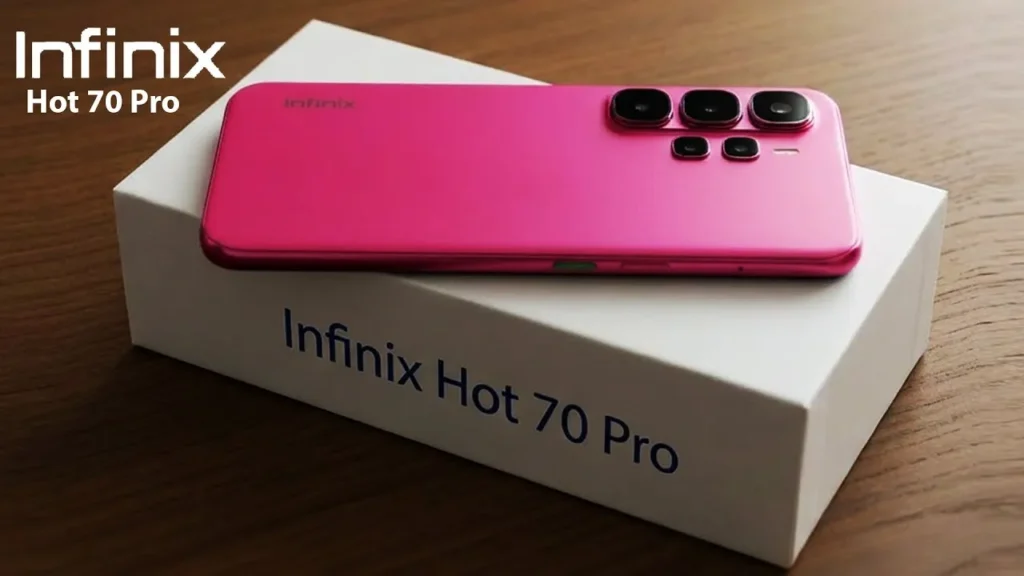
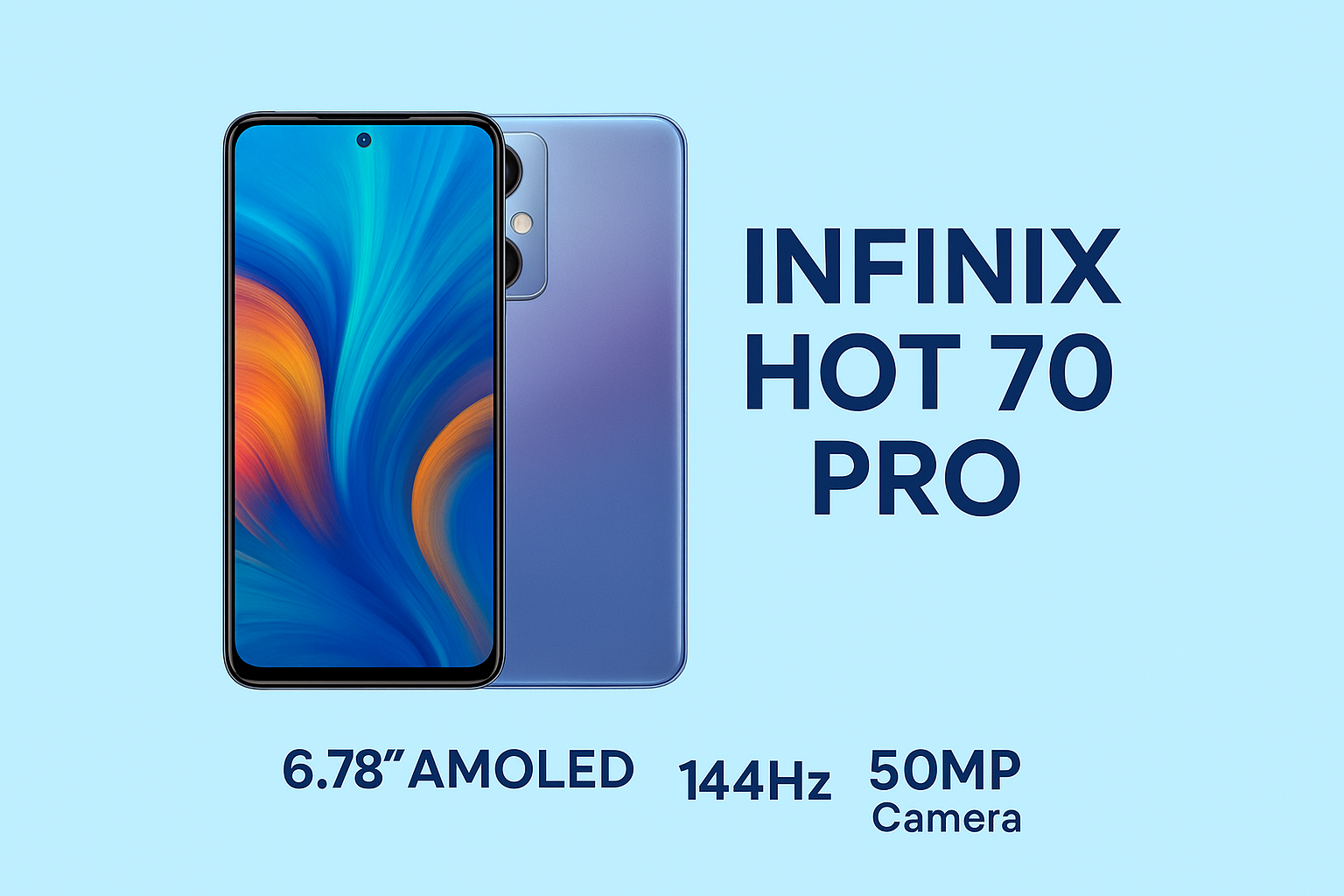
The Infinix Hot 70 Pro arrives as a deliberate midrange contender that prioritizes display fluency and sustained autonomy. At its core is a large 6.78-inch AMOLED panel with high refresh-rate positioning in vendor copy; that combination promises visibly smoother scrolling, snappier UI transitions, and an improved gaming feel compared with many budget alternatives. The camera system centers around a 50MP main sensor — a familiar spec point for this tier — while a reported ~5160 mAh battery aims to deliver long screen-on times that match the display’s appetite for bright, colorful content. Local price trackers list the 8GB/128GB SKU at around PKR 46,999 as of Oct 26, 2025, placing the Hot 70 Pro squarely against Redmi and Tecno offerings that emphasize different tradeoffs (charging speed, updates, or camera hardware).
Compact comparison
| Model | Display | Chipset | Camera (main) | Battery | Typical price |
| Hot 70 Pro | 6.78″ AMOLED, high refresh (120–144Hz reported) | MediaTek variants (SKU-dependent) | 50MP | ~5160 mAh | ~PKR 46,999 (8/128; Oct 26, 2025) |
| Hot 60 Pro | 6.78″ AMOLED / 90–120Hz (varies) | Helio/MediaTek variants | 50MP | ~5000–5200 mAh | ~PKR 46k (varies) |
| Closest Redmi/Tecno rival | 6.6–6.8″ AMOLED/LCD, 120Hz | Snapdragon/Dimensity (varies) | 50/64MP | 5000–5200 mAh | Varies by model |
Design & build
Design follows the Hot-series DNA: large front real estate for the display, slim bezels, and a sizable rear camera island. Trackers show glossy gradient finishes (e.g., Dreamy Purple) with a plastic frame used to balance cost and weight — a typical midrange approach that keeps the device light while offering premium visuals on the rear.
Front: Expect flat or mildly curved glass over the AMOLED panel. The front will be dominated by a display with a centered or left/right punch-hole cutout, depending on region SKUs.
Frame: Plastic is likely to keep costs and weight down while avoiding antenna band complications. A plastic frame doesn’t mean cheap in hand — well-executed plastics can feel solid and resist dents more than thin metal rails.
Back: Glossy / AG finishes are common; these look attractive but attract fingerprints. If your editorial style favors clean product shots, include an AG matte and a glossy option to show the visual differences.
Camera bump: A prominent island housing the main sensor and secondary lenses — this is a common aesthetic now and helps visually differentiate the phone.
Weight: Predicted 190–220 g given the 6.78″ display and ~5160 mAh battery.
Durability: No consistent IP rating in early listings; treat the phone as not officially water/dust rated unless the final spec sheet indicates otherwise.
Display
The display is the Hot 70 Pro’s marquee feature. Vendor pages emphasize a 6.78-inch AMOLED panel and a high refresh-rate option (120–144Hz in some listings). In practice, the Combination of AMOLED contrast and a high refresh rate matters for both perceived quality and everyday usability.
What it delivers:
- Smooth UI & gaming: Moving from 60Hz to 120/144Hz yields noticeably smoother scrolling and crisper motion in supported animations and games. It’s not only about frame count: smoother refresh reduces motion judder and makes touch interactions feel more immediate.
- AMOLED strengths: Deep black levels, high contrast, and saturated colors — great for watching video and viewing HDR content (if the phone supports HDR decode). For social media and photography, the display will make images pop.
- Missing lab numbers: Early listings don’t provide measured peak nits, color gamut coverage (P3), or PWM behavior. Those lab figures are crucial: peak brightness determines outdoor legibility, while PWM and flicker characteristics can affect visible flicker and battery consumption at low brightness.
- Real-world tips for review: Measure peak brightness (manual + adaptive), color gamut (sRGB/P3), PWM/flicker frequency, touch sampling rate, and real daylight photos of the screen for readers.
Performance
Public trackers indicate MediaTek SoCs for the Hot 70 Pro, and some listings point to Helio-class chips in certain regions. This positions the phone as a power-efficient midrange performer rather than a raw-performance flagship.
Everyday use: Social apps, messaging, browsing, and light multitasking should feel smooth when paired with 8GB RAM. The phone should handle app switching and background tasks reasonably well with XOS memory management.
Gaming: Expect playable performance at medium settings in popular mobile shooters like PUBG Mobile and Call of Duty Mobile. Frame rates will depend heavily on the specific SoC variant and thermal throttling. With a lower-mid GPU, you might get 40–60 FPS on medium settings; reduce resolution or graphic details to lock higher and more stable FPS.
Thermals & sustained performance: Midrange chips can throttle under long gaming sessions. For rigorous reviews, include a 20–30 minute GameBench log showing average FPS, frame-time stability, and CPU/GPU temperature traces. These metrics show not just peak performance but sustained behavior, which matters for real users.
Synthetic benchmarks: AnTuTu and Geekbench will give a ballpark for raw throughput, but don’t overemphasize single-run scores. Sustained thermal performance and real-world app behaviour are more valuable to buyers.
Infinix software & optimization: XOS typically includes a game toolbox, performance modes, and memory optimization features. Test these modes to see the FPS uplift and thermal tradeoffs; sometimes the “performance” mode increases heat and battery draw for modest FPS gains.
Cameras
Trackers list a 50MP main camera for the Hot 70 Pro with smaller secondary cameras (macro/depth/ultrawide depending on SKU) and a ~13MP selfie sensor. The camera system is a social-media-focused package rather than a flagship pro setup; the final evaluation depends heavily on ISP tuning, EIS/OIS availability, and the size of the main sensor.
Camera hardware
- Rear: 50MP primary + 1–2 assist sensors (ultrawide/macro/depth, SKU-dependent).
- Front: ~13MP selfie (reported).
What to test & when you have a retail unit
- Daylight photos (main) — include full-frame images and 100% crops to judge resolving power. Daylight is where sensors generally perform best; look for detail retention in textures (hair, fabric), controlled sharpening, and acceptable dynamic range between sky and shadows.
- Ultrawide (if present) — evaluate color matching compared to the main camera, edge sharpness, and distortion correction. Ultrawide modules in this price band often lag the main sensor in dynamic range and detail.
- Low-light / Night Mode — take hand-held night mode vs standard exposures. Low-light performance for midrange phones is heavily reliant on computational stacking: compare noise reduction, highlight preservation, and color accuracy.
- Portrait mode — test edge detection on busy backgrounds, hair detail, and subject skin tones. Many midrange phones apply beauty smoothing; decide whether to keep it on or off for sample galleries.
- Selfie — show daylight and low-light selfies with and without skin-smoothing filters. Selfie tuning often skews towards pleasing skin tones at the cost of natural texture.
- Video — crucial to test EIS: record a handheld walk at 4K/1080p at standard and at “stabilization” modes to judge micro-jello, rolling-shutter, and crop. Stabilization tuning is as important as resolution for usable footage.
- Macro / close focus — if present, judge whether the dedicated macro lens is useful or merely a gimmick compared to cropping from the main sensor.
- Comparisons — include 100% crops compared directly to the Hot 60 Pro and to similarly priced Redmi/Tecno phones in the same price band.
Battery life & charging
Reports list a battery around 5160 mAh — a capacity that should deliver strong endurance for a midrange device, especially when paired with an efficient MediaTek SoC and AMOLED panel.
Expected real-world behaviour:
- Mixed day: 1.5+ days likely for a typical user (social apps, browsing, video, occasional gaming).
- Screen-on time (SoT): Expect roughly 6–8 hours of SoT under typical mixed use; running the display at 120/144Hz will reduce SoT relative to 60Hz.
- Gaming: Extended gaming at high refresh rates will accelerate drain; plan for shorter gaming sessions or throttle refresh to prolong play.
Charging:
Charger wattage is inconsistent across early listings. Many phones in this price bracket ship with ~33W chargers; confirm whether a charger is included and the quoted charge rate for your local SKU. Charging time tests (0→50% and 0→100%) are essential editorial metrics.
Standardized tests to run:
- Video loop at 150 nits until shutdown (repeatable SoT measurement).
- Charging times with the included adapter (0→50% and 0→100%).
- Day-long heavy usage log (start 7:00 → next day 7:00) with screen time and app usage recorded.
Software & UI experience
The Hot series ships with Infinix’s XOS layered over Android; trackers list Android 14/15 in some markets. XOS brings features aimed at gamers and customization fans — a game toolbox, floating windows, gesture navigation, and themes. That functionality can be compelling, but be mindful of region-specific preinstalled apps and ad placements that have been present in past XOS iterations.
What to check in a hands-on review:
- Bloatware/ads: Evaluate the out-of-the-box experience for promotional pop-ups and removable vendor apps.
- Game mode: Test frame rate locking, network optimizers, and performance profiles.
- Update policy: Infinix’s update cadence varies; check official support pages for Android release and security patch promises.
- UI polish: At high refresh rates, animations and gesture responsiveness should remain consistent — look for stutter or dropped frames that undermine the display’s benefit.
Connectivity & extras
Reportedly, the Hot 70 Pro includes dual-SIM, Wi-Fi, Bluetooth, and region-dependent NFC. The Hot series often keeps an IR blaster and a 3.5 mm jack in the mix — practical extras for many buyers. For Pakistan buyers, remember the PTA registration requirements for imported phones; buying through official channels simplifies warranty and verification. Globally, verify the SKU’s 4G/5G bands for carrier compatibility. Always confirm NFC and GPS module specifics for local fintech and navigation needs.
Price & where to buy
Pakistan: Price trackers list the 8/128 variant near PKR 46,999 (checked Oct 26, 2025). This puts the Hot 70 Pro in competitive midrange territory, particularly if the display and battery live up to trackable claims. When publishing, always include a “price updated” date and link to reputable local retailers.
Other markets: Vendor pages show local currency conversions; prices vary with taxes, import duties, and promotions. Use reputable retailers (Daraz in Pakistan, Official Infinix Stores, or large e-tailers) for affiliate links and to ensure warranty coverage.
Buying tips:
- Confirm SKU — features like NFC and 5G can differ across regions.
- Warranty & service: Buy from authorized distributors to ensure warranty validity.
- Promo timing: Festival sales often produce significant short-term discounts on midrange phones — consider holding for a sale if you’re not in immediate need.
FAQs
A: Yes, for buyers who want a large AMOLED display and a strong battery at a midrange price. If you need best-in-class camera OIS or guaranteed long OS support, check alternatives first.
A: Reported capacity is ~5160 mAh. Expect a full day-plus of heavy use; we’ll add measured SoT once we run our standardized video loop.
A: NFC and 5G availability depend on the regional SKU — verify the exact variant sold in your market on retailer pages or the official Infinix product page.
A: Mostly a display and battery tune-up with marginal chipset revisions. See our comparison table for details.
A: Charging wattage is inconsistent across early listings (typical class is 33W). Confirm whether a charger is included in the retail box on the official SKU page.
Final verdict
The Infinix Hot 70 Pro is a well-positioned midrange phone that leans gaming-friendly thanks to a reported 6.78″ AMOLED panel with a high refresh rate and an ample ~5160 mAh battery. For buyers prioritizing smooth visuals, long battery life, and social-ready camera output at a competitive price (reported ~PKR 46,999 for the 8/128 SKU on Oct 26, 2025), the Hot 70 Pro is an attractive option. Its compromises are predictable: midrange chipset performance that can throttle under sustained loads, camera results that rely heavily on software tuning, and uncertain update guarantees under XOS.
