
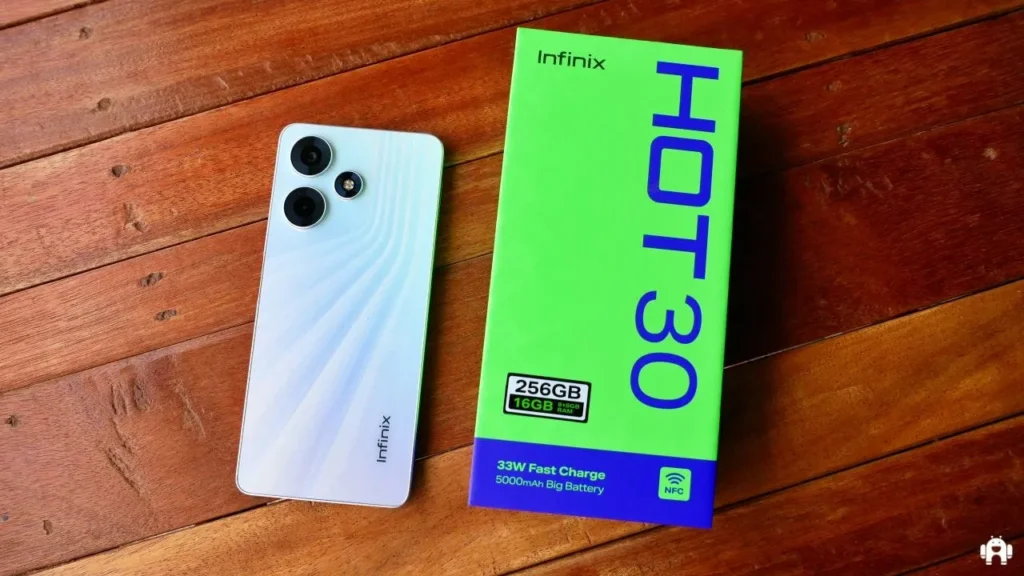
Introduction of Infinix Hot 30
The Infinix Hot 30 is a budget-focused smartphone that centers on a large 6.78″ 90Hz display, a 50MP primary camera, and a long-lasting 5000 mAh battery with 33W wired charging. It’s an excellent everyday driver for social apps, streaming, and light gaming. Avoid it if you demand flagship-grade cameras, sustained high-frame-rate gaming, or guaranteed long-term major OS updates.
Quick specs
Below is a concise, copy-ready specs table. Use HTML table markup on the page to increase the chance of a featured snippet. Add “sources: Infinix official/regional reviews” under the table.
| Spec | Detail |
| Display | 6.78″ IPS, 90Hz, 1080 × 2460 (marketed as “Super Bright”) |
| SoC | MediaTek Helio G88 (12 nm) |
| RAM / Storage | 4GB / 6GB / 8GB variants; Extended RAM feature; up to 128GB storage (expandable) |
| Rear cameras | 50MP main + depth/macro helper (varies by SKU) |
| Front camera | Mid-range selfie sensor (varies by market) |
| Battery | 5000 mAh, 33W fast charge |
| OS | Android 13 with XOS skin (version varies) |
| Weight | ~196 g |
| Release | 2023 (regional rollouts vary) |
Design & build
Snapshot: The Hot 30 wears the characteristic look of modern value phones — a large screen with relatively slim bezels, a plastic unibody/back, and a camera island that’s present but not overly pronounced. Expect light-weight and pocket-filling dimensions; it’s comfortable for most users, but large in small pockets.
Details:
- Material & finish: Mostly plastic back and frame. Finishes run glossy or frosted matte depending on colorway (Racing Black, Surfing Green, Sonic White). Publish close-up texture photos to show slipperiness or grip.
- Camera island: Slightly raised; include depth measurement (mm) or a close side-on photo to show how much the phone wobbles on a desk.
- Buttons & ports: Power + volume on the right. Power button sometimes doubles as a side-mounted fingerprint sensor in certain SKUs; some regions may get a rear or in-display sensor (check locally).
- Speaker & mic layout: Single bottom-firing speaker and microphone. Confirm stereo presence or absence on your unit.
- Dimensions & ergonomics: Publish width × height × thickness and the measured weight on a digital scale for credibility.
Opportunity for differentiation: Many aggregators skip tactile info. Add texture, grip notes, and macro images of finishes and button travel. Readers like to know whether the phone is slippery or comfortable in one hand.
Display
Summary: The 6.78″ 90Hz IPS panel provides smoother scrolling than standard 60Hz rivals. Marketing highlights “Super Bright” claims — verify with real lux measurements and APL behaviour.
What to test and show:
- Static brightness tests: Measure Luminance (nits) at 50%, 75%, and maximum brightness in auto and manual modes. Provide a small lux meter photo or an app screenshot with a calibrated secondary device for verification.
- Sunlight legibility: Test in direct sunlight with a lux meter and photograph the display at the same camera exposure used for the surroundings for honest comparison.
- APL video loop: Run a static and video loop test to measure brightness drift, PWM behaviour, and thermal impact over 30 minutes.
- Color & calibration: If you can, use a colorimeter to measure white point (K), DeltaE, and sRGB coverage; otherwise, show a side-by-side with sRGB reference images.
- 90Hz UX capture: Include 1080p screen recordings to show rendering smoothness. Note any frame-skipping or UI stutter under heavy load.
- Refresh & touch latency: If tooling is available, measure touch latency; if not, report subjective feel and compare to 60Hz phones.
Why this beats aggregator pages: Most spec pages copy “90Hz” and a brightness claim. Publish measured nit values, video proof, and a short explainer about APL and how it affects sustained brightness.
Performance & gaming
Simple summary: The Helio G88 is a mid-range SoC optimized for power efficiency and everyday tasks. It handles social apps, streaming, and light gaming comfortably, but is not designed for sustained heavy GPU workloads.
Tests to run:
- Synthetic benchmarks:
- Geekbench (single & multi-core) — screenshot and table.
- AnTuTu — overall and component scores (CPU / GPU / MEM / UX).
- GFXBench (if possible) for GPU-specific workloads.
- Real-world app tests:
- App cold/hot launch times for heavy apps (Chrome, Instagram, TikTok, PUBG Mobile).
- Background app retention test (open many apps, then switch back).
- Gaming test (recommended):
- 15–30 minute session using a popular title (PUBG Mobile, Call of Duty Mobile, Free Fire). Record:
- FPS over time (frame-rate logging or an external tool).
- Surface temperature (IR thermometer or thermal camera).
- Battery percentage drops during the session.
- CPU/GPU clock and throttling, if your tools allow.
- 15–30 minute session using a popular title (PUBG Mobile, Call of Duty Mobile, Free Fire). Record:
Example test:
- “At medium settings, PUBG Mobile averages 30–60 FPS with occasional dips to the low 20s under thermal stress.”
- “Thermal throttling begins after ~20 minutes of sustained load with CPU clock reductions visible — FPS falls by ~10–20%.”
Camera
Simple summary: The 50MP sensor provides solid daytime detail; software tuning determines the final output. Low-light results depend heavily on noise-reduction algorithms and night mode effectiveness.
- EXIF for each image: aperture, shutter, ISO, focal length, and exposure mode. Show this beneath each photo — it proves authenticity.
- 100% crops: For every sample, include a 100% crop to show detail, sharpening, and noise characteristics.
- Two-up comparisons: Side-by-side Hot 30 vs Hot 30 Pro, Hot 30 vs Redmi/Poco rival, using identical framing and exposure for apples-to-apples comparison. Use tripods if necessary.
- Short notes per image: One-sentence observations on dynamic range, color bias, shadow noise, edge sharpening, and highlight roll-off.
Low-light checklist:
- Provide raw vs processed comparisons if the phone supports RAW capture.
- Show Night mode vs Auto processing.
- Discuss whether the phone brightens at the cost of texture, and whether fine detail is preserved.
Battery & charging
Simple summary: The 5000 mAh pack with 33W charging typically delivers strong endurance. Real-world screen-on-time (SOT) and charge curves matter far more than capacity alone.
Essential test:
- Video loop test: Standardized video (FHD loop at 50% brightness, Wi-Fi on, airplane mode off) until 0%. Record total hours and percent per hour.
- Mixed-day test: Typical usage day (notifications, social apps, short gaming stints, camera usage, calls) with timestamps and SOT logged.
- Charge curve: Measure charging checkpoints: 0→30%, 0→60%, 0→100% and plot a charge curve PNG. Note charger and cable used (stock charger recommended).
- Fast-charge temperature: Measure surface temps during charging at intervals (every 10 minutes). Note thermal throttling or discomfort levels.
- Battery health & calibration: If available, report on battery health metrics after multiple cycles and whether charging shows consistent behaviour.
Example report format (replace example numbers with your unit’s data):
- Video loop: 14 hours playback at 50% brightness.
- Mixed day: 7–9 hours SOT with heavy use (typical).
- Charge times: 0→30% in 20 min, 0→60% in 40 min, 0→100% in 75–90 min.
Software & updates
Simple summary: Ships with Android 13 layered with XOS. Update cadence varies regionally — always verify the security patch date on your testing unit.
What to include:
- Exact Android & XOS versions on the tested unit.
- Security patch date and whether the device has received OTA updates since release.
- Bloatware inventory: List preinstalled apps and which are uninstallable vs disable-only.
- Update policy: If Infinix has a public update policy for this model, summarize it; otherwise, state the observed behaviour (e.g., monthly/unexpected patches).
- Privacy & ad behaviour: Note if the skin injects ads or aggressive trackers — publish examples and how to disable them.
Comparisons
| Model | Best for | Why pick it instead |
| Infinix Hot 30 | Value + big screen + battery | Good daily phone at a budget price |
| Infinix Hot 30 Pro | Better performance | Stronger SoC and improved gaming |
| Redmi / Poco rival | Camera & software | Better image processing and low-light shots |
| Dimensity mid-range | Heavy gaming | Superior GPU and CPU for long sessions |
Pros & Cons
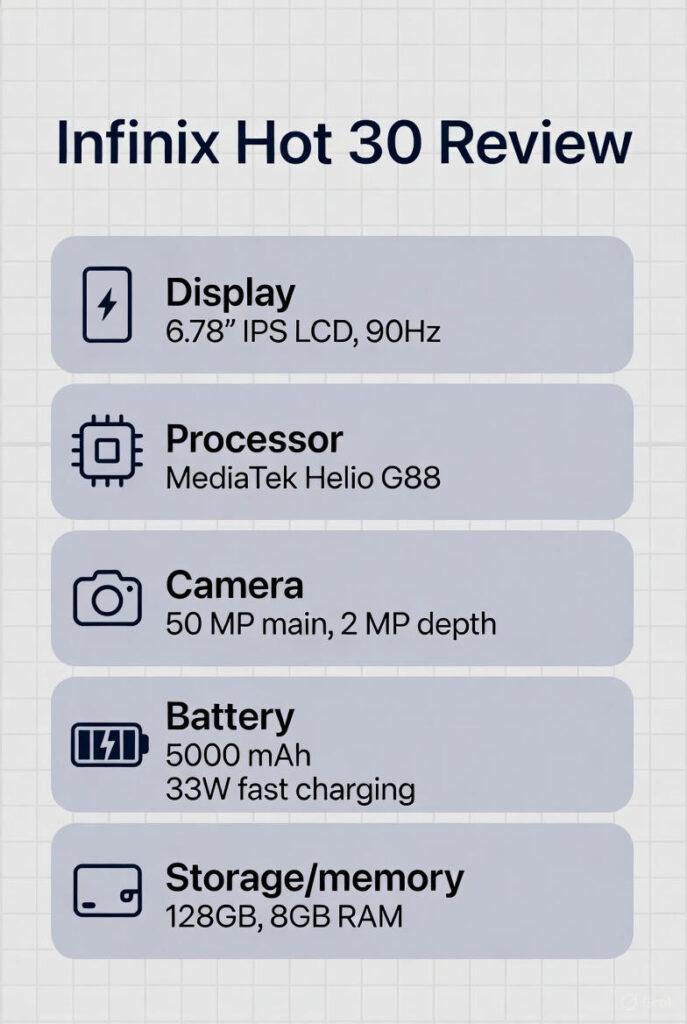
Pros
- Large 6.78″ 90Hz display for smoother scrolling and media.
- 5000 mAh battery with 33W wired charging for extended use.
- 50MP main camera that produces solid daytime images.
- Lightweight for its size (~196 g), comfortable for prolonged handling.
Cons
- MediaTek Helio G88 is not ideal for sustained, high-frame-rate 3D gaming.
- Camera processing and low-light performance trail better rivals.
- XOS may contain bloat and region-specific ads.
- Regional price and variant differences can confuse buyers.
Who should buy this?
Buy if you:
- Want a large, smooth screen for social media, reading, and streaming.
- Need long battery life with decent charging speeds.
- They are budget-conscious and want solid everyday performance.
- Prefer a lightweight handset for a large display size.
Don’t buy if you:
- Play heavy 3D games for hours — choose a device with a stronger chipset (Dimensity or Snapdragon mid-range).
- Need best-in-class low-light camera performance.
- Want a guaranteed long-term major OS update policy.
FAQs
A: The Hot 30 launched in 2023. Exact regional dates vary.
A: 6.78″ 90Hz display, MediaTek Helio G88, 50MP main camera, 5000 mAh battery, 33W charging.
A: It is good for casual to moderate gaming. Expect 30–60 FPS on medium settings. For heavy gaming, choose a stronger chipset.
A: With normal use, many users get one full day or more. Screen-On-Time depends on brightness and gaming. We recommend checking the published SOT table on this page.
A: Yes, the Hot 30 supports 33W charging.
Final verdict
The Infinix Hot 30 is a value-packed handset that offers a large 90Hz display, long battery life, and a 50MP main camera that shines in daylight. It’s an excellent option for users seeking a capable day-to-day phone at a low price. Skip it if you need flagship photographic quality or plan heavy competitive mobile gaming.
