
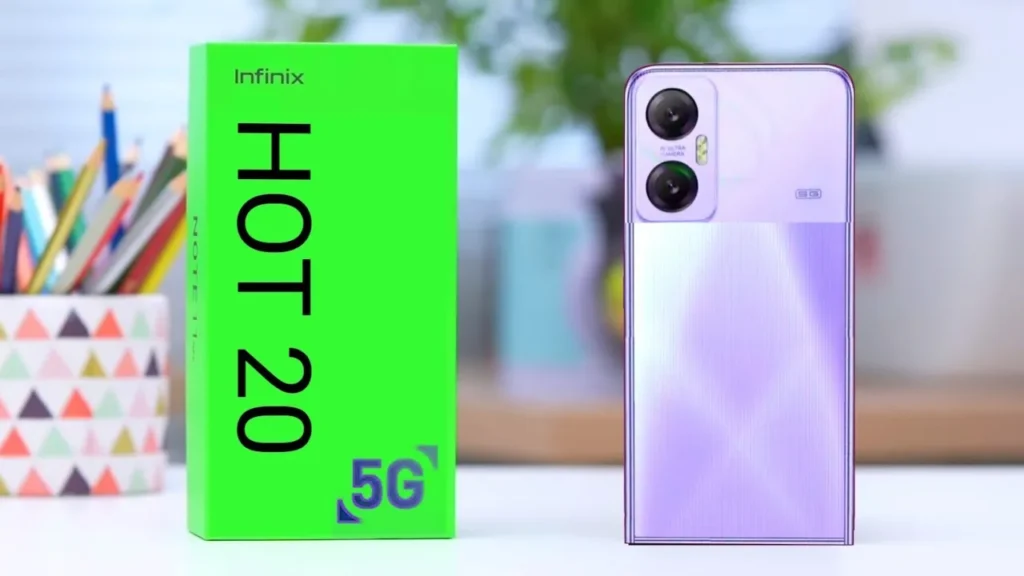
Introduction of Infinix Note 20
A researcher on the Infinix Note 20 will find the following comprehensive guide easy to understand in simple terms: the official specifications, the actual performance, the performance of the camera, the battery life, its intended users, and its intelligent alternatives. The Note 20 is being marketed as a value-first, big-screen phone with an AMOLED panel, a mid-range chipset of the Helio G96-class, and a large battery – a strong choice when media consumption and battery life are the priorities on a budget.
At-a-glance specs
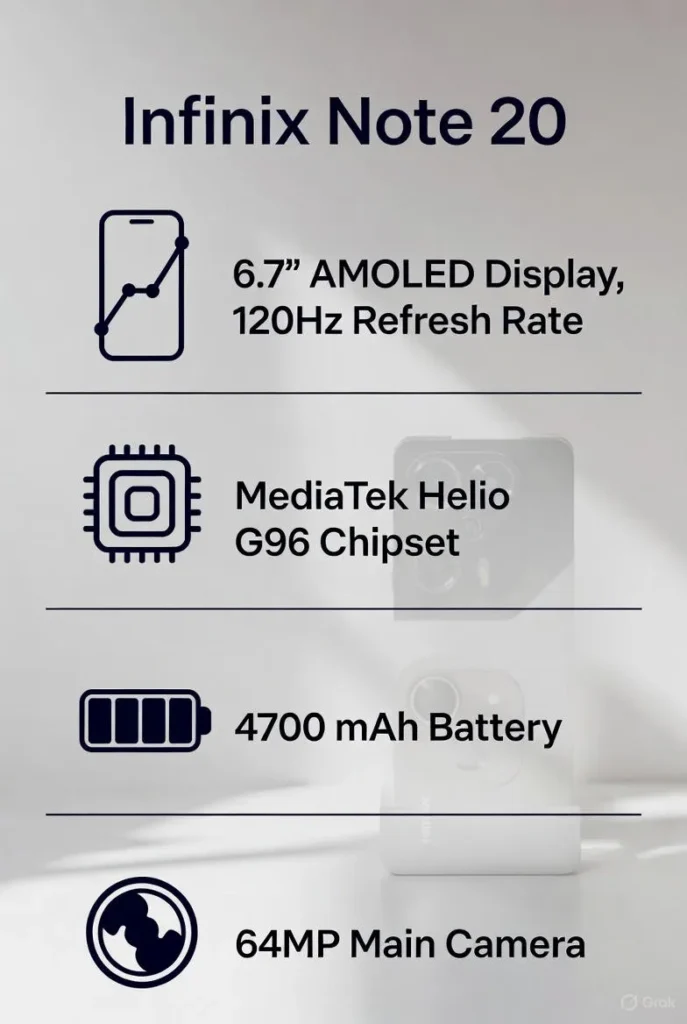
- Display: 6.7″ AMOLED, 120Hz (smooth scrolling & vibrant media).
- SoC / Chipset: MediaTek Helio G96-class midrange octa-core processor.
- RAM & Storage: 6GB RAM / 128GB storage (common SKU); variants may differ.
- Rear cameras: 64MP primary + 12MP ultrawide + 2MP macro/depth (market-dependent).
- Front camera: 16MP selfie shooter.
- Battery: ~4700 mAh with fast-charge support (charger included varies).
- OS: Android 12 with XOS skin (builds and updates vary by region).
- Connectivity: 4G LTE (5G availability depends on SKU), Wi-Fand i, Bluetooth, and possible NFC in select regions.
Design & display
The Note 20 follows the current midrange design: it has no curved sides, the back is covered with a matte or glossy finish (again, depending on the color scheme), and the camera island is a rectangle. It will be a high-end construction that is not overly costly, the rear panel could be either plastic or composite, and the frame is made of metal-feel. Concisely, it appears refined without the cost of glass and metal flagship material.
Display that outperforms its price
Where the Note 20 stands out is its display. An AMOLED panel at 6.7 inches paired with a 120Hz refresh rate is uncommon at lower price brackets and becomes the phone’s primary selling point. The result is deeper blacks, saturated colors, and smoother UI motion than you’ll see on many LCD-equipped competitors.
Performance & gaming
Chipset & real-world performance
The Note 20 normally sells on a MediaTek Helio G96-based chipset (midrange 12nm family). The given type of SoC is designed to handle everyday activities: messaging, web browsing, navigation of applications, media playback, and simple games. It is not a flagship powerhouse; nevertheless, it is good enough to be used by most people.
- Apps & multitasking: 6GB RAM handles routine multitasking — messaging, a browser with a few tabs, background music or podcasts — without frequent reloads.
- Storage: 128GB base storage is common and ample for many people; a microSD slot is often present for those who keep large media libraries.
Gaming expectations
- Casual games (e.g., Subway Surfers, Mobile Legends): smooth operation with medium settings.
- Require 3D titles (e.g., Genshin Impact): playable, but you will need to lower the quality of the rendering and frame rates. Frame dips and more extended load times are to be expected than on higher-end SoCs.
- Thermal: Midrange silicon will get warm when under prolonged load; thermal throttling can be achieved after prolonged gaming. This would be satisfactory to the majority of recreational gamers; professional mobile gamers ought to look at gaming-intensive models.
Cameras
Camera hardware
- Main sensor: 64MP primary camera (usually using pixel-binning to combine information into 16MP outputs for better low-light performance).
- Secondary lenses: 12MP ultrawide (or similar) and a 2MP Auxiliary lens used for macro or depth sensing.
- Selfie: 16MP front-facing camera.
What to expect in photos
- Daylight: Good detail and natural-looking colors when lighting is favorable. The 64MP sensor with pixel-binning tends to produce clean, well-exposed images in daylight/night: Acceptable to decent results with Night Mode engaged; expect more noise and softer detail than premium devices.
- Ultrawide: Good in the landscape and group shots, generally less sharp with edge distortion.
- Macro: A creative lens that was often used as a spec instead of a useful lens, great in creative close-ups, but not a pro lens.
- Video: 1080p recording is standard; stabilization (EIS) can be offered, but will not be as good as flagship-grade gyroscope-aided steadicam shots. 4K is not as widely supported on midrange SKUs.
Camera practical advice
- Shoot in daylight for best clarity.
- Use Night Mode for darker environments.
- For portraits, use the main camera and software bokeh instead of low-resolution secondary sensors.
- Keep expectations realistic: the Note 20 is strong for social-media-ready images, not professional photography.
Battery & charging
Battery capacity & charging
Average specifications indicate a battery capacity of about 4700 mAh, and fast charging (the wattage consented to actually depends on the region and model, though it is commonly 18W to 33W). That functionality, along with an AMOLED screen and adaptive refresh rate, typically has a very high level of endurance.
Real-world expectations
- Light use (calls, messaging, occasional browsing): 1.5–2 days possible.
- Moderate use (social apps, video streaming, navigation): one full day comfortably; often still 20–30% remaining by the end of the day.
- Heavy use (sustained gaming, long-screen-on time): a full day, but with faster drain.
Charging time depends on the shipped charger wattage. With typical 18–33W chargers, a full top-up often takes ~60–90 minutes. Regions that ship a higher-watt charger will see faster top-ups.
Battery saving tips
- Lower refresh rate to 60Hz when long endurance is a priority.
- Disable always-on display or reduce brightness and timeout settings.
- Restrict background refresh for apps you rarely use.
- Use power-saving modes for travel days or long remote sessions.
Software, updates & bloatware
OS & skin
Most Note 20 units ship with Android 12 layered with Infinix’s XOS skin. XOS adds custom gestures, game optimization modes, floating windows, and some AI-driven features on newer builds.
Update policy
Infinix’s update cadence is variable and often less genthat of erous than premium manufacturers. Budget and midrange phones commonly receive fewer major Android updates and a shorter security-patch window. If multi-year OS support is crucial for you, consider brands with stronger, documented upgrade commitments.
Bloatware
Expect some preinstalled apps and promotional content. Many of these can be disabled, but a subset may be non-removable system utilities. If you dislike vendor apps, look for retailer-unboxed or “clean” versions where possible, or plan to disable/ignore them.
Connectivity & extras
- Cellular: 5G is conditional on the SKU and the market; 4G LTE is common. Ensure compatibility of bands with your country/ carrier.
- Wi-Fi & Bluetooth: Updated models have specifications exact depending on SKU.
- NFC: Available on some regional models, NFC is used to support contactless payments and transit in NFC markets. Make sure that NFC is the thing for you before you buy.
- Sensor:s Fingerprint (side-mounted or under-display, depending on configuration), accelerometer, compass, proximity, and probably a gyroscope.
Comparisons
Here’s how the Note 20 typically stacks up vs. rivals in the same price bracket:
- Redmi Note series (e.g., Redmi Note 12/13): Often offers stronger performance per dollar, slightly better software polish, and more aggressive value pricing.
- Realme Narzo / Realme 10 / 11: Aggressive pricing and sometimes faster charging tech; Realme often competes strongly on CPU/GPU value.
- Samsung A-series (lower midrange): Better software support and wider service networks; Samsung emphasizes software longevity and brand trust.
- Poco / Motorola midranges: Can offer cleaner Android Experiences or superior raw performance depending on the SKU.
If display and battery are your top priorities, the Infinix Note 20 is compelling. If you prioritize raw CPU/GPU muscle or guaranteed software longevity, investigate Redmi, Poco, or Samsung alternatives.
Pros & cons
Pros
- Big AMOLED screen with smooth 120Hz refresh for superior media consumption.
- Large battery for long endurance.
- Good value for media-focused buyers.
- Roomy storage options in many SKUs.
Cons
- Midrange chipset — not ideal for camera gaming.
- The camera setup is good for casual use, but not flagship-class.
- Software updates may be limited compared with premium competitors.
- Variant fragmentation (NFC, charger, and bands differ per region).
Smart buying tips
Price expectations
The prices are market and time-dependent. The Note series has traditionally occupied a low-end to mid-range niche, being much cheaper than a luxury flagship. Compare prices at local shops and marketplace; promotional activities, like seasonal deals, as well as local promotion,s can make the final price change.
Where to buy
- Official Infinix store / authorized dealers: Best for warranty support and official service.
- Local marketplaces (e.g., Daraz, PriceOye, WhatMobile): Often competitive prices — validate seller ratings and warranty.
- Brick-and-mortar retailers: Good if you prefer to test the screen or check fit-and-finish in person.
What to check before buying
- Exact SKU: Confirm RAM/storage, NFC presence, and whether the screen is AMOLED (rare regional mislabeling occurs).
- Charger in the box: Some regions exclude chargers. Check the listing.
- Warranty & service: Official warranty is usually safer for claims and repairs.
- Return policy: Confirm return period and conditions.
FAQs
A: Yes — the AMOLED 6.7″ screen and smooth refresh rate make it excellent for video.
A: For most people, one full day with heavy use and up to two days with light use. The exact time depends on the settings and how you use it.
A: Daytime photos are good for social sharing. Low-light and portrait depth are fine for casual users, but not flagship grade.
A: Many Note-series phones are 4G. 5G depends on the specific SKU and region — check the seller listing.
A: Infinix updates vary. Budget/midrange phones usually get fewer major updates than flagship phones. Confirm on Infinix support pages.
Final verdict
The Infinix Note 20 is a viable and balanced option to customers who desire a big AMOLED display, good battery life, and reasonable daily functions at an affordable cost. It will not appeal to users who want flagship-quality cameras or the best gaming experience, but when it comes to media, browsing, and everyday life, it is a good competitor.
