
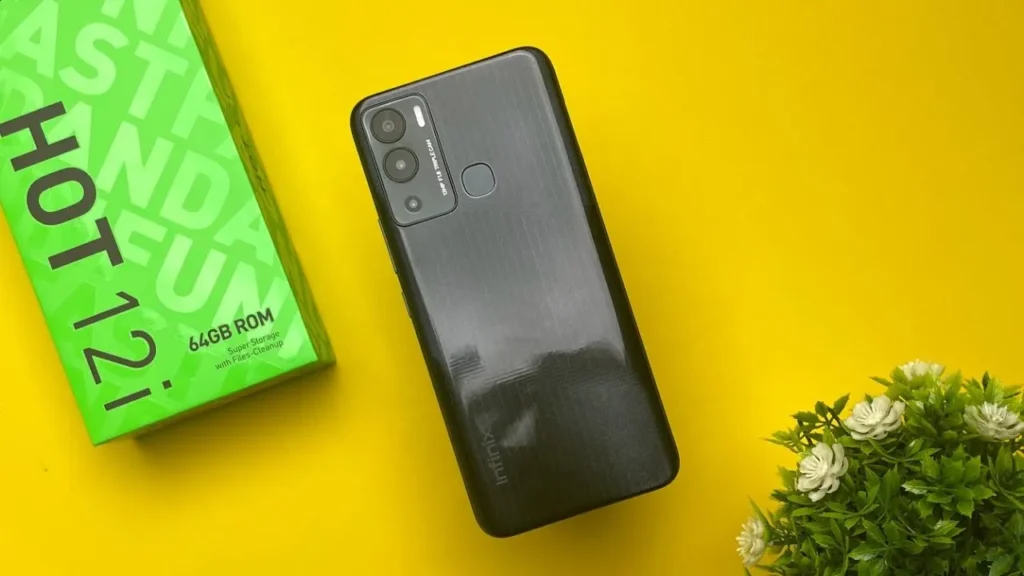
Introduction of Infinix Hot 12i
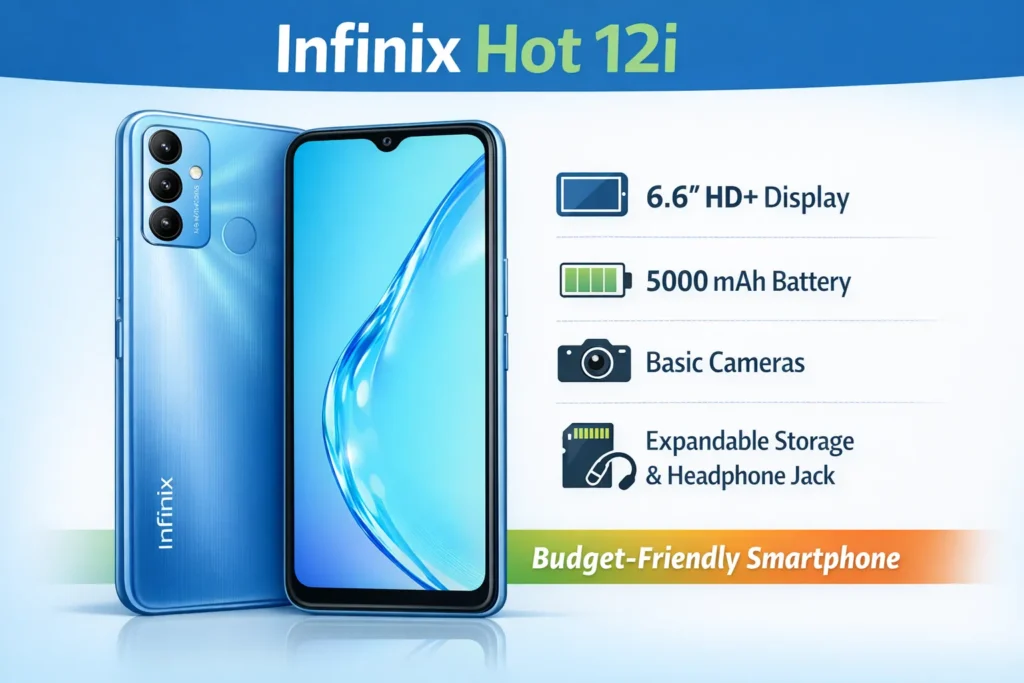
The Infinix Hot 12i is a no-frills budget smartphone that emphasizes endurance, a large display, and straightforward daily usability. It’s an excellent value for people who need reliable battery life, a spacious screen for videos and social apps, and expandable storage — but don’t expect flagship performance or class-leading camera results. A budget Android handset offering a large HD+ display, 5000 mAh battery, basic cameras, expandable storage, and a value-first experience suited for calls, media consumption, and light app use.
Full specs
| Item | Specification |
| Full marketing name | Infinix Hot 12i |
| Display | ~6.5″–6.6″ IPS, HD+ (720×1600), some SKUs may offer 90Hz |
| Chipset | Entry-level MediaTek or Unisoc (varies by region) |
| CPU | Octa-core (mix of efficiency & performance cores) |
| GPU | Entry-level Mali/IMG-class |
| RAM | 2GB / 3GB / 4GB (region dependent) |
| Storage | 32GB / 64GB, expandable via microSD |
| Main camera | Single 8MP–13MP (AI enhancements vary) |
| Front camera | 5MP–8MP |
| Video | Up to 1080p@30fps (typical) |
| Battery | 5000 mAh (typical) |
| Charging | 10W–18W (microUSB or USB-C, depending on SKU) |
| OS at launch | Android with XOS skin |
| Sensors | Fingerprint (side/rear), accelerometer, proximity |
| Connectivity | 4G LTE, Wi-Fi 802.11 b/g/n, Bluetooth 5.0 (typical) |
| Physical | Plastic body, multiple colors, ~190–200g |
| Ports | 3.5mm headphone jack, microSD slot, microUSB/USB-C |
| Price bracket | Entry-level / budget segment |
Design & build
The Hot 12i is a textbook budget design: plastic chassis, molded back, and practical ergonomics. It focuses on utility rather than premium materials.
What you’ll appreciate
- Lightweight and comfortable: The plastic build keeps the weight down and makes longer single-handed use more pleasant.
- Colorful finishes: Infinix often uses glossy or gradient plastics that look modern from a distance.
- Practical features: 3.5mm headphone jack, microSD slot, and a dedicated dual-SIM tray (depending on market).
What to expect
- A functional, not premium, feel — no metal frame or glass back.
- Basic button and port tolerances are still fine for everyday handling.
- Side-mounted or rear-mounted fingerprint sensor in many SKUs (fast and reliable for the price).
Display
The Hot 12i’s strong selling point is its sizable display. While it’s not Full HD, the screen is tuned for media and social use.
Key points
- Size & format: Around 6.5–6.6 inches with an HD+ 720×1600 canvas — large and easy on video.
- Sharpness: HD+ is readable and acceptable for daily use, but fine detail (small text, very sharp imagery) won’t match Full HD or AMOLED panels.
- Refresh rate: Some SKUs may include a 90Hz panel — this makes scrolling and animations feel smoother. If you care about snappiness, look for the 90Hz variant.
- Brightness & outdoor use: Adequate indoors; direct sunlight legibility is average. Turn up the brightness for outdoor scenes or use the adaptive brightness setting.
- Color & viewing angles: IPS panels offer predictable color and wide viewing angles, though blacks aren’t as inky as OLED.
Practical display advice
- If you frequently use the phone outdoors, prefer the brightest-selling SKU, and test in sunlight before buying.
- For battery savings, drop to 60Hz (if the phone supports toggling) and avoid maximum brightness.
- Enable dark mode where available to reduce power draw from UI elements.
Performance
Inside the Hot 12i, you’ll find an entry-level SoC (MediaTek or Unisoc, depending on SKU). That means day-to-day tasks are smooth, but heavy workloads reveal the phone’s limits.
Real-world observations
- Every day apps (calling, WhatsApp, Instagram, YouTube) run fluidly.
- App launch times are slightly slower than mid-rangers; expect a fractionally perceptible lag when opening large apps.
- Multitasking with multiple memory-hungry apps can force background reloads on lower RAM models (2GB/3GB).
- Thermal performance is fine for short sessions; sustained heavy use (gaming, long video rendering) causes warmth and possible throttling.
Gaming notes
- Casual and 2D games perform well.
- 3D titles (PUBG Mobile, Call of Duty Mobile, Genshin) are playable at low/medium settings, but don’t expect steady 60 FPS. Frame drops and occasional stutter occur in complex scenes.
- Use “low graphics,” limit frame rate, and close background apps for the best experience.
Tips to improve
- Choosea 4GB/64GB model where available for fewer app reloads.
- Keep background sync for non-essential apps off.
- Use a lightweight launcher or disable unnecessary XOS Bloatware to free memory.
Camera
The camera system on the Hot 12i is pragmatic: it aims to capture shareable photos in good light but does not match more advanced sensors or computational photography found in pricier phones.
Main camera
- Daytime: Results are acceptable with healthy color and decent dynamic range in well-lit scenes.
- Detail: Limited compared to higher-megapixel sensors; fine texture and distant detail can be softer.
- Low-light: Noise is visible, and detail falls away; night shots are the weakest area.
Front camera
- Adequate for video calls and casual selfies in daylight.
- Front portraits have limited natural bokeh; avoid overly relying on software blur.
Video
- Up to 1080p@30fps is typical; stabilization is limited or absent, so handheld footage can appear shaky.
- Use a steady hand or a tripod for improved clips.
Practical camera tips
- Shoot in daylight for best results.
- Use HDR for high-contrast scenes (sky + foreground).
- Avoid digital zoom; move physically closer if possible.
- Use third-party camera apps only if you need different processing or manual controls.
Battery life
One of the Hot 12i’s defining strengths is battery capacity. With a typical 5000 mAh cell, the phone is optimized for extended on-screen time.
Realistic expectations
- Light users (calls, messaging, low screen time): 1.5–2+ days.
- Moderate users (social apps, some video, occasional gaming): a full day with charge left for morning.
- Heavy users (continuous gaming, long hotspot sessions): expect one full day with evening charging.
Charging behaviour
- Charging wattage varies: 10W in some SKUs, up to 18W in others. If the SKU uses microUSB 10W charging, a full charge may take 2.5–3 hours. USB-C + 18W is noticeably faster.
- Overnight charging is convenient, but slower chargers lengthen top-up times.
Battery saving suggestions
- Turn off 90Hz if present for substantial savings.
- Reduce screen brightness or use adaptive brightness.
- Enable battery saver and restrict background activity for non-essential apps.
- Use Wi-Fi instead of mobile data when possible.
Software, UI, and update expectations
Infinix ships the Hot 12i with XOS on top of Android. XOS adds custom theming, gesture controls, and proprietary utilities.
User experience notes
- XOS offers customization: themes, icon packs, and navigation tweaks.
- The skin includes preinstalled apps; some are removable, some are not.
- Expect a good feature set but occasional bloatware-like items that you may want to uninstall or disable.
Update policy
- Budget models in this price bracket typically receive security patches and minor fixes. Major Android version upgrades are uncommon for entry-level phones.
- If long-term OS upgrades are a priority, consider mid-range devices with clearer update commitments.
Connectivity & extras
- Dual-SIM support and microSD expansion are common.
- 3.5mm headphone jack is present in most SKUs — great if you rely on wired audio.
- Fingerprint sensor (side or rear) and face unlock provide fast biometric access.
- 4G LTE, Wi-Fi b/g/n, and Bluetooth 5.0 are standard — 5G is not expected.
Variants
Manufacturers often ship slightly different hardware depending on the region. Check these before purchasing:
- RAM & storage configuration (2/32, 3/32, 4/64).
- Exact chipset model — affects performance and modem capabilities.
- Charging port: microUSB vs USB-C — prefer USB-C.
- Display refresh rate: 90Hz vs 60Hz.
- Camera megapixel count: 8MP vs 13MP — affects detail.
- Local warranty and service network.
Quick comparison
| Feature | Hot 12i (typical) | Typical budget rival |
| Battery | 5000 mAh | 4000–5000 mAh |
| Display | 6.5″ HD+ (90Hz optional) | 6.5″ HD+ (60Hz common) |
| RAM/Storage | 2–4GB / 32–64GB | 3–4GB / 32–64GB |
| Camera | Basic single/dual | Basic single/dual |
| Charging | 10W–18W | 10W–18W |
| Price | Very affordable | Very affordable |
Pros and Cons
Pros
- Long battery life (5000 mAh typical).
- Large display for media and social apps.
- Expandable storage and headphone jack.
- Very affordable — strong value for basic users.
Cons
- Entry-level chipset — modest performance.
- Camera performance is limited in low light.
- Plastic build — not premium.
- Limited major Android upgrades expected.
FAQs
A: With normal use, expect a full day and often more. Light users can get up to 2 days.
A: Not well. Casual games run fine, but heavy 3D games will need low settings and may lag.
A: Yes — the phone usually has a microSD slot for extra storage.
A: Some versions use microUSB; others use USB-C. Charging wattage is basic (10W–18W). Verify the variant.
A: It’s fine in good light for social photos. Low-light shots are noisy and not very detailed.
Conclusion
The Infinix Hot 12i is exactly what it sets out to be: a practical, budget-first smartphone built around endurance and a roomy display. If your priorities are long battery life, comfortable media viewing, expandable storage, and basic, reliable day-to-day performance — all at a very low price — the Hot 12i is a sensible, low-risk choice. It delivers excellent runtime thanks to its 5,000 mAh cell, a large HD+ screen that’s pleasant for videos and social feeds, and sensible convenience features like a headphone jack and microSD expansion that many users still value.
