

Introduction of Infinix Hot 10 Play
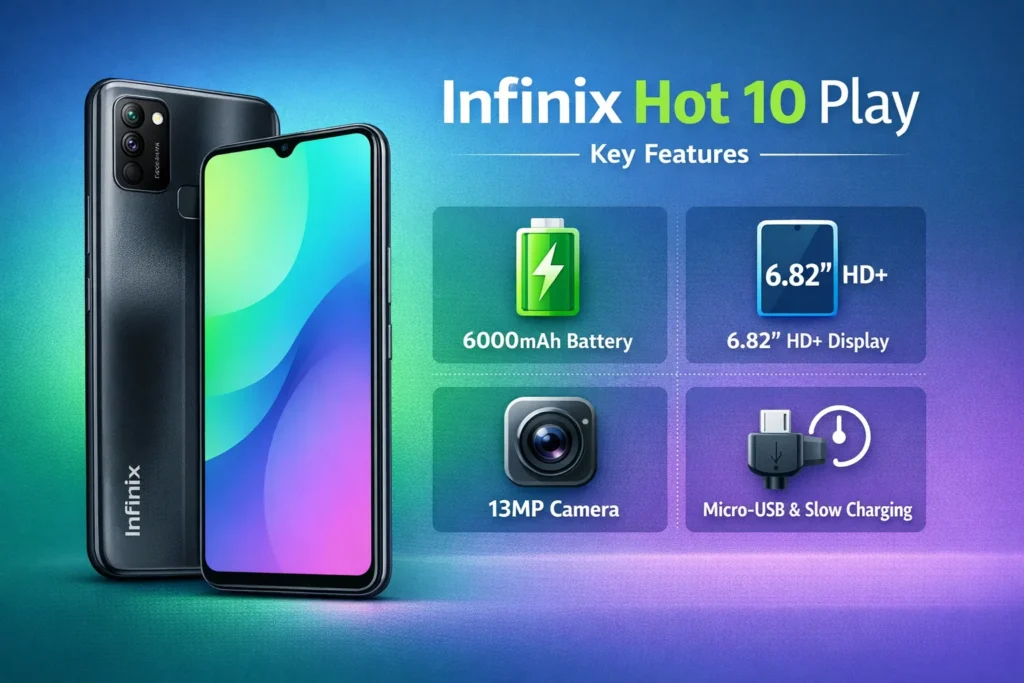
The Infinix Hot 10 Play is a battery-centric, ultra-budget handset: huge 6,000mAh cell, very large 6.82″ HD+ display, and acceptable daytime photos. It’s ideal for users who prioritize multi-day usage and big media consumption on a tight budget. Tradeoffs: many SKUs use micro-USB and slow charging, the OS is Android 10 with XOS 7 (dated), and low-light photography is weak. Buy it for endurance and a big screen; skip it if you want quick charging, a sharp FHD panel, or robust night shooting.
Design & display
The Hot 10 Play adopts a no-frills design philosophy. It uses a plastic chassis with a textured rear to boost grip and reduce fingerprints. The plastic construction keeps the weight reasonable despite the enormous battery. The rear-mounted fingerprint sensor is positioned for natural thumb reach and unlocks the device reliably for everyday use. Bezels aren’t tight by modern standards — expect thicker borders, especially along the chin,— but that’s a common compromise at this price.
What you get:
- Lightweight plastic shell for economy and durability.
- A rear fingerprint sensor that works quickly in routine use.
- A very large screen suitable for media.
What you miss:
- Glass or metal premium materials.
- Slim bezels and a modern symmetrical design.
- Any IP rating or dust/water protection.
Display: very large but HD+ resolution
The 6.82″ IPS panel is the phone’s main selling point: it’s better for watching videos and for legibility when reading. However, the display is 720×1640 (HD+), so pixel density is modest. Text and small UI elements can appear soft compared with FHD+ devices. Peak brightness is adequate for indoor use, but it can struggle in direct sunlight.
Good for:
- Long video sessions and streaming.
- Reading e-books and social feeds.
Not for:
- Users who want razor-sharp text or high pixel density.
- Frequent outdoor use where peak luminance matters.
Tip: If your audience cares about crispness, compare the Hot 10 Play with FHD alternatives (Redmi, Poco, Realme) in your buying guide.
Performance & gaming
The Hot 10 Play ships with either a MediaTek Helio G25 or Helio G35, depending on market and inventory. The G35 is marginally faster: higher clock speeds and a bit more GPU oomph, which translates to smoother animations and better frame rates in light gaming.
Real-world performance
For everyday tasks (calling, messaging, WhatsApp, light browsing), both chips handle the workload. Multitasking is limited by RAM configuration: 2GB/3GB models will swap more and force apps to reload more often. For social and light productivity, the phone is competent.
Gaming notes:
- Casual titles (such as Angry Birds, Subway Surfers, and Candy Crush) run smoothly.
- Heavier titles (PUBG Mobile, Call of Duty Mobile) are playable only at low graphics presets, and only Acceptably on G35 units. Expect heating during long sessions and occasional frame drops.
- Don’t expect high-refresh gaming; the display is 60H,z and the SoC is not geared for competitive frame rates.
Benchmarks: Synthetic scores will be modest. Use them to set expectations for readers — emphasize battery endurance rather than raw performance.
Optimization tips:
- Close background apps before heavy gaming.
- Use a game-booster mode (if XOS has one) to prioritize CPU/GPU resources.
- Lower resolution and frame presets in demanding games.
Battery
The 6,000mAh battery is the defining characteristic. In everyday mixed usage — messaging, a few hours of social media, calls, and notifications, plus some video — expect 10–12 hours of screen-on time (SOT) as a reasonable baseline. Light users can get two days or more.
Real-world example session:
- 1 hour YouTube (screen brightness ~200 nits)
- 30 minutesof casual gaming
- Several short messaging sessions & calls
→ Typical SOT: 10–12 hours.
Video loop tests at a standardized brightness are a clear way to demonstrate endurance (publish a CSV of minute-by-minute battery % so readers can validate). Manufacturer claims of 20+ hours of continuous playback are optimistic when you factor in background services and network activity, but the long playback numbers are credible.
Charging
Many retail kits ship with a micro-USB and a low-watt charger. This means longer charge times — a full top-up may take 2.5–3+ hours. The time to 50% is relatively long compared to modern fast-charging phones.
Charging checklist for reviewers:
- Report time to 10%, 50%, 80%, and 100% using the included charger.
- Provide a charging curve CSV (minutes vs %).
- Indicate whether the SKU has USB-C in your market (some variants may).
Practical charging tips for users:
- Use the supplied charger — it’s certified to be safe for the provided battery.
- Avoid cheap third-party chargers that may misreport power or harm battery longevity.
- If rapid top-ups are needed, check local SKUs for a USB-C variant (rare for this model).
How we test
- A video loop at 200 nits with minute-by-minute battery logs (CSV).
- A PCMark battery benchmark result (if you use the tool).
- A mixed-use SOT log with app usage breakdown (screen on per app).
- Charging curve (CSV) recorded with the ship-included adapter and an aftermarket USB-C charger for comparison, if applicable.
Cameras
The Hot 10 Play centers on a single 13MP main sensor aided by algorithmic “AI” enhancements. There are no ultrawide, macro, or telephoto optics of note. Video capture tops out at 1080p.
Daylight photos
Under ample light, the camera produces social-ready images: pleasant colors, acceptable detail for social media sharing, and decent dynamic range if HDR is enabled. Don’t expect pixel-level clarity — aggressive noise reduction and sharpening are visible when you crop heavily.
Shooting tips for best daylight results:
- Keep HDR on for high-contrast scenes.
- Tap to focus and expose correctly on the subject.
- Avoid extreme crops — keep images for social sizes rather than big prints.
Low-light photos
Low-light is the phone’s weakest area. Noise increases, fine detail is lost, and a lack of optical stabilization (OIS) results in soft or blurred frames if you hand-hold. Night mode can eke out a small improvement, but don’t expect miracles.
Night photography advice:
- Use a tripod or a steady surface.
- Avoid digital zoom.
- Use the flash sparingly — it can flatten lighting and produce harsh shadows.
Portraits and video
Portrait mode is software-based and produces mixed edge detection. For close subjects, it works adequately; for complex hair or transparent objects, it struggles. Video at 1080p is usable for casual clips; stabilization is limited, and fast motion will show jitter.
What to the camera section:
- Full-res sample gallery: daylight, indoor, night, portrait, and any macro shots (if available).
- 1:1 crops to demonstrate noise and sharpening.
- A short 30–60s 1080p video sample showing Stabilization Performance.
- Offer a downloadable ZIP of full-res images for transparency.
Software & updates
The device ships with Android 10 + XOS 7. XOS provides additional features and custom UI elements, but also brings preinstalled apps (bloatware) that some users find intrusive. As with many ultra-budget phones, major Android version updates are unlikely to be frequent. Security patches may be irregular.
First-boot checklist:
- Uninstall or disable unwanted apps.
- Turn off notifications from promotional apps.
- Update core apps from Google Play.
- Enable basic privacy protections: screen lock, Play Protect.
- Audit app permissions for camera, mic, and location.
Update expectations: If you need timely Android version upgrades or long-term software support, this model is not the best choice.
Comparisons
The Hot 10 Play is a niche phone — it’s built around battery and screen size, not balanced flagship characteristics. Here’s a practical matrix you can use for comparison tables:
| Phone | Display | SoC | Battery | Charging |
| Infinix Hot 10 Play | 6.82″ HD+ | G25 / G35 | 6000 mAh | Slow (micro-USB many SKUs) |
| Redmi 9T | 6.53″ FHD+ | Snapdragon | 6000 mAh | Faster (USB-C) |
| Poco M3 | 6.53″ FHD+ | Snapdragon | 6000 mAh | Faster (USB-C) |
| Realme Narzo | 6.5″ FHD+ | MediaTek / Helio | 5000 mAh | Faster options |
Practical recommendation buckets:
- If you want the absolute longest battery and the biggest display on a shoestring budget → Infinix Hot 10 Play.
- If you prefer sharpness and faster charging → consider Redmi 9T or Poco M3 (FHD+ panels).
- If you want a better camera + more balanced performance at modest extra cost → Realme or Tecno mid-range SKUs.
Who should buy it?
Buy the Infinix Hot 10 Play if:
- You prioritize battery life above all else.
- You want a large screen for streaming and reading.
- You use light apps and don’t demand high-end gaming or professional photography.
Don’t buy if:
- You require fast charging or USB-C by default.
- You want an FHD display with crisp text and images.
- You depend on prompt OS updates and better low-light photography.
FAQs
Typical mixed use is 10–12 hours SOT. Standby and light users can get 2 days.
Regional SKUs use either Helio G25 or Helio G35. Check the box or retailer listing.
Many units ship with a micro-USB and a slow charger. Some markets may offer USB-C SKUs; confirm before buying.
Light gaming is fine. For PUBG, set graphics to low — the G35 SKU performs better than G25.
Yes — a rear-mounted fingerprint sensor. Face unlock is available, but less secure.
Final notes
The Infinix Hot 10 Play is a purpose-built ultra-budget smartphone that clearly prioritizes battery life and screen size over speed, cameras, or modern charging tech. Its massive 6,000mAh battery delivers genuinely excellent endurance, often lasting up to two days for light users, while the huge 6.82″ display makes it comfortable for video streaming, reading, and casual browsing. Everyday performance from the Helio G25/G35 is adequate for basic tasks and light gaming, but it’s not meant for power users, and the HD+ panel lacks sharpness compared to FHD rivals.
