

Introduction of Infinix Note 11
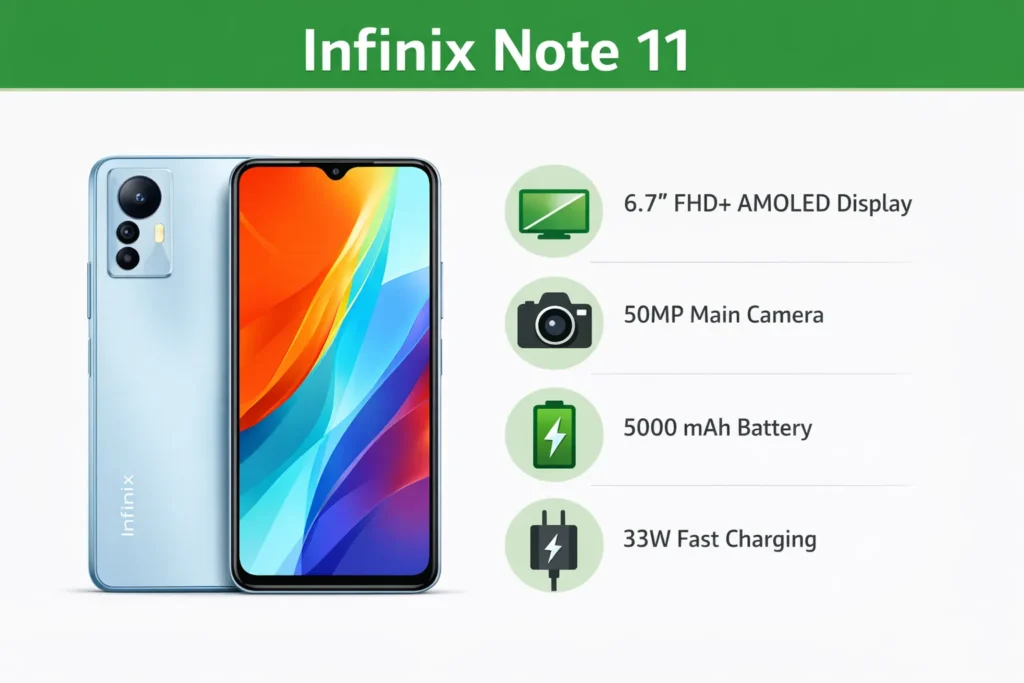
The Infinix Note 11 is positioned as a value-focused, large-screen device that emphasizes screen quality and battery endurance. The assessment expands on the device’s principal features — the 6.7-inch FHD+ AMOLED panel, a 50MP primary lens, and a 5,000 mAh cell with 33W rapid refill. Our goal is to provide a thorough, practical handbook: measurable observations, utilization hints, lens examples guidance, competitor contrasts, and advice on whether to purchase. This handbook is written to be accessible; where technical detail matters, we add depth for power readers while keeping the core narrative clear for everyday consumers.
Quick specs
- Model: Infinix Note 11
- Display: 6.7″ FHD+ AMOLED (60/120Hz varies by locale)
- SoC: MediaTek Helio G88
- RAM / Storage: 4GB / 6GB RAM · 64GB / 128GB storage (locale variants)
- Rear lenses: 50 MP primary + 2 MP depth (+ AI lens)
- Front lens: 16 MP
- Cell: 5,000 mAh
- Refill: 33W rapid refill (power adapter bundled)
- OS: Android 11 with XOS
- Connectivity: 4G LTE (varies by SKU), Wi-Fi, Bluetooth
- Mass: ~184 g (approx — confirm per locale)
- Colors: Multiple matte finishes
Design & build
The styling language is subdued and modern, with a mostly flat profile and a matte finish on the rear that reduces fingerprints. Construction is largely plastic, which keeps mass low; for a 6.7-inch handset, the device feels surprisingly lightweight and manageable. Rounded corners and a narrow bezel contribute to an ergonomic single-hand grip despite the large panel.
What to like
- Slim and lightweight for a large-screen device.
- Matte finish helps with grip and reduces visible smudges.
- Clean camera island design that’s unobtrusive.
What to know
- Construction is mostly polymer, not metal or glass, like a flagship.
- No IP water resistance rating for most SKUs (verify your locale).
- The rear finish is durable but less premium than glass-backed models.
Display
At the heart of the Note 11 is a 6.7-inch FHD+ AMOLED panel that produces deep blacks and vivid hues. AMOLED technology allows per-pixel illumination control, leading to excellent contrast and efficient power utilization when dark themes or black pixels are displayed. Where 120Hz is supported, you’ll notice smoother navigation and animations; some locale variants are limited to 60Hz.
Real-world notes
- Colors are punchy and great for streaming apps and video playback.
- Contrast is exceptional due to true blacks on an AMOLED panel.
- Indoor brightness is strong; outdoors, direct sun can wash out colors compared with premium luminance levels.
- If your SKU offers 120Hz, enable it to enjoy snappier scrolling; be mindful that sustained high refresh can increase cell draw.
Extended display analysis
Beyond the immediate impression of punchy colors and deep blacks, the Note 11’s AMOLED panel behaves predictably across a variety of content types. Streaming HDR-adapted content benefits from the panel’s ability to render deep blacks and a high perceived contrast ratio, which makes cinematic scenes look more dimensional compared with an IPS panel of similar resolution. Color Calibration from the factory tends to be tuned toward vividness rather than strict accuracy; this is a deliberate stylistic choice by the maker that favors pop and saturation for mass-market appeal. If color fidelity for professional image work matters, consider measuring and applying a custom profile.
Adaptive refresh rates balance fluidity and cell life. When 120Hz is active, transient animations and quick scrolls are noticeably more fluid — the interface feels more responsive. However, sustained 120Hz can increase power consumption, so the system often uses an adaptive strategy that steps down refresh to conserve energy during static or text-heavy use. This dynamic scaling is a practical compromise for consumers who want occasional fluidity without a steep endurance penalty.
Performance
The MediaTek Helio G88 inside the Note 11 is a mid-range chipset that prioritizes efficiency rather than raw 3D throughput. In everyday operations — social networking, messaging, web browsing, streaming video — the device behaves fluidly with minimal hiccups. For casual games and emulator-style titles, performance is comfortable. When pushed with demanding 3D titles like PUBG or similarly heavy engines, expect to dial down in-game rendering to medium or low settings to maintain playable frame rates.
Good for
- Browsing, social apps, messaging, and video streaming.
- Multitasking with a handful of apps open.
- Casual gaming and light productivity.
Not ideal for
- Continuous heavy 3D gaming at maximum settings.
- Very heavy multitasking with many simultaneous background processes.
Real-life tips
- Close unused background apps before long gaming sessions to reduce thermal throttling.
- Apply battery saver during marathon usage days if you need every percent to last.
Real-world benchmarks & gaming
Synthetic assessments provide an approximate indicator: the Helio G88 posts mid-range results, offering adequate single- and multi-core throughput for mainstream tasks but trailing the higher-tier Snapdragon chips in sustained GPU throughput. In practical usage, app launches and UI navigation are fluid; extended gaming will reveal the chipset’s thermals and GPU limits with occasional frame drops under sustained load.
Thermal behavior is moderate. Under continuous heavy load, the device’s back becomes warm, noticeable but not uncomfortable. We advise shorter gaming sessions with occasional breaks or lowering graphics levels for marathon plays to keep thermals and cell draw manageable.
Cameras
The 50MP primary lens captures plentiful detail in well-lit scenes and produces images ready for social sharing and casual prints. The secondary 2MP depth sensor assists with subject-background separation for portrait shots but does not substitute for a true ultra-wide or macro module. The ISP in the SoC performs standard demosaicing and noise reduction; the output is tuned for pleasing color and accessible dynamic range during daytime shooting.
Daylight
- Solid detail and natural color rendition.
- Wide dynamic range in bright scenes; highlights are handled reasonably well.
Indoor & low light
- Noise increases as illumination decreases.
- Fine detail drops in low-light images; night modes help, but results remain behind flagship low-light performance.
Front camera
- The 16MP front lens yields good selfies during daytime.
- Portrait selfies have acceptable background blur, though edge separation can be imperfect.
Tips for better photos
- Use HDR in high-contrast scenes to preserve sky and foreground detail.
- Lock focus and exposure by tap-and-hold for faces or bright windows.
- Keep steady in low light or mount the device on a tripod for night scenes.
Camera and image processing
The 50MP sensor typically operates with pixel binning, combining multiple photodiodes into a single output to improve light sensitivity and reduce noise. In favorable lighting, the sensor affords fine detail and pleasing color rendition; in lower light, the advantages of binning become more evident as individual pixels collect more photons and noise patterns become less pronounced.
Battery life
The 5,000 mAh cell combined with a relatively efficient chipset and an AMOLED panel translates to strong endurance. Practical usage yields a full day for heavy users and often close to two days for moderate users. The included 33W adaptor reduces top-off durations significantly compared with older slow chargers: initial refills are rapid to about 50–60% in the first half hour, then slow down to protect cell longevity.
Real-life
- Normal daily use (calls, messaging, music, video streaming): easily a full day.
- Heavy screen-on usage (extended gaming or streaming): expect shorter runtimes but usually still finishing the day.
- If you travel, carry the 33W adapter for quick refills between sessions.
Battery testing and charging patterns
In standardized looped video tests at 200 nits, the Note 11’s 5,000 mAh cell posts competitive runtimes comparable to other devices with similar capacity and efficiency. The included 33W refill follows a common fast-charge curve: a steep initial ramp up to roughly 50–60% within 20–30 minutes, followed by a gradual taper as the battery approaches top capacity to maintain longevity.
Software
The handset ships with Android 11 and Infinix’s XOS skin layered on top, which introduces additional features and visual changes. XOS offers customizations like gesture navigation, theme assets, and app management, but it often comes bundled with promotional apps and notifications in some locales. Disabling or removing unused preinstalled apps improves storage and reduces background activity.
What you get
- Useful extras: gesture controls, themes, and app management.
- Some preinstalled applications that many consumers might consider bloat.
- The option to disable promotional notifications via settings.
Connectivity & sensors
Most SKUs provide Wi-Fi, Bluetooth, GPS, and 4G LTE; some locale variants differ in band coverage or included hardware such as NFC. Common sensors include a fingerprint reader (side-mounted or rear, depending on SKU), accelerometer, proximity, ambient light sensor, and gyroscope. Ports typically include USB-C and, on many models, a 3.5mm headphone jack — verify your local SKU to confirm which accessories are bundled.
Infinix Note 11 vs rivals
| Phone | Display | SoC | Cell | Best for |
| Infinix Note 11 | 6.7″ AMOLED | Helio G88 | 5000 mAh | Video/cell worth |
| Redmi Note 11 | 6.43″ AMOLED 90Hz | Snapdragon 680 | 5000 mAh | Balanced throughput |
| Realme Narzo 50A | 6.5″ IPS | Helio G85 | 6000 mAh | Battery-first buyers |
How to pick
- Want the largest AMOLED? Infinix Note 11 is the pick.
- Want slightly stronger CPU performance and smoother 90Hz adoption? Consider the Redmi alternative.
- Want the longest run between refills? Choose devices with 6000 mAh.
Who should buy the Infinix Note 11?
- Buy it if you prioritize a large, high-quality AMOLED screen and extended cell life at an affordable price point.
- Avoid it if low-light lens performance or high-end gaming throughput are your primary concerns.
Pros & Cons
Pros
- Large 6.7″ AMOLED panel.
- 50MP primary lens that performs well in daylight.
- 5,000 mAh cell with a bundled 33W rapid refill.
- Lightweight for its class.
- Excellent value for video consumers.
Cons
- Average low-light lens behavior.
- XOS includes preinstalled apps and promotional notifications in some locales.
- Not a flagship-grade chipset for sustained high-end gaming.
- 5G availability depends on SKU and locale.
FAQs
Yes, a 6.7″ FHD+ AMOLED panel.
50 MP main sensor plus a 2 MP depth lens.
5,000 mAh with 33W fast charging in the box.
Good for casual titles; heavy 3D games require reduced settings.
If you need an affordable AMOLED and a long battery, yes — but compare local prices and newer 5G options.
Final verdict
The Infinix Note 11 nails a large AMOLED panel and an extended cell at a budget price. It’s an outstanding pick for video lovers and everyday consumers. If you want flagship-level night imaging or top gaming throughput, look elsewhere.
