
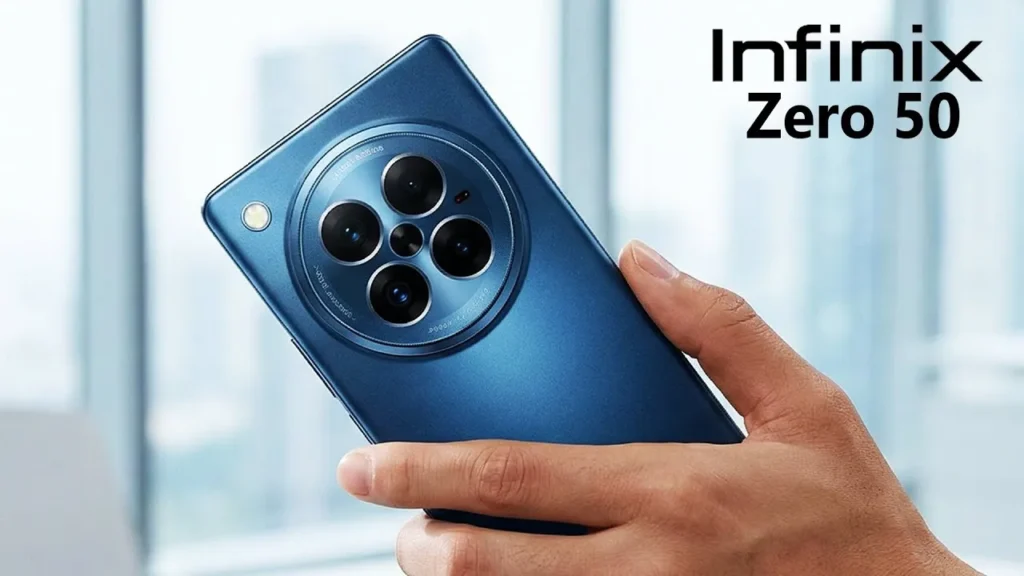
Introduction of Infinix Zero 50
The Infinix Zero 50 is a mid-range handset designed for creators and gamers, featuring a high-refresh AMOLED display, a large battery with rapid wired charging in many SKUs (commonly advertised as 67W), and a selfie/video emphasis that suits vloggers. Specs vary across regions — some SKUs list MediaTek Dimensity processors, while others list a Snapdragon 7-series-class chip; verify the exact model number before making a purchase. Daylight photos are good; low-light and ultrawide are mixed. Battery life is solid for typical daily use; the fast charger (if included) quickly tops up. Buy if you want a smooth screen and fast charging at a midrange price; look elsewhere if you need top-tier low-light photography or guaranteed extended OS updates.
Quick specs
- Model name: Infinix Zero 50
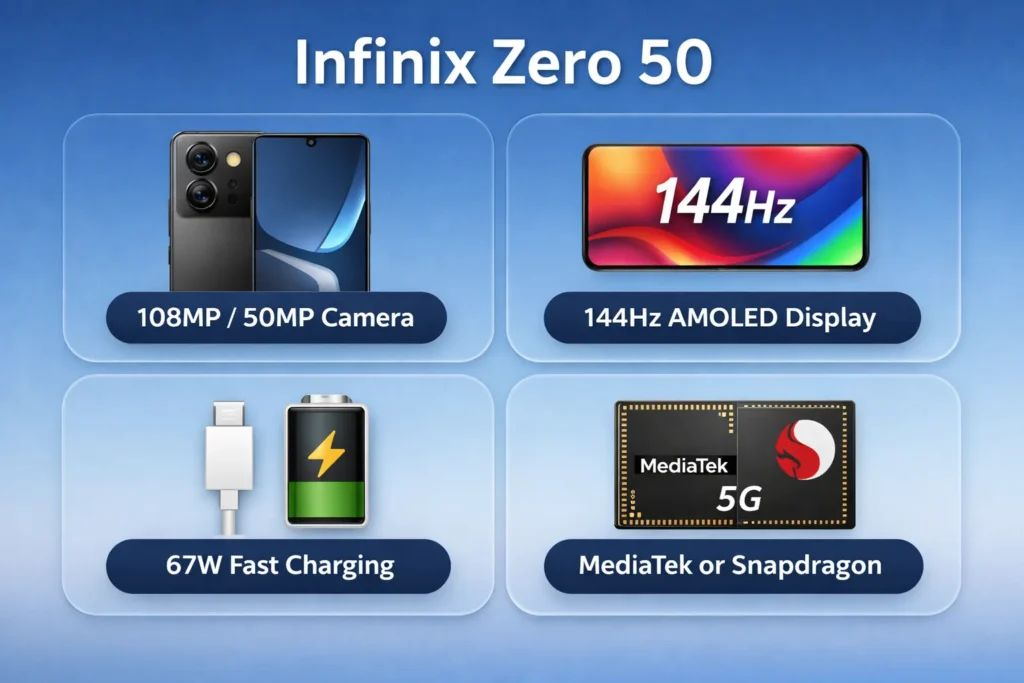
- Display: Large AMOLED, high refresh rate commonly 120Hz; some SKUs report 144Hz and claims of 10-bit rendering
- Processor: Varies by SKU — MediaTek Dimensity series in some regions; Qualcomm Snapdragon 7s-class variants in others.
- Main camera: Reported as either 108MP or 50MP main sensor — ultrawide + macro/depth vary by SKU
- Front camera: High-megapixel selfie, commonly optimized for high-resolution video capture (some SKUs advertise 4K front video)
- Battery: Typically 5,000–5,500 mAh
- Charging: Many SKUs list 67W wired fast charging (charger inclusion varies by market)
- OS: Android (reports indicate Android 15 with XOS skin in recent listings)
- Extras: Higher refresh, adaptive refresh, and advanced selfie/video modes in some regional SKUs
Display
What to expect from the AMOLED panel
When you think of the display as a signal in an NLP pipeline, imagine the raw pixel stream being transformed by filters (color calibration), normalization (adaptive brightness), and sampling (refresh rate). The Zero 50 targets a fluid UI experience through high sampling frequency — i.e., high refresh rate — which reduces the perceived motion blur and makes animations feel more continuous.
- Refresh: 120Hz is common; some SKUs claim 144Hz. Higher sampling (Hz) reduces temporal aliasing when scrolling and during rapid gestures.
- AMOLED benefits: True blacks via pixel gating, excellent contrast, and the potential for lower power draw when many pixels are dark (thanks to per-pixel emission control).
- Color & gamut: Tends toward vivid factory profiles. If you need faithful color reproduction, switch to “Natural” or sRGB mode in the display settings.
- Peak brightness: Variable by SKU and panel binning; if the panel achieves high nits, outdoor readability improves significantly.
Real-user notes
- Running at 144Hz consumes more energy than 60–90Hz. Use adaptive refresh or manually set 60/90Hz if you prioritize battery.
- If editing photos on-device, check for a 10-bit panel claim (better gradients, fewer banding artifacts).
- For gaming: the lower motion-to-photon latency at higher refresh improves responsiveness, but watch for thermal and battery consequences.
Cameras
Camera hardware summary
Different SKUs use different sensor stacks, which explains conflicting spec sheets. The principal patterns we see:
- Main sensor: Either a high-resolution 108MP sensor (with pixel-binning) or a 50MP sensor, depending on SKU. Both can produce sharp daytime crops.
- Ultrawide: Present on most versions but often with a smaller sensor and narrower dynamic range.
- Front camera: High-megapixel, often with a marketing emphasis on high-resolution video (some SKUs support 4K selfie video).
- ISP & software: Much of image quality depends on the ISP tuning, denoising, and HDR Algorithms — software matters as much as sensor size.
Daytime vs night performance
- Daylight: Expect crisp detail and strong color; the main sensor tends to be the best performer for detail and dynamic range.
- Portraits: Generally fine in bright conditions. Edge detection is good enough for social sharing but not flawless in complex backgrounds.
- Low light: Expect mixed results. Night mode helps, but won’t match flagship-level noise suppression or dynamic range. Secondary cameras (ultrawide, macro) often struggle in low light.
- Ultrawide: Good for landscapes in daylight; softer and less detailed than the primary sensor.
- Selfie vlogging: Strong point — high-res front sensor and video features make it viable for creators; test stabilization and audio capture before committing.
Video: stabilization & vlogging
- Stabilization: Decent for handheld 1080p footage. 4K stabilization is often software-based and may crop the image.
- Vlogging: Front-facing 4K (when present) plus good exposure handling makes the phone attractive for vloggers; check the microphone quality and whether the audio is stereo or mono in real clips.
Performance
Why different SKUs matter
Manufacturers commonly ship different SoCs to different markets. That means the same model name can host different processors, affecting CPU throughput, GPU performance, efficiency, heat envelope, and real-world battery life.
- MediaTek Dimensity variants: Often optimized for multicore efficiency and power, sometimes offering strong connectivity features (modem differences).
- Snapdragon-like 7s-class variants: May deliver different GPU performance and thermal behavior, which matters for sustained gaming.
How to check and what to expect
- Check model number (SKU): The definitive way to disambiguate. Retail pages or the box usually list an alphanumeric model (e.g., X####).
- Bench expectations: Both chip families can handle everyday tasks. Gaming performance depends on GPU, thermal cooling, and software throttling.
- Sustained load: Long gaming sessions can reveal thermal throttling — verify with sustained stress tests if gaming is a priority.
Battery & charging
Capacity and real-world use
Most SKUs offer 5,000–5,500 mAh battery capacities — a pragmatic range that commonly delivers a full day of typical use (social apps, light gaming, email, media).
Key variables:
- Refresh rate (120–144Hz) directly increases display-driven power draw.
- SoC efficiency variations across SKUs affect overall runtime.
- Network conditions (poor signal increases modem power draw).
Charging speeds & expectations
67W wired charging is frequently advertised. In lab conditions with the included charger and optimal thermal conditions, 0→100% typically completes in under an hour — often around 35–50 minutes depending on charger output and charge curve behavior.
Important: Some regions exclude the charger from the box. Confirm in the retail listing whether a compatible 67W charger is included or whether you must buy one separately.
Real tests you should run.
If you own the device, these empirical checks are quick and reveal the real-world behavior:
- 0→100% charge test with the included adapter (document times at 10% intervals).
- Video loop test at 150 nits (compare SOT with competitors).
- Gaming endurance: Run a demanding game for 30–60 minutes, log FPS and surface temperature.
- Thermal & throttling: Monitor CPU/GPU clocks under prolonged load.
Software & updates
OS and skin
Recent listings report Android 15 with XOS overlay. XOS adds features and visual changes; it also includes preinstalled apps that you can usually disable.
Update policy & security patches.
Infinix provides OS updates,s but the number and cadence of major OS upgrades and security patches can vary across models and markets. If long-term software support is critical, verify Infinix’s update policy for your country or consider buying from a vendor with explicit longer-term support.
Real-world tests
Think of this as a test suite — reproducible checks to produce a reliable dataset.
Camera comparison checklist
- Daylight wide & ultrawide (1:1 crops)
- Low-light single-shot vs Night mode
- Portrait edge detection across backgrounds
- Selfie video at 4K and 1080p (stability and exposure)
- Video stabilization (walk test) at both 1080p and 4K
Performance tests
- Single-core and multi-core synthetic benchmarks (for reproducibility)
- 30-minute gaming session on a heavy title; log FPS over time
- Thermal imaging, or at least surface temperature logging after heavy load (phone thermometers)
Battery tests
- 0→100% charge time with the included charger
- Screen-on time across mixed use
- Video loop at standardized brightness
- Battery drain per hour under gaming
Who should buy the Infinix Zero 50?
Buy it if:
- You want a high-refresh AMOLED for smooth UI and gaming.
- You value fast wired charging and long battery life.
- You create vlogs or frequently use the front camera for video.
- You want good midrange value without paying flagship prices.
Don’t buy it if:
- You require best-in-class low-light photography (flagships still lead).
- You need guaranteed long-term OS upgrades (check support policy).
- Your market ships a weaker SoC SKU, and you need high sustained GPU performance — verify model number.
Comparison
| Feature | Infinix Zero 50 | Competitor A (example) | Competitor B (example) |
| Display | High-refresh AMOLED (120–144Hz) | High-refresh IPS/AMOLED | Midrange AMOLED |
| Camera | 108MP / 50MP variants | Stable main sensor | Flagship main sensor |
| Battery | 5,000–5,500 mAh, 67W (many SKUs) | Similar or slightly smaller | Similar |
| SoC | Region-based (Dimensity/Snapdragon-like) | Single SoC | Single SoC |
| Price | Midrange value | Midrange | Often higher |
| Best for | Display + charging + vlogs | Balanced users | Photo-focused buyers |
Buying checklist
- Confirm SKU/model number on the seller page.
- Verify chipset (MediaTek vs Snapdragon).
- Confirm main camera (108MP vs 50MP).
- Check whether the 67W charger is included.
- Confirm warranty and return policy.
- Test in-store if possible: camera samples, screen refresh, and basic performance.
- If buying online, purchase from official or trusted retailers and keep the box sealed until testing.
FAQs
A: Launch timing and availability vary by country. Some markets saw releases in 2025.
Some units ship with a MediaTek Dimensity-class SoC; others have a Qualcomm Snapdragon 7s-type processor.
A: The Zero 50 ships with an AMOLED display and high refresh rates commonly at 120Hz; certain SKUs and market pages advertise 144Hz.
A: Different listings show different main sensor resolutions. Some SKUs list a 108MP main sensor (usually with pixel-binning) while others list 50MP.
A: Battery sizes commonly fall between 5,000 and 5,500 mAh. Many retailer pages advertise 67W wired charging capability, although the included charger may vary by market.
Closing
The Infinix Zero 50 is a strong mid-range option for users who prioritize a smooth high-refresh AMOLED display, fast wired charging, and capable front-facing video features without stepping into flagship pricing. In daily use, it delivers a fluid UI, reliable all-day battery life, and solid daylight camera performance — strengths that make it especially appealing to content creators, vloggers, and casual gamers.
