

Introduction of Infinix Zero 4
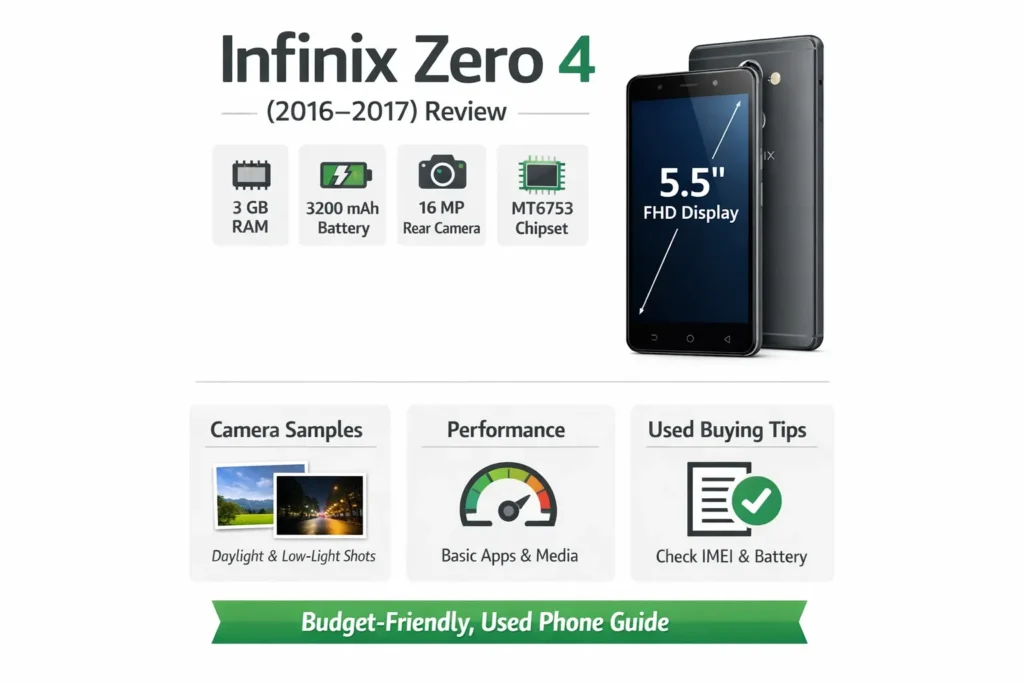
The Infinix Zero 4 is a 2016–2017 mid-range phone with a 5.5″ FHD display, MediaTek octa-core chipset, and 3 GB RAM. Good as a cheap used phone for basic tasks; avoid it for heavy gaming or long-term security needs.
Quick specs
- Model: Infinix Zero 4
- Release: 2016–2017
- Display: 5.5″ IPS, 1920 × 1080 (FHD)
- SoC: MediaTek MT6753 (typical SKU)
- RAM / Storage: 3 GB / 32 GB (microSD)
- Rear camera: 16 MP (varies by region)
- Front camera: 8 MP (varies)
- Battery: ~3200 mAh (Zero 4); Zero 4 Plus ~4000 mAh
- OS: Android with XOS overlay (Marshmallow / Nougat era)
- Status: Discontinued / available used
Why read this Infinix Zero 4 review?
If you’re considering an Infinix Zero 4 (either used or leftover stock), this guide helps you decide quickly. It outlines what the phone still does well in 2026, where it falls short, and the key checks you must do before buying a second-hand unit. Practical advice is prioritized: request camera samples, test battery performance, verify IMEI/blacklist status, and confirm the SKU.
Design & Display
Build, ergonomics, colors.
When it launched, the Zero 4 aimed to look and feel like a slightly premium mid-ranger. Typical units have a metal-look back (some are faux-metal), reasonably thin bezels for 2016, and a 5.5″ footprint that suits most hands. Color options differed by market; always confirm the pictured color and SKU in listings.
What to inspect on a used unit
- Back cover scratches, dents, or bends
- Screen scratches, chips, dead pixels, or discoloration
- Loose buttons, a wobbly charging port, or a headphone jack
- Bent frame or uneven gaps (signs of drops or bad repairs)
Measured brightness & viewing
The FHD IPS panel was sharp for its time, delivering good pixel density and pleasing colors indoors. Under direct sunlight, it struggles against modern phones with higher peak brightness and HDR capabilities. If you plan to use the phone outdoors frequently, test the display in bright conditions.
What to show in a listing
- A daylight photo of the screen showing brightness at max
- A test showing off-axis viewing angles and color shift
- A close-up that proves no dead pixels or burn-in
Performance & Benchmarks
SoC, CPU/GPU, real-world app performance
Most Zero 4 models use the MediaTek MT6753: an octa-core Cortex-A53 chipset designed for efficiency rather than raw speed. The Mali-T720 GPU handles basic graphics and UI rendering, but isn’t well-suited to modern 3D games. Real-world experience (in 2026) will be that the phone handles messaging, web browsing, and video playback acceptably, but intensive multitasking and newer apps will feel sluggish.
Real-world expectations
- Social apps and messaging: acceptable, but app switching is slower than on modern phones
- Video playback: smooth for 1080p media
- Gaming: basic games run; heavy 3D titles will stutter or drop frames
Benchmark table
Benchmarks are only a rough historical guide and vary by firmware and test app version.
| Benchmark | Typical score (historical) |
| AnTuTu (overall) | ~30k – 45k |
| Geekbench 4 (single) | ~600 – 800 |
| Geekbench 4 (multi) | ~2000 – 3000 |
Modern budget phones (post-2020) outperform these ranges significantly — keep that in mind when comparing.
Camera — Samples & analysis
Hardware & features
Advertised specs commonly show a 16 MP rear sensor and an 8 MP front sensor, but actual sensor models and lens apertures varied by SKU and market. Sensor revisions — or differing camera modules — happen frequently across regions, so confirm the SKU or request sample images.
What to expect from images
- Daylight: Decent detail and suitable colors for social sharing.
- Indoor: Reduced detail and increased noise; low-light processing of the era relied more on software than hardware.
- Low light: Noisy, soft detail, and blown highlights in many cases. Don’t expect Night Mode-quality results.
- Selfie: Serviceable for social posts; not studio-level.
Gallery
Always include or ask for 6–12 camera samples (full resolution) to verify claims:
- Daylight wide scene (landscape)
- Close-up/texture shot with a 100% crop
- Indoor ambient light scene
- Low-light / street lamp shot
- Selfie (indoor)
- Macro/close focus (if claimed)
Provide EXIF for each shot to prove authenticity (date/time, model, lens). 100% crops give buyers confidence about sensor detail and sharpening.
Battery & Charging
Reported capacity & standardized test ideas
- Zero 4: ~3200 mAh
- Zero 4 Plus: ~4000 mAh (when present)
Standardized tests to run or request:
- 1080p video loop (airplane mode, 50% brightness) — yields baseline drain for display/SoC.
- Mixed-use day test — messaging, browsing, music/YouTube for a realistic screen-on-time estimate.
- Charging test — record 0→100% times in 15-minute intervals to verify charger/cable health.
Real expectations
- 3200 mAh: roughly 4–6 hours SOT under light use (varies widely).
- 4000 mAh (Plus): noticeably better, possibly 6–8 hours SOT.
Battery health in used devices varies by charge cycles, storage habits, and replacement history — always request recent battery health screenshots or run a cycle test.
Software & Support
Out-of-the-box Android/iOS version
Depending on the market, the Zero 4 shipped with an XOS overlay on Android Marshmallow or Nougat. Official OTA support was limited; by 2026, the device would no longer receive official security updates. This matters for banking apps, corporate use, or privacy-conscious buyers.
Security patch situation & custom ROM advice
- Official updates: unlikely. Do not assume recent security patches.
- Custom ROMs: Some community ROMs (LineageOS, custom builds) may be available but come with caveats: installation complexity, potential stability issues, and risk of bricking. Custom ROMs void warranty and may lack vendor-specific features (camera tuning, modem firmware). Only proceed if you’re comfortable with flashing and troubleshooting.
Zero 4 vs Zero 4 Plus
| Feature | Zero 4 | Zero 4 Plus |
| Battery | ~3200 mAh | ~4000 mAh |
| Size | 5.5″ FHD | 5.5″ FHD |
| Performance | MT6753 typical | May vary — verify SKU |
| Best for | Compact used buyers | Buyers who want better battery life |
Price & Where to Buy
Where to look
- Daraz — possible leftover or refurbished stock
- OLX / local classifieds — second-hand listings with Bargaining Room
- Local used phone shops/bazaars — inspect in person before buying
Price tips and negotiation
- Ask for date-stamped photos, full-res camera samples, and a battery health screenshot.
- Be wary of vague photos, claims like “untested” or prices that are too good to be true.
- Verify IMEI and confirm it’s not blacklisted or stolen.
- Expect prices to vary widely depending on condition, battery health, and whether the original charger/box is included.
Pros & Cons
Pros
- The FHD display provides sharp text and decent video
- Comfortable 5.5″ size for most users
- Cheap on the used market — good value for basic tasks
Cons
- Aging SoC — not suitable for demanding games or long-term app compatibility
- Limited (or no) software/security updates by 2026
- Average low-light photography and moderate charging speeds (microUSB)
Who should buy it in 2026?
Buy it if:
- You need a very cheap FHD phone for calls, messaging, and video.
- You’re on a tight budget and can inspect the unit in person.
- You can toleratea lack of updates or run a community ROM.
Avoid it if:
- You need up-to-date security patches, reliable performance for gaming, or superior low-light camera performance.
FAQs
A: Only as a used budget phone for calls, messaging, and video. For security updates and heavy apps, choose a newer device.
A: The Zero 4 usually lists around 3200 mAh. The Zero 4 Plus often has ~4000 mAh. Always check your SKU.
A: It depends on the SKU and market — many original Zero 4 units do not include a fingerprint sensor. Verify photos and listing.
A: Many units use MediaTek MT6753 (octa-core). Performance is fine for basic use but not for modern 3D games.
A: Daylight images are decent for the era; low-light performance is average. Ask the seller for full-res camera samples before buying.
Final verdict
The Infinix Zero 4 was a competent mid-range phone in its time. In 2026, it’s a value option only on the used market for light users. If security, modern performance, or excellent cameras matter, spend a little more on a recent budget device. If you do buy a Zero 4, insist on camera samples, battery-health proof, and a hands-on inspection.
