
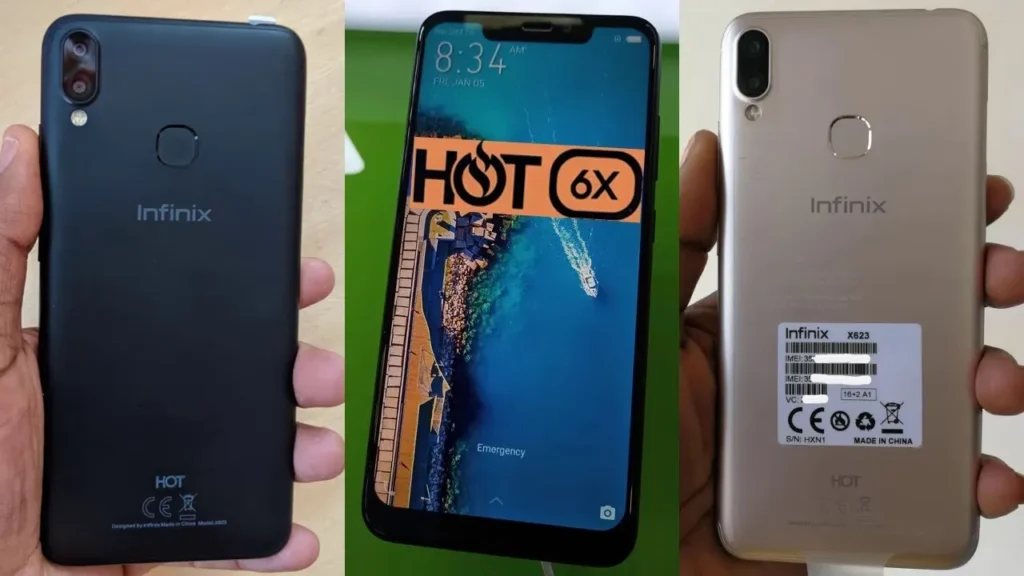
Introduction of Infinix Hot 6X
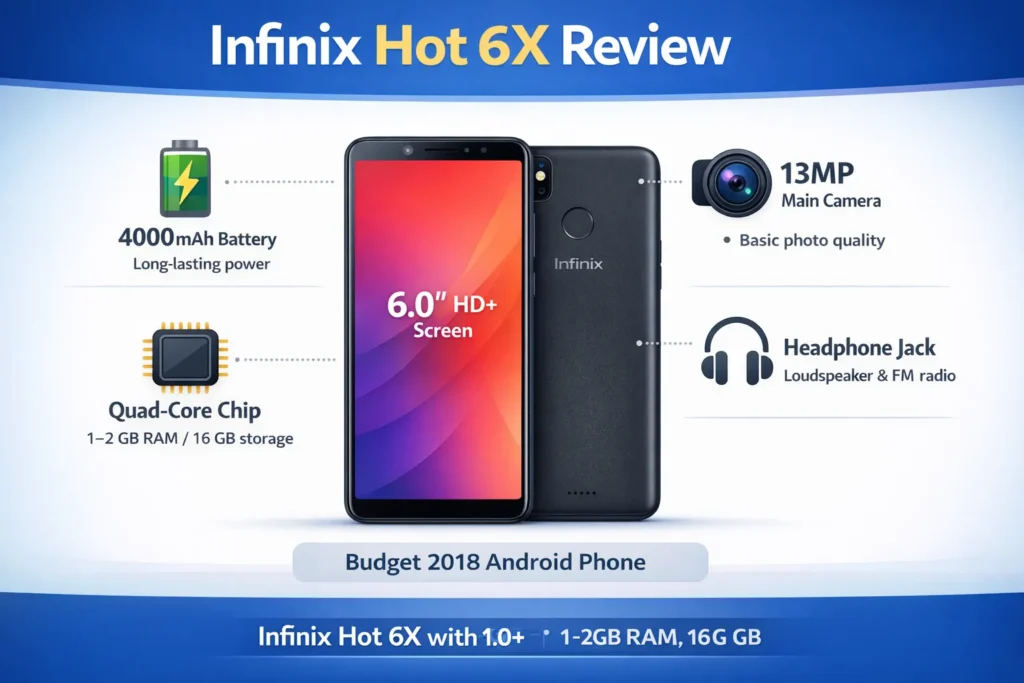
A low-cost 6.0″ HD+ Android phone with a 4000 mAh battery, 13MP main camera, Android 8.x (XOS), and a modest MediaTek quad-core processor — designed for light daily use and excellent battery life. This Infinix Hot 6X review explains the phone in simple, plain language. The Hot 6X is a budget handset introduced in 2018 featuring a large 6.0″ HD+ display, a 4000 mAh battery, an entry-level MediaTek quad-core SoC, and a basic 13MP main camera.
Full quick specs
Budget 6.0″ HD+ Android phone, 4000 mAh battery, 13MP main camera, 1–2GB RAM, and 16GB storage (typical), MediaTek MT6737 quad-core — suitable for basic tasks and long battery life.
Key specs
| Category | Detail |
| Model | Infinix Hot 6X |
| Launch | 2018 (wide release in many markets during 2018) |
| OS at launch | Android 8.0 (Oreo) with XOS skin (Hummingbird) |
| SoC | MediaTek MT6X737 (quad-core) |
| CPU / GPU | 4 × Cortex-A53 (1.3 GHz) / Mali-T720 MP2 |
| RAM / Storage | Typically 1GB / 2GB RAM; 16GB internal storage; microSD supported |
| Display | 6.0″ IPS LCD, 720 × 1440 (HD+), ~268 ppi |
| Rear camera | ~13MP main (f/2.2 class, basic AF) |
| Front camera | ~8MP selfie (variants exist, some with LED flash) |
| Video | 1080p@30fps likely on good SKUs; stabilization limited |
| Battery | 4000 mAh, non-removable, micro-USB charging |
| Dimensions/weight | ~157.7 × 75.4 × 8.0 mm; ~170–180 g |
| Extras | 3.5mm headphone jack, FM radio, microSD slot; biometric options vary by SKU |
Design & build
The Infinix Hot 6X follows a pragmatic, cost-conscious design typical of entry-level phones from its era. Materials and finishing prioritize durability and cost-efficiency over a premium feel.
Materials & finish: The chassis and back are primarily plastic, sometimes with textured or glossy finishes depending on colorway. That plastic keeps the unit light and less fragile than glass-backed phones, but it can show surface scratches if left unprotected.
Ergonomics: A 6.0″ screen with a tall 18:9 aspect ratio keeps the width reasonable (~75 mm). That makes it comfortable in most hands for one-handed reach to the top third of the display, though full-size typing often uses two hands. The device is light enough for prolonged use without fatigue.
Aesthetic: Budget-friendly colors were typical at launch — Sandstone Black, Magic Gold, Bordeaux, etc. Expect conservative styling rather than bold premium curves or glass accents.
What’s in the box:
- Infinix Hot 6X handset
- Charger (likely 5V/1–2A, micro-USB)
- Micro-USB cable
- SIM tray / eject tool (varies)
- Quick start guide, warranty card
- Basic earphones in some markets
Display
The Hot 6X sports a 6X.0″ IPS LCD at HD+ resolution (720 × 1440). For the price bracket, this is an expected compromise: large, usable, but not super sharp.
Sharpness: The pixel density (~268 ppi) keeps text readable and UI elements clear for everyday use. You’ll notice the difference compared with Full HD displays (more visible pixels), especially on small text or densely packed UI.
Color & viewing: IPS panels in this class tend to offer solid viewing angles and acceptable color reproduction for media consumption and social images. Colors will be punchy but not as accurate as higher-tier panels.
Brightness & outdoor use: Typical peak brightness is moderate — perfectly usable indoors and in shaded outdoor conditions, but very bright sunlight can challenge the display. A matte or anti-glare protector helps if you read outside often.
Protection: Many budget phones do not ship with high-end glass protection (like Gorilla Glass). If screen durability matters, add a tempered glass protector.
Performance & real-world usage
Under the hood, the Hot 6X’s MediaTek MT6737 (quad-core Cortex-A53) is an entry-level chipset designed for basic efficiency and low cost. Combined with low RAM on many SKUs (1–2GB), the experience is tuned for light tasks.
What it handles well:
- Phone calls and SMS
- Messaging apps (WhatsApp, Telegram)
- Social feeds (Facebook, Instagram, Twitter) with light browsing
- Video streaming at 720p or adaptive quality
- Casual games and lightweight apps
Where it struggles:
- Heavy multitasking (many apps in RAM simultaneously)
- Demanding 3D games at higher graphics settings — expect low frames and Thermal Throttling.
- Intensive photo or video editing, large downloads without microSD expansion
Real-world advice: If your routine is messaging, social media, YouTube, and occasional camera use, the phone will satisfy. If you keep many apps open or want high-performance gaming, move up to a modern midrange device.
Camera
The camera package on Hot 6X is functional and straightforward: a ~13MP main sensor at the rear and an ~8MP front-facing sensor on many SKUs. Processing and optics are basic, which informs what photos will (and won’t) look like.
Daylight shooting: In good light, the camera produces usable images for social sharing. Images are typically punchy, with boosted color saturation and contrast — flattering for social posts but not color-accurate for professional work.
Low light & night: Low-light performance is a major weakness. Expect noise, smeared detail, and uneven exposure in dim conditions. There’s limited dynamic range and no sophisticated night processing.
Autofocus & speed: Autofocus and shutter response are acceptable in static scenarios, but can be sluggish with fast action. Processing can introduce visible lag between frames.
Video: If available on your SKU, 1080p@30fps is typical. Video stabilization is minimal to non-existent; use steady hands or a tripod for acceptable results.
Practical tips to get better photos:
- Shoot in daylight or bright, even indoor lighting.
- Use HDR mode for high-contrast scenes to retrieve shadow detail.
- Avoid digital zoom — move physically closer.
- Hold the phone steady or brace it on a surface in low light.
- Prefer single-focus subjects; fast motion can blur.
Battery life & charging
Battery is one of the Hot 6X’s strongest attributes. A 4000 mAh battery paired with a modest chipset and an HD+ display almost always translates into long endurance.
Typical real-world battery behavior:
- Light to moderate use (calls, messaging, social scrolling, some video) commonly lasts a full day and often extends to 1.5 days.
- Screen-on time (SOT) in mixed usage scenarios is commonly in a practical band of 5–8 hours, depending on activities and network conditions. Heavy gaming or long GPS navigation reduces this considerably.
Charging: The phone uses micro-USB and standard charging currents. There’s no modern fast charge tech built in — expect slower top-ups compared to contemporary 18W/33W chargers. A full charge can take considerably longer than modern USB-C fast-charging phones.
Software & updates
The Hot 6X launched with Android 8.x (Oreo) and Infinix’s XOS skin (Hummingbird variant around the time of release). The skin introduces additional features and some preinstalled apps.
Key software considerations:
- Android 8 is now aged; long-term security updates and major Android upgrades are unlikely for a device of this vintage.
- Expect some preinstalled vendor or third-party apps that may feel like bloat; many of these can be disabled or uninstalled.
- If staying current on security and platform updates matters, choose a newer device with official update commitments.
Connectivity & sensors
The Hot 6X includes the baseline connectivity features you’d expect in a budget handset.
Typical features:
- Wi-Fi (most SKUs single-band), Bluetooth, GPS (A-GPS)
- 3G/4G LTE support may vary by SKU — check your model’s band support for your region
- FM radio and a 3.5mm headphone jack are typically present
- Some SKUs include a rear fingerprint reader or face-unlock options, but this is SKU-dependent
Variants & regional SKUs
Manufacturers commonly release slightly different SKUs by region. The Hot 6X often came in 1GB (Go edition) and 2GB RAM options, both commonly paired with 16GB storage. Other variations included single vs dual SIM, and small camera or software differences.
Buying note: Always verify the model number and seller listing to ensure the variant matches your needs — especially RAM (1GB vs 2GB) and LTE band support.
Pricing & availability
The Hot 6X launched as a cost-conscious option in 2018. By 2026, the device will be discontinued in many territories; you’ll find units primarily as used/refurbished inventory or leftover new stock.
Where to look:
- Local second-hand marketplaces and classifieds
- Refurbishers and certified pre-owned sellers
- Regional retailer clearance or leftover new-stock listings
Buying tips:
- If you need a phone mainly for calls, messaging, and long battery life, a used Hot 6X can be a sensible budget pick.
- Compare prices with newer ultra-budget options; modern entry phones often deliver better performance and more recent Android versions at similar or slightly higher prices.
- Inspect used units carefully for battery health, screen damage, and port condition (micro-USB ports can wear).
- Ask sellers for the exact SKU/regional model to confirm network compatibility.
Real-world tests & what reviewers noticed
Hands-on impressions and early reviews when the Hot 6X launched emphasized battery life and practical daily performance for basic apps. Camera performance was repeatedly noted as adequate in daylight but weak in low light.
Suggested tests:
- Battery endurance test: Loop streaming or continuous video playback at 50% brightness until shutdown to get controlled SOT numbers.
- Camera test: Shoot daylight, indoor, and low-light shots with HDR on and off for comparison.
- Gaming: Run a light title and a heavy title to assess both frame rates and thermal behavior.
- Benchmarking: Antutu or Geekbench for performance context — expect notably low scores by modern standards.
Pros & cons
Pros
- Long battery life (4000 mAh)
- Large 6.0″ HD+ display at a budget price point
- Good value for basic daily tasks (calls, social media, video)
- Handy extras: headphone jack, FM radio, microSD expansion
Cons
- Outdated software (Android 8.x) with limited update prospects
- Low RAM and storage on base SKUs — can feel slow with many apps
- No modern fast charging and uses micro-USB instead of USB-C
- Camera and raw performance are basic — not suited for gaming or pro photography
Alternatives
If you need more performance, better cameras, or longer software support, consider current budget and midrange phones instead. Look for:
- Better performance: Devices with modern MediaTek Helio/Dimensity or Qualcomm Snapdragon 600/700 series chips.
- Better camera: Phones with 48MP/64MP main sensors and decent night modes.
- Software longevity: Newer phones promise at least 2 Android version upgrades and regular security patches.
If you give me your budget and country, I can list three concrete alternatives available locally and compare them against the Hot 6.
Who should buy the Infinix Hot 6X?
Buy the Hot 6X if:
- You need a very cheap phone for calls, WhatsApp, social media, and video streaming.
- You value long battery life above raw performance.
- You’re buying on a very tight budget (used or refurbished markets).
Don’t buy the Hot 6X if:
- You want smooth, heavy 3D gaming or advanced multitasking.
- You require up-to-date Android versions and reliable security updates.
- You need a high-quality camera system or fast charging.
FAQs
A: It depends. For extremely tight budgets and basic everyday use (calls, messaging, social media, video), a Hot 6 can still be serviceable.
A: The Infinix Hot 6X uses a 4000 mAh battery — one of the phone’s best attributes, delivering strong endurance for most light-to-moderate use patterns.
A: It launched with Android 8.x (Oreo) layered with Infinix’s XOS (Hummingbird). Official platform upgrades are unlikely at this stage.
A: You can run lightweight or low-detail modes of demanding games, but performance will be limited: expect low frame rates, graphical compromises, and possible overheating during prolonged play.
A: Typical SKUs come with 1GB or 2GB of RAM and 16GB of storage.
Verdict
The Infinix Hot 6X is a budget-focused, long-endurance phone with a large display and genuinely solid battery life. It delivers reliable, basic performance for everyday tasks but is constrained by old software, minimal RAM on base SKUs, a micro-USB port, and modest camera capabilities. If your needs are simple — calling, messaging, social media, and long battery life — it remains a usable low-cost choice, particularly in second-hand markets. If you want future-proofing, progressive camera features, or gaming performance, look for a newer budget or midrange phone.
