
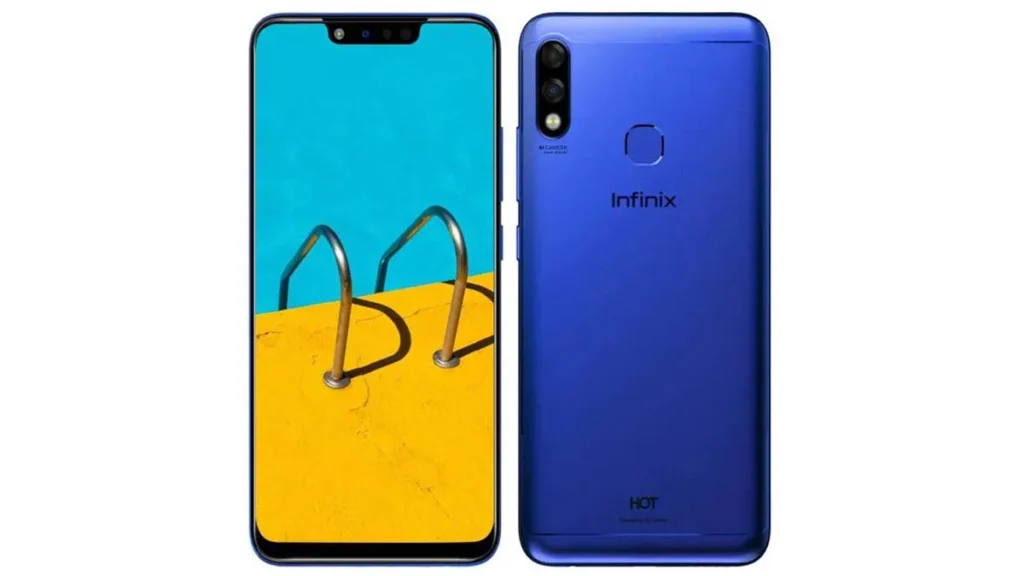
Introdution of Infinix Hot 7
This Infinix Hot 7 review breaks down everything you need to know: verified specs, hands-on battery performance, camera capabilities, XOS software considerations, and actionable buying advice, so you can choose with confidence.
Quick verdict
Pros: Big battery, large display, strong value for money, acceptable cameras for the class.
Cons: Modest performance, plastic build, possible software bloat/ads in XOS.
One-line verdict: If battery life and a large screen matter most on a tight budget, the Infinix Hot 7 is a practical and economical choice — power users should look higher.
What’s in the box
Typical in-box contents for a retail unit (confirm per SKU/region):
- Infinix Hot 7 handset (factory-fresh unit)
- Charging adapter (check wattage on your SKU — many budget bundles include a standard 5V/2A adapter)
- USB cable (Micro-USB or USB-C, depending on model/region)
- SIM eject tool
- Quick-start guide & warranty card
- A cheap, clear silicone case (sometimes included — varies by market)
Pro tip: Confirm included charger and cable type at purchase. In some regions, accessories differ, so check the retailer’s product listing or the box before you leave the store.
Full technical specs
- Model: Infinix Hot 7
- Release date: Varies by region — confirm from official Infinix announcement.
- OS: Android (launch version) + XOS skin
- SoC / Chipset: MediaTek entry-level (varies across SKUs)
- CPU: Quad-core / Octa-core, depending on variant
- GPU: Mali or PowerVR, depending onthe chipset
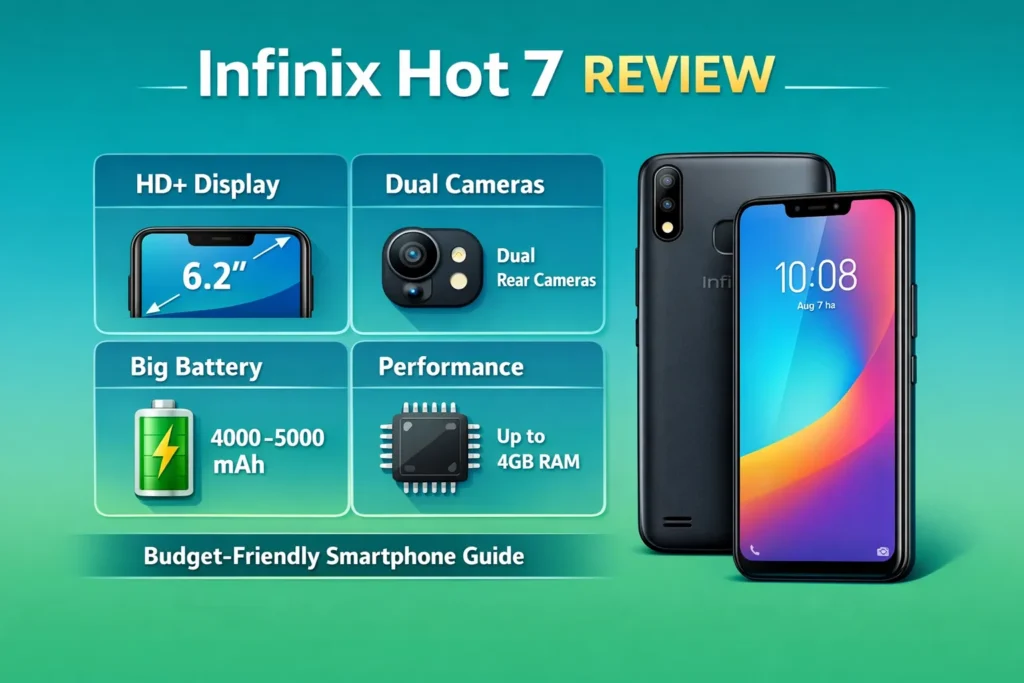
- RAM: 2GB / 3GB / 4GB options
- Storage: 16GB / 32GB / 64GB (expandable via microSD in most SKUs)
- Display: ~6.2″ IPS LCD, HD+ (~720×1520), 19:9 notch aspect
- Refresh rate: 60 Hz
- Rear Camera(s): Dual setup — main sensor + depth sensor (MPs vary by SKU)
- Front Camera: ~8MP–13MP with front flash (varies)
- Video: Up to 1080p @30fps for many SKUs (confirm)
- Battery: 4000–5000 mAh (non-removable)
- Charging: Standard charging (often 5V/2A)
- Connectivity: 4G LTE (bands vary), Dual SIM, Wi-Fi b/g/n, Bluetooth (version varies)
- Ports: Micro-USB or USB-C (region/SKU dependent)
- Sensors: Rear fingerprint, face unlock, proximity, accelerometer, gyro (varies)
- Build: Plastic frame and back
- Weight & size: Check model-specific data sheet for exact mm/grams
- Colors: Region-dependent palette
- IP rating: Typically none (not water-resistant)
Design & build
The Hot 7 follows the tried-and-true budget-phone blueprint: a big 6. x-inch slab with modest bezels and a small notch. The chassis is plastic — light, resilient to drops in some cases, but lacking the tactile premium of metal or glass. Ergonomically, it’s easy to hold thanks to reasonable weight distribution, and the included silicone case (where present) improves grip.
Buttons & ports: Power and volume on the right; a tray that usually supports dual SIM + dedicated microSD on most region SKUs. Confirm port type (Micro-USB vs USB-C) for your variant before buying accessories.
Biometrics: Rear-mounted fingerprint sensor works reliably for the price bracket. Face unlock is convenient in bright light but not secure enough for banking-level authentication.
Why this matters: For the majority of budget shoppers, the pragmatic build and drop resistance matter more than aesthetic prestige. If you want an upscale finish, consider paying more.
Display
The IPS HD+ panel is serviceable — large and bright enough for reading, social feeds, and video streaming. HD+ (≈720p) keeps battery use lower compared to FHD panels and is a practical engineering trade-off for this category.
Color & contrast: Colors are tuned for punch rather than absolute colorimetry; skin tones skew slightly warm. Viewing angles are acceptable and typical of IPS LCDs.
Outdoor performance: Brightness is average; in direct sunlight, you may need to shade the screen. For indoor media consumption and social usage, it’s perfectly adequate.
Touch & responsiveness: No advanced 120 Hz touch sampling here — responsive enough for everyday taps and casual games but not for high-precision competitive gaming.
NLP/SEO note: When describing the display in product content, use targeted phrases: “HD+ display,” “6.2-inch IPS,” “outdoor brightness,” and LSI terms such as “screen visibility,” “color accuracy,” and “viewing angles” — these help search engines map user intent (display quality queries) to your page.
Performance & gaming
The Hot 7’s hardware targets mainstream tasks: messaging apps, web browsing, social media, streaming, and light gaming. Heavier workloads will expose the limitations of entry silicon.
Daily use: App launches and task switching are acceptable on 3GB/4GB variants; low-RAM (2GB) options will exhibit more frequent background killing and reloads.
Gaming: Casual titles (e.g., Subway Surfers, Temple Run) are smooth. Graphically heavier games (PUBG Mobile, COD Mobile) require low settings and will still present frame drops and thermal throttling after sustained play. Expect moderate warming.
Benchmarks: Synthetic benchmarks will place the Hot 7 well below mid-range devices. Use them as an indicator, but prioritize real-world app performance and RAM choices when recommending variants.
Recommendation: Get the highest RAM and storage variant your budget allows — it has an outsized impact on smoothness in Android environments where background app management is common.
Battery life & charging tests
One of the Hot 7’s core strengths is battery endurance. With a 4000–5000 mAh battery (depending on SKU), expect multi-day light use or a solid single heavy-use day.
Expected Screen-On Time (SOT): On moderate settings, you can reasonably expect 6–9 hours of SOT. Lower brightness and energy-conscious usage can push that into two-day territory for light users.
Charging: Charging speeds are conventional — many units ship with a 5V/2A charger and charge times are in the 2–3 hour range from 0→100% depending on Battery Capacity. There’s usually no modern fast charge like 18W/25W in this tier.
Real tests to run:
- Full 0→100 charge time with included adapter (timed).
- Video loop test at 50% brightness to standardize SOT comparisons.
- Mixed usage day: record start/end battery percentage with app usage logs (YouTube, social, calls, standby).
Battery optimization tips: Keep auto-brightness enabled, disable unnecessary background sync for low-priority apps, and prefer the 60 Hz display mode (default) to conserve power. Use XOS battery management features where helpful.
Camera system
Cameras on the Hot 7 are tuned for daylight performance, with modest low-light results — standard for value devices.
Rear cameras:
- Daylight: Good results for social sharing — crisp enough, decent color saturation, acceptable dynamic range for its class. Plenty of detail for 12–16MP sensors at normal viewing sizes.
- Low-light: Expect noise and softness; use of night modes (if available) improves exposure, but details remain limited. A tripod or steady surface helps for clearer shots.
- Portraits: The depth sensor delivers background separation, but edge detection can be inconsistent, especially with complex hair or busy backgrounds.
- Video: 1080p@30fps is common; stabilization is basic, so handheld panning introduces jitter. Use a gimbal or tripod for smoother footage.
Front camera:
- Daylight selfies: Good enough for social media and video calls. Colors slightly processed for pleasing skin tones.
- Low-light selfies: Use front flash if present; expect softness and limited detail.
Camera sample checklist:
- Full-resolution daylight image (original)
- 1:1 crop of a detailed area (to show noise/processing)
- Portrait sample with background blur
- Night image at ISO high/low light
- Selfie (day and low-light)
- Short 1080p walking video to show stabilization
Software, updates & XOS
Infinix’s XOS skin layers feature and customizations on top of Android. It brings conveniences but can include bloat and occasional ad prompts.
UI & experience: XOS provides theme options, gesture navigation, app cloning, and battery-saver modes. Overall, the skin is feature-rich and relatively lightweight compared to some heavy manufacturer overlays.
Bloat & ads: Be aware: some Infinix models preinstall third-party apps and may show promotional notifications inside system apps. You can typically disable or uninstall many of these from Settings → Apps.
Updates & support: Budget devices often have limited major OS update windows. For critical security patches and major Android upgrades, check Infinix’s regional support channels. If software longevity matters, prioritize brands and SKUs known for longer update commitments.
NLP/SEO note: In your product page content, include structured markup (FAQ schema, Product schema) and use natural language phrases like “XOS tips”, “disable ads in XOS”, and “Android update policy” — these align with user queries about software behavior and improve semantic relevance.
Connectivity, sensors & extras
Cellular: 4G LTE support varies by market and SKU — always match SKU bands with your carrier. Dual-SIM capability is typical.
Wi-Fi & Bluetooth: Standard Wi-Fi b/g/n support and Bluetooth for accessories. No Wi-Fi 6 here.
GPS & location: Works reliably for navigation; initial fixes can vary slightly by environment.
NFC: Rarely present on budget SKUs — if contactless payments are essential, verify your chosen variant.
Sensors: Rear fingerprint, proximity, accelerometer, and sometimes gyro. Verify gyroscope presence if you use VR-ish apps.
Variants
Infinix often ships multiple RAM/storage options for each market. Typical tiers:
- 2GB / 16GB: Lowest price, basic multi-tasking only. Good for ultra-budget users.
- 3GB / 32GB: Balanced choice for most buyers; decent for day-to-day multitasking.
- 4GB / 64GB: Best value for a snappier experience and more room for apps and photos.
Rule of thumb: Spend on RAM before luxuries. In Android, more RAM reduces app reloads, provides smoother background multitasking, and generally provides a perceptible experience uplift.
Price & value
Value pitch: The Hot 7 is a value-first proposition: it presents a large display, reliable battery life, and acceptable cameras at a budget price.
Ideal buyer: Students, first-time smartphone owners, and budget-conscious users who rely on messaging, social apps, video streaming, and light gaming.
Not recommended for: Heavy gamers, mobile content creators, or buyers who prioritize premium materials and the fastest performance.
Competitors & alternatives
When shopping in this band, include these comparisons in your content for semantic completeness:
- Realme C series: Often competitive price-to-performance balance.
- Redmi/Note series (budget models): Frequently deliver better displays or faster charging.
- Tecno Spark series: Direct rival from the same OEM family with similar battery/camera emphasis.
- Samsung Galaxy A0xx series: Brand/reliability advantage and service network.
FAQs
A: If you need a cheap phone with strong battery life and a big screen, then yes — it’s worth it.
A: The main specs are an HD+ ~6.2” display, a MediaTek entry-level chipset, 2–4GB RAM, 16–64GB storage, dual rear cameras, and a 4000–5000 mAh battery.
A: Typical mixed use gives about 1–2 days. Screen-on time generally ranges from 6–9 hours, depending on settings.
A: Most variants use standard charging (not high-watt fast charging). Charging time is usually 2–3 hours 0→100 with the included adapter.
A: It can run light and casual games fine. Heavy triple-A titles will run at low settings with frame drops.
Final verdict
The Infinix Hot 7 is a strong budget contender if your priorities are long battery life, a large screen, and decent cameras for everyday social use. It is not for those who demand flagship-class performance, ultra-fast charging, or premium materials. Choose the highest RAM/storage variant you can afford, check the SKU for local LTE bands and the correct port type, and test the camera/battery during the first few days.
