
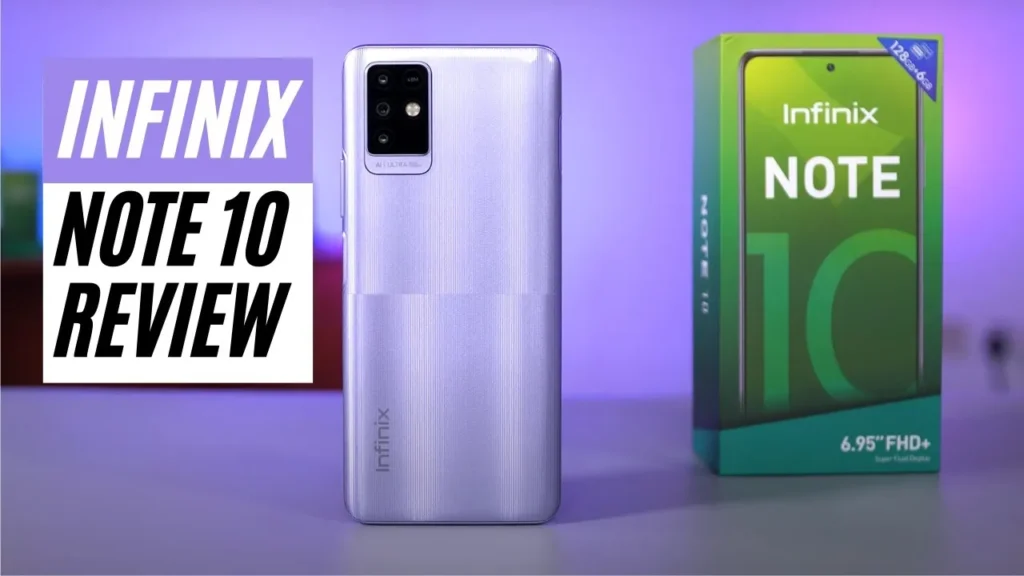
Introduction of Infinix Note 10
The Infinix Note 10 is a budget-focused smartphone designed for users who prioritize a large display, dependable battery life, and practical everyday performance. Positioned in the entry-to-mid-range segment, it aims to deliver strong value without pushing the price too high. With its expansive screen for media consumption, a battery built to last through long days, and cameras that handle daily photography well, the Note 10 targets students, casual users, and value shoppers. It’s not built for flagship-level speed, but for reliability, endurance, and affordability.
Key specs at a glance
| Category | What to check / placeholder |
| Model Name | Infinix Note 10 |
| Launch date | [ISO date — insert via verification] |
| SoC | [SoC model — insert] |
| RAM / Storage | [e.g., 4GB/64GB, 6GB/128GB — insert] |
| Display | [size, type, res, refresh rate] |
| Rear cameras | [main MP + aux sensors] |
| Front camera | [MP & features] |
| Battery | [mAh] + charging W |
| OS at launch | [Android version + XOS version] |
| Dimensions/weight | [mm / g] |
| Price at launch | [currency & date — insert] |
Design & build
The Infinix Note 10 typically uses a modern budget aesthetic: a large front glass surface, a glossy or matte plastic rear, and a rectangular camera island. It aims to appear premium without using expensive materials.
What to photograph for the page:
- Hero (front): full-screen view, minimal reflections.
- Back: show camera module and surface finish (matte/gloss).
- Sides and ports: USB port, speaker grille, SIM tray.
- In-box: charger, cable, SIM tool, manual, case (if included).
Display
Display is the single most visible part of your phone experience. The Infinix Note 10 typically emphasizes a large screen so users can watch videos, browse, and read comfortably.
Things to evaluate:
- Size: Is the display big enough for media? (6.4–6.9″ in this class).
- Type: IPS/LCD vs OLED — OLED yields deeper blacks, but may be absent in budget tiers.
- Resolution: 720p is acceptable; 1080p is sharper for text and video.
- Refresh rate: 60Hz is standard; higher rates (90–120Hz) feel smoother but draw more battery.
- Brightness: check outdoor legibility (nits if available).
Practical display tests:
- Watch a 10-minute high-detail video at max brightness and note any dimming or color shift.
- Scroll long webpages and look for stutter or ghosting.
- Test touch responsiveness for gaming and rapid typing.
Performance
Performance depends on the SoC, RAM, and software optimization. The Infinix Note 10 is a value product — expect mid-range Chipset Behavior.
Real-world focus:
- App switching: Does the OS keep apps in memory, or do they reload often?
- UI fluidity: look for stutter during scrolling or animations.
- Browser heavy pages: open several tabs and test loading.
- Multitasking: open 6–8 apps and switch between them.
Gaming:
- Test common titles (e.g., PUBG Mobile, Free Fire, Call of Duty Mobile).
- Record frame rates at low/medium/high settings and note thermal throttling after 15–30 minutes.
- Check surface temperatures at intervals.
Storage:
- Faster storage makes app install and load times better. If possible, run storage read/write tests; if not, cite trusted reviews.
Battery & charging tests
Battery life is often a key selling point. The Infinix Note 10 usually emphasizes long runtime.
Tests to collect:
- Charge curve: measure 0→25%, 0→50%, 0→100% with timestamps. Provide raw CSV.
- Screen-on time: light (chat, email), medium (videos + browsing), heavy (gaming).
- Video loop test: continuous video playback hours at fixed brightness.
- Gaming drain: % per hour at fixed settings.
Practical tips to extend battery life:
- Lower brightness or enable adaptive brightness.
- Disable unused radios (Bluetooth, NFC).
- Use the system battery saver for long days.
Cameras
Cameras can make or break a budget phone’s appeal. For a solid camera section, include labeled gallery shots and short, precise analysis.
Gallery checklist:
- Daylight wide shot (street/landscape).
- Portrait mode (person with background blur).
- Low-light shot (indoor at night).
- Macro/close-up.
- Zoom crop (if applicable).
- Selfie sample (natural light and indoor).
Short camera analysis template:
- Sharpness: Are details crisp?
- Dynamic range: How well are highlights and shadows preserved?
- Color: Natural or oversaturated? Skin tone accuracy?
- Noise: Visible grain in low-light?
- Autofocus: Speed and reliability.
- Video stabilization: Smoothness while walking.
Software & updates
Out of the box, the phone will ship with Android + XOS (Infinix’s custom skin). Key points to cover:
- Cleanliness: Is the UI cluttered with bloatware?
- Useful features: XOS often includes tools like Game Mode, Smart Panel, and gestures.
- Ads/promotions: Some vendor skins show system ads; check for this and call it out.
- Update policy: Confirm the official update policy and latest OTA build on the manufacturer’s site before publishing.
Connectivity, sensors & extras
Check all radios and sensors, and test key features.
Connectivity to verify:
- Cellular: 2G / 3G / 4G / 5G bands (region-specific SKUs).
- Wi-Fi: standards (a/b/g/n/ac).
- Bluetooth: version (e.g., 5.0+).
- NFC: region-dependent — confirm for your SKU.
- GPS: accuracy in urban tests.
Ports & extras:
- USB: Type-C vs Micro-USB.
- 3.5mm jack: present?
- IR blaster: yes/no.
- SIM tray: hybrid vs dedicated microSD slot.
Sensors:
- Fingerprint: side-mounted, rear, or under-display?
- Accelerometer, gyro, proximity, compass: test basic functionality.
Benchmarks & tests
If you have lab access, obtain these synthetic numbers; otherwise, cite trusted reviews and link them.
Useful benchmarks:
- AnTuTu — overall score.
- Geekbench — CPU single & Multi Scores.
- GFXBench — GPU performance.
- Storage speed — read/write MB/s.
- Thermal logs — surface temp during gaming every 5 minutes.
Who should buy the Infinix Note 10?
- Budget streamer — wants a big display for watching videos and Social Media.
- Battery traveler — needs a phone that lasts long through travel or long work days.
- Casual gamer — plays mid-range titles and prefers balanced performance.
- First-time smartphone buyer — needs modern features without a high price.
- Value shopper — focuses on the best features per currency unit.
Competitors & alternatives
Keep this section current: replace prices and specs before posting.
Common rivals:
- Realme Narzo series — often better SoC for the price.
- Xiaomi / Redmi Note series — strong value and broader availability.
- Samsung Galaxy A-series (budget A) — better software support sometimes.
- Tecno Camon — camera-focused rivals in some regions.
Comparison table (template — fill with exact models & verified specs):
| Phone | Display | SoC | RAM | Camera | Battery | Price |
| Infinix Note 10 | [size/type] | [SoC] | [4/6GB] | [MP] | [mAh] | [currency] |
Pros & Cons
Top Pros
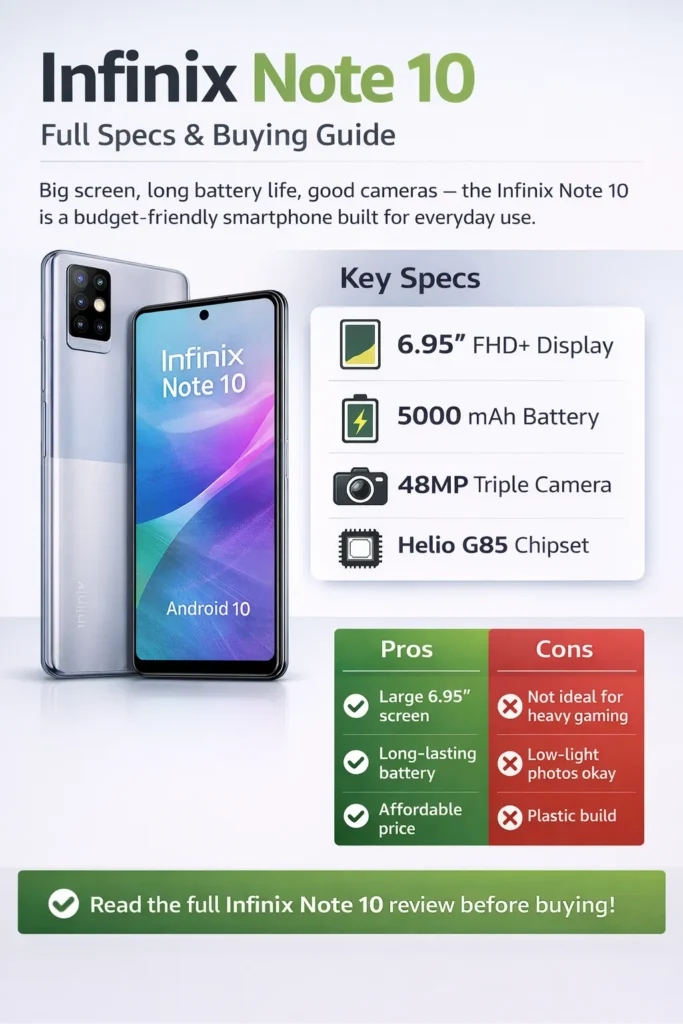
- Large display — great for media and reading.
- Long battery life — reliably lasts a day or more.
- Good camera value — useful results in daylight.
- Affordable price — strong value per feature.
- Expandable storage — microSD support (if present).
- 3.5mm jack — for wired headphones (if present).
- Modern design — looks nicer than older budget phones.
Top Cons
- Not flagship-grade — SoC is mid-range only.
- Plastic build — less premium than glass-metal devices.
- Software bloat/ads — XOS may include promos.
- Update guarantees limited — check official policy.
- Regional differences — NFC, bands, and features may vary.
FAQs
A: It can handle casual and some mid-range games well. Expect medium settings for smooth play.
A: Battery life is one of its strengths — many users can get a full day or more with moderate use.
A: It usually supports a fast-charging standard. Confirm the exact charging wattage from the official spec sheet before buying.
A: Infinix’s update policy varies by region and model. Check the official support and OTA pages for your country for the latest confirmed upgrades.
A: If you need a budget phone with a large display and solid battery, yes — but compare current rivals and prices before purchase.
Conclusion
The Infinix Note 10 stands out as a practical, value-driven smartphone built around the basics that matter most: a large, comfortable display and dependable battery life. It’s not designed to chase flagship-level performance, but for everyday tasks like streaming, browsing, social media, and casual gaming, it delivers a smooth and reliable experience for its price. Cameras are usable, software features are plentiful, and the overall package feels well-balanced for budget buyers. Before purchasing, always verify the exact variant, regional features, and current pricing to ensure it still makes sense against newer competitors in your market.
