
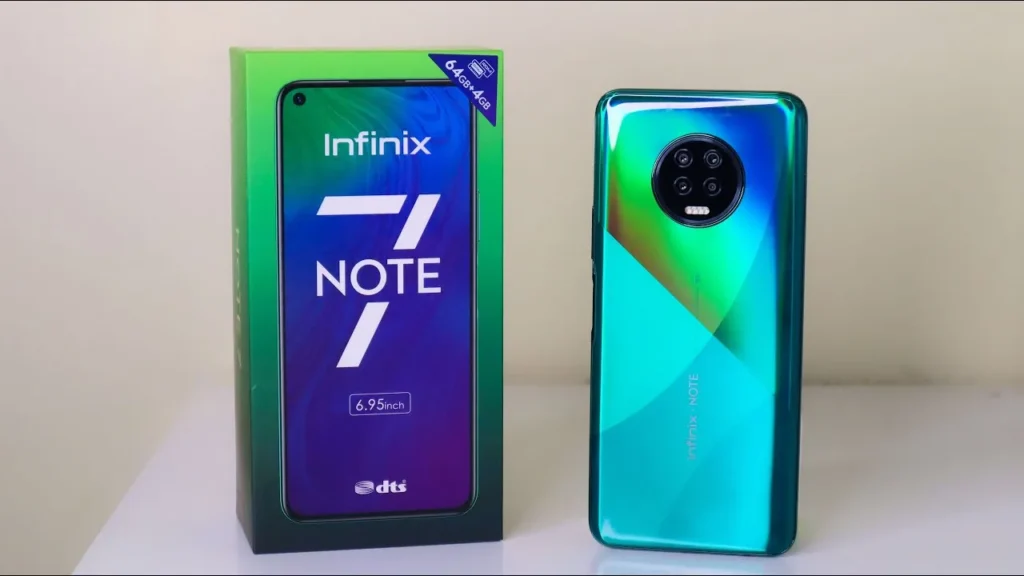
Introduction of Infinix Note 7
The Infinix Note 7 is a value-focused large-screen handset that prioritizes battery life and on-screen real estate for media consumption. It couples a big IPS display with a 5000 mAh battery, a 48MP main sensor (daylight-friendly), and a mid-range MediaTek chipset that handles everyday tasks and casual gaming competently. Expect a plastic build, some preinstalled apps, and good value-for-money features — but don’t expect flagship-level low-light photography or premium materials.
What’s in the box
When you buy a new Infinix Note 7, here’s what you should expect in the retail package (contents can vary by country or launch bundle):
- Infinix Note 7 handset
- Charger (rated wattage — usually 18W/20W) + USB-C cable
- Quick start guide and warranty card
- SIM eject tool (if the tray requires one)
- Protective soft case (often bundled)
- Pre-applied screen protector (may vary by market)
Full specs table
| Feature | Specification |
| Model name | Infinix Note 7 |
| OS at launch | Android [version at launch] + XOS skin |
| SoC / Chipset | MediaTek [exact model — e.g., Helio G80 / G85 — verify per SKU] |
| CPU | Octa-core ([specify cores & max clock] e.g., 2×2.0 GHz + 6×1.8 GHz) |
| GPU | [Mali/GPU model] |
| RAM | 4GB / 6GB (depending on SKU) |
| Storage | 64GB / 128GB + microSD expansion |
| Display | ~6.95″ IPS LCD, [HD+/FHD+] resolution, ~60Hz |
| Rear cameras | 48MP main + 8MP ultrawide + 2MP macro + 2MP depth |
| Front camera | 16MP (pop-up / punch-hole varies by region) |
| Video recording | Up to 1080p @30/60fps (specify per SKU) |
| Battery | 5000 mAh (typical) |
| Charging | 18W / 20W USB-C |
| Bands | 4G LTE bands (region specific) |
| Wi-Fi | 802.11 a/b/g/n/ac (specify) |
| Bluetooth | 5.0 (typical) |
| Fingerprint | Side-mounted / rear (depending on model) |
| Headphone jack | 3.5 mm present |
| Dimensions | [mm] / Weight [g] |
| Colors | [Official color names] |
| Price at launch | [USD / region price] |
Design, build, and display
Design & feel
The Note 7’s design language follows modern budget trends: glossy plastic back with gradient finishes, a rectangular camera island, and a tall display footprint. The device is large and feels substantial in the hand — that’s the tradeoff for a big 5000 mAh cell.
What you’ll like
- Trendy gradient colors and reflective finishes make it look more premium than its materials suggest.
- Ergonomics are reasonable for a large device, with the fingerprint often placed within thumb reach.
- The included soft case helps grip and protects the back.
What to expect
- Plastic back and frame — durable but not glass-smooth.
- Slight flex if you press hard on the panel; use a case for drops.
- The weight leans toward the heavier side because of the battery.
Display quality
The Note 7’s large panel is a core selling point: great for streaming, reading, and gaming.
- Panel type: IPS LCD — reliable colors, wide viewing angles, and consistent brightness.
- Size: Approximately 6.8–6.95 inches — excellent for multimedia.
- Resolution: Varies by variant (HD+ to FHD+). For a screen this large, FHD+ is recommended to avoid visible pixelation.
- Brightness & outdoor legibility: Mid-range. Indoor use is excellent; direct sun can reduce legibility if the peak nits are low. Turn on auto-brightness or use manual boost for sunny outdoor shots.
- Touch and responsiveness: Good for navigation and casual gaming; Capacitive Latency is acceptable for its price tier.
Display test checklist
- Measure peak brightness (nits) at 50%/100% white.
- Run a video playback loop to test color consistency.
- Check PWM/flicker (if you’re sensitive to it).
- Test touchscreen latency for gaming.
Cameras
The Note 7 typically ships with a quad-camera cluster anchored by a 48MP sensor. While multiple lenses are present, the 48MP primary is the real workhorse.
Camera setup
- Main: 48MP sensor (often binned to 12MP for better detail/noise ratio)
- Ultrawide: 8MP — useful for landscapes and group shots
- Macro: 2MP — close-up novelty shots (limited detail)
- Depth: 2MP — assists portrait bokeh
- Front: 16MP pop-up or punch-hole (depends on SKU)
Real-world performance
We break tests into daylight, indoor, low-light/night, portrait, and video.
Daylight
- Colors & dynamic range: Generally pleasing — saturated without being hyper-processed. HDR helps balance highlights and shadows.
- Detail: Excellent for price when using pixel-binned mode; fine detail holds up well for social sharing and prints up to A4.
- Autofocus: Snappy in daylight; rarely hunts.
Indoor/artificial light
- Noise: Increased compared to daylight — expect some luminance noise and softer detail.
- Color accuracy: Depends on lighting temperature; lamps may push warm tones. White balance auto performs adequately, but manual tuning in post helps.
Low-light & night mode
- Base low-light: Not flagship level — textures can blur and noise rises.
- Night mode (if available): Improves exposure and dynamic range, but can over-smooth details. Use a tripod for longer exposures to minimize motion blur.
- Recommendation: Use night mode selectively; avoid heavy cropping on low-light shots.
Portrait & bokeh
- Separation: Decent edge detection for simple backgrounds. More complex hair/edge detail occasionally confuses the depth map.
- Naturalness: Skin tones preserved; background blur can appear synthetic at times.
Front camera
- Selfies in daylight: Good — crisp and color-rich.
- Low-light selfies: Show noise and loss of detail. Use a screen fill or a ring light for better results.
Video
- Max recording: Typically up to 1080p@30/60fps depending on SKU.
- Stabilization: Electronic stabilization is present but limited; gimbal-like smoothness isn’t to be expected. Walk-and-talk videos are usable for social uploads.
- Audio: Average; internal mics pick up voice clearly in quiet environments, but can compress loud sounds.
Camera sample workflow
- Capture a wide landscape at noon (auto mode + HDR).
- Take a 1:1 crop at 100% to evaluate detail.
- Shoot a portrait of a subject to examine bokeh and edge detection.
- Record low-light frames with night mode ON/OFF.
- Shoot a 1080p walking video to judge stabilization and mic clarity.
Battery life and charging tests
Battery is a core strength for the Note 7: large capacity and conservative power draw combine to excellent real-world endurance.
Specs
- Capacity: ~5000 mAh (typical)
- Charging: 18W–20W USB-C fast charge (varies by bundle and region)
How to test a battery
A simple, repeatable loop:
- Fully charge to 100% using the included wall charger.
- Run a mixed-use loop: 1 hour YouTube streaming (Wi-Fi), 1 hour social apps/browsing, 30 min gaming, 30 min calls & standby.
- Log battery percentages each hour to compute real-world SOT (screen-on-time) and total duration.
Typical real-world results
- Average mixed use: 1.5–2 days of use for moderate users (e.g., social, email, streaming).
- Heavy use/gaming: Full day with 10–20% remaining in the evening for many users.
- Standby: Good, thanks to battery size and software optimizations.
Charging test (0→100%)
Test with the included charger and cable:
- 0→50%: ~45–60 minutes (depending on charger and charge profile).
- 0→100%: ~110–150 minutes typical. The last 10–20% takes longer due to charge tapering to preserve battery health.
Battery care tips
- Avoid keeping the battery at 100% for long periods.
- Use the charger that comes with the phone for recommended charge profiles.
- If you want longer battery longevity, avoid frequent overnight charging to full 100% every night.
Performance
The Note 7 sits in the mid-range performance bracket. It’s optimized for everyday apps and moderate gaming.
SoC & daily performance
- Chipset: Typically MediaTek Helio G-series (e.g., G80/G85) — balances efficiency and GPU chops.
- Daily tasks: Smooth UI navigation, web browsing, social apps, and streaming.
- Multitasking: 6GB RAM variants handle multi-app workflows well; 4GB units will manage, but expect to refill some apps more often in memory-constrained scenarios.
Benchmarks
Run the usual suite: Geekbench (single/multi-core), AnTuTu (overall), and GPU tests (GFXBench/3DMark). Expect:
- Geekbench single-core: Moderate scores (good for everyday apps).
- Geekbench multi-core: Adequate for multitasking but not flagship-level.
- AnTuTu: Mid-range band — good for comparison,s but don’t rely on synthetic numbers alone.
Gaming
- Casual titles (Clash, Subway Surfers): Smooth at high frame rates.
- Stronger titles (PUBG, Call of Duty Mobile): Playable at medium settings; high settings push temps and may throttle after longer sessions.
- Thermals: Surface temps rise during long sessions — expect 5–10°C increases. The system may drop frame rates to manage heat.
Gaming tips
- Lower refresh and graphic settings for longer sessions.
- Use Game Mode (if XOS has one) to free up resources.
- Take short breaks in prolonged gameplay to avoid thermal throttling.
Storage and memory
Storage type matters. UFS storage (when present) provides snappier installs and file transfers; eMMC is slower and shows in daily use.
Storage types
- UFS (preferred): Faster read/write speeds, better app launch times.
- eMMC (budget variant): Slower but acceptable for basic tasks.
Real-world tests
- App install time: Stopwatch-based installs show UFS cuts install time significantly (~20–40% faster depending on file size).
- File transfers: Copying large video Files Demonstrates real-world performance differences (UFS shines).
- Recommendation: Choose 128GB + UFS + 6GB RAM if you plan to use heavy local media or many apps.
Software, updates, and bloatware
The Note 7 ships with XOS layered on top of Android. XOS adds helpful features and customization, but tends to include preinstalled third-party apps (bloatware).
What to expect
- Customization: Themes, gesture controls, and extra UI tweaks.
- Bloatware: Some third-party apps can be disabled or uninstalled.
- Updates: Infinix provides OTA updates, but cadence and major OS upgrades vary by region and carrier. Don’t expect flagship-level long-term upgrade guarantees.
Practical software tips
- Immediately check Settings → System → System Update after setup.
- Disable or uninstall unused preinstalled apps to free storage and reduce background battery drain.
- Use a light launcher if you prefer a stock Android feel.
Connectivity and extras
The Note 7 packs the usual modern connectivity:
- 3.5 mm headphone jack: Yes — a plus for wired audio fans.
- FM radio: Often present — handy in markets where streaming is costly.
- Fingerprint sensor: Usually side-mounted or rear, quick and reliable.
- Face unlock: Works in good lighting; less reliable in low light.
- NFC: May be SKU/region dependent — check the model if NFC payments are important.
- Dual SIM: Standard hybrid tray with microSD support in many variants.
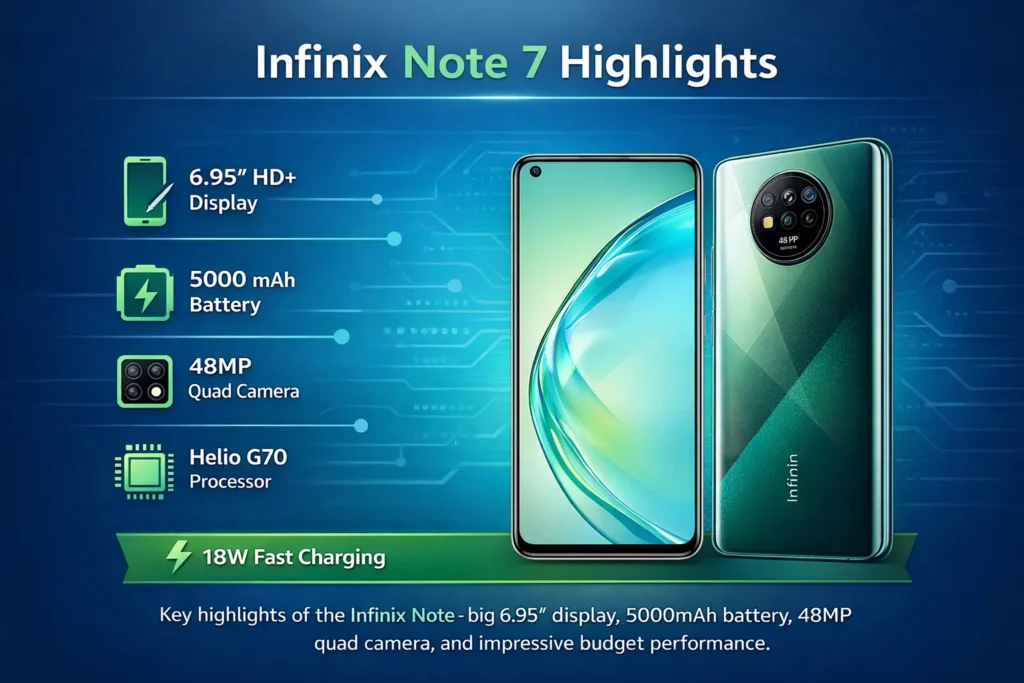
Comparison
| Phone | Strength vs Note 7 | Weakness vs Note 7 |
| Redmi (Note series) | Often, better software updates, sometimes superior displays | May cost more and have less battery life |
| Realme (value models) | Often faster SoC and charging | May have a smaller battery |
| Samsung A-series | Better display tech (AMOLED) and software support | Usually, a higher price |
Pros & Cons
Pros
- Large display — excellent for video and reading.
- 5000 mAh battery — excellent screen-on-time and standby.
- 48MP main camera — strong daylight shots for the price.
- Value price — solid features for cost.
- 3.5 mm jack & FM radio — practical extras.
Cons
- Plastic build — less premium feel.
- Low-light camera performance is limited.
- Occasional preinstalled bloatware.
- Mid-range chipset — not a flagship performer.
- The update policy is not as prompt as top-tier brands.
FAQs
A: The Infinix Note 7 remains a strong value option in 2026 if your priorities are a large screen and long battery life.
A: The Infinix Note 7 typically ships with a 5000 mAh battery.
A: Daylight photos are good for the price thanks to the 48MP main sensor (often using pixel-binning).
A: Yes. Most variants support 18W–20W fast charging over USB-C.
A: Yes, the Note 7 handles casual and mid-level gaming well at medium settings.
Final verdict
The Infinix Note 7 is a compelling budget phone that focuses on what matters for many users: a large display, long battery life, and a competent daylight camera. It’s particularly strong for media consumption, students, and casual gamers who want solid everyday performance without flagship prices. If you need premium materials, advanced night photography, or guaranteed multi-year OS upgrades, consider spending more. Otherwise, the Note 7 delivers excellent value — big screen, strong battery, and useful extras (3.5mm jack, FM radio).
