
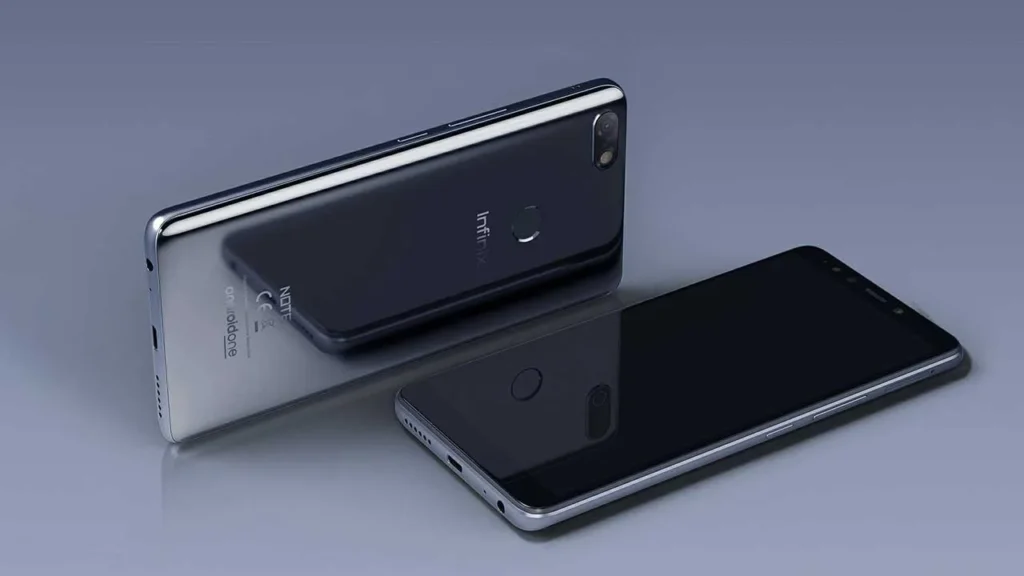
Introduction of Infinix Note 5 Pro
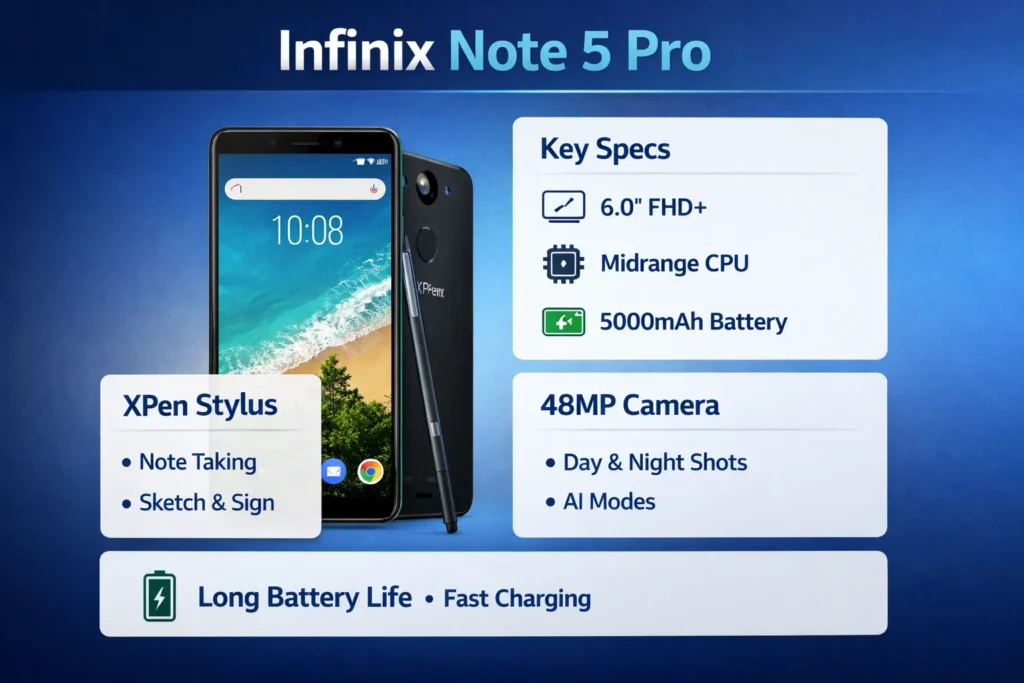
The Note 5 Pro targets users who prioritize a tall display for reading and multimedia, a high-capacity battery for prolonged sessions, and a stylus workflow for annotation and quick capture. It usually ships with a midrange chipset, multiple RAM/storage SKUs, and camera tuning optimized for well-lit contexts. This guide is structured like an annotated dataset — each section is a labeled feature, with suggested tests (metrics), recommended photographic assets, and publication tokens editors can use to optimize for search and conversions.
Quick specs table
| Category | Key details |
| Model name | Infinix Note 5 Pro |
| Display | 6.0–6.3″ IPS or AMOLED, FHD+ (1080×2340), 60–90Hz |
| SoC / Chipset | MediaTek or Qualcomm midrange (varies by SKU) |
| RAM / Storage | 4 / 6 GB RAM; 64 / 128 GB storage; microSD slot (dedicated/hybrid) |
| Rear cameras | 48 MP main (or 12 MP depending on SKU) + depth/ultrawide/macro variants |
| Front camera | 16–32 MP selfie |
| Battery | 4,500–5,000 mAh; fast charge (18–33W typical) |
| Stylus | XPen support (active stylus) |
| OS | Android with XOS skin (varies by release) |
| Connectivity | 4G LTE, Dual SIM, Wi-Fi ac, Bluetooth 5.0, GPS |
| Ports | USB-C (or micro-USB on older SKUs), 3.5mm jack |
| Weight / Build | ~180–210 g; plastic or metal frame, glass/plastic back |
Display
Treat the display like the model’s primary output channel. In NLP terms, it’s the device’s “render layer” — how tokens (text, images, video) are visually presented to the user. Key metrics = feature-level attributes you should measure and publish as structured data.
Measurements to collect:
- Screen size (diagonal) — influences perceived immersion and ergonomics.
- Resolution & pixel density (ppi) — impacts text clarity and UI crispness.
- Panel type (IPS vs AMOLED) and refresh rate — affects contrast, black level, and animation smoothness.
- Max measured brightness (nits) — crucial for outdoor legibility, especially under direct sunlight; measure both indoor and peak outdoor at full-white.
- Color accuracy/gamut (sRGB %) — if you have the tools, include a colorimeter reading.
How to present:
- Short table with measured values.
- A sentence comparing the measured peak to typical midrange peers: e.g., “At ~500 nits, the Note 5 Pro is suitable for most outdoor use but trails flagship HDR panels.”
Photographer tip: capture a sunlight-legibility photo at the same exposure settings as baseline shots to visually demonstrate practical brightness.
Performance
Model the device’s compute subsystem as a sequenced pipeline: SoC → thermal management → storage I/O → runtime. For readers, numeric benchmarks are the tokens they parse to infer real-world responsiveness.
What to measure:
- Chipset model & clocks (explicit SKU string).
- Geekbench (single/multi) — show screenshots and interpret scores.
- AnTuTu overall and subscores — CPU, GPU, memory, UX.
- 3DMark or equivalent for GPU.
- Storage read/write speeds (AndroBench or equivalent).
- Thermal behavior — surface temperature traces during sustained workloads (e.g., 30-min PUBG session).
- App load times and observed stutters.
Interpretation guidelines:
- “In the execution trace for everyday usage, a 6GB RAM SKU will generally maintain active app embeddings without frequent cold starts. Heavy tensor workloads (high-fidelity games) stress the GPU, showing frame drops and thermal throttling after Extended Periods.”
Example reader-facing lines:
- “Everyday tasks are smooth on 6 GB RAM. Heavy gaming requires medium settings for sustained play.”
- “Measured AnTuTu: 210k–320k depending on SKU — report your SKU’s measured value.”
Battery & charging tests
View the battery as the device’s energy corpus; tests quantify the battery’s endurance embedding for different use-case intents (streaming, browsing, gaming). Use repeatable, controlled tests and publish raw CSV for transparency.
Vital tests to run:
- Declared capacity (mAh).
- Controlled battery rundown (screen-on test) — set brightness to 200 nits and run until shutdown; record Screen-On Time (SOT).
- Charging curve — record timestamps for 0→10→20→30→50→80→100% while using the included charger.
- Standby drain — 12-hour idle with Wi-Fi on (record percent lost).
- Real-world day log — narrate a mixed-use day with app list and SOT.
Camera
Treat the cameras as multiple classifiers tuned to different domains (daylight classifier, low-light enhancer, portrait segmentation). The publication should contain labeled samples and crop comparisons for reproducibility.
Recommended photographic dataset:
- Daylight wide (primary sensor) + 2× crop.
- Portrait (subject separation) with depth map observations.
- Ultrawide (if present) with distortion notes.
- Macro samples.
- Low-light (night mode vs auto) with crops.
- Selfie and group selfie.
- Video clips: 1080p stabilization test (walking), 4K sample if supported.
Editorial elements:
- EXIF metadata attached and provided as a ZIP of full-res files.
- Side-by-side day vs night crops with annotations on noise, detail retention, and white balance.
- A vertical/gif stylus+camera demo if you recorded in portrait orientation.
Camera narrative:
- “The daytime model returns sharp frames with saturated color vectors suitable for social sharing. Under low-light distributions, noise increases, and detail collapses; Night mode denoises but occasionally oversmooths textures.”
Video note:
- “EIS performs adequately at 1080p; 4K stabilization is inconsistent and shows residual wobble.”
Software & updates
Frame the software layer as the device’s language model: it shapes the user experience, injects heuristic shortcuts, and influences long-term maintainability via updates.
Checklist:
- Ship OS (Android version + XOS skin).
- Bloatware inventory — list preinstalled apps and whether they’re removable.
- Update policy — summarize the vendor’s official stance if available (declare “varies by region” when uncertain).
- Current firmware — note the build number and changelog link if present.
Writer-friendly guidance:
- “Describe whether XOS provides useful extra features (e.g., gesture shortcuts, one-handed mode, app cloning) or whether it adds annoying notifications and duplicate apps.”
- “Explain how readers can check for updates in Settings → About → System updates and encourage readers to install security patches.”
Tip list:
- Disable auto-start apps in settings to reduce background battery drain.
- Use the built-in economy or battery saver modes for longer SOT.
Connectivity, sensors, and ports
This is a technical inventory — list the presence and behavior of common hardware tokens: Wi-Fi, Bluetooth, GPS, NFC (if present), FM radio, and the physical port type.
What to test:
- Wi-Fi throughput using the same router and distance profile.
- GPS lock time and accuracy using a mapping app and a known route.
- Bluetooth pairing & audio stability with TWS earbuds.
- Cellular signal strength across two carriers (if you can test locally).
- Speaker loudness (dB meter) and mono/stereo behavior.
- Presence ofa 3.5mm jack and functionality.
Editor note:
- Highlight missing features like NFC in certain SKUs; call out whether the microphone and earpiece perform well in call conditions.
Comparisons
Comparison is a similarity-matrix operation: choose peers in the same price band and populate a feature vector for display, chipset, battery, and unique features (stylus).
Example simplified table:
| Feature | Infinix Note 5 Pro | Rival A (e.g., Redmi Note) | Rival B (e.g., Realme) |
| Display | 6.0″ FHD+ | 6.5″ FHD+ OLED | 6.4″ FHD+ |
| SoC | Midrange | Comparable midrange | Snapdragon midrange |
| RAM | 4/6 GB | 4/6 GB | 6 GB |
| Battery | 5,000 mAh | 5,000 mAh | 4,500 mAh |
| Stylus | Yes | No | No |
| Fast charge | 18–33W | 18–33W | 30W |
| Price | Value segment | Value segment | Value segment |
Pros & cons
Pros
- Big battery that supports long screen-on sessions.
- XPen stylus for note-taking and quick annotations.
- Competitive price for the feature set.
- Decent daytime camera performance for social media.
Cons
- Midrange SoC — heavy gaming requires lower settings.
- Low-light camera performance is average compared to flagship tiers.
- Some SKUs use plastic materials that feel less premium.
- OS update cadence varies by region.
Buying guide & price tips
This is a transaction funnel: reduce buyer friction by presenting SKU mapping, warranty cues, and packaging checks.
Checklist before purchase:
- Confirm SKU & model number for correct RAM/storage and LTE bands.
- Check included charger wattage in box contents.
- Warranty & service centers — confirm local support.
- Box contents — verify XPen included for stylus SKUs and whether a case is bundled.
Where to buy:
- Official stores or reputable marketplaces (regional platforms such as Daraz, Jumia, Amazon, depending on the market).
- Check local sellers’ return and repair policies.
Price tips:
- Watch price drops in the first 6–12 months after launch; promotional windows often lowthe er effective price.
- If you need higher gaming capability, consider paying a premium for a competitor with a stronger chipset.
FAQs
A: If you prioritize a large display, durable battery life, and an affordable stylus experience, it remains a good value.
A: Mixed-use typically yields 1–2 days. In a controlled 200-nits screen-on test, expect roughly 8–12 hours SOT depending on the SKU and background activity.
A: Many SKUs include XPen support. Confirm your region and model — some variants are stylus-equipped while others are not.
A: It runs popular mobile games at medium-to-low settings. Prolonged sessions may show frame drops; a chipset with higher GPU power is better for heavy gamers.
A: Daytime photos are generally fine for social sharing. Low-light detail and dynamic range are average and will lag behind pricier competitors.
Final verdict
The Infinix Note 5 Pro offers a compelling value proposition for consumers who prioritize screen real estate, extended battery life, and stylus-based productivity at a budget-friendly price point. It performs well for everyday tasks and note-taking; however, it is not geared toward sustained high-FPS gaming or best-in-class low-light photography.
