
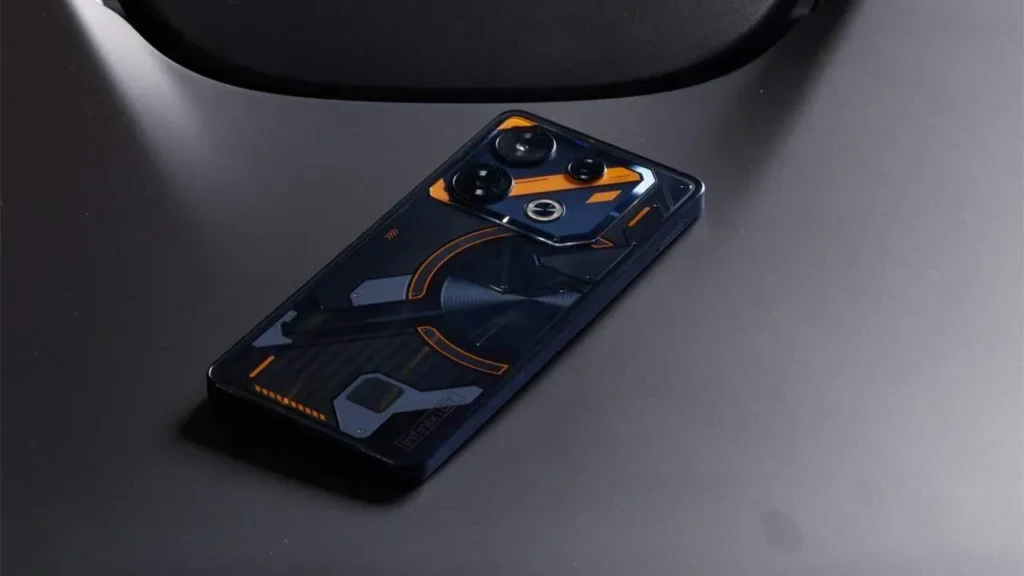
Infinix GT 10s
Infinix GT 10s is presented as a gaming-focused midrange phone that balances fast performance, a bright AMOLED display, and long battery life at a competitive price. Expect aggressive styling, gamer-centric software features, and value-for-money positioning for mobile gamers and power users.
Full specs
Model name: Infinix GT 10s
Launch / announced: (placeholder — e.g., Aug 2023 for GT 10 series reference)
OS: XOS (Android base) — initial build & security patch: (replace)
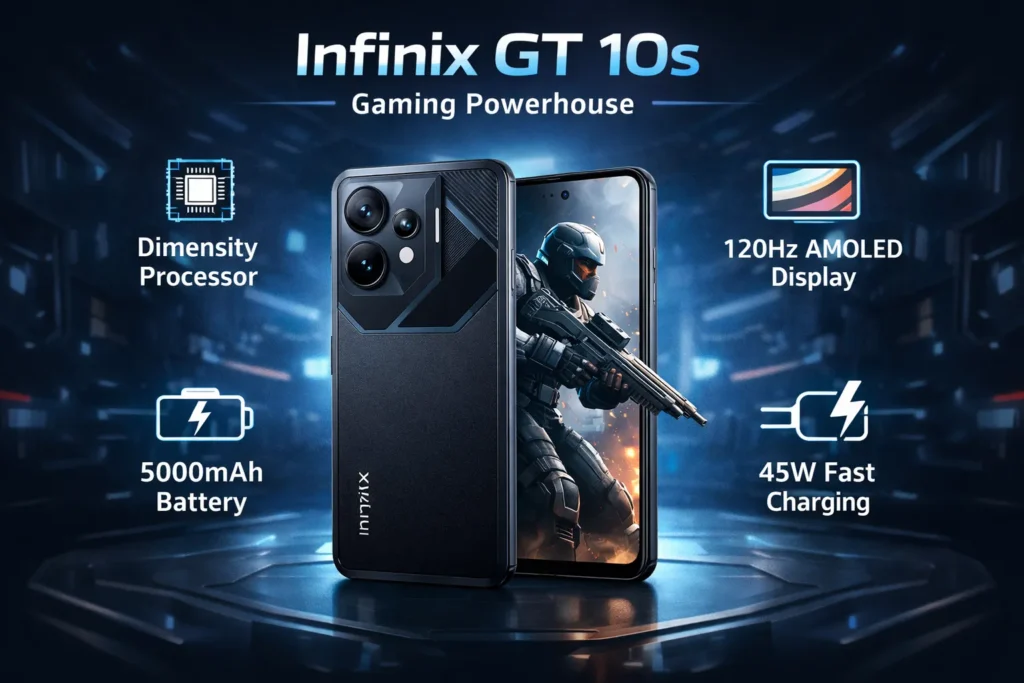
SoC / Chipset: MediaTek Dimensity (example: Dimensity 8050) — replace with official SKU
GPU: (fill from official)
RAM / Storage: 8GB / 128GB (variants: 8/256, 12/256). Expandable via microSD? (confirm)
Display: ~6.67″ AMOLED, 1080×2400, 120Hz (example), HDR support, peak brightness ~900 nits — confirm exact numbers
Rear cameras: 108MP main (wide) + 2MP + 2MP (example) — OIS/EIS: confirm official SKU
Front camera: ~32MP (example)
Battery: 5000 mAh, 45W fast charging (example) — confirm protocol (USB-PD / proprietary)
Connectivity: 5G (selected bands), Wi-Fi 6 optional, Bluetooth 5.3+, NFC (market dependent)
Ports: USB-C (specify USB 2.0 vs 3.x), 3.5mm headphone jack (if present)
Dimensions/weight: (replace)
Colors: Cyber Black / Mirage Silver / region variants — confirm
In-box items: Charger, USB-C cable, SIM tool, protective case (region dependent)
Design & display
Design language
GT-series phones commonly adopt bold gamer aesthetics: large camera islands, chamfered frames or patterned backs, and accent lighting or grill-like textures. Expect ergonomics that balance a large battery and gaming controls while staying pocket-friendly. Materials can range from polished polycarbonate to matte glass finishes, depending on SKU and price.
Display
If the GT 10s follows the GT family, expect an AMOLED display — superior for contrast, battery efficiency with dark modes, and deep blacks. Most GT-line phones ship with 120Hz panels to deliver smooth scrolling and gaming. For buyers: prefer AMOLED + 120Hz for a responsive feeling and gaming advantages.
Practical tips
- Use adaptive refresh (if available) to save battery in casual use.
- Lower resolution from native to 1080p if the phone offers higher for battery savings.
- Enable power-saving profiles during long commutes or prolonged background sync to extend SOT.
Display testing checklist
- Brightness readings at 0%, 50%, 100% (lux meter; record at center).
- Peak brightness in sunlight / HDR mode (nits).
- Color gamut coverage (sRGB & DCI-P3 percentage).
- Average Delta-E (lower is better).
- PWM / flicker frequency & amplitude check (important for users sensitive to flicker).
- Touch sampling rate & latency test (ms) — important for esports players.
- HDR playback test (YouTube Dolby Vision/HDR10 sample).
- Uniformity & backlight bleed check in dark scenes.
Performance and gaming
Expected chipset & performance profile
The GT series targets midrange to near-flagship territory depending on the variant. Expect Dimensity-class SoCs (or comparable Snapdragon midrange chips) tuned for sustained load. Thermal management and software game modes are critical to sustained FPS.
Gaming test checklist
- 30-minute sustained gameplay session in titles like PUBG / BGMI / Call of Duty Mobile at the highest stable settings (record average FPS, min FPS, thermal readings).
- Thermal throttling trace: log CPU/GPU clocks and surface temperature (°C) every 60 seconds.
- Frame-time variance CSV export for long sessions.
- Battery drain during gaming (percent used in 30 minutes at 120Hz).
- Input latency test (tap-to-fire): measure with a high-speed camera if possible.
- Behaviour under charger: performance delta when playing while charging (and whether charging causes thermal throttling).
Memory & storage behavior
- Check extended RAM (if XOS supports virtual RAM) — measure app reload rates and multitask behavior.
- Storage throughput test (random read/write and sequential) to estimate app loading time and texture streaming for games.
Gaming tips for users
- Consider using a light clip cooler for tournaments or marathon sessions.
- Use wired earphones to cut latency for shooters.
- Turn on “game mode” to block distractions and prioritize CPU/GPU.
- Close background sync apps to keep performance stable.
Camera system
What to expect
GT phones often favor high-megapixel sensors with binning to improve Daylight Detail. Without OIS or strong ISP tuning, low-light performance and long-exposure night shots may be average. HDR and AI scene enhancement are common.
Camera testing protocol
Scene list:
- Daylight wide (multiple exposures)
- HDR backlit portrait (sun behind subject)
- Indoor artificial light (warm LED)
- Night street (moving light sources)
- Portrait close-ups (bokeh & subject separation)
- Macro (close focus)
- 2× and digital zoom crops (compare to main sensor crop)
- Ultra-wide (if present)
Capture method
- Save RAW + JPEG for every static test.
- Use a tripod for static scenes; handheld for real-world samples.
- Record EXIF, shooting mode (auto/night/pro), and focal length for each shot.
- Deliver: labeled ZIP of RAWs, 1:1 crops, and a CSV mapping file names to settings.
Video tests
- Stabilization: walk test at 1080p@60 and 4K@30 (if supported)
- EIS/OIS behaviour in day / low-light
- Audio capture quality with internal mic (wind suppression test)
- Rolling shutter & focus hunting under panning
Camera QA outputs
- Full-res photos and RAW ZIP labeled by test scenario.
- 1:1 crops for detailed comparison.
- Short comparison gallery that includes competitor crops for context.
- Editor note: Offering RAW downloads increases transparency and trust.
Battery & charging
Expected battery spec
Many GT lineage devices ship with 5,000 mAh cells and fast charging (30–65W depending on SKU). Confirm official charging wattage and protocol (USB-PD, proprietary pump tech).
Battery test checklist
- Charging curve CSV: log % every minute from 0→100 (include temperature).
- Screen-on-time (SOT) video loop test at 150 nits (loop of local video sample).
- Web browsing SOT (auto-scroll pages with mixed media).
- Gaming drain test: 30-minute gameplay at 120Hz with thermal log.
- Charging temperature monitoring: measure hotspot temperature near the battery and backplate.
- Battery health: run 100 charge cycles and log capacity retention (long-term test suggestion).
Practical battery tips
- Avoid leaving the phone at 100% for long periods; use battery optimization if XOS includes “optimized charge.”
- During heavy gaming sessions, unplug momentarily if temperatures spike above recommended thresholds.
- If the phone heats while charging, remove heavy cases for faster heat dissipation.
Software & updates
XOS
XOS commonly includes gaming modes, performance toggles, and a suite of apps and customizations. Exact version and security patch level must be shown on the page (always include OTA build number and patch date).
What to document in your review
- Exact XOS version + Android base + security patch date.
- Changelog link or summary for first OTA patches.
- Update policy: specify official OS upgrade promises and security update windows; if not published, mark as “unconfirmed” and advise checking official communication.
Connectivity, ports, and sensors
5G bands: Absolutely list exact 5G NR bands per SKU & region — this is a deal-breaker for many buyers. Always map SKU ↔ bands.
Wi-Fi: Note whether Wi-Fi 6 (802.11ax) is present — difference matters for home networks and low-latency gaming.
Bluetooth: Note version (5.2 / 5.3) and supported codecs (SBC, AAC, aptX, LDAC).
NFC & IR: Mark NFC presence per region. Many Infinix releases make NFC optional.
Ports: USB-C spec (USB 2.0 vs USB 3.x), OTG support, and whether the 3.5mm headphone jack remains.
Sensors: Gyroscope (critical for VR & shooters), magnetometer, accelerometer, proximity, ambient light sensor, fingerprint sensor type (in-display optical vs side-mounted), and barometer if present.
Pricing, availability, and buying tips
| Country | MSRP | Common retailer | Date checked |
| Pakistan | PKR XX, XXX | Daraz / Official retail | YYYY-MM-DD |
| India | ₹ XX, XXX | Amazon / Flipkart | YYYY-MM-DD |
| UAE | AED XXX | Noon / Official retail | YYYY-MM-DD |
Buying tips
- Prioritise higher RAM/storage variants for gaming.
- Match 5G bands to your carrier (very important in region-specific markets).
- Prefer official retail channels for warranty & service centre access.
- If camera quality is a priority, request sample photos or test in-store.
- If uncertain, wait for the first OTA patch cycle (often, performance and camera tuning improve after launch).
Comparisons
How to pick rivals: choose phones in the same price bracket and focus: Poco/Redmi or Realme midrange gaming phones typically compete with GT models.
Comparison table:
| Model | Display | SoC | Battery | Standout |
| Infinix GT 10s | 6.67″ AMOLED 120Hz (example) | Dimensity-class (example) | 5000 mAh | Gamer styling & value |
| Poco X5 / Redmi Note (example) | 120Hz IPS/AMOLED | Snapdragon / Dimensity | 5000 mAh | Price/perf value |
| Realme / OnePlus Nord (example) | 120–144Hz AMOLED | Snapdragon / Dimensity | 4500–5000 mAh | Better UI & update policy |
Decision matrix:
- Choose GT 10s if you want gamer styling and battery priority.
- Choosea competitor if OS update policy or camera tuning is a higher priority.
- Choose Poco/Redmi for pure price-to-performance.
Who should buy the Infinix GT 10s
Buy it if:
- You want a gaming-oriented phone with a long battery and a fast AMOLED screen.
- You like bold design and game-enhancing software extras.
- You want the best value/performance within this price band.
Don’t buy if:
- You require long, guaranteed OS upgrades (confirm update policy).
- You need the best-in-class camera available in flagship devices.
- You prefer ultra-light or premium metal/glass flagship ergonomics.
FAQs
A: Yes — it’s designed with gamers in mind: fast refresh display, focused chipset tuning, and game-focused software features.
A: Typical GT models use a 5000 mAh battery.
A: Many GT-line SKUs ship with AMOLED panels — expect an AMOLED if the GT 10s follows that family pattern. Confirm with official specs.
A: This depends on the SKU and market. Many Infinix phones include a 3.5mm jack — check the official spec sheet for your region.
A: Infinix occasionally publishes update promises for certain models.
Conclusion
The Infinix GT 10s is positioned as a value-driven gaming smartphone that blends performance, display quality, and battery endurance into one competitive package. With its expected AMOLED panel, high refresh rate, large battery, and Dimensity-class chipset, it targets users who want smooth gameplay and strong daily usability without flagship pricing. While final judgment depends on confirmed specifications and regional availability, the GT 10s appears ideal for gamers, students, and multimedia users seeking performance on a budget. Before purchasing, verify official specs, 5G band support, software update policy, and camera samples to ensure it matches your long-term needs.
