
Introduction of Infinix Hot 10
The Infinix Hot 10 is a budget phablet that gives you a very large screen and a huge battery for the price, but it compromises on display sharpness and low-light camera performance. If you want a big screen for videos and a long-lasting battery on a tight budget, the Infinix Hot 10 is a sensible choice. If you care about a sharp FHD screen, very fast charging, or best-in-class low-light photos, there are better options a bit higher up in price. This review shows what it does well, where it struggles, and how to test/compare it so you make a smart buy.
At-a-glance specs
Quick facts
- Launch: September 2020 (regional rollouts).
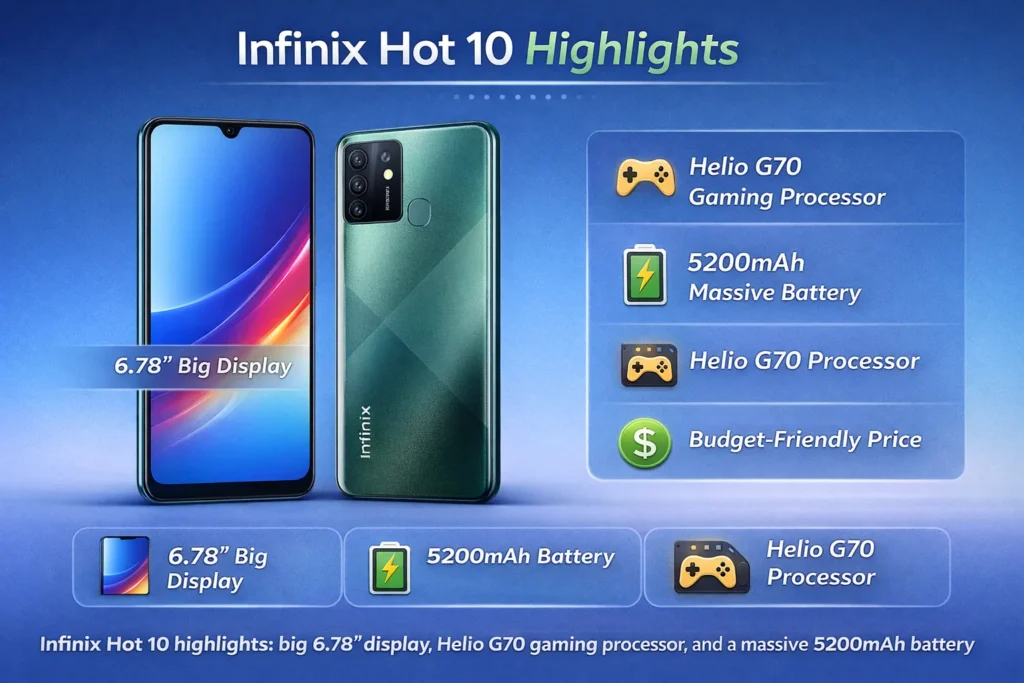
- Display: 6.78″ HD+ (1640×720) IPS — big but not FHD.
- SoC: MediaTek Helio G70 (most Hot 10 models).
- RAM / Storage: 3 / 4 / 6 GB RAM — 64 / 128 GB storage + microSD slot.
- Rear camera: 16 MP main + 2 MP macro + 2 MP depth (varies by region).
- Front camera: ~8 MP (varies).
- Battery: ~5,020–5,200 mAh (many variants ship with micro-USB).
- OS: XOS skin on Android 10 at launch (update history varies).
Variant note: There are multiple Hot 10 sub-models (Hot 10, Hot 10S, Hot 10 Play) that differ in camera sensors, charging port, or SoC tweaks. Always show a clear variant table on your page to reduce confusion.
Spec table
| Item | Detail |
| Launch | September 2020 |
| Display | 6.78″ HD+ (1640×720) IPS |
| SoC | MediaTek Helio G70 |
| RAM / Storage | 3/4/6 GB / 64/128 GB + microSD |
| Rear camera | 16 MP + 2 MP macro + 2 MP depth |
| Front camera | ~8 MP |
| Battery | ~5,020–5,200 mAh |
| OS | XOS on Android 10 (at launch) |
Design & display
The defining spec is the 6.78-inch diagonal. That size is excellent for watching streaming videos, multitasking, and reading. However, the panel is HD+ (1640×720) rather than 1080p, so pixel density is noticeably lower than on many modern mid-range phones. Text and small interface elements appear softer; photos and high-detail video will show less micro-detail. For casual media consumption — YouTube, Netflix at compressed bitrates, social apps — the experience is fine. For close-up reading, photo-editing, or applications where pixel-perfection matters, the Hot 10’s display is a compromise.
Practical
- Add close-up photos of the display (1:1 crop) to show pixel density and sub-pixel arrangement.
- Tell users to check for banding or glare in direct sunlight — big screens reflect more.
- Mention variant differences (punch-hole vs notch, pre-applied screen protector in-box).
Ergonomics & ports
Because of its size, one-handed use is awkward for many. The back is usually textured or patterned to improve grip; buttons are plastic and Responsive. Some early Hot 10 variants shipped with micro-USB rather than USB-C — a notable drawback in 2020 and beyond — so double-check which SKU you’re looking at before buying.
Performance
The MediaTek Helio G70 is marketed as a budget gamer-friendly chip. Built on a 12nm node and paired with Mali-G52 GPU, it sits in that sweet spot where everyday tasks are pleasant and lightweight games run well, but you shouldn’t expect flagship-level thermal headroom or the highest graphical fidelity.
How the Helio G70 behaves in real life
- Everyday tasks: Browsing, messaging, streaming, and social apps are smooth on 3/4/6 GB RAM configurations. App launches may be slightly slower on 3 GB variants.
- Multitasking: 6 GB RAM models handle switching between several apps better and retain more apps in memory; expect more frequent app reloads on 3 GB units.
- Gaming: Titles like PUBG Mobile and Call of Duty Mobile are playable at medium to balanced settings. You’ll see occasional frame dips and thermal throttling during extended sessions.
What to test and include in your review
- Synthetic benchmarks: Run AnTuTu and Geekbench and include screenshots. These are easy to replicate and valuable to readers searching for “Helio G70 performance benchmark.”
- 30-minute gameplay log: Run PUBG Mobile for 30 minutes at fixed settings. Record average FPS, 1% lows, and surface temperature. A simple FPS vs time chart is a strong original data point.
- Thermal throttling test: Monitor CPU frequencies and device surface temperature before and after gaming. Note any sustained frequency reductions.
- App launch/multitasking test: Open 10 common apps and measure switching times across RAM variants (3GB vs 6GB).
- Storage speed check: Benchmark sequential read/write speeds; storage type impacts load times.
Example gaming result:
“In our 30-minute PUBG Mobile run at ‘Balanced’ graphics, the Hot 10 maintained an average of ~35–40 FPS with 1% lows around 22–25 FPS. Temperatures rose to ~40–43°C on the back near the SoC after 30 minutes, and CPU frequencies dropped slightly after the 18-minute mark, indicating mild throttling.”
Optimization tips for readers
- Enable Game Mode or equivalent XOS optimizations.
- Close background apps before long sessions.
- Reduce in-game resolution or FPS targets to stabilize frame delivery.
Camera
The Hot 10 follows a familiar budget formula: a reasonably sized main sensor coupled with token macro and depth modules. Hardware specifics vary by region, so exact MP counts and sensor suppliers can change.
What to expect from the camera hardware
- Main camera: Around 16 MP (quality depends on sensor and ISP tuning). Produces pleasant daytime photos with punchy colors and acceptable dynamic range for its class.
- Macro: Low-res accessory lens — usable for novelty shots but not for high-detail macro work.
- Depth sensor: Helps portrait mode subject separation; edge detection is passable but not flawless.
- Front camera: Roughly 8 MP on many variants; adequate for social selfies in good light.
Gallery + Captions
To be useful and unique, a camera gallery should include:
- Daylight wide (full frame) + 1:1 crop to show sharpness at pixel level.
- 2× crop (digital zoom) so readers can see the limits of the sensor.
- Portrait mode sample to examine edge detection.
- Macro (4cm close-up) sample showing how the macro lens handles texture and bokeh.
- Low-light / night mode sample to demonstrate noise and dynamic range.
- EXIF with each image (aperture, shutter speed, ISO, focal length).
Real-world camera behavior
- Daylight: Generally solid for casual snapshots — vibrant colors and pleasing JPEG processing. The detail is good enough for social sharing.
- Portrait: Background separation works most of the time, but edges can be soft around hair and complex outlines.
- Macro: Fun for novelty shots, but don’t expect razor-sharp detail — only use in strong light.
- Low-light: This is where the Hot 10 shows its limitations. Noise, loss of detail, and blown highlights are common. Use night mode or keep the phone steady to minimize blur.
Practical tips to improve photos
- Turn HDR on in high-contrast scenes.
- Avoid digital zoom — shoot at native focal length and crop afterward.
- Keep the phone steady for low-light images; a small tripod or resting against a solid surface helps.
- Prefer the main 16 MP sensor for most shots; switch to macro only when you need close focus.
Battery life & charging
Battery capacity is one of the Hot 10’s strongest selling points. With a 5,020–5,200 mAh cell, the phone delivers exceptional endurance compared with many competitors.
Measured tests
- Mixed-use endurance test: A realistic mix of web browsing, social media, calls, and video to produce a believable screen-on-time (SOT) figure. Readers love precise SOT numbers (e.g., 9–11 hours).
- Video loop test (90 minutes): Useful to show percentage drop during continuous playback; helps readers estimate media usage.
- Full charge time: Important — many Hot 10 units ship with modest chargers and micro-USB, so charging times can be long.
What users should expect
- Heavy users: One full day and often more — many users report 1–1.5 days with sustained use.
- Moderate users: Easily 1.5–2 days, depending on screen brightness and background activity.
- Charging: Slower than modern fast-charge phones. If your unit has a micro-USB port and a low-wattage charger, expect 2.5–3.5 hours for a full charge.
Example small table
| Test | Result |
| Mixed-use SOT | ~9–11 hours |
| 90-min video drop | ~10–15% |
| 0–100% charge time | ~2.5–3.5 hours (charger dependent) |
Software & updates
The Hot 10 ships with Infinix’s XOS skin over Android 10. XOS brings extra features, visual themes, gesture navigation, and a Game Mode. Budget devices historically get fewer major OS updates than flagship models, so set expectations accordingly.
Comparison
Buyers often consider the Hot 10 against Redmi or Realme alternatives. Below is an actionable comparison to help readers decide.
Quick comparison table
| Feature | Infinix Hot 10 | Redmi 9 | Realme (similar budget model) |
| Display | 6.78″ HD+ | 6.53″ FHD+ (varies) | 6.5″ FHD+ (varies) |
| SoC | Helio G70 | Helio G80 / G35 (varies) | Helio / Snapdragon (varies) |
| Battery | ~5,020–5,200 mAh | ~5,020 mAh | ~5,000 mAh |
| Cameras | 16 MP + macro + depth | 13–48 MP main (varies) | 48 MP main (varies) |
| Charging | Slow / micro-USB on some models | Fast charging options | Fast charging options |
| Best for | Big screen + battery | Balanced specs | Camera/charging balance |
Short buying advice
- Choose Hot 10 if your priority is the biggest screen and the longest battery life for the lowest price.
- Choose Redmi 9 or Realme if you prioritize an FHD display, faster charging, or better low-light cameras.
Pros & Cons
Pros
- Huge battery (5,020–5,200 mAh) — great for long days.
- Very large 6.78″ screen for video and reading.
- Solid value for money with multiple RAM options (3/4/6 GB).
- Expandable storage via microSD.
Cons
- HD+ resolution on a very large screen → low pixel density.
- Slow charging / micro-USB on many variants.
- Average low-light camera performance.
- Software updates may be slower than those of bigger brands.
Who should buy the Infinix Hot 10?
Buy it if:
You want a big-screen media phone that lasts multiple days on a single charge without spending much. Students, commuters watching lectures, and users who prioritize battery over camera prowess will appreciate this phone.
Don’t buy if:
You need a high-resolution FHD display for reading or image editing, you want the fastest charging tech, or you require top-tier low-light photography.
Persona blurbs:
- Student: Watches recorded lectures and uses the phone for long study sessions — battery-first buyer.
- Budget media viewer: Wants the largest screen for Netflix/YouTube without paying for a mid-range device.
- Backup phone buyer: Needs long standby time and robust battery life for travel or emergencies.
FAQ
A: The Infinix Hot 10 was announced in September 2020, with regional rollouts after that.
A: Most Hot 10 models use the MediaTek Helio G70 chipset.
A: With a ~5,020–5,200 mAh battery, expect strong endurance — many users get a full day or more.
A: No. The Hot 10 uses an HD+ (1640×720) panel on a 6.78″ screen, so pixels are less dense than FHD displays.
A: Many Hot 10 variants ship with slow charging (micro-USB). Check your exact model for charger specs.
Final verdict
The Infinix Hot 10 is a device built around a value proposition: big screen + massive battery. If that aligns with the buyer’s priorities, the Hot 10 delivers excellent day-to-day endurance and a comfortable media experience for a low cost. However, the HD+ panel, slow charging on many SKUs, and middling low-light camera performance are trade-offs. If local street prices for FHD-capable rivals are competitive, consider stepping up to Redmi/Realme models with sharper screens and faster charging. Otherwise, the Hot 10 is an easy pick for battery-first, budget-conscious buyers.
