
Introduction
Should you desire a low-cost smartphone with a superb screen size and extended battery life, one of the contenders is frequently the Infinix Hot 11i, which is frequently a great value option in the locations where it is sold. It comes in various regional configurations and, again depending on the list, with a large screen (approximately 6.7-6.95”), a MediaTek G-series chipset (reportedly as Helio G80 / G85 / G88), and a 5,000 mAh battery. Display resolution, camera sensor, and SoC may vary by SKU, so ensure that one knows the specific one before proceeding with publication or purchase.
Quick specs table
| Field | Typical / Reported value | Notes & what to verify |
| Model name | Infinix Hot 11i | Many listings use “Hot 11i”; some stores conflate it with the Note 11i family. |
| Display | ~6.78″–6.95″ IPS LCD — HD+ or FHD+ (varies) | Some SKUs list 720×1640; others 2460×1080. Confirm exact resolution and PPI per SKU. |
| SoC (reported) | MediaTek Helio G85 / G80 / G88 (region-dependent) | Different markets show different G-series chips — match benchmark results to exact SKU. |
| RAM | 3GB / 4GB / 6GB (options) | Confirm local SKU. |
| Storage | 32GB / 64GB / 128GB + microSD | Expandable storage typical. |
| Rear camera | 16MP / 48MP main + auxiliary depth/macro (varies) | Many variants differ; check EXIF from sample images. |
| Front camera | ~8MP | Varies slightly by listing. |
| Battery | 5,000 mAh | Consistently reported across sources. |
| Charging | Standard — check claimed wattage per box | Some Infinix phones use 18W–33W; confirm included charger. |
| OS / UI | Android 11 + XOS 7.x (varies) | XOS adds Game Mode, RAM Care, and other features. |
| Connectivity | 4G LTE (bands vary) | List exact bands for your market. |
| Ports | USB-C is often present; a 3.5mm headphone jack is usually present | Confirm per SKU. |
| Dimensions/weight | ~171 × 77 × 8.5–9 mm; ~195 g | Slight variations by version. |
Design & Display
Why design & display matter for conversion
Shoppers scan hero images, size-in-hand photos, and the display spec first. If the screen is quoted as FHD+ in one SKU but HD+ in another, buyers will notice the difference in sharpness and perceived value — and returns or complaints increase when affiliate links don’t match the SKU shown.
What to include in the design section
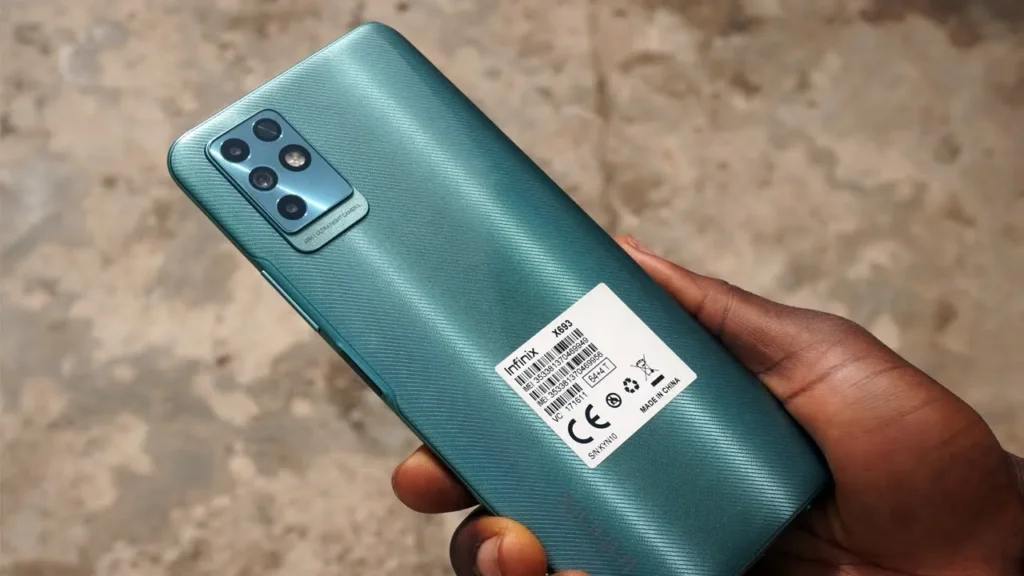
- Hero images: Front, back, camera module, ports, and a scale photo (phone in hand). Use alt text like: Infinix Hot 11i front view — 6.78-inch display, slim bezels.
- Material & finish: Most budget Infinix phones use plastic (polycarbonate) backs and frames; call this out.
- Color options: list official color names per market (e.g., Obsidian Black, Morandi Green, Ocean Wave) and supply thumbnail swatches.
- Ergonomics: Note size, weight, and how the rounded edges feel in-hand.
Display testing checklist
- Peak brightness (nits): measure with a light meter to report outdoor readability.
- Color accuracy: photograph color charts and, if possible, report sRGB / DCI-P3 coverage.
- Resolution verification: record the display’s exact pixel count — HD+ vs FHD+ changes PPI and buyer expectations.
- Refresh rate: document whether the panel is 60Hz, 90Hz, or higher.
- Touch latency & responsiveness: use sample touch latency apps or timed tests.
Include a small table summarizing measured brightness, PPI, and refresh rate for the unit you tested. If multiple SKUs exist, show a second row for alternate configurations and list sources.
Performance & benchmarks
Searchers who type “Infinix Hot 11i review” expect numbers and real-world logs. Because the Hot 11i family contains different SoCs in different regions, it’s critical to match each benchmark result to the tested SKU.
Tests to collect
- Geekbench (single-core / multi-core) — run 3× and report the mean.
- 3DMark / GFXBench — Wild Life or comparable for GPU performance.
- AnTuTu (optional; note version) — include version and date.
- Thermal throttling: run a 30-minute stress test; log CPU clocks, temperature, and % throttle every 5 minutes.
- Real-game logs: test PUBG Mobile / COD Mobile at pre-defined settings (Low / Medium / High); record average FPS, minimum FPS, and stutter occurrences.
- Storage speed (if relevant): read/write benchmarks for internal eMMC/UFS storage.
Methodology notes:
- Run all tests in a controlled environment (20–25°C ambient).
- Use airplane mode (or consistent network conditions) for repeatability.
- Use the same charger and cable for battery-influenced tests.
- Log screenshots and test start/end timestamps for transparency.
Battery & charging
Battery life is a primary buying driver in the budget Segment. The Hot 11i family’s 5,000 mAh capacity is a headline spec, but real-world runtime changes with resolution, SoC efficiency, and refresh rate.
- Video loop runtime: standardize a 1080p loop at 50% brightness (or 120 nits) and report hours: minutes.
- Screen-on time (SOT): report SOT over mixed use (social apps, web browsing, 30-min video, some light gaming).
- Charge curve: record times for 0→25, 0→50, 0→80, and 0→100 using the included charger and a widely used third-party charger.
- Battery health & temperature: note any abnormal heat or fast-draining apps.
Typical expectations
With a 5,000 mAh battery, most Hot 11i units will deliver strong endurance (day-plus usage in mixed scenarios). Higher-resolution FHD+ and 90Hz panels will reduce SOT compared to HD+ 60Hz variants, so always tie runtime results to the tested SKU.
Cameras
Because the Hot 11i has differing camera sensors across regions (some list 48MP, others 16MP), include camera EXIF proof and full-size samples to avoid confusion.
Camera test plan
- Daylight: 5 scenes — wide landscape, mid-tele, close-up, portrait, HDR backlit.
- Low-light: indoor dim light, streetlamp shots, and extreme low-light scenes.
- Portrait: 2 subjects at different distances; evaluate bokeh rendering and edge detection.
- Macro / Ultrawide: test if the SKU includes those lenses.
- Video: 1080p at device’s highest supported fps; check electronic stabilization.
- Selfie: daylight and indoor.
Camera assets to include with your review
- Full-size JPEGs (6–12 images) with EXIF intact for transparency.
- 1:1 crops with annotated detail/noise comparisons.
- Camera scorecard: Daylight / Night / Portrait / Video scores and a visible rubric.
- Downloadable ZIP with RAW/JPEG samples for power users and other reviewers.
Software, updates & support links
OS details and update cadence shape long-term user satisfaction more than spec sheets.
What to document
- OS / UI: the Hot 11i generally ships with Android 11 and XOS 7.x on many SKUs; cite specific build numbers.
- Security patch level: show the exact date from Settings.
- OTA history: link to regional Infinix support pages or release notes if available.
- Preinstalled apps & bloatware: list common preloaded applications and whether they are removable.
Comparison
| Model | Display | SoC | RAM / Storage | Rear main | Battery | Price tier |
| Infinix Hot 11i | 6.78–6.95″ (HD+/FHD+) | Helio G85 / G80 / G88* | 3–6GB / 32–128GB | 16–48MP | 5,000 mAh | Budget |
| Infinix Hot 11 (base) | 6.7″ HD+ | Unisoc variant | 4GB / 64GB | 13MP | 5,000 mAh | Budget |
| Infinix Note 11i | 6.95″ FHD+ | Helio G85 | 4 / 64 | 48MP | 5,000 mAh | Budget-plus |
| Competitor (e.g., Redmi/POCO entry) | ~6.5–6.7″ | Snapdragon/MediaTek | 4 / 64 | 48MP | 5,000 mAh | Budget |
Buying advice
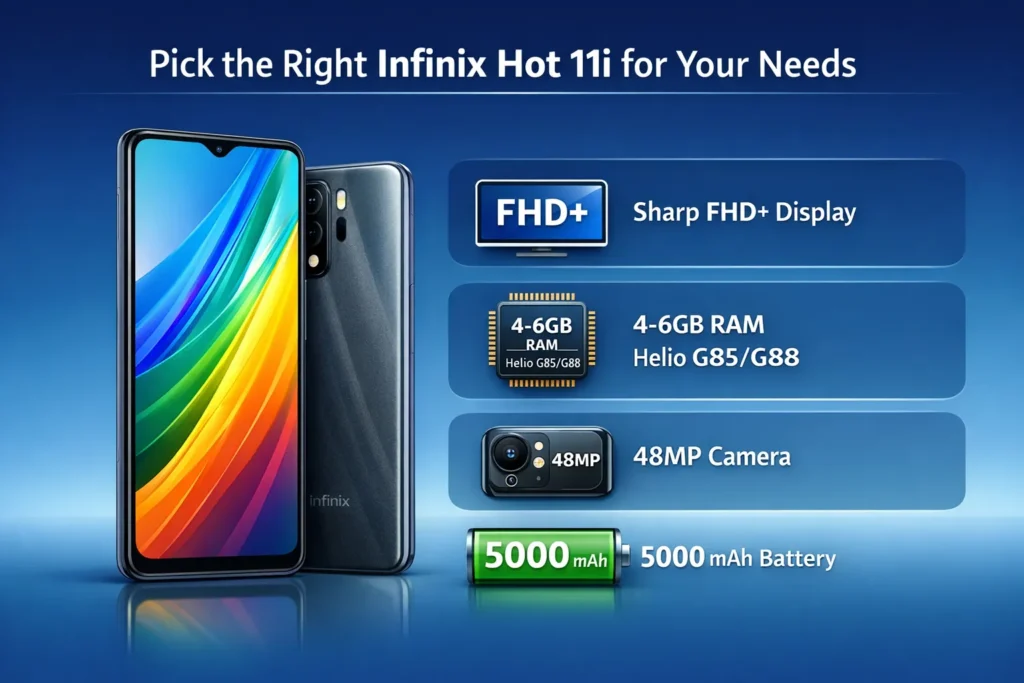
- Best for video & sharp text: choose the SKU that lists FHD+ resolution (confirm before purchase).
- Best for light gaming & smoother UI: pick higher RAM (4–6GB) and, if available, the stronger SoC (G88/G85 preferred).
- Best for photos: choose a SKU with a 48MP main sensor and verify via EXIF/Sample Images.
- Best for battery-focused users: any 5,000 mAh SKU will be competitive; prefer HD+ and 60Hz for the best SOT.
FAQs
The Hot 11i is a budget phone commonly reported with a ~6.7–6.95″ LCD, MediaTek G-series chipset, 3–6GB RAM, and a 5,000 mAh battery; specs vary by region.
For light to moderate gaming, it’s fine — test results depend on the exact SoC and RAM. Expect mid-range performance on G85/G88 SKUs.
With a 5,000 mAh battery, a typical mixed-use SOT often reaches a full day or more. Real numbers depend on screen resolution and chipset.
Some regional variants list a 48MP main sensor; others list lower-resolution sensors. Check EXIF/sample photos for confirmation.
Pick the SKU with FHD+ if you want a sharper display, higher RAM for gaming, and the 48MP sensor if photography matters.
Conclusion
Infinix Hot 11i is a good choice of a budget smartphone–when you choose the right one. The large display, trusted progressive battery of 5,000 mAh, and adaptable pricing are its strongest points, making it a good option for an average user who prioritizes screen size and battery life over high-end phone performance. Nonetheless, this cannot be considered a universal phone: the display resolution, chipset, and camera hardware can differ depending on the region, and these differences make a significant impact on performance, sharpness, and battery life. A variant with FHD+ provides better clarity of texts and video, a 4-6GB RAM with Helio G85/G88 is easier to multitask and play, and a 48MP camera SKU is more camera-focused. Most of the variants will be satisfying to battery-oriented users, including HD+ 60Hz models that maximize screen-on time.
