
Introduction
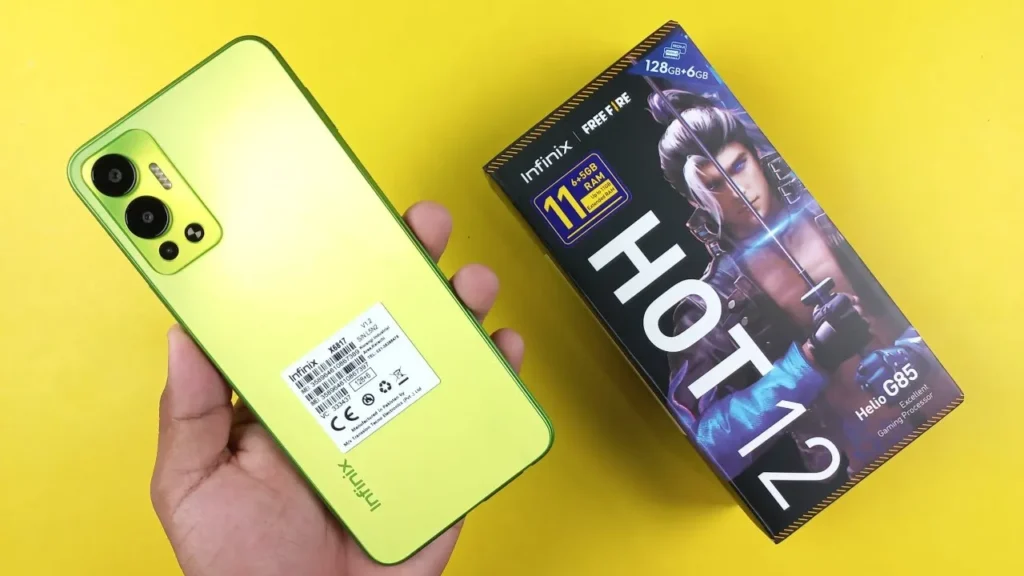
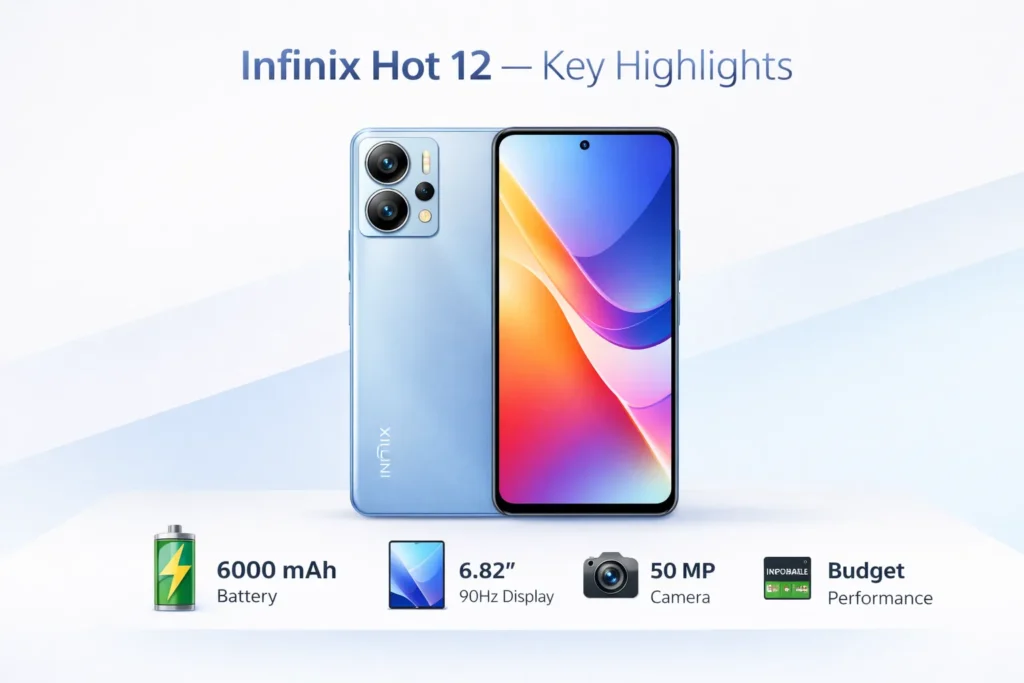
Infinix Hot 12 gives you a huge 6000 mAh battery, a 6.82″ 90 Hz display, and expandable storage at a low price. If battery life and smooth scrolling matter most, this is a smart buy. If you want a crisp 1080p screen, top camera, or high-end gaming, look at alternatives from Redmi or Realme.
Key specs
- Launch date: August 17, 2022
- Display: 6.82″ HD+ (~720×1612), 90 Hz refresh
- SoC / Chipset: Varies by SKU — Helio G37, Helio G85 or UniSoc T616 in some regions
- RAM / Storage: 4 / 6 GB RAM, 64 / 128 GB storage, microSD support
- Rear Camera: 50 MP main (varies by market)
- Front Camera: ~8 MP selfie
- Battery: 6000 mAh
- OS: XOS over Android 11/12 (depends on region)
- Extras: Headphone jack, IR, dedicated microSD tray
Why this review matters
Think of this review as an evaluation script for a model: it inspects the architecture (hardware), training data (firmware/software), inference speed (performance), and generalization (battery life under different workloads):
- Design & comfort — ergonomics and build (how it feels and how robust it is)
- Display — what 90 Hz means practically on an HD+ panel
- Performance — realistic expectations across SKUs with recommended benchmarks to include
- Battery — real-life endurance and charging behavior (actionable test outputs)
- Camera — sample types and pitfalls (day vs night)
- Software — XOS quirks, bloatware,e and update expectations
- Who should buy — buyer personas and alternatives
Design & build
The Hot 12 is a large-form-factor device: 6.82″ screen and a 6000 mAh battery yield a tall, broad chassis. This is the equivalent of a heavy but high-capacity transformer model — great throughput at the cost of portability.
- Good: surprisingly light for a 6000 mAh device, with a textured plastic back that reduces slips (tactile grip).
- Bad: thicker than many 5000 mAh rivals; not a one-handed phone for most users.
- Practical tip: use a slim (thin, svelte) case instead of a bulky one — maintain grip without adding excessive bulk.
Build materials & durability.
- The device uses plastic frames and a plastic back — think of robustness and shock tolerance prioritized over premium glass. That’s like favoring robustness of older models for edge deployment rather than premium labs where aesthetics (glass, metal) matter.
Photos & assets to include
- Hero lifestyle shot (someone holding the phone)
- Close-up of the camera island
- Thickness comparison shot with competitor (e.g., Redmi / Realme)
- MicroSD / SIM tray image
Display
A 90 Hz panel gives smoother UI motion and scrolling than a 60 Hz panel. In NLP terms, it reduces jitter and improves temporal coherence when rendering sequences. However, the panel is HD+, not FHD; so the spatial resolution (token granularity) is lower — small text and fine UI elements will appear softer than on 1080p panels.
Good for:
- Smooth scrolling and social feeds
- Casual gaming where frame rate matters more than image crispness
- Video streaming (YouTube, upscaled)
Not great for:
- Reading ultrasmall text for long sessions (higher PPI preferred)
- Scrutinizing high-detail photos (softness noticeable)
Measurements:
- Brightness (cd/m²) — indoors & outdoors
- Color accuracy (ΔE) — lower is better
- Contrast ratio & black level
- PPI (roughly calculated from 6.82″ HD+)
Performance
Because the Hot 12 ships with different SoCs by region, you must treat each SKU as a different model checkpoint. Always declare which SKU you tested.
SoC families & implications
- Helio G37 (base): good for day-to-day tasks, light apps, and casual gaming. Efficient but not a performance monster.
- Helio G85 / UniSoc T616 (Play / Pro-ish regions): stronger for sustained gaming and heavier workloads. Better GPU throughput and often less thermal throttling over time.
Benchmark suggestions:
- AnTuTu total score — overall synthetic performance
- Geekbench — single-core & multi-core CPU measures
- 3DMark / GPU test — GPU throughput if available
- Real-world tests — app cold/warm launch times, multi-app switching latency
Testing conditions: Battery %, background app list, and ambient temperature — these improve reproducibility.
Gaming: a 20–30 minute gaming session with logged FPS vs time is valuable content.
Gaming expectation table:
| Game | Settings | Expected FPS (Helio G37) | Expected FPS (G85 / T616) |
| PUBG Mobile | Low / 30 FPS cap | 25–35 | 35–45 |
| Free Fire | Medium | 30–40 | 40–55 |
| COD Mobile | Low | 18–28 | 28–35 |
Battery life
The 6000 mAh battery is the phone’s standout — think of it as an extended context window allowing many operations between recharges.
Recommended tests:
- Video loop at 120 nits (hours)
- Web browsing SOT (hours) — simulated browsing via scripts on Wi-Fi
- 60-minute gaming drain — percentage drop in battery after one hour at fixed settings
- Charging curve: minutes to 10%, 30%, 50%, 80%, 100%
- Standby drain overnight test
Typical real-world results
- Light use: 1.5–2 days (social, calls, occasional streaming)
- Moderate use: full day + evening; 6–8 hours SOT likely
- Heavy use (gaming + streaming): faster drain, but still comparatively better than many 4,000–5,000 mAh phones
Charging behavior
Most Hot 12 SKUs come with modest fast-charging (varies 18W–33W). With a 6000 mAh cell, full recharge times on lower-watt chargers will be longer — often over 90 minutes on slower chargers. Plot the charging curve and publish times to important milestones (0→50%, 0→100%).
Cameras
A 50 MP main sensor looks tempting on spec sheets, but image quality depends heavily on ISP and software tuning — in other words, the post-processing model. On budget SoCs, denoising and sharpening algorithms often trade detail for smoother photos.
On-paper vs real life
- Daylight: good for social sharing; acceptable sharpness and color rendering. HDR works, but it can look processed.
- Indoor/low light: expect noise and detail loss due to aggressive denoising and limited optical throughput. Night mode (if present) helps but is not a miracle worker.
- Portraits: software-driven bokeh; edge detection is decent in good light but may struggle with complex edges.
- Ultra-wide / macro: availability and quality vary by SKU; many regions ship without an ultrawide.
- Video: typically 1080p@30fps with modest electronic stabilization.
Camera assets:
- Full-res daylight sample
- Indoor sample
- Low-light/night sample
- Portrait sample + 2× crop
- Ultra-wide (if present)
- EXIF + settings for each sample (aperture, shutter, ISO)
- Video clips for stabilization tests
Software & updates
XOS is the skin over Android; it brings extra features but also many preinstalled apps (bloatware). In model terms: vendor-added utilities and Telemetry components.
What to expect
- Bloatware: Several vendor apps are included; some can be disabled from settings, but others require an ADB uninstall to be removed fully.
- Update policy: Infinix is a budget OEM; OS upgrades are inconsistent across SKUs. Don’t assume guaranteed multi-year Android version updates.
- Security patches vary by region and SKU — check the build information in settings.
Hot 12 vs Hot 12 Play vs Hot 12 Pro
Make an expandable comparison table on mobile so readers can pick the SKU they own.
| Model | Typical SoC | Battery | Best for |
| Hot 12 (base) | Helio G37 | 6000 mAh | Battery-first shoppers |
| Hot 12 Play | Helio G85 / T610 | 6000 mAh | Better gaming value |
| Hot 12 Pro | UniSoc T616 (some regions) | 5000–6000 mAh | Balanced performance (region-specific) |
Alternatives to consider
If you’re choosing in this price bracket, consider:
- Redmi / Xiaomi: often better screen resolution (1080p)
- Realme / Poco: sometimes stronger SoC and better cameras
- Samsung A-series: cleaner software and wider update support in some markets
Rule-of-thumb: pick Hot 12 for battery life and price. Choose Redmi/Realme if you prefer sharper displays and better imaging.
Pros & Cons
Pros
- Massive 6000 mAh battery for long days
- 90 Hz panel for smoother UI interactions
- Dedicated microSD slot for storage expansion
- Low cost for core features
Cons
- Large HD+ screen shows softness with dense text and fine detail
- SKU variance means inconsistent performance across regions
- Average low-light camera performance
- XOS includes bloatware and an uncertain update policy
FAQs
A: Casual games run fine. Heavy games need reduced graphics on the base Helio G37.
A: Yes. The phone has a 90 Hz refresh rate on a 6.82″ HD+ panel.
A: Ships with XOS over Android 11 or 1,2 depending on region. Check the box or settings for the exact build.
A: It produces usable shots, but expect noise and lost detail compared with higher-end sensors.
A: Buy Hot 12 for battery and value. Choose Redmi/Realme for sharper screens or better cameras.
Final verdict
The Hot 12’s battery (6000 mAh) and 90 Hz smoothing are strong value points, especially at its price. The HD+ resolution on a large 6.82″ panel reduces PPI and makes fine details look soft. Performance varies by SKU — always check model code before publishing a definitive verdict. For battery-first buyers, the Hot 12 is a solid 7. If you prioritize camera fidelity or screen crispness, consider alternatives from Redmi or Realme.
