
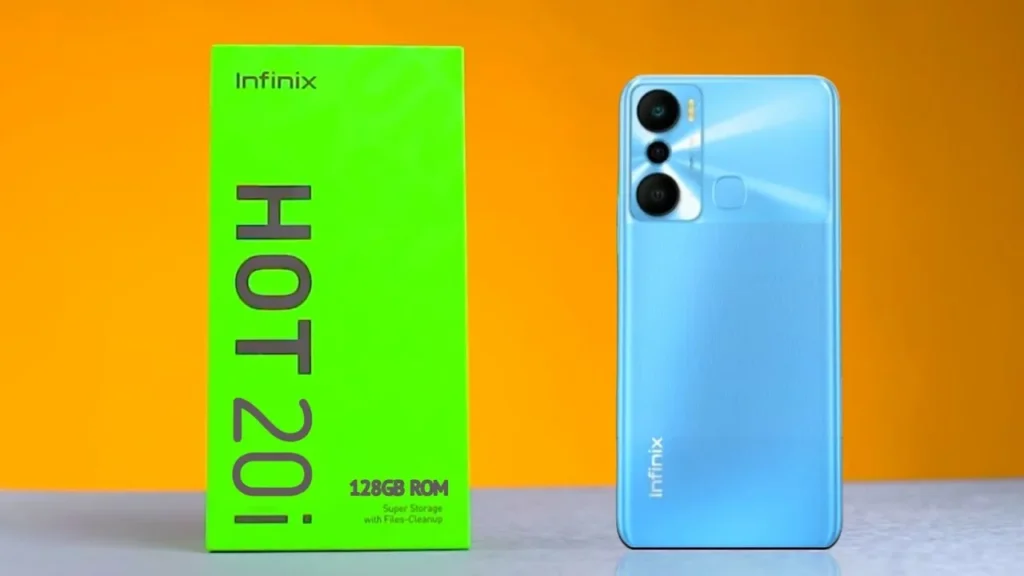
Introduction of Infinix Hot 20i
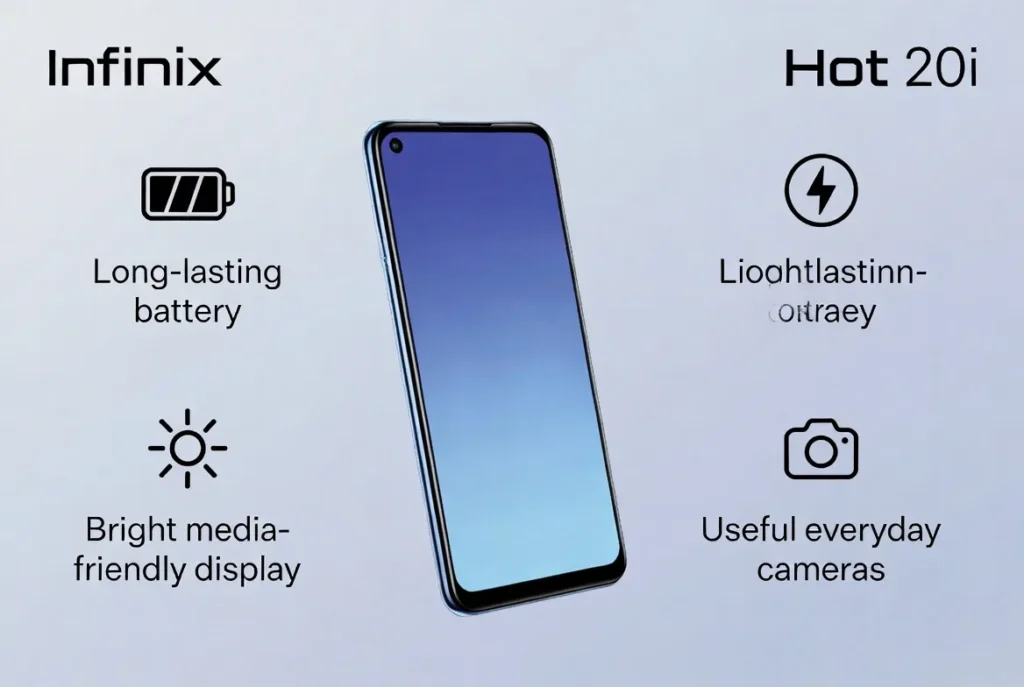
Infinix Hot 20i is a smartphone created to suit customers who desire to save money by having a reliable daily phone. It addresses the features that are the most important at this price: a big, comfortable screen to view media, a battery that lasts one day (or more), and easy-to-use cameras that can tackle casual photography. This guide is divided into the real-life strengths and weaknesses of the Hot 20i, its specifications, performance, camera, battery life, price, and comparisons, so you can instantly decide whether the phone will fit your budget or not.
Full Specs
| Field | Value |
| Model | Infinix Hot 20i |
| SoC (chipset) | Manufacturer listed chipset — (e.g., MediaTek / Qualcomm — confirm) |
| CPU | CPU cores and clock |
| GPU | GPU model |
| RAM options | e.g., 4GB / 6GB |
| Storage options | e.g., 64GB / 128GB |
| Expandable | microSD yes/no |
| Display | size, resolution, panel type (AMOLED / IPS), refresh rate |
| Peak brightness | nits (manufacturer claim) |
| Main camera | MP + aperture + sensor (if available) |
| Selfie camera | MP + aperture |
| Battery | mAh + charging wattage (in-box) |
| OS / UI | Android version + XOS version |
| Dimensions / Weight | mm / grams |
| Colors | list |
| Price (launch) | local currency |
| Official page | manufacturer product URL |
Design & Build
The Hot 20i is generally dressed in a sleek, contemporary style: one with slim bezels, either a matte or a glossy back out of plastic, and a hole or a slight notch cut in the back to house the selfie camera. The phone is designed to appear well-polished at a cost less than that of the luxury materials. Expect practical decisions — a plastic frame and back for resilience, a comfortable rounded edge for everyday holding, and a camera module that’s noticeable but not overbearing. If the marketing sheet doesn’t list glass protection, plan to apply a screen protector as a precaution.
Practical design
- Headphone jack: Many budget Infinix models include a 3.5mm jack — handy if you use wired headphones.
- Fingerprint sensor: Could be side-mounted (power button) or on the rear. Some variants might offer face unlock.
- SIM tray: Check if it’s a dedicated dual-SIM + microSD slot or a hybrid. Dedicated slots are better for storage expansion, plus two SIMs.
- Ports: Prefer USB-C over micro-USB — USB-C is more future-friendly and supports faster wired charging/transfer.
Display
Key display terms
- Resolution: Higher numbers mean crisper text and images. Full HD (1080p) is ideal on 6.4–6.8″ screens.
- Panel type: AMOLED gives deep blacks and punchy colors; IPS is accurate and reliable, but with less contrast.
- Refresh rate: 60Hz is standard; 90Hz/120Hz feels smoother while scrolling or gaming.
- Peak nits: Bigger brightness numbers help outdoors.
How to test the display in stores
- Open a bright website to see if the screen washes out in sunlight.
- Play a fast-moving video to check motion clarity.
- Inspect blacks — AMOLED shows deep blacks, IPS can look slightly gray.
- Scroll quickly to check touch responsiveness.
Performance
What the SoC and RAM mean in simple words
- SoC (chipset): The phone’s brain. Budget SoCs handle chatting, streaming, and social apps well; demanding 3D titles will slow down unless settings are lowered.
- RAM: 4GB works for basic usage; 6GB+ gives smoother multitasking.
- Storage type: UFS is faster (apps load quicker) than eMMC — check the spec.
Real-world expectations
- Daily apps (social, browsing, streaming): Smooth and pleasant for routine tasks.
- Heavy gaming: Expect to disable some visual effects for playable frame rates.
- Multitasking: Depends on RAM; 4GB may struggle with many tabs or apps open at once.
Cameras
Camera feature checklist
- Main sensor MP: Higher MP helps daylight detail, but isn’t everything for low-light.
- Sensor model: If specified (Sony, OmniVision), list it for credibility.
- Stabilization: OIS (optical) or EIS (electronic) stabilizes video. OIS is rare at this price.
- Video caps: Note max resolution and frame rate (e.g., 1080p@30/60).
- Modes: Night, Portrait, Pro, Ultra-wide, Macro — call out which modes exist and how they work.
Battery & charging
What to look for
- Capacity (mAh): More mAh usually means longer battery life.
- Charging wattage: Fast charging reduces downtime—note whether a fast charger is included.
- Charging protocol: PD (USB Power Delivery) or proprietary standards matter if you use third-party chargers.
Recommended battery tests for content
- Screen-on-time averages (e.g., 6–9 hours is typical for strong battery phones).
- Charge tests: 0→50% and 0→100% times (report temperatures).
- Day-to-day log: Track a typical day (social, navigation, photos, streaming).
Software & updates
What to check
- Android base version and Infinix’s XOS skin version.
- Security patch level at the time of review.
- Official update policy — number of promised major Android versions and security updates.
Connectivity & extras
Important items to list
- Wi-Fi standard (e.g., 802.11ac).
- Bluetooth version.
- NFC (for contactless payments) — yes/no.
- IR blaster — useful as a remote.
- GPS systems (A-GPS/GLONASS/Galileo).
Hot 20i vs Competitors
Replace Rival A/B with specific models you want to compare.
| Feature | Infinix Hot 20i | Rival A | Rival B |
| Price (approx) | TEMPLATE | TEMPLATE | TEMPLATE |
| Display | size/panel/refresh | ||
| SoC | chip name | ||
| Main Camera | MP + stabilization | ||
| Battery | mAh + charging | ||
| Best for | Value / Battery / Display | Gaming | Camera |
Pros & Cons
Pros
- Good value for money.
- Likely long battery life.
- Comfortable display for media.
- Good for daily tasks and social apps.
Cons
- Not a flagship — limited gaming power.
- Software update policy may be short.
- Camera low-light results may be average.
FAQs
A: See the canonical specs table above. Important items to confirm: chipset, RAM, storage, battery, and camera specs on the official product page.
A: Battery life varies with use. Expect strong screen-on time for typical use (social + video). For exact numbers, see our battery test (0→50, 0→100 results) in the article once tests are available.
A: Many budget Infinix models include a 3.5mm jack. Confirm with the in-box contents list and official specs.
A: Colors and region availability vary. Check the official product page and local retailers.
A: Manufacturer update policy varies by model and region—check the official policy on the brand website.
Conclusion
The Infinix Hot 20i delivers exactly what budget buyers expect: long battery life, a comfortable, large display, and dependable everyday performance at a low price. It’s well-suited for calls, messaging, social media, video streaming, and casual photography, making it a sensible choice for students, first-time smartphone users, or anyone upgrading on a tight budget. That said, if your priorities include heavy gaming, advanced low-light photography, or long-term software updates, you’ll want to look at higher-tier alternatives.
