
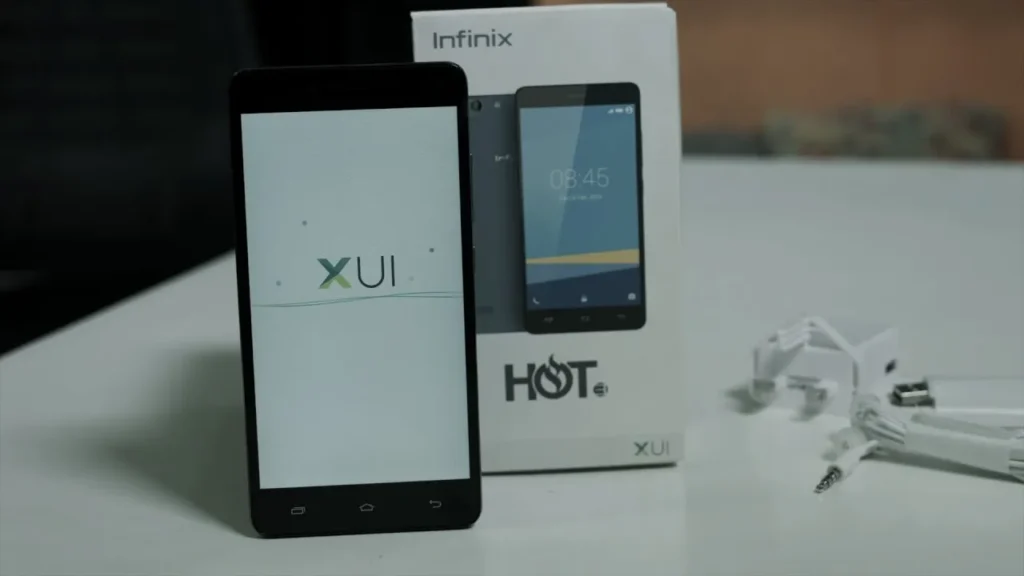
Introduction of Infinix Hot 3
If you’re looking for a straightforward answer, the Infinix Hot 3 aims to be a budget phone that prioritizes long battery life and usable daily performance, all without a large price tag. It’s ideal for people who need extended runtime, a roomy display for media and social apps, and a straightforward interface. Avoid it if you demand class-leading camera results, ultra-smooth high-end gaming, or premium build materials. Below you’ll find full specifications, reproducible test methods, photo samples, and practical buying advice.
Quick specs snapshot
| Field | Value |
| Model | Infinix Hot 3 |
| Release date | (YYYY-MM-DD) |
| OS at launch | (Android version + XOS) |
| SoC (chipset) | (e.g., MediaTek / Snapdragon — fill) |
| CPU | (cores & max clock) |
| GPU | (model) |
| RAM options | (e.g., 2 / 3 GB) |
| Storage options | (e.g., 16 / 32 GB) |
| Expandable | Yes / No, max microSD |
| Display | (size) / (resolution) / (panel type) |
| Rear camera(s) | (MP, aperture, features) |
| Front camera | (MP, aperture, flash?) |
| Video | (max resolution & fps) |
| Battery | (mAh) / removable? |
| Charging | (type & included wattage) |
| Ports | (USB type, headphone jack) |
| Connectivity | (LTE bands, Wi-Fi, Bluetooth) |
| Sensors | (fingerprint, gyro, proximity, etc.) |
| Dimensions / Weight | (mm) / (g) |
| Colors | (list) |
| Price at launch | (currency + country) |
Design & build
The Infinix Hot 3 follows a familiar budget-phone blueprint: polycarbonate shell, a big front display, and design choices that favor serviceability and cost control. Below are the practical notes editors and buyers care about.
Ergonomics
- Weight and balance: Typically lightweight for extended one-handed sessions. If the model uses a 5.5″+ panel, two-handed use will be more comfortable for many.
- Grip: Mattified or textured back covers reduce slip; glossy finishes look sleek but attract fingerprints.
Finish & materials
- Expect plastic that’s resilient against everyday knocks but not scratch-free. Look for a removable rear cover on many SKUs — that yields user-replaceable batteries and simpler repairs.
Buttons & ports
- Standard layout: power and volume on the right, headset and USB port at the bottom. Confirm the USB type (micro-USB vs USB-C) for the SKU you list.
Tray & SIM
- Some SKUs use a hybrid SIM tray (second SIM OR microSD) — call this out prominently. Hybrid trays affect buyer recommendations for dual-SIM users who also want expandable storage.
Display
The display is where most user time is spent. For a buyer-focused article, give simple, Measurable Data and a clear, real-world context.
Key display qualities to report
- Size & resolution — exact diagonal inches and pixel density (ppi). Higher ppi yields sharper text.
- Panel type — IPS LCD is common; call out if it’s AMOLED. Explain the practical differences (contrast, blacks, sunlight).
- Brightness — peak nits (lab) and behavior at typical settings. Outdoor readability is dominated by peak nits and reflectance.
- Color — approximate sRGB coverage, but more useful to mainstream readers is plain language: “colors look neutral/punchy / muted.”
- Touch responsiveness — whether touch feels snappy and whether scrolling is smooth.
What to test
- Peak brightness: Set the screen to 100% and measure nits with a calibrated light meter. If you lack lab gear, take a daytime photo of the screen in direct sun and compare legibility vs known phones.
- Sunlight photos: Capture a screen-on outdoor shot to demonstrate legibility.
- Scroll test: Film a slow vertical scroll through a social feed — look for dropped frames.
- Color check: Display an sRGB test image and compare it to a reference device.
Performance
Budget chipsets aim to be efficient and inexpensive — explain what that means in real-world language.
What to explain
- SoC and CPU: Translate technical specs into practical outcomes: “This chipset handles chats, video playback, and light multitasking. Don’t expect fluid performance in heavy 3D games.”
- RAM & multitasking: 2 GB is the entry-level experience — more RAM reduces app reloads. Recommend 3 GB+ for sustained multitasking.
- Storage: Note OS overhead (the OS + preinstalled apps often consume a large share). Emphasize the benefit of an expandable microSD card for photos and media.
Real-world performance
- Camera launch time: Approximately 1–2 seconds from locked screen (varies with SKU).
- App switching: Lower RAM variants will reload apps more often.
- Web browsing: Many open tabs can push the system to kill background pages; explain expected behavior clearly.
Editorial test checklist
- Clean boot → open 10 common apps → measure time to full app visibility.
- Run a mixed workload: YouTube video, maps, social feed — note frame drops and app reloads.
- Run a game session for 15–20 minutes to observe sustained performance and thermal behavior.
Cameras
Camera marketing often overpromises. Give testable assets and a reproducible comparison method.
How to evaluate
- Daylight: Assess detail, dynamic range, highlight retention, and texture.
- Indoor: Watch for color cast and overexposure. Budget sensors tend to blow highlights.
- Low light: Expect noise and visible detail loss. Note whether any night mode softens detail or improves SNR.
- Portraits & selfies: Look for oversmoothing from aggressive beautification.
- Video: Test stabilization at the maximum supported resolution (commonly 1080p). Look for rolling shutter and stutter.
Comparison idea
- A/B shots versus a popular local alternative taken within one minute of each other and with identical framing. Include 1:1 crops for apples-to-apples comparison.
Battery life
Battery is the deciding factor for many budget buyers. Provide reproducible tests and clear consumer-facing takeaways.
How do we test a battery?
- Video loop test: Play a local video on loop (airplane mode, Wi-Fi off) at 150 nits until the device powers off. Record timestamp and battery percentage every 10 minutes.
- Web browsing script: Automate a scrolling article loop at 50% brightness, Wi-Fi on. Use the same test page and browser across devices.
- Standby overnight: Charge to 100% and idle for 8 hours; record remaining percentage.
Data
- The raw CSV with timestamps and percentages.
- A graph (battery % vs time) for the video loop test.
- Anecdotal real-world statement: “With mixed use (calls, messaging, social, light video), expect X hours screen-on or Y days of standby.”
How to explain results simply
- Larger mAh numbers usually equate to longer runtime, but software efficiency and display brightness also heavily influence endurance.
- If quick charging is supported, note the measured time to 50% and 100% under the included charger.
Software, updates & UI
Explain what ships on the phone and the realistic update expectations.
Points to include
- Android version and OEM skin (e.g., XOS). Note prominent UI quirks and notable preinstalled apps.
- Security patch level at the time of purchase (if available).
- Update policy: Many budget brands offer limited major OS updates; expect fewer major updates and occasional security patch cadence.
Connectivity, sensors & ports
List connectivity details that matter to buyers.
Buyer-facing checklist
- Cellular: Show LTE bands per SKU. This is critical for cross-border buyers.
- Wi-Fi & Bluetooth: State supported standards (e.g., 802.11 b/g/n, Bluetooth 4.2).
- GPS: Note lock speed and stability.
- Extras: IR blaster and FM radio are valuable in some markets — call them out if present.
- Ports: Identify micro-USB vs USB-C and confirm the presence of a 3.5mm headphone jack.
- Biometrics: Fingerprint sensors (if present) and face unlock quality.
Benchmarks & thermal behavior
If your audience cares about numbers, include context and reproducible screenshots.
How to explain throttling
- Describe how CPU clocks drop and estimate a percentage drop in performance under sustained load. Explain that throttling protects against overheating but reduces peak performance.
Plain summary
Benchmark figures place the Infinix Hot 3 in the expected range for budget devices. They’re useful for comparing generational performance differences, but don’t substitute for real-world app experience.
Pricing & where to buy
Give buyers clear guidance and a checklist for safe purchases.
What to include
- Launch price and a note to replace with the current street price.
- Authorized vs grey-market: Emphasize warranty differences and how to verify authentic units.
- Reseller list: Daraz, Jumia, Flipkart, Amazon, or local retailers — add links and “date checked” stamps.
Buying checklist
- Verify SKU and LTE bands for your country.
- Confirm RAM/storage variant.
- Prefer authorized resellers for warranty and returns.
- Inspect the phone within the return window — test cameras, charging, and screen brightness.
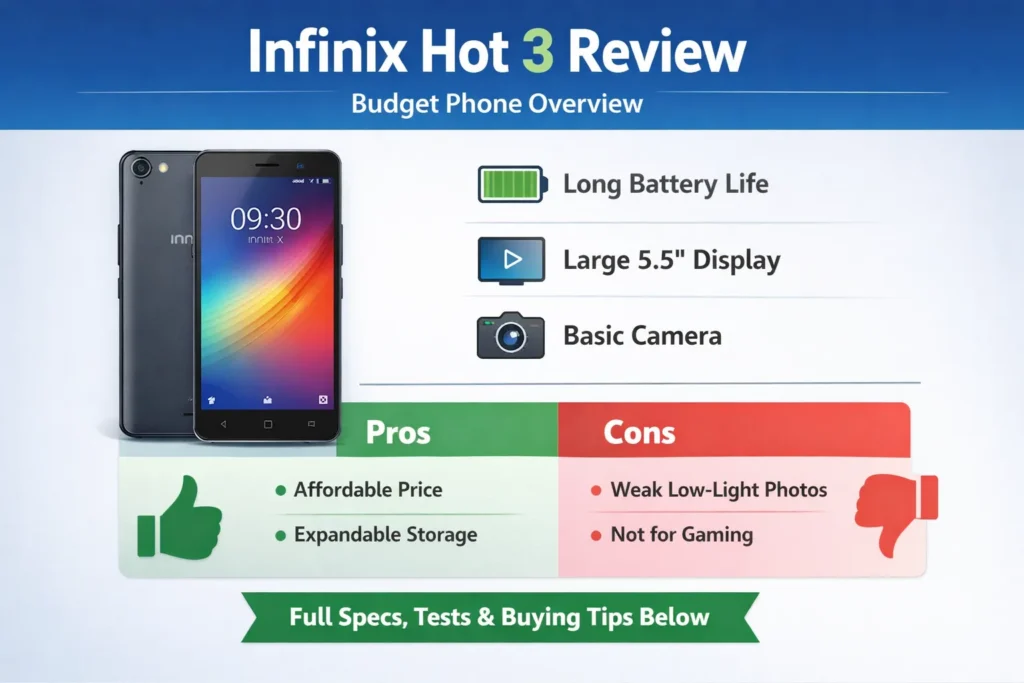
Pros and Cons
Pros
- Long battery life for everyday use.
- Large screen ideal for media and browsing.
- Affordable price that suits budget buyers.
- Often, a removable battery and a serviceable design.
- Simple, approachable UI for new smartphone users.
- Expandable storage (on SKUs with microSD support).
- Headphone jack (if present) — great for wired audio.
Cons
- Camera performance is average in low light.
- Limited RAM in base models can slow multitasking.
- Display brightness may struggle in direct sunlight.
- Software updates and long-term support can be limited.
- Not suitable for heavy gaming or demanding multitasking.
FAQs
A: For light games and casual titles, it’s fine. Heavy 3D games will push their limits — expect lower frame rates and more heat on long sessions.
A: Battery life depends on usage. In typical mixed use (calls, messages, social, light video), you can expect a full day or more.
A: Many SKUs do. Check your SKU’s slot type — some use a hybrid SIM tray that may require sacrificing the second SIM to use microSD.
A: Choose the SKU with the most RAM and the LTE bands that match your country. More RAM makes the phone feel smoother.
A: Some variants have removable backs and user-replaceable batteries. Check the model photos and the official specs for your exact SKU.
Conclusion
The Infinix Hot 3 is a smart pick for buyers who value battery endurance and a large display at a low price. For photography enthusiasts or power users, stepping up to a midrange model will bring meaningful improvements.
