
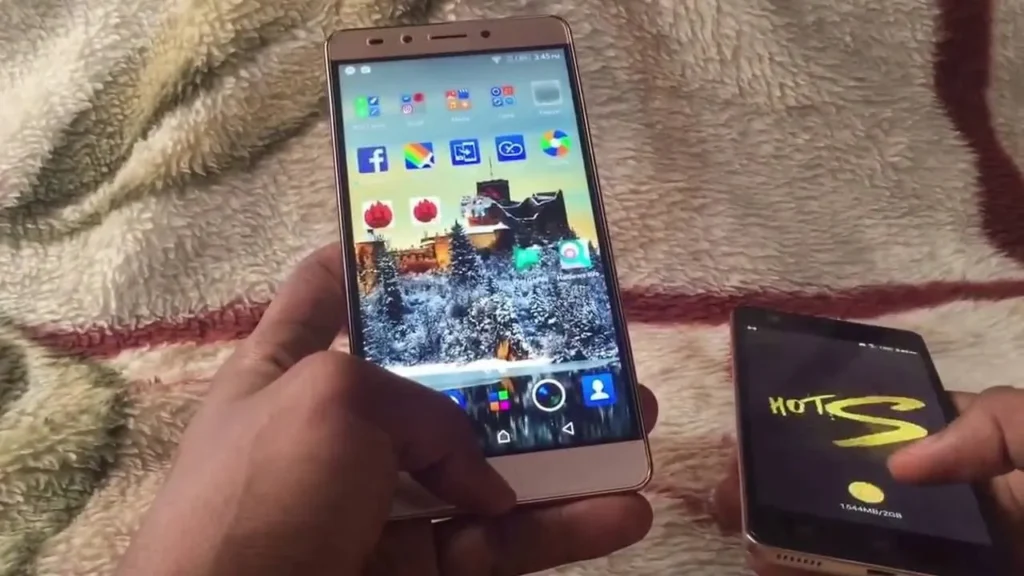
Introduction of Infinix Hot 3 Pro
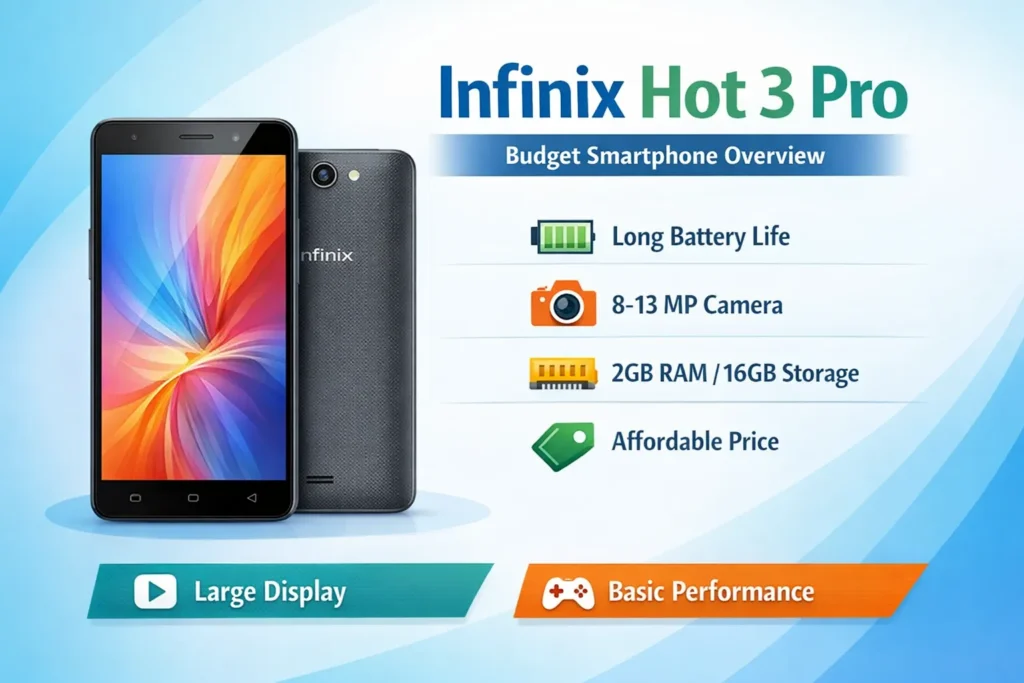
Think of the Infinix Hot 3 Pro as a compact sequence model: compact parameters, efficient inference, and an emphasis on long runtime rather than raw compute. It’s a budget Android device that trades peak throughput for extended battery life and a large observation window (display). If you want a low-cost instrument that reliably processes daily tasks (calls, messaging, light browsing) with minimal power drainage, this is a strong candidate.
Pros: durable battery endurance, expansive display, very economical price.
Cons: constrained compute for heavy multitasking or modern 3D workloads, camera performance drops in low-illumination contexts, and software updates/weighting may lag behind newer model releases.
What is the Infinix Hot 3 Pro?
In canonical terms, the Infinix Hot 3 Pro is an entry-level Android smartphone produced by Infinix. If you map devices to machine-learning analogies, this handset is an optimized small-parameter model with a focus on battery-level optimization and user-facing throughput for routine applications. The device’s architecture prioritizes energy economy and a straightforward user interface rather than pushing computational benchmarks.
Who should buy the Infinix Hot 3 Pro?
Treat this like a classification problem: which user classes map to a high probability of satisfaction with the Hot 3 Pro?
- Budget-oriented users who prioritize long battery life over high throughput.
- Casual consumers who mainly run communication and social-networking applications (e.g., tokenized text sequences such as WhatsApp, Facebook, Twitter).
- First-time smartphone adopters who need simple affordances, plenty of screen real estate, and predictable runtime metrics.
Not recommended:
- Power users requiring low-latency computation for heavy multitasking, high-end 3D gaming, or video editing.
- Mobile photographers or content creators who require strong low-light camera inference and high dynamic-range capture.
Quick specs
| Feature | What to expect |
| Display | Large IPS screen, ~5.5–6.0 inches (HD resolution) |
| SoC (compute) | Entry-level MediaTek / Spreadtrum (region-dependent) |
| RAM / Storage | 2GB / 16GB typical; 3GB / 32GB for higher SKU |
| Battery | Large capacity ~3000–4000 mAh |
| Camera | Rear: 8–13 MP (varies by SKU) — Front: ~5 MP |
| OS | Android + XUI skin |
| Price tier | Budget / value segment |
Design & Build
If we treat devices like model architectures, the Hot 3 Pro uses a practical plastic chassis to minimize manufacturing cost while maximizing battery capacity. Many SKUs ship with a removable back cover, enabling user access to battery and storage expansion — analogous to a modular architecture where components are replaceable.
Key design observations:
- Plastic frame and rear — pragmatic and resilient, not premium.
- Removable back in many variants — enables battery swap and physical maintenance.
- Noticeable bezels — functional ergonomics over bezel-less aesthetics.
- Weight and thickness skewed toward battery capacity rather than sleekness.
In summary: design choices favor utility and serviceability; the device is optimized for durability and low-cost repair rather than premium materials.
Display
The display acts like an observation window into the environment. On the Hot 3 Pro, it is typically an IPS panel tuned for cost efficiency and readable color reproduction. For tasks like video playback, reading, and social feeds, it is more than adequate.
Display behavior:
- Comfortable for media consumption and reading; adequate pixel density for HD content on a 5.5–6.0-inch screen.
- Outdoor readability is limited; under direct sun, the panel can appear washed, similar to low SNR.
- Color reproduction is serviceable but not colorimetric-grade — pleasant for everyday images but not color-critical workflows.
From an editorial standpoint, capture calibrated brightness (nits) and the reflectivity metric during testing.
Performance
Think of the SoC as the inference engine and RAM as the cache size. The Hot 3 Pro’s SoC is entry-level: it’s power-efficient, but single-core or multi-core throughput will lag behind modern Midrange Processors.
Everyday throughput:
- Smooth for baseline workloads: voice calls, instant messaging, light web browsing.
- Multitasking is limited on 2GB RAM variants — app reloads and context switching overhead are observable.
- Gaming: casual titles run fine; heavy 3D workloads will either throttle or require reduced settings.
Optimization tips:
- Use lightweight launchers to reduce renderer overhead.
- Keep background processes trimmed to minimize context switching.
- Offload heavy tasks (e.g., video editing) to cloud-based services when possible.
Battery life
Battery endurance is the core objective function for this device. With a 3000–4000 mAh battery in a low-compute envelope, the phone achieves extended wall-clock runtime compared to higher-performance peers.
Empirical expectations:
- Light use (calls, SMS, sparse web): 1.5–2 days runtime.
- Moderate use (social apps, streaming, casual camera use): reliably a full day.
- Heavy use (gaming, GPS navigation, extended streaming): most of a day; top-up by evening may be required.
If we model battery drain as a piecewise linear function with states (idle, moderate, heavy), the Hot 3 Pro’s slope is shallow during idle and moderate phases, reflecting its efficient background scheduling and low-power compute units.
Testing checklist:
- Video loop test at ~200 nits for 90 minutes — record start/end battery percent.
- Browser loop (scripted mixture of pages and interactions) for 60 minutes.
- Gaming session for 30 minutes and observe thermal throttling and percent drop.
- Long idle standby test for 48 hours to measure background drain.
Cameras
In camera terms, the Hot 3 Pro provides baseline sensors and a basic image signal processing pipeline. Performance is variable: acceptable in daylight, but noisy and detail-depleted in low light.
Rear camera behavior:
- Daylight: good dynamic range for casual snapshots, adequate detail for social sharing.
- Low light: increased noise, limited dynamic range, and soft textures — expect loss of fine detail.
- Modes typically include HDR, Panorama, and basic scene selections.
Front camera behavior:
- Suitable for video calls and casual selfies.
- Not engineered for studio-grade portraits or computational-portrait bokeh.
Practical tips:
- Shoot in abundant light (sunlight or strong indoor lighting).
- Use HDR for backlit scenes to preserve highlights and recover shadow detail.
- Avoid digital zoom; prefer cropping in post or moving physically closer to the subject.
Software & updates
The Hot 3 Pro ships with Android topped by Infinix’s XUI skin. Similar to model weights frozen at training time, OS versions and security updates can vary by region and SKU.
Important notes:
- Shipments can include older Android variants depending on the market.
- Update cadence for budget devices is typically slower — security patches and major OS upgrades may lag.
- Remove/disable bloatware to reclaim storage and reduce background processing.
Recommendation: Verify the Android version at purchase and confirm warranty/service support for updates in your market.
Connectivity & extras
Usual features include:
- Dual SIM (commonly hybrid trays) — helpful for separating work/personal profiles.
- microSD slot — expandable storage for camera datasets and media.
- 3.5 mm headphone jack — analog audio support.
- Wi-Fi and Bluetooth — standard connectivity.
- NFC: often absent on many budget SKUs — check SKU details.
Comparision
When building a comparative baseline, position the Hot 3 Pro against competitors by three main axes: battery capacity (runtime), compute resources (RAM/SoC), and imaging quality.
| Phone | Battery | RAM/Storage | Camera | Best for |
| Infinix Hot 3 Pro | Large | 2/16 or 3/32 | 8–13 MP | Battery life, price |
| Competitor A | Medium | 2/16 | 8 MP | Slightly higher clock speed |
| Competitor B | Small | 1/8 | 5 MP | Ultra-low price |
Buyer’s guide
When deciding whether to buy the Hot 3 Pro, treat it like a scoring function where each requirement (battery, performance, camera, budget) gets a weight.
Buy if:
- Battery life is your top priority.
- You want a large screen and a simple UI.
- Your budget is constrained, and you need a dependable daily driver.
Don’t buy if:
- High-performance gaming or mobile content creation is a hard requirement.
- Low-light photography is a priority.
- You need frequent software updates or the latest Android features.
Pricing & where to buy
Prices vary by market, SKU, and retailer. For buying decisions:
- Check official retailers and authorized distributors for warranty and after-sales support.
- Price-check across local marketplaces and confirm SKU serial numbers to avoid mismatched variants.
- For second-hand purchases, inspect battery health, display condition, and network lock status.
If you run promotions or affiliate links, ensure your links point to authorized sellers to protect customers and reduce return rates.
FAQs
A: It can run casual games well, but heavy 3D titles will be slow. Choose a phone with a stronger CPU and more RAM for heavy gaming.
A: For light to moderate use, expect a full day or more. Heavy users may need a top-up by night.
A: Some variants do. Check your SKU or the back cover — if it’s removable, the battery may be user-replaceable.
A: Yes, most versions include a microSD slot.
A: It depends on the region and the SKU. Many units ship with an older Android version and XUI skin.
Final verdict
If your priority is long runtime and a large, readable display for media consumption and messaging, the Infinix Hot 3 Pro is a pragmatic, affordable choice. It doesn’t attempt to be a performance leader or a computational photography specialist — but it reliably fulfills the role of a battery-centric daily driver for users with modest compute needs. If you require heavy gaming, advanced photography in low light, or a continuously updated OS, consider stepping up to a midrange device with a more powerful SoC and better camera modules.
