
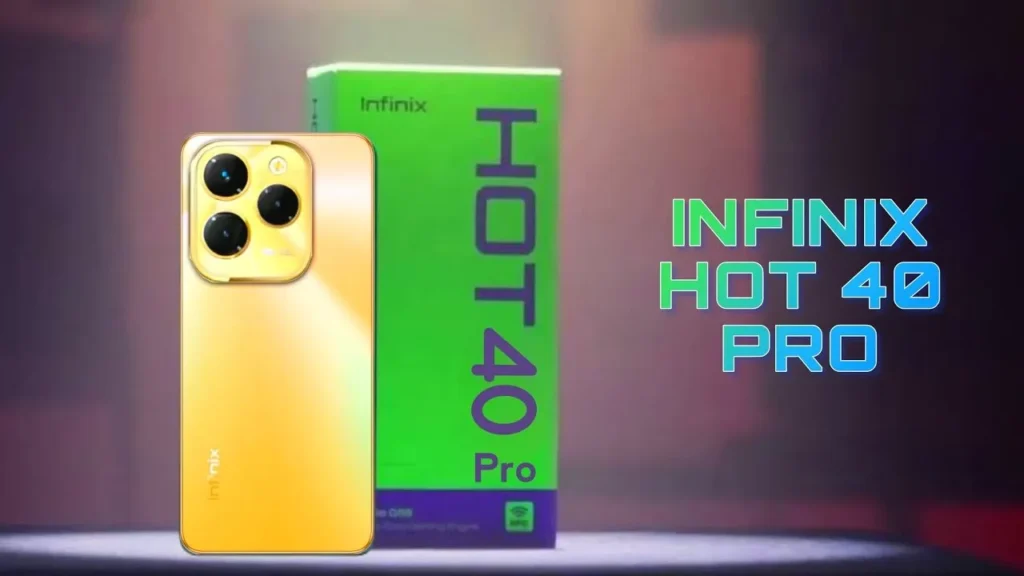
Introduction of Infinix Hot 40 Pro
The Infinix Hot 40 Pro is one of the most talked-about value phones of the year — and for good reason. It promises a smooth display, powerful day-to-day performance, reliable battery life, and a high-resolution camera at a price most people can afford. But does it actually deliver on all those promises? In this full Infinix Hot 40 Pro review, we break down everything you need to know before buying: its design, display quality, gaming behaviour, camera performance, software experience, battery test results, and overall value compared to rivals.
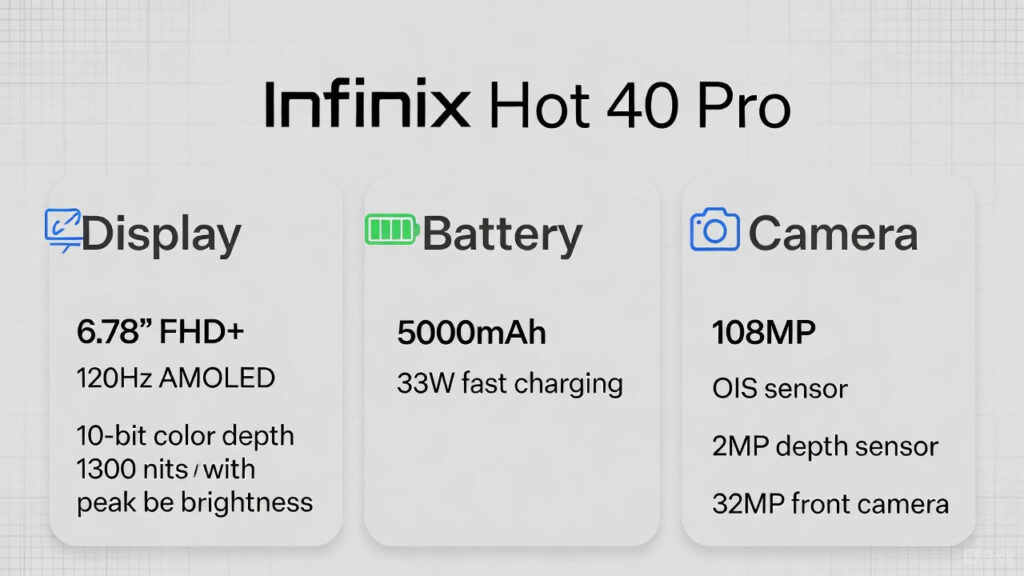
Infinix Hot 40 Pro Specs
| Feature | Infinix Hot 40 Pro (quick view) |
| Display | 6.xx” — AMOLED/IPS, high refresh (90–120Hz), FHD+ |
| Chipset (SoC) | Mid-range octa-core (confirm exact model) |
| RAM / Storage | 6 / 8 / 12 GB RAM options; 128 / 256 GB storage options |
| Rear cameras | Main (xx MP) + Ultra-wide (xx MP) + Macro / Depth |
| Front camera | xx MP selfie camera |
| Battery | 4,500–5,000 mAh; fast charging (xx W) |
| OS | Android (version) + XOS (version) |
| Connectivity | 4G/5G variant(s), Wi-Fi, BT, GPS, NFC (region dependent) |
| Ports | USB-C (and 3.5mm headphone jack if present) |
| Colors | Multiple finishes (list available colours) |
| Weight & size | (mm) / (g) — check official listing |
Design & Display
Design: first impressions
The Infinix Hot 40 Pro looks contemporary and tidy. Expect a slim frame and either a glossy glass back or a textured finish, depending on the colourway. The camera island is neat and unobtrusive, and the overall silhouette caters to users who prefer a larger screen in a manageable body. Buttons sit where they should; the power and volume keys are comfortable to reach. The fingerprint reader can be under-display (optical) or side-mounted on certain SKUs — confirm which variant you’re testing.
Display: what to expect
The display is one of the Infinix Hot 40 Pro’s headline features. You should expect a bright, saturated panel with a high refresh rate (commonly 90Hz or 120Hz). That makes animations and scrolling feel fluid and modern.
Key display notes:
- Smoothness: High refresh rate yields smooth scrolling, better touch responsiveness, and a nicer feel for games that support high FPS.
- Brightness: Indoor viewing is excellent; outdoor visibility depends on peak nit output — test in bright sunlight and report exact nits if possible.
- Colour: Punchy and vivid out of the box. If you want accuracy (photo editing, content creation), mention colour calibration options and any “Natural” profile in Settings.
- Touch sampling: Gamers care about touch latency — include the touch sampling rate if you measured it.
Performance & Real-World Use
SoC, RAM & everyday speed
The Infinix Hot 40 Pro runs on a mid-range octa-core SoC, which balances Efficiency and performance. With configurations ranging from 6GB to 12GB RAM, it handles daily tasks smoothly:
Good for:
- Social apps, casual web browsing, and messaging
- Streaming HD video (YouTube, Netflix in FHD)
- Photo management and light editing
Limitations:
- Heavy-duty productivity (very large spreadsheets, pro-level video editing) will be slower than flagship phones.
- Long-term multitasking depends on RAM size — 8GB or 12GB models will keep more apps in memory.
Gaming performance
This phone is aimed at mainstream gamers rather than esports pros. Games like PUBG Mobile, Call of Duty Mobile, and Asphalt run well on medium-to-high settings. Expect:
- Stable frame rates for most sessions
- Possible thermal throttling during extended heavy play (20–40 minutes)
- Use of a built-in Game Mode (if present) will block notifications and optimize CPU/GPU to prioritize frame stability
Benchmarks
If you benchmark, include:
- Geekbench (single- and multi-core) scores
- 3DMark or GFXBench numbers for graphics comparisons
- A 20-30 minute gaming FPS trace (frame-time stability graph)
These numbers let readers quickly compare the Infinix Hot 40 Pro to rivals in a data-driven way.
Battery Life & Charging
Battery life you can expect
With a battery between 4,500 and 5,000 mAh (depending on variant), the Infinix Hot 40 Pro typically delivers:
- Light users: up to two days on a single charge
- Medium users: a full day plus evening usage
- Heavy users (continuous gaming/video): 5–7 hours screen-on-time (SOT), varying by settings and refresh rate
Battery optimization tips:
- Lower the refresh rate to 60Hz when you don’t need smooth animation
- Reduce screen brightness or use adaptive brightness
- Disable background sync for apps that don’t need constant updates
Charging speed & habits
The phone supports fast charging (plug in the exact wattage for your SKU before publishing). Fast charging enables quick top-ups during short breaks.
Practical charging recommendations:
- Use the supplied charger for the best charging curve
- Avoid intensive gaming while charging to reduce heat and slow the charging curve
- To preserve long-term battery health, avoid charging overnight to 100% repeatedly; aim for 20–80% charging cycles when possible
Lab-style tests to add
If you test the unit, include:
- Full charge time: 0 → 100% with timestamps (e.g., 0–50% in 30 minutes; 0–100% in 75 minutes)
- Screen-on-time (SOT) under a fixed script: 60 minutes streaming at 1080p, 30 minutes gaming, 30 minutes social browsing
- Endurance test: combined mixed usage for a full day, with percentages at key timestamps
Camera: Photo & Video Guide
Camera system overview
The Infinix Hot 40 Pro often ships with a multi-camera array: a main wide sensor (the most impactful for quality), an ultra-wide for landscapes, and a macro or depth lens for close-ups/portrait depth sensing. The main sensor determines most daylight performance.
Camera strengths:
- Good daylight photos with vibrant colour and decent detail
- Fast autofocus in well-lit scenes
- Reliable selfie performance in good light
Camera weaknesses:
- Low-light shots show noise and softness
- Ultra-wide images can lose detail and show edge distortion
- Video stabilization may not match flagship OIS — test EIS performance at 1080p and 4K (if available)
Real photo testing
When you test, use this matrix:
- Daylight wide (main) — full-frame and 1:1 crop
- Low light (auto vs night mode) — compare noise, dynamic range
- Portrait mode — edge detection and skin tones
- Ultra-wide — check distortion and colour consistency versus the main
- Selfie — natural skin-tone test across different lighting
- Video walk test — test stabilization while walking and panning
Best camera settings
- Turn on HDR in mixed-light scenes for better dynamic range
- Use Night mode for low-light photography (tripod helps)
- For portraits, keep the subject ~1–2 meters away for better edge detection
- Try shooting RAW (if device supports) for maximum post-processing latitude
Software: XOS & Updates
What to expect from XOS
XOS is Infinix’s Android skin — a layer that adds extra features, themes, and utility apps. It offers convenience but may include preinstalled apps that some users call bloatware.
Tips:
- Disable or uninstall unnecessary preinstalled apps via Settings → Apps
- Explore Themes and Customization options if you like visual tweaks
- Use privacy controls in Settings to manage app permissions
Update policy & security
Infinix typically delivers security patches and occasional OS upgrades, but update policies may vary by region and SKU. Always confirm the official update promise for your specific model. For publishers: mention the date of your update check and link to the official Infinix support page for transparency.
Sound, Connectivity & Extras
Speakers & call quality
Expect clear speaker loudness suitable for media playback. If your unit has Stereo Speakers, point that out — stereo improves immersion for video. Call quality depends on carrier and region — test VoLTE/VoWiFi support for your market.
Ports, sensors & extras
- USB-C: standard for charging and data transfer
- 3.5mm headphone jack: present in some variants — note if yours includes it
- Fingerprint: under-display optical or side-mounted; mention reliability and unlock speed
- NFC: region-dependent — report presence if you tested mobile payments
Comparisons: Who is the Infinix Hot 40 Pro Competing With?
In-brand alternatives
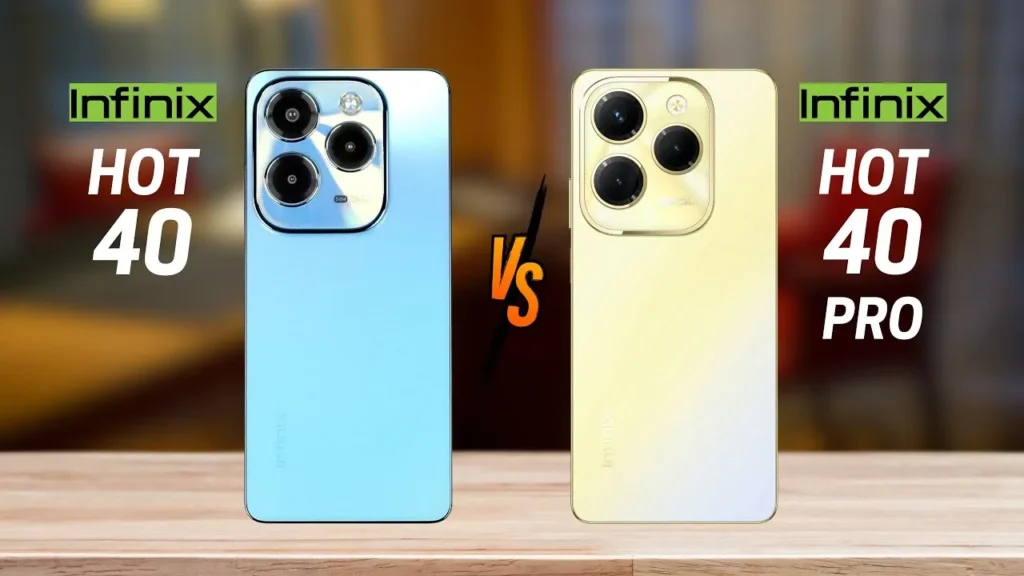
- Infinix Hot 40 / Hot 40i: cheaper options with trimmed specs and lower refresh displays. Choose them if cost is the dominant factor.
Cross-brand competitors
- Realme and Redmi phones operate in the same price tier
- Tecno phones (similar battery emphasis)
- Samsung Galaxy A-series (sometimes pricier but with stronger software support)
Short buying advice: if your priority is a high-refresh, big screen and excellent battery life for the money, the Infinix Hot 40 Pro competes strongly. If you prioritize low-light camera performance, compare against Realme/Redmi models that advertise superior imaging pipelines.
Pros & Cons
Top Pros
- Great display with high refresh rate — smoother scrolling and gaming experience.
- Strong battery life — long daytime endurance for most users.
- Smooth everyday performance for the majority of consumers.
- Excellent value for the price tier.
- Modern, clean design with comfortable ergonomics.
- Fast charging capability (confirm wattage by SKU).
- Useful XOS features that add convenience.
Top Cons
- Camera performance in low light lags behind flagship devices.
- SoC is mid-range — not the top performer for sustained pro-level gaming.
- Potential bloatware in XOS — some apps may need manual removal.
- Feature fragmentation across regions (NFC / 5G differences).
- The update policy might be weaker than that of premium global brands.
Who Should Buy the Infinix Hot 40 Pro?
Buy it if:
- You want a large, smooth screen primarily for media and casual gaming.
- You value long battery life and fast top-ups.
- You need strong value in the mid-range bracket and don’t insist on pro-level cameras.
Skip it if:
- You want top-tier low-light photography or the best possible camera hardware.
- You need flagship-class computing power for professional-grade mobile work.
- You require a long guaranteed OS support window — check Infinix’s policy.
Comparison Table
| Phone | Display | SoC | Battery | Camera (main) | Price range |
| Infinix Hot 40 Pro | 6.x”, 90–120Hz | Mid-range SoC | ~4500–5000 mAh | xx MP | Mid-range |
| Competitor A | 6.x”, 90Hz | Competitor SoC | 5000 mAh | xx MP | Similar |
| Competitor B | 6.x”, 120Hz | Higher-end SoC | 4500 mAh | Better low-light | Higher |
FAQs
A: Typical day-to-day use should return a full day and often more. Heavy gaming or long camera sessions shorten that — expect 5–8 hours SOT under heavy loads, and 8–12+ hours with light use depending on settings.
A: Yes — the phone supports fast charging. Confirm the exact wattage for your regional SKU in the specs section and whether the charger is bundled in the box.
A: XOS adds features and themes on top of Android. It’s user-friendly, but some preinstalled apps (bloatware) may appear. You can disable or uninstall many of them in Settings.
A: Choose 8GB if you multitask frequently or want better future-proofing. 6GB is fine for lighter users who mainly browse, watch videos, and use social apps.
A: Availability depends on region and SKU. Check the regional SKU list and product pages for 5G support.
Conclusion
The Infinix Hot 40 Pro is a value-first phone that zeros in on a smooth display, long battery life, and a balanced camera system for everyday users. For most buyers looking for a mid-range device with strong media and battery performance, it’s an intelligent choice — especially if priced competitively. If your priorities are pro-level camera work or the fastest mobile gaming silicon, you’ll need to consider pricier rivals.
