
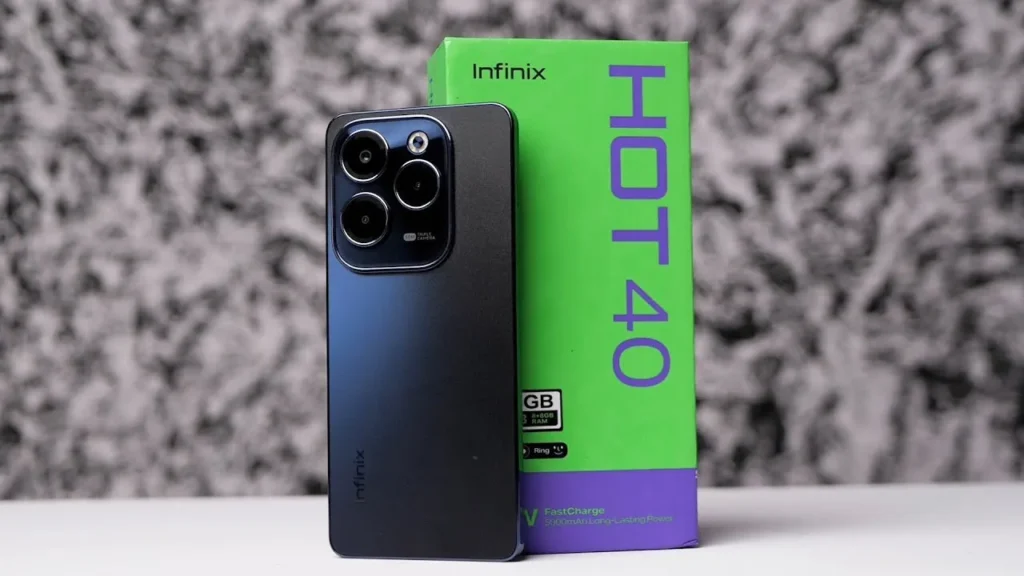
Introduction of Infinix Hot 40
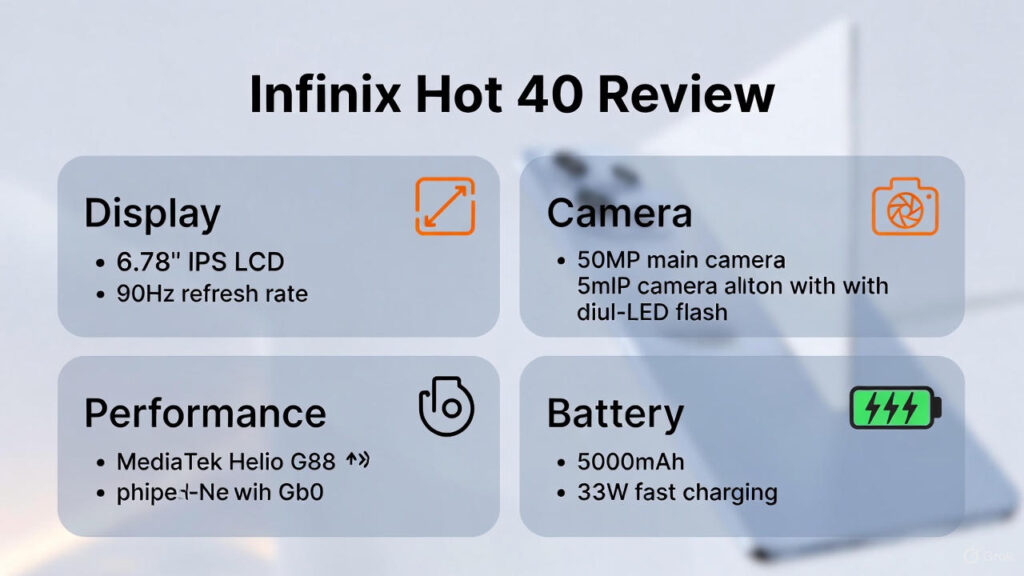
When you need a huge, no-nonsense phone that cuts out the frills and provides what is needed, then this Infinix Hot 40 review is your cup of tea. A 6.78-inch 90Hz screen, a 50MP main camera, a 32MP selfie shooter, MediaTek Helio G88 performance, and a 5,000mAh battery is paired with a 5.95-inch screen, a 50MP main camera, a 32MP selfie camera, MediaTek Helio G88 performance, and a 5,000mAh battery, the Hot 40 promises media friendly comfort, good battery life and selfie ready photos at budget friendly price
Quick specs
| Item | What you get |
| Display | 6.78″ FHD+ IPS, 90Hz |
| Chipset | MediaTek Helio G88 (12nm) |
| RAM / Storage | 6 / 8GB + virtual RAM, 128 / 256GB |
| Rear camera | 50MP main + 2MP macro + AI |
| Front camera | 32MP selfie |
| Battery | 5,000 mAh, ~33W charging |
| OS | Android 13 with XOS 13.x |
| Weight | ~196 g (varies by region) |
| Extras | microSD slot, fingerprint, Face Unlock, 4G LTE (varies by SKU) |
Design & build
The Hot 40 adheres to the familiar, pragmatic blueprint of modern budget phones. A few tactile and visual details are worth calling out:
- Front: The 6.78-inch display dominates the fascia with slender bezels and a central punch-hole for the selfie lens. It’s clearly conceived as a media-first device — watching video and scrolling social feeds feel immersive.
- Rear: The back uses a frosted plastic finish that resists grime and fingerprints. The texture gives a near-premium visual while keeping costs low. That matte, anti-smudge covering also softens glare and makes the phone look cleaner in photos.
- Controls: Buttons are located on the right edge: power (which may house the side-mounted fingerprint scanner on some SKUs) and a two-step volume rocker. The layout is conventional and ergonomically sensible.
- Weight & handling: At around 196 g, the Hot 40 is relatively light given its large footprint. You’ll feel the size during extended one-handed usage sessions, but it’s comfortable for long video playback. Tip: Use a thin case to improve grip because a larger handset is easier to drop.
- I/O: Expect USB-C for charging and data, and in many regions, a 3.5mm headphone jack remains on board — a plus for wired-audio fans. A dedicated microSD tray is common and keeps storage flexible without sacrificing a second SIM slot in most configurations.
Display
The 6.78″ FHD+ IPS panel is the Hot 40’s headline feature. It’s a large, legible screen that prioritizes media enjoyment.
- Smoothness: The 90Hz refresh rate is immediately noticeable compared with typical 60Hz displays. Scrolling through feeds, animated UI elements, and menus feel noticeably more fluid — a pleasing upgrade that benefits everyday use more than raw benchmark numbers ever could.
- Color profile: Out of the box, colors skew warm. This results in pleasant skin tones and a slightly cinematic look for video. If you prefer punchier hues, the Settings menu includes color-profile options to adjust saturation and temperature.
- Brightness & legibility: Brightness is fine for indoor use and moderate outdoor conditions, but under intense sunlight, the IPS panel lags behind premium OLED alternatives — highlights can wash out. Adaptive brightness helps in changing light, and switching to 60Hz will extend battery life when you need it most.
- Viewing angles: For an IPS display, viewing angles are good. Sharing the screen for group video watching works well without dramatic color or brightness shifts.
Performance & real-world use
The MediaTek Helio G88 is a power-efficient midrange SoC built on a 12nm process. It’s tuned to provide balanced day-to-day performance while preserving battery life.
- Everyday tasks: Social media apps, messaging, web browsing, and streaming run smoothly. The UI is responsive, app launches are snappy for the class, and the combination of 6/8GB RAM plus virtual RAM improves background retention for many multitasking scenarios.
- Multitasking: Virtual RAM (a feature that borrows storage space to expand working memory) helps with keeping more apps alive in the background, though physical RAM is still the faster and preferable option for frequently used applications.
- Gaming: Light titles such as Free Fire and Mobile Legends are enjoyable at medium settings with stable frame rates. Heavier 3D games (Genshin Impact, Call of Duty Mobile at high settings) will require significant setting reductions and may run into throttling after prolonged play. For casual gamers, the Hot 40 is fine; for those chasing high-fps competitive sessions, look elsewhere.
- Storage: UFS vs eMMC variants can vary by SKU; faster storage improves app load times and general system snappiness. If you plan to keep lots of large apps and media locally, choose the 256GB variant or rely on microSD expansion where available.
Thermal behavior & throttling
Budget SoCs aim for thermal balance; performance is throttled gently to avoid overheating.
- Short sessions: Brief gaming or benchmark runs usually produce only mild warmth.
- Extended sessions: After sustained usage, expect gradual frequency reductions to manage temperature — this is standard for midrange silicon.
- Charging & heat: Fast charging and heavy gaming together can raise surface temperature; if the device feels hot, allow it to cool down before continuing to heavy usage.
Camera
Infinix positions the Hot 40’s imaging stack for social sharing: quick, flattering, and convenient.
Main camera (50MP) — daylight & everyday
- Daylight: The 50MP primary sensor captures sharp, contrasty shots with a slightly warm color bias — flattering for skin tones and outdoor portraits. The default processing leans toward boosted midtones and pleasing contrast rather than clinical accuracy.
- Detail & cropping: The sensor supports pixel-binning to combine smaller pixels into larger effective pixels for cleaner images in average light. Use 50MP mode when you need more cropping headroom.
- HDR: The algorithm manages high-contrast scenes competently, preserving highlights while lifting shadows enough for social sharing without heavy-handed HDR artifacts.
Low-light & Night Mode
- Low light: Expect usable night shots, but don’t anticipate flagship-grade detail. Noise and softness are present, and illuminated areas can bloom.
- Night Mode: Multi-frame stacking and longer exposure times help improve exposure and noise reduction. Without OIS, keeping the phone steady is critical — use a table or lean on a steady surface for the best low-light frames.
Selfie camera (32MP)
- Social-ready: The 32MP front shooter yields high-resolution selfies with smooth skin processing and pleasant color reproduction. Portrait selfies present acceptable subject-background separation for the class.
- Streaming & video calls: The front cam is well-suited for bright-room streaming and social video.
Video
- Resolution: 1080p recording is the practical choice for most users. 4K may not be supported or may be limited depending on the SKU and firmware; 1080p gives consistent results.
- Stabilization: EIS is average. For smooth pans or long takes, consider a gimbal or firm grip.
Battery life & charging
The 5,000mAh cell is a principal strength of the Hot 40 — endurance is a core selling point.
Real-world runtime
- Mixed usage: For combined social, video streaming, and light browsing, most users will see between 1.5 and 2 days of use. That makes the phone excellent for commuters, frequent travelers, and people who don’t want daily tethering to a charger.
- Heavy gaming: Intensive gaming will reduce runtime considerably, as GPU loops and high refresh rates are power-hungry. Consider lower refresh rates and brightness for marathon gaming sessions.
Charging
- Speed: Many Hot 40 SKUs ship with ~33W charging. Real-life full charges usually take around an hour, give or take, depending on the charger and the device’s battery curve.
- Curve: A typical charging graph will show a faster ramp from 0→50% and a slower taper from 80→100% as the battery management system protects longevity.
Software & user experience (XOS on Android 13)
Infinix ships the Hot 40 with XOS layered on Android 13 — a customizable skin with feature-rich options.
- Customization: XOS includes themes, icon packs, widgets, floating windows, and gesture navigation. If you enjoy tailoring visuals and interaction, XOS gives you a lot of levers to pull.
- Productivity features: Floating windows and split-screen make multi-app workflows smoother. Game Mode helps block notifications and reduce interruptions during gameplay.
- Preinstalled apps: Expect some preinstalled apps, some of which are removable and others that may only be disable-able. This is common among budget OEMs.
- Updates: OTA cadence varies by region; Infinix issues updates, but long-term policy and frequency can differ across markets. Check official channels for the latest support information.
Connectivity, ports & sensors
- Mobile data: Most SKUs offer LTE/4G; 5G availability depends on the market and specific model numbers. Confirm the SKU for your region before purchasing.
- Wi-Fi & Bluetooth: Hardware supports modern standards adequate for streaming and peripheral use.
- NFC: Not guaranteed on all SKUs — verify if contactless payments matter to you.
- Ports: USB-C for charging and data; many variants still include a 3.5mm headphone jack.
- Biometrics: Side-mounted fingerprint readers or other placement variants; Face Unlock is available too, providing convenient, if not bulletproof, security.
Storage & expandability
- Built-in storage: 128GB and 256GB variants are commonly offered. If you store many videos and photos locally, consider the larger capacity.
- microSD slot: A dedicated microSD slot is common and lets you expand storage without sacrificing SIM flexibility in dual-SIM SKUs — a practical advantage for media-heavy users.
Quick comparisons
Hot 40 vs Moto G62
- Display: Hot 40’s 6.78″ panel is larger and more immersion-focused.
- Performance & updates: Motorola often emphasizes a cleaner Android experience and potentially steadier update cadence — check region specifics.
- Battery & charging: Both deliver respectable endurance; charging speed depends on the variant.
Hot 40 vs Infinix Hot 40 Pro
- Performance: The Pro typically gets a stronger SoC, better display technology, and faster charging. Choose Pro for more gaming and display fidelity.
- Value: The regular Hot 40 is the value play — choose it for screen size and battery life on a budget.
Who should buy the Infinix Hot 40?
Buy it if:
- You want a big, fluid 90Hz screen for video and scrolling.
- You need long battery life and multi-day endurance.
- High-resolution selfies and social-ready photos are a priority.
- You value practical features like virtual RAM and a microSD slot for expandable storage.
Don’t buy if:
- You are a committed mobile gamer seeking high framerates for prolonged competitive play.
- You need top-tier low-light imaging or professional-grade video stabilization.
- You require long-term, frequent Android version upgrades — larger global brands may offer better policies.
Pros & Cons
Pros
- Large 6.78″ 90Hz display that’s great for media.
- 5,000mAh battery with ~33W charging for solid endurance.
- 50MP main camera and 32MP selfie for social photos.
- Good value with practical extras (microSD, 3.5mm jack).
- Virtual RAM helps with multitasking and app retention.
Cons
- Helio G88 isn’t a high-end gaming SoC.
- Low-light photography and video stabilization are average for the class.
- XOS includes preinstalled apps that some may call bloat.
- Update cadence may be less frequent than larger global competitors.
FAQs
A: Many Hot 40 models ship with 4G LTE only; 5G availability depends on SKU and region.
A: Yes — the 32MP front camera is strong for daylight selfies and social content. Portrait mode and skin tones are handled well for the class.
A: Yes — most Hot 40 variants include a dedicated microSD slot. Check the SKU you are buying to confirm the exact slot and max capacity.
A: The Pro usually upgrades the chipset, display quality, and charging speed.
A: Update frequency depends on region and carrier. Infinix provides OTAs, but the exact cadence varies.
Coclusion
The Infinix Hot 40 is an outstanding value proposition for users who prioritize media playback, long battery life, and a strong selfie experience at a modest price. It combines a big 90Hz display, decent general-purpose performance, and a long-lasting 5,000mAh battery into a competitively priced package. If you require sustained high-framerate gaming or premium low-light photography, consider stepping up to a higher-tier phone or the Hot 40 Pro.
