
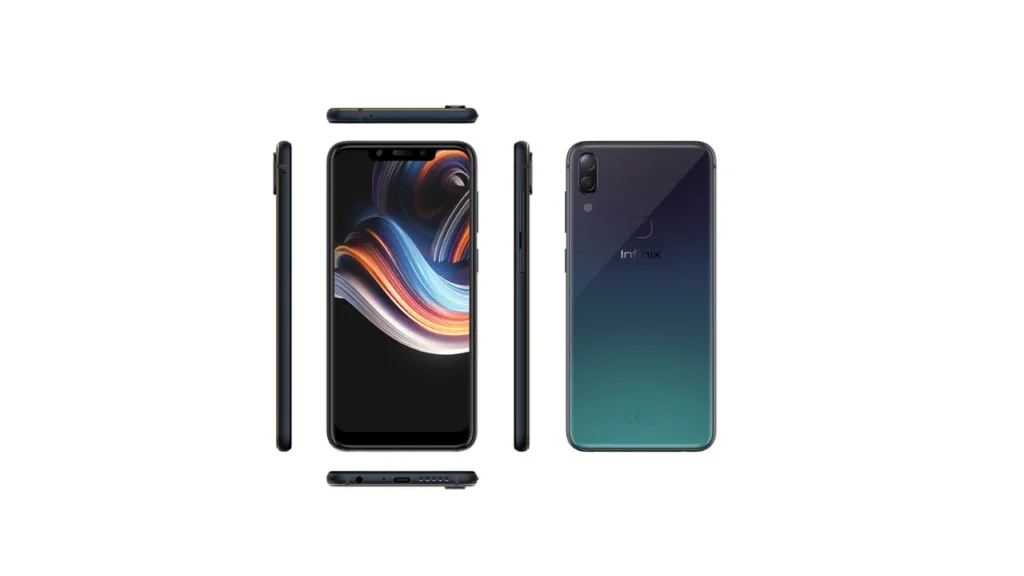
Infinix Hot 6 Review
This Infinix Hot 6 review gives you everything — real-world battery, camera tests, full specs, and buying advice. Clear, simple, and packed with data, so you can make a decision quickly. Infinix Hot 6 explained for everyone.
The Infinix Hot 6 is an affordable phone with a large display and a capacious battery. It’s a solid pick for users seeking extended uptime and straightforward everyday performance. If your priorities are elite gaming or top-tier low-light photography, there are more capable (and costlier) alternatives. Best for buyers on a constrained budget who prioritize battery longevity and practical value.
At-a-glance specs
| Field | Specification |
| Model | Infinix Hot 6 |
| Launch | (Insert release/announcement date) |
| Display | 6.0″ (example) HD+, IPS, 18:9 (insert exact) |
| SoC | MediaTek (insert exact model) |
| RAM / Storage | 2 / 3 GB RAM; 16 / 32 GB storage (variants) |
| Expandable | microSD support (yes/no, up to X GB) |
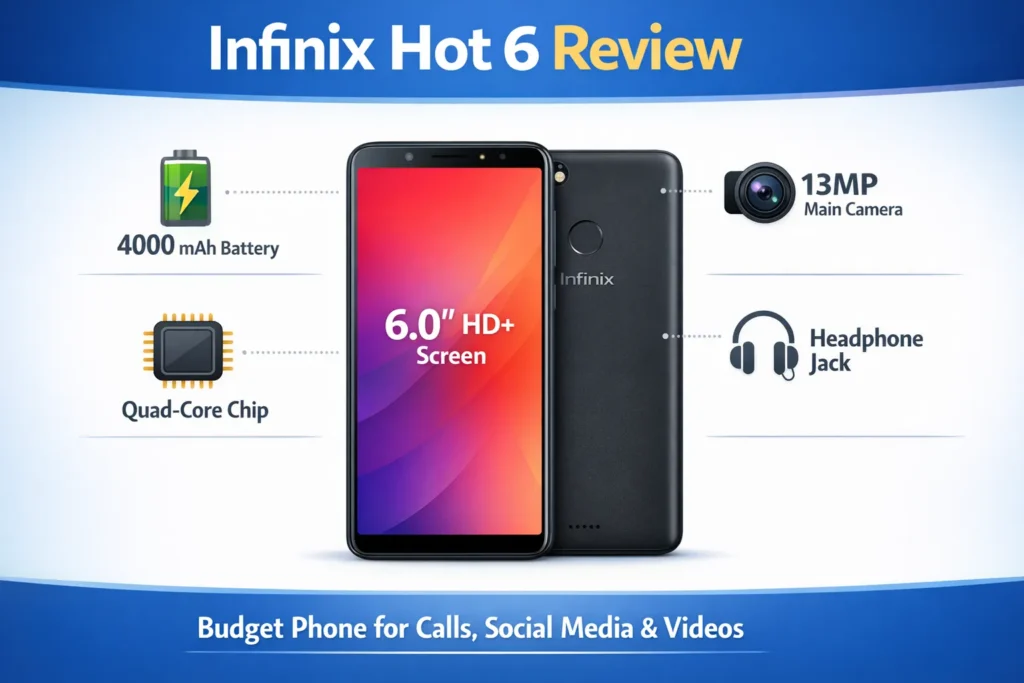
| Main Camera | 13 MP (or 8 MP) + depth/macro (specify) |
| Selfie | 8 MP (with flash) |
| Battery | 4000 mAh (example) — non-removable |
| Charging | 5V/2A (standard) — no fast charge (adjust if different) |
| OS | Android (version) with XOS (version) |
| Connectivity | 4G LTE, Wi-Fi 802.11 b/g/n, Bluetooth 4.x |
| Dimensions / Weight | (insert exact) |
| Colors | Black, Gold, Blue (variants) |
Design & build
The Hot 6 adheres to a functional, unpretentious design language. Materials prioritize cost-efficiency and durability rather than premium aesthetics.
Key points:
- Build: Polycarbonate back and frame — keeps mass modest and price accessible. The tactile finish tends to be matte (or glossy, depending on variant); test for grease and fingerprint retention.
- Grip & ergonomics: Rounded edges and a manageable thickness make extended usage comfortable. Larger displays usually necessitate two-handed interactions for reachability.
- Buttons & ports: Physical power and volume keys on the right edge; charging port (micro-USB or USB-C—verify the SKU) at the bottom. 3.5 mm headphone jack presence is a meaningful UX win for budget buyers.
- Biometrics: If a fingerprint sensor is present, evaluate placement (rear or side), unlock speed, false accept/reject rates, and face-unlock reliability under diverse lighting. If omitted, emphasize pattern/PIN reliability.
- Practical editorial tip: Add high-resolution, in-hand, and macro photos. Use alt text with keywords, e.g., “Infinix Hot 6 front view — black” for semantic clarity.
Display
Required numeric specs:
- Size: (e.g., 6.0″)
- Resolution: HD+ (720 × 1440) or actual resolution — include pixel density (ppi).
- Panel: IPS LCD (or specified)
- Refresh rate: 60 Hz (typical for budget phones)
Real-world evaluation:
Large panels are beneficial for streaming and reading. IPS offers consistent viewing angles but lacks the contrast and deep blacks of AMOLED. For everyday media, color reproduction is acceptable; however, saturation and dynamic range are less vivid than those of higher-end panels.
Outdoor legibility:
If measured peak luminance is ~400 nits, the display performs acceptably in bright daylight with some struggle. If the peak is lower, recommend shade or higher contrast text for comfortable reading.
Touch & responsiveness:
Touch sampling rate and latency are fine for routine tasks; competitive gaming has no high-refresh-rate advantage due to the standard 60 Hz.
Display tests to run:
- Brightness (nits) at 100% and in auto mode.
- Color accuracy (Delta-E), if you have a colorimeter.
- PWM/flicker detection for users sensitive to flicker.
- Pixel density verification and grain visibility at normal viewing distances.
Performance
SoC and day-to-day behavior:
Budget Infinix models commonly ship with entry-level MediaTek SoCs. For standard apps — messaging, social, streaming — the experience is smooth. Heavier multitasking or modern 3D games can reveal slowdowns, especially on 2 GB RAM configurations.
Benchmarks to include and methodology:
- AnTuTu: Run three times and report the median to mitigate outliers.
- Geekbench: Single-core and multi-core median scores.
- GFXBench / 3DMark: For GPU throughput and sustained load behavior.
Gaming practical plan:
- Run 15-minute sessions of PUBG Mobile / Free Fire on low/medium settings; log average FPS, frame drops, and temperature at 5-minute intervals.
- Casual games (Temple Run, Subway Surfers) should be fluid.
- Thermal throttling: a 30-minute GFX loop will reveal performance degradation and chassis temperature changes.
Memory & storage behavior:
- 2 GB RAM variants show more frequent app reloads; 3 GB feels less aggressive in memory management.
- eMMC vs UFS: eMMC is slower and more common at this tier—note read/write speeds if possible.
Battery
Capacity example: 4000 mAh. Charging: 5V/2A (box charger) unless specified otherwise.
Suggested test methodology:
- Screen-on time (SOT): Conduct three repeatable measurement loops (browsing, streaming, social apps) at a normalized brightness (200 nits). Report the average SOT.
- Charge test: 0→100 with included charger; log percent over time at 30-min intervals. Note Charger wattage and cable quality.
- Standby drain: Enable Wi-Fi and idle for 24 hours; log battery percentage loss.
- Endurance score: Combine SOT, standby drain, and charging time into a single normalized metric for quick comparison.
Cameras
Camera hardware:
- Rear: main sensor MP, aperture, and additional depth/secondary sensor details.
- Front: selfie sensor, MP, and flash availability.
- Video capture: resolutions and frame rates (e.g., 1080p@30fps or 720p).
Camera test matrix:
- Daylight: Wide, landscape, and 100% ultracrop.
- Backlit / HDR: Faces in front of bright skies to evaluate dynamic range and HDR algorithm.
- Low-light / Night: Handheld vs tripod to profile noise and detail.
- Portrait mode: Edge detection and depth blur quality.
- Macro / Close-up: Focus accuracy and fine-detail capture.
- Video stabilization: Walk-and-record sample to evaluate EIS (if any).
How to present samples:
- Include full-size downloadable images with EXIF metadata.
- Show 100% crops and annotate the ISO, shutter speed, and any in-phone AI mode toggled.
- For each sample, attach a short caption: camera settings and recommended in-phone adjustments (e.g., “HDR ON for backlit scenes”).
Quick camera verdict:
Daylight images are serviceable for social media — colors are generally neutral to slightly muted. In low light, noise and loss of detail are common; long-exposure night modes (if present) help but are not a substitute for larger sensors and optics.
Software, firmware & support
What to capture for the model page:
- Android version at launch (e.g., Android 8/9) and XOS skin iteration.
- OTA build number and changelog excerpts (copyable).
- Update cadence: frequency of security patches and major Android updates (if known).
- Known quirks and workarounds (carrier-specific features or bugs).
Connectivity & extras
Connectivity checklist:
- LTE bands: Enumerate all supported bands and map to regional carrier compatibility.
- Dual SIM: Confirm slot arrangement (hybrid vs dedicated microSD).
- Wi-Fi: 802.11 b/g/n typical; specify 2.4 GHz vs 5 GHz availability.
- Bluetooth: Version (e.g., 4.2) and supported codecs (SBC, aptX if present).
- GPS: A-GPS, GLONASS, BeiDou support for improved geopositioning.
- Sensors: Accelerometer, proximity, ambient light, compass; gyroscope presence/absence impacts AR and VR apps.
- Extras: FM radio, IR blaster, and headphone jack presence—these matter in many emerging markets.
Comparisons
When constructing comparison tables, select 3–5 contemporaneous rivals in the same price bracket. Example categories: Xiaomi / Redmi budget range, Realme C series, Tecno Spark Models.
Example compact comparison:
| Feature | Infinix Hot 6 | Competitor A | Competitor B |
| Display | HD+ 6.0″ | HD+ 6.0″ | HD+ 5.99″ |
| SoC | MediaTek X | Snapdragon Y | MediaTek Z |
| RAM | 2/3 GB | 3 GB | 2 GB |
| Battery | 4000 mAh | 4500 mAh | 4000 mAh |
| Camera | 13 MP | 12 MP | 16 MP |
| Price | $XXX | $XXX | $XXX |
Pros & Cons
Top Pros
- Excellent battery life relative to price.
- Large display ideal for media consumption.
- Attractive price-to-feature ratio.
- Headphone jack and expandable storage (if present).
- Straightforward XOS enhancements for less tech-savvy users.
Top Cons
- Entry-level processors limit heavy gaming.
- Camera performance degrades in low light.
- Lack of fast charging in many SKUs.
- Plastic construction feels utilitarian, not premium.
- Update cadence for Android versions may be sporadic.
Buying guide
Where to buy:
- Official Infinix online store and authorized resellers.
- Major e-commerce marketplaces (Daraz in Pakistan, Amazon in some regions).
- Local brick-and-mortar retailers (provide store finder links if available).
Price-checking tips:
- Compare sealed-box pricing across trusted sellers; check shipping timelines and return policies.
- Look for bundle deals: protective case, screen protector, or extended warranty.
- When buying refurbished, verify battery health and return guarantee.
FAQs
A: If you want long battery life and a large screen at a low price, yes. It’s not for heavy gamers or camera-focused users.
A: In real use, expect around 6–8 hours SOT depending on screen brightness and apps. Exact SOT varies by model and usage.
A: Most budget variants use standard charging (5V/2A). Fast charging is usually not included.
A: Daylight shots are good for social sharing. Low-light photos show noise; video is basic.
A: It can run games on low to medium settings but will not deliver high FPS or sustained smooth performance for long sessions.
Final verdict
The Infinix Hot 6 is a pragmatic budget phone built for users who value a long-lasting battery and a large, readable display. It performs reliably for daily communications, streaming, and casual browsing; however, heavy gamers and photography enthusiasts may find its limitations more pronounced. For its price bracket, it offers solid value.
