
Introduction
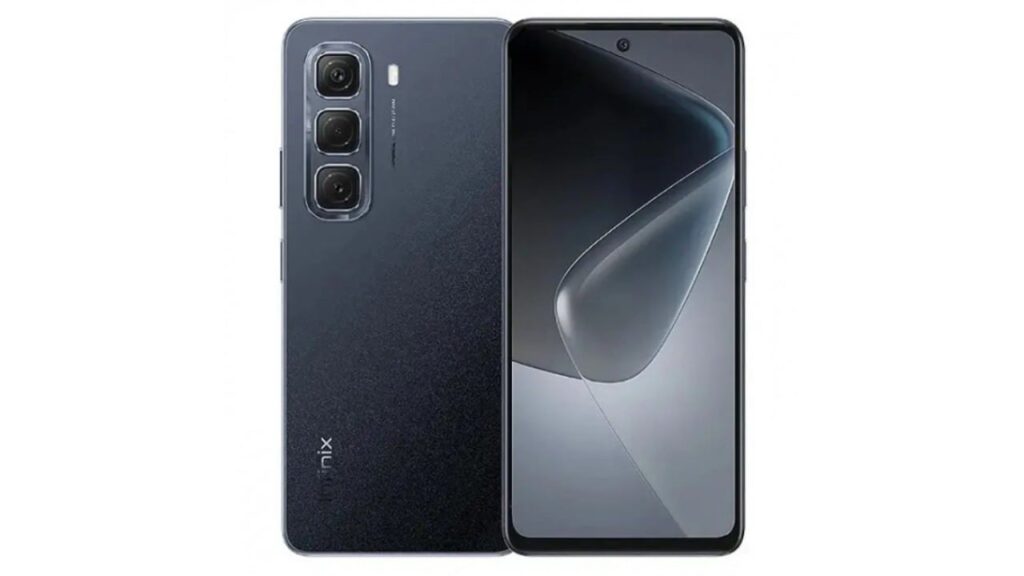
Infinix Hot 60i (2025) is a practically designed, cost-effective smartphone geared towards consumers who are more concerned with practical stability and smooth tactile connected experience rather than screens full of pixels or Marvelous performance. The Hot 60i is convincing when its main features are battery run times, a responsive UI scrolling due to a 120Hz display, and a 50MP main shooter that allows you to capture pictures in daylight. Look elsewhere in case you require an FHD screen, sustained high-framerate gaming, UFS storage to support snappy application loading, or extended OS/security support.
What’s new & what’s in the box
What’s new (2025 refresh)
The Hot 60i is a 2025 refresh of the Hot series that focuses on delivering improved perceived smoothness and battery life at a very aggressive price. Key updates to highlight:
- 120Hz adaptive refresh on an HD+ LCD — a big UX improvement over 60Hz budget phones.
- 50MP main camera as the headline shooter, trading sensor resolution for improved daylight detail potential.
- Larger battery cells (≈5,160mAh on many listings) and wider adoption of faster wired charging in some regions (45W on many SKUs; others still ship with 18W adapters).
- Android 15 with XOS skin in many markets, bringing fresh UI features and a security baseline.
What’s in the box
- Infinix Hot 60i handset
- USB-C cable
- Charger (wattage varies by market)
- SIM ejector tool
- Clear soft case
- Quick start guide/warranty card
Design & build — first impressions
Materials & finish: The Hot 60i uses plastics that are suitable for the budget on the back side and the frame. The colorways can consist of glossy or satin matte finish; the glossy ones are prone to fingerprints, but appear more glamorous in photographs.
Ergonomics & weight: The gadget is compact and can be carried around, and the edges are gently rounded and allowing one to reach the device with one hand. The fingerprint scanner placed on the side doubles as a power key – comfortable enough for most people.
Structural notes: The gadget is compact and can be carried around, and the edges are gently rounded and allowing one to reach the device with one hand. The fingerprint scanner placed on the side doubles as a power key – comfortable enough for most people.
Display — 120Hz vs HD+, brightness and real use
Key panel specs
- Size: 6.7–6.78 inches (IPS/LCD)
- Resolution: HD+ (~720 × 1600)
- Refresh rate: 120Hz adaptive
Why does the 120Hz matter
At this price point, a 120Hz refresh rate produces a noticeable UX advantage. Scrolling, UI animations, and transitional motion feel significantly smoother compared to legacy 60Hz phones. For many users—especially younger buyers and those migrating from older phones—the feel of the UI can outweigh raw pixel density.
The tradeoff — HD+ resolution
A 720p-class panel on a ~6.7″ canvas results in a lower pixel-per-inch count than FHD rivals. That means:
- Small text (e.g., dense web pages, PDFs) appears less crisp.
- UI elements and fonts can show slight aliasing at close reading distances.
- Video upscaling is fine for social apps, but it shows soft edges in detailed scenes.
Brightness & outdoor visibility
Reported peak luminance numbers for retail samples sit around 650–700 nits in many listings — adequate for most outdoor conditions, but not best-in-class. When reviewing, photograph a sunlight shot and measure brightness with a light meter to verify real-world usability.
Color accuracy & viewing angles
The panel tends to be punchy (consumer-pleasing saturation) with typical IPS viewing-angle behavior. It’s neither the most color-critical nor the most pro-grade panel, but it matches the phone’s value proposition.
Recommendation for reviewers
Include:
- A sunlight visibility photo.
- A measured nits reading with a lux meter or photometer.
- A short 120Hz vs 60Hz screen-capture video to demonstrate perceived smoothness.
- A discussion about whether the smoother refresh rate negatively impacts battery life (it can, unless adaptive mode helps).
Performance — chipset, benchmarks & gaming
Typical SoC & memory
- SoC: MediaTek Helio G81 Ultimate has been used in various markets, and some of them might sell variants based on Dimensity (see SKU).
- RAM/Storage: 4/6 /8 GB RAM, 128/256GB eMMC 5.1 storage (expandable via microSD).
What to test
Many competitor reviews stop at a quick benchmark. To create a defensible, unique review, run:
- AnTuTu & Geekbench (device-specific), and include full screenshots.
- Prolonged gaming test – 2-30 minutes of play of an average game (PUBG Mobile, Free Fire) with an FPS tracking and an FPS vs time graph.
- Thermal throttling — CPU/GPU temperature time curve of a sustained stress test (e.g., 30-minute 3DMark stress or gaming run).
- Storage benchmarks — sequential and random read/write tests to show eMMC performance.
- App-switching test — measure how many apps remain cached and how quickly common apps reload.
Real-world summary
- Daily tasks: Smooth for social apps, video, and web browsing.
- Heavy multitasking: Expect some stutters if the RAM/SoC combo is the base 4GB/G81 variant.
- Sustained gaming: Good for casual gamers at medium settings; sustained performance will show thermal-induced frame drops.
Camera — samples, low-light, video & analysis
Hardware layout (typical)
- Main: 50MP wide sensor (headline spec)
- Secondary: Macro/depth sensor (low impact)
- Front: ~5MP selfie camera (typical)
Daylight performance
The 50MP sensor is capable of providing satisfactory daylight photography, and in high-contrast situations, full of aggressive colors and effective HDR. To determine detail, offer full-resolution downloads and 2x / 4x crops. Sharpening of color, dynamic range, and color fidelity.
Low-light performance
Expect average low-light capability: noise, softer detail, and limited dynamic range when compared to phones with higher-end sensors and ISPs. If a Night mode exists, compare Night vs Auto to show differences.
Video
- Stabilization: Not flagship-class — electronic stabilization may be effective but limited for high-motion capture.
- Resolution & bitrates: Vary by SKU — test your sample for max resolution and framerate (e.g., 1080p@30/60fps). Include a frame grab and a note on rolling shutter and stabilization.
Battery & charging
Claimed battery & charging
- Battery: ~5,160 mAh (some markets list up to 6,000mAh)
- Charging: Many listings show 45W wired charging support, though some SKUs ship with 18W chargers.
Standardized tests to run
- Video loop (1080p local, 50% brightness) — run tests at both 120Hz and 60Hz to highlight the refresh-rate impact.
- Web browsing loop — scripted scrolling with push notifications, to mimic real-world use.
- Gaming loop — 30 and 60 minute sessions, log battery percentage drop, and FPS over time.
- Standby drain — 24-hour idle with Wi-Fi and cellular settings noted.
- Charge times — 0→50% and 0→100% using the included charger; plot a charge curve.
Example battery test table
| Test | Conditions | Result (example — replace) |
| Video loop (120Hz) | 1080p local, 50% brightness | 14 h runtime |
| Web browsing (120Hz) | Scripted scrolling, auto-sync | 10 h SOT |
| Gaming (30 min) | PUBG medium settings | 6% drain / 30 min |
| Standby (24h) | Wi-Fi + cellular active | 2–4% drain / 24h |
| Charge 0→50% | 45W charger (claimed) | ≈25 minutes |
Graphs that rank
- Discharge curve (battery % vs time)
- Charge curve (voltage/current vs time along charge)
- FPS vs time for gaming session
- CPU temp vs time for thermal testing
Software & XOS — bloat, features, and updates
Typical software situation
Many Hot 60i units ship with Android 15 skinned by XOS. XOS brings feature additions (game mode, gestures, custom themes, privacy toggles), but also regional bloatware in several markets.
What to check & document
- Preinstalled apps — list them, explain whether they are uninstallable or only disableable.
- System promotions — document any in-UI ads or promotional recommendations with screenshots.
- Update policy — budget Infinix phones often have limited OS update windows; check the manufacturer’s promise (if any) and document security patch recency.
Practical reviewer actions
- Show a settings screenshot of installed apps and storage usage.
- Check for an update policy note in the official documentation or retailer listing and link to it.
Alternatives — which phones to consider instead
If the Hot 60i doesn’t match your priorities, consider:
Under ~USD 120 (value)
- Tecno Spark (2025) can offer better raw CPU performance in some SKUs.
Small premium (sharper screen & better battery/SoC)
- Poco / Tecno M-series — many ship with FHD panels and more efficient chips like Dimensity 6000+ range.
For cameras & storage
- Seek phones with UFS storage and stronger ISPs (often slightly pricier but worth it for heavy photographers).
Alternatives table
| Model | Why choose | Typical price (region) |
| Tecno Spark (2025) | Generally stronge-CPU in some SKUs | $90–$130 |
| Poco M-series (FHD) | Sharper FHD display & better SoC | $140–$200 |
| Dimensity 6400 phones | 5G + better power efficiency | $150–$220 |
Who should buy the Infinix Hot 60i?
Buy it if:
- You want a phone that routinely lasts the day and then some.
- You value the tactile smoothness of a 120Hz screen even on a budget.
- You want a 50MP main camera for casual daylight photos without spending on a midrange flagship.
Don’t buy if:
- You demand an FHD display with high pixel density for reading or productivity.
- You play prolonged high-frame-rate mobile games and need top-tier thermal management.
- You require long-term software support and frequent security updates.
Full specs table
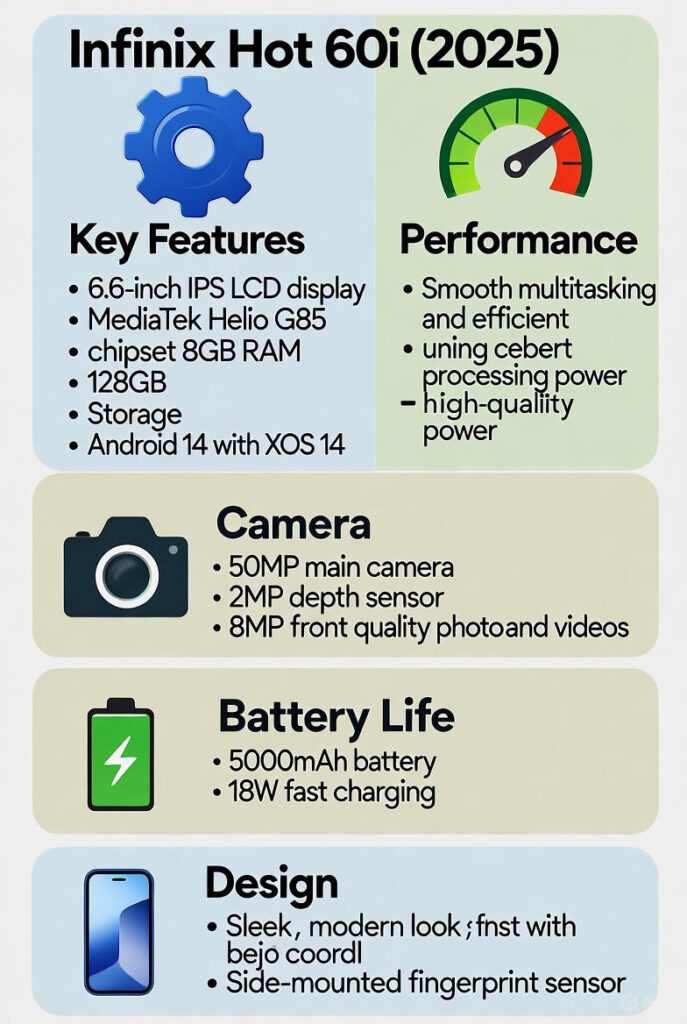
| Item | Specification |
| Launch | June–Aug 2025 (varies by market) |
| OS | Android 15 with XOS (varies) |
| Display | 6.7–6.78″ IPS LCD, 720×1600 (HD+), 120Hz adaptive |
| SoC (typical) | MediaTek Helio G81 Ultimate (some markets vary) |
| RAM / Storage | 4 / 6 / 8GB RAM; 128 / 256GB eMMC 5.1 (expandable) |
| Rear cameras | 50MP main + auxiliary macro/depth |
| Front camera | 5MP (typical) |
| Battery | ~5,160 mAh (some markets differ) |
| Charging | 45W wired (many listings); some SKUs 18W |
| Connectivity | 4G/5G depends on SKU, Wi-Fi, BT, GPS, USB-C |
| Sensors | Side fingerprint, accel, prox, gyro (varies) |
| Weight / dims | Varies by configuration |
| Price (launch) | Region-dependent — check local retailers |
FAQs
Ans: It depends on the regional SKU — many Hot 60i units use the Helio G81 (4 GB), while some markets have Dimensity variants with 5G. Always check the model number before buying.
Ans: With a ~5,160mAh cell, you should expect a full day of moderate use. Heavy users may still get a day, but test the phone with our standardized battery tests to know the exact screen-on-time.
A: Many market listings show 45W wired charging support, but some SKUs ship with 18W chargers. Confirm which charger ships in your region.
A: It’s fine for casual gaming. For long sessions or maximum frame-rate stability, choose a phone with a stronger SoC and better thermal management.
A: The 120Hz refresh rate makes animations and scrolling feel very smooth, but the HD+ resolution won’t match FHD phones in sharpness. If you care about pixel density, look for FHD phones.
Conclusion
The Infinix Hot 60i (2025) is a well-balanced budget phone built for practicality rather than performance bragging rights. Its 120Hz display, solid battery endurance, and capable 50MP daylight camera make it a smooth and reliable daily driver for casual users. However, the HD+ screen, eMMC storage, and limited long-term updates remind you of its budget DNA. Overall, it’s a great value pick if you prioritize smoothness, battery life, and affordability over gaming power or display sharpness.
