
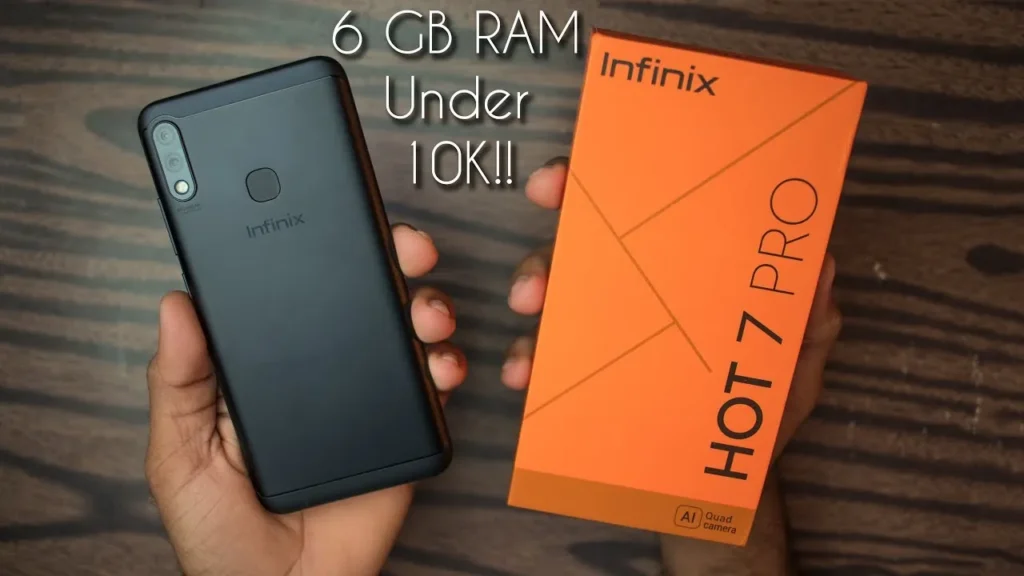
Introduction of Infinix Hot 7 Pro
A pragmatic budget pick. The Infinix Hot 7 Pro delivers a large 6.2″ HD+ screen and long battery life from a 4000 mAh cell at a very accessible price. It’s not designed for heavy gaming or flagship-class photography, but for media consumption, long runtimes, and everyday messaging, it’s a solid, value-focused phone — good if priced competitively, skip if you need high-performance gaming or top-tier cameras.
Who this phone is for
Budget buyers who want long battery life and a big screen for media, and who don’t need a flagship camera or gaming performance.
Biggest strengths
- 4000 mAh battery (promises long screen-on time)
- Large 6.2″ HD+ display for video and reading
- Very affordable; good value at bargain prices
Biggest weaknesses
- Modest MediaTek Helio P22 performance (entry-level)
- Average low-light camera performance
- XOS software can include bloat/ads in some SKUs
Quick verified specs
| Field | Details |
| Model | Infinix Hot 7 Pro |
| Release | March 2019 |
| Display | 6.2″ IPS LCD, ~720×1520 (HD+) |
| SoC | MediaTek Helio P22 (MT6762) (vendor variance possible) |
| Battery | 4000 mAh |
| OS | Android 9 (XOS 5.0) |
| RAM / Storage | 2/3/4 GB RAM; 32/64 GB storage (microSD) |
| Rear camera | Dual setup — main + depth sensor (specs vary by SKU) |
| Front camera | Single selfie camera + LED flash on some variants |
| Colors | Varies by market |
Design & build
Fit & finish
- The chassis is primarily plastic, standard for the budget segment. It keeps weight down and reduces manufacturing costs.
- Finishes vary: glossy, matte, or subtly textured backs are common. Textured backs help reduce fingerprint visibility and improve grip.
- The camera bump and fingerprint sensor (if present) are typically modes, tidy, but not premium.
Ports, buttons & SIM tray
- Typical layout: power button and volume rocker on the right; SIM tray on the left; headphone jack on the top or bottom, depending on SKU.
- Many SKUs from this era still use Micro-USB instead of USB-C — confirm your retail unit and mention clearly on your page.
- Most models offer a triple-slot tray: dual SIM + dedicated microSD.
Display
What HD+ means for users
- Pixel density is lower than that of Full HD (FHD) phones. Text and fine details are a little softer, especially at normal viewing distances.
- For social media, streaming video, and reading, HD+ is perfectly serviceable — the tradeoff is lower battery drain.
- IPS panels deliver good viewing angles and natural color rendition (not the punchy saturation of AMOLED).
Display tests to run
Brightness test
- Tools: a lux meter app, a separate camera with manual exposure, or a handheld lux meter.
- Steps: Set brightness to 100%; measure in a dark room and in bright outdoor light. Repeat with Auto Brightness.
Color & white balance
- Open a pure white webpage and a pure black image. Photograph both in consistent light to reveal tint and backlight uniformity.
- Publish a side-by-side image and call out any blue/red tint.
Touch responsiveness
- Use a drawing app and scribble quickly to look for lag or missed strokes. Record a short video to publish if possible.
Outdoor readability
- Photograph the screen under direct sunlight at 50% and 100% brightness. Include annotated notes on legibility.
Comparison image
- Add a side-by-side comparison with a mid-range competitor to show text sharpness and color differences.
Performance
Real-world expectations
- Messaging, browsing, social apps: Smooth for WhatsApp, Facebook, Instagram (basic scrolling and photo viewing).
- Multitasking: With 2–3 GB RAM, you’ll see frequent app reloads. 4 GB RAM improves multitasking noticeably.
- Gaming: Casual 2D games are fine. Heavy 3D titles will need low graphics settings and may stutter.
- Thermals: Under sustained load (e.g., extended gaming), expect some warming but not extreme throttling on this chip.
Performance tests to include
- App open times: Measure time to open Chrome, YouTube, and a graphically heavy game like PUBG Mobile (low settings).
- Multitasking test: Open 6–8 apps, switch between them, and note reloads.
- Thermal test: Run a 20-minute game and note surface temperature and any frame drops.
- Storage type: Check whether storage is eMMC or UFS — most budget phones use eMMC (slower).
Example table:
| Task | Expectation | Your unit result |
| Launch Chrome | ~1–2 s | INSERT |
| PUBG (low) | Playable ~20–25 FPS | INSERT |
| App switching | May reload on 2GB RAM | INSERT |
Camera
Camera test methodology
- Daylight wide shot: Auto mode, textured scene (leaf, brick). Publish full-res + 100% crop.
- Portrait/depth: Portrait mode on a person/object 1–2 m away. Publish full image + 100% crop at subject edge.
- Low-light test: Same scene at night, with and without any night mode. Use a tripod if available.
- Selfie test: Indoor and outdoor selfies, plus a low-light selfie using LED flash.
- Video test: Record a 1-minute 1080p clip; evaluate stabilization and audio quality.
Suggested camera verdict language
- Daylight: Acceptable for social sharing. Colors lean natural; some sharpening applied.
- Portrait mode: Works, but edge detection can fail on complex backgrounds.
- Low-light: Weak compared to mid-range devices; expect noise and reduced detail.
- Video: Adequate for casual clips; stabilization is limited.
Include: a short “camera settings” block explaining how to set HDR, AI, or Pro mode for best results.
Battery
Battery test methodology
Run these tests on a fully charged device (overnight full charge), with Wi-Fi and mobile data on, brightness at 50% (or Auto — specify your choice), and all background apps cleared.
Video loop test
- Play an offline 720p video on loop at 50% brightness until shutdown.
- Record runtime.
Web browsing test
- Use a repeatable script or manually rotate through news sites at 1 minute per page until shutdown.
Mixed use
- 1 hour YouTube (Wi-Fi), 30 minutes social media, 30 minutes camera usage, 1 hour phone calls — track SoT and total duration.
Standby test
- Fully charge, leave overnight with mobile network on — record % drop after 8 hours.
Table template for results:
| Test | Conditions | Result |
| Video loop | 50% brightness, offline 720p | INSERT h INSERT min |
| Web browsing | Auto-brightness, Wi-Fi | INSERT h INSERT min |
| Mixed use | As described above | INSERT SoT / total hours |
| Standby | Overnight 8h | INSERT% drop |
Realistic expectations
Expect 7–10 hours screen-on time on mixed use with a 4000 mAh cell and HD screen if Power Management is sensible. Actual SoT varies by RAM, background tasks, and signal strength.
Software & updates
- Ships with Android 9 + XOS 5.0 (region-dependent).
- XOS adds features (themes, gesture shortcuts) but also may include preinstalled apps and ad prompts in some builds.
- What to check: presence of carrier apps, uninstallability of bloatware, and whether apps push notifications or ads.
- Check Settings → About phone for Android security patch level and build number. Many budget phones get limited OS updates; document the current patch level in your review.
Suggested language to include:
“Check the Settings → About phone → Android security patch and build number. If you see ad prompts from system apps, show a screenshot and explain how to disable them.”
Comparisons
Comparison template:
| Phone | SoC | Battery | Screen | Camera | Price (PKR) | Who should buy |
| Infinix Hot 7 Pro | Helio P22 | 4000 mAh | 6.2″ HD+ | Dual rear | INSERT | Budget, battery-focused |
| Redmi [model] | [SoC] | [mAh] | [size] | [setup] | INSERT | Better performance/camera |
| Realme [model] | [SoC] | [mAh] | [size] | [setup] | INSERT | Best mid-budget value |
Pros & Cons
Pros
- Long battery thanks to 4000 mAh.
- Big screen for media and reading.
- Very affordable price point.
- Expandable storage (microSD).
Cons
- Modest performance (Helio P22).
- HD+ resolution on a large display means softer text vs FHD.
- Average low-light camera.
- Potential software bloat/ads (XOS).
Who should buy the Infinix Hot 7 Pro?
Buy if: you need long battery life, a big screen, and a very low price.
Don’t buy if: you play heavy 3D games, need top camera photos, or want the snappiest UI.
Price & where to buy
- Add a short live price snapshot and date: Price in Pakistan — ₨ X, XXX (as of [date]).
- List 2–3 local trusted retailers (e.g., Daraz PK, local authorized stores) and link them (verify links before publishing).
- Include a “Where to buy” quick list: online marketplaces, official stores, and local retailers.
- If using affiliate links, disclose the relationship clearly near the CTA.

FAQs
Yes, if you need a budget phone with a big screen and a long battery. Not ideal for heavy gaming or top camera quality.
Main specs: 6.2″ HD+ display, MediaTek Helio P22, 4000 mAh battery, Android 9 (XOS 5.0), 2/3/4 GB RAM, 32/64 GB storage.
Battery life depends on use. With 4000 mAh, expect strong day-long use and possibly 7–10 hours screen-on time under mixed moderate use.
Prices vary by seller and time. Add a live price and the date you checked (e.g., “₨ XX, XXX as of Jan 27, 2026”).
It depends on local pricing. If competitors cost a bit more, they may offer better SoC and camera.
Final verdict
The Infinix Hot 7 Pro is a sensible pick for buyers who want a big screen and long battery life on a tight budget. It trades off performance and camera quality to keep the price low. If you want a phone for basic apps, long media playback, and reliable daily use, the Infinix Hot 7 Pro offers good value. If you need gaming performance or best-in-class cameras, consider slightly more expensive alternatives.
