
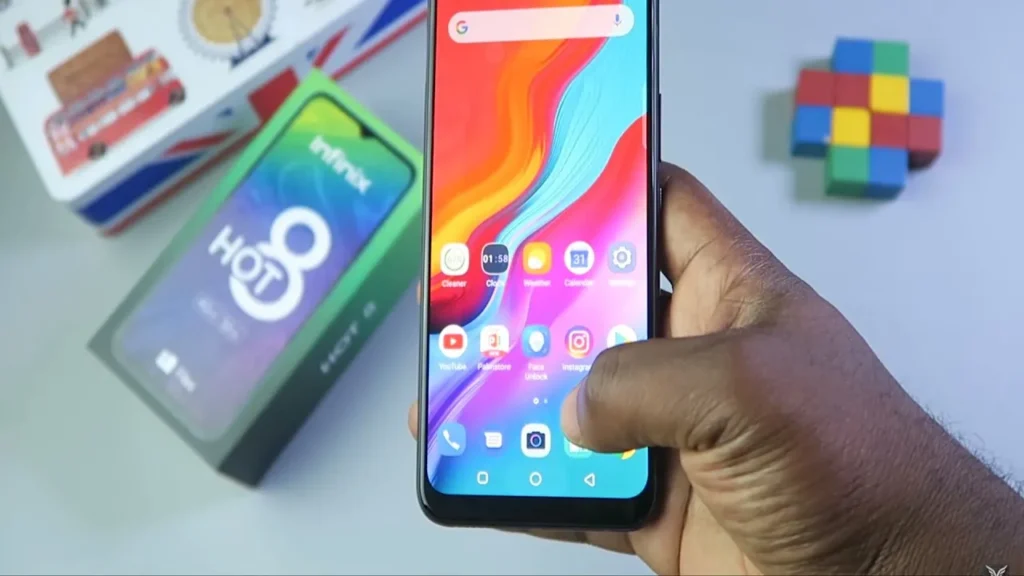
Infinix Hot 8 Pro
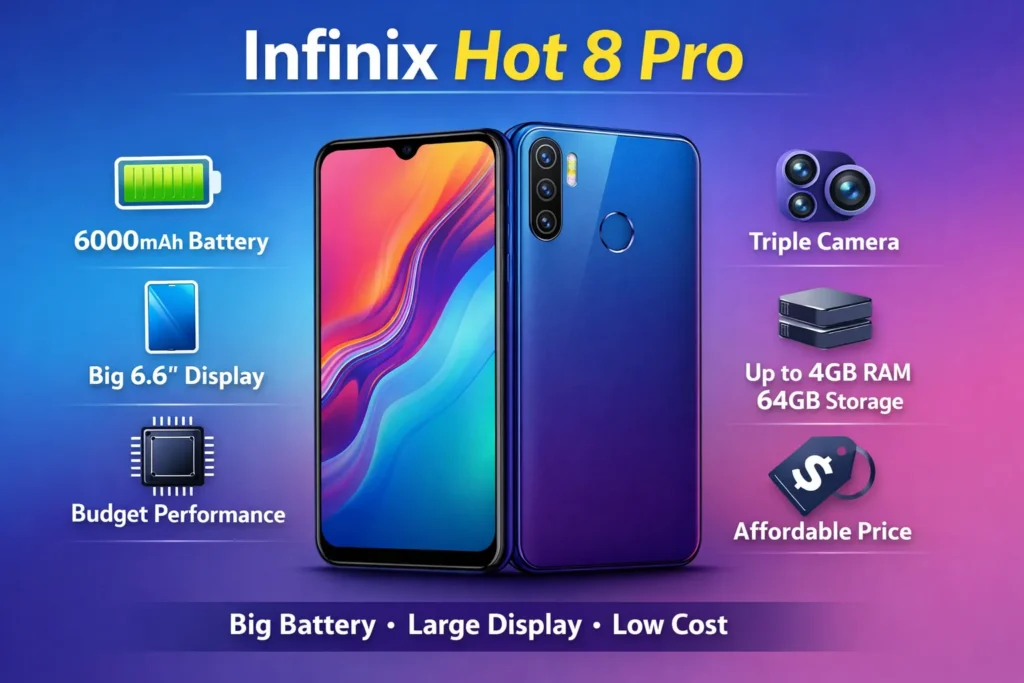
The Infinix Hot 8 Pro is positioned as a budget-conscious mobile device that optimizes for energy budget (battery capacity), a large visual output (display), and an attractive price-to-performance ratio. Ideal for users who prioritize long battery endurance, comfortable media consumption, and enough working memory/storage for everyday app interaction and social workflows.
Overview
The Infinix Hot 8 Pro is a budget-tier device engineered to deliver maximal useful throughput for everyday tasks while minimizing cost. If we model a user’s daily session as a stream of tokens (notifications, messages, videos, browsing actions), this phone is tuned to keep that stream flowing for long durations — i.e., it emphasizes battery life and uninterrupted media playback. It trades off peak compute performance (raw CPU/GPU throughput) for prolonged inference time (battery duration).
Who it’s for:
- Users who primarily consume content (video streaming, social feeds) — large display and battery favor that workflow.
- Casual photographers who mostly shoot in good light; computational photography does helpful post-processing but lacks flagship-grade low-light prowess.
- Budget-conscious buyers who want the most uptime per rupee/dollar.
Who it’s not for:
- Users requiring low-latency, high-frame-rate gaming for long sessions.
- Power users who demand frequent major OS upgrades and the fastest app launch times.
- Professionals who need precise color reproduction or a camera system tuned for demanding creative workflows.
Full specs
- Model: Infinix Hot 8 Pro
- Display: 6.6-inch IPS/LCD (placeholder) — HD+ / FHD+ (replace with exact resolution)
- Chipset: MediaTek / Unisoc / Qualcomm (placeholder) — confirm exact SoC model.
- RAM / Storage: Typical options: 3/32GB, 4/64GB (placeholder)
- Rear cameras: triple/quad array (main + macro/depth + AI) — megapixels placeholders
- Front camera: placeholder MP
- Battery: ~6000 mAh (placeholder — verify)
- Charging: placeholder wattage (confirm whether USB-C and PD support exist)
- OS: Android with XOS (placeholder Android version; e.g., Android 10/11)
- Dimensions / Weight: placeholder
- Price at launch: placeholder
Design & build
From an engineering perspective, the Hot 8 Pro is a pragmatic design: a plastic chassis and back to reduce BOM cost, with attention to ergonomic geometry for longer hand sessions. The design choices prioritize thermal management, battery vaulting, and drop resistance — plastic back plates can dissipate shocks better and keep weight down relative to glass.
Key UX/engineering points:
- Grip & comfort: Rounded edges improve one-handed ergonomics; the larger battery typically increases thickness, affecting pocketability.
- Buttons & ports: Expect the standard placement: power + volume on the right rail. Confirm whether the device uses micro-USB (older, slower) or USB-C (reversible, faster). The presence of a 3.5mm jack is still common in this segment.
- Materials: Plastic/polycarbonate back => lighter and more flexible but less premium-looking than glass; easier to scuff.
- Colorways: Typically offered in solid black, blue, or gradient finishes. A soft case is recommended to add tactile grip and drop protection.
Practical tip: Add a soft TPU case and a tempered glass protector — low cost vs. high insurance.
Display
The display is a primary modality for the Hot 8 Pro. For a device positioned as a content-first model, the panel size and perceived brightness register as key features.
What to measure and expect:
- Resolution and DPI: If the phone is HD+ (~1600×720) at 6.6″, pixel density will be moderate (~266-280 PPI). FHD+ (~2400×1080) yields crisper text and UI elements. For NLP-style content (long-form reading), higher pixel density improves legibility.
- Brightness (peak nits): Critical for outdoor readability. Budget IPS panels often peak lower than 500 nits; direct sunlight will reduce perceived contrast. Measure peak brightness in auto mode and manual max mode.
- Color gamut & calibration: Expect sRGB-ish coverage; not a professional colorimeter-grade panel. If color-critical work matters, this isn’t the device for it.
- Viewing angles & black levels: IPS panels offer wide angles but with a higher black floor than OLED — affects perceived contrast in dark scenes.
Practical UX tip: Use adaptive brightness and a night/light reading profile; lowering brightness and using dark mode across apps can extend battery life noticeably.
Performance
When analyzing the Hot 8 Pro as if it were an inference engine, evaluate its SoC as the compute core, RAM as the context window size, and storage throughput as the retrieval latency.
Key points:
- SoC (compute architecture): Budget phones frequently use Energy-Efficient ARM cores in midrange MediaTek or Unisoc SoCs. These balance single-thread performance and multi-thread throughput for standard apps; they are not designed for prolonged heavy GPU loads.
- RAM (working memory): 3–4GB RAM constrains the number of large background contexts (apps) you can keep resident. 4GB gives smoother app switching and fewer reloads.
- Storage (I/O): eMMC vs UFS: Many budget devices use eMMC, which is slower on random reads/writes; this manifests as longer app install times and slower cold launches. UFS offers better I/O throughput for smoother UX.
- Thermals & throttling: Under sustained stress (long gaming sessions or extended video encoding), thermal throttling will reduce clocks to maintain safe temperatures; measure sustained performance rather than burst numbers.
Behavior in real use:
- Everyday tasks — web browsing, messaging, streaming — will be fluid.
- Heavy multitasking — multiple social apps, background services, and browser tabs — may cause background app reloads or UI stutters on lower RAM variants.
- Gaming — casual titles run okay; AAA 3D games will require reduced graphics settings and may produce FPS dips.
Optimization tips:
- Use the device’s Game Mode to prioritize CPU/GPU cycles when needed.
- Limit background sync for heavy apps and disable high-frequency location updates.
- Consider the 4/64GB variant if you frequently switch applications or keep many browser tabs.
Camera
Cameras combine optical hardware and software post-processing. In budget devices, the computational layer tries to compensate for smaller sensors and limited optics.
Common configuration:
- Main sensor: Often 12–48MP (placeholder). Pixel-binning may be used (combine pixels for better low-light performance) at the software layer.
- Secondary sensors: Depth sensors or macro sensors (2MP) provide auxiliary data but often have limited resolution value. Depth assists portrait segmentation; macro sensors provide close-focus shots but lack detail compared to cropped main sensor images.
- Selfie camera: Mid-range MP count; works well in good light.
What to expect:
- Daylight: Good dynamic range, accurate colors, and useful detail. Computational sharpening and HDR blend produce pleasing images.
- Low light/night: Noise and loss of fine detail; night modes attempt multi-frame stacking but are limited by sensor size and stabilization. Use a tripod or rest the phone while shooting in low light.
- Portrait mode: Background blur is software-driven; edge detection can be imperfect around hair or complex edges.
Shooting tips:
- Daylight: Tap to focus and lock exposure; compose with the grid to keep horizons and subjects aligned.
- Low light: Use Night mode if available; stabilize the phone.
- Macro: Move slowly and ensure good lighting — macro sensors need plenty of light.
- Selfies: Use ambient light from behind the camera position for flatter, more flattering illumination.
Camera checklist:
- Capture a daylight, indoor, low-light/night, portrait, macro, and selfie sample.
- Save EXIF and include camera model, aperture, ISO, and shutter speed per shot.
- Compare crops at 1:1 to a rival to demonstrate detail retention.
Battery & charging
In the device-as-model analogy, battery capacity is the energy budget that supports inference and IO operations. Larger capacity extends uptime but may increase mass.
Key notes:
- Capacity: Many Hot-series phones emphasize large batteries (5,000–6,000 mAh). This translates to longer wall-clock uptime for typical usage patterns.
- Typical screen-on time: Expect ~8–12 hours of SoT depending on brightness, network use, and background tasks. Real-world results vary with settings and app mix.
- Charging: Budget devices may ship with slower chargers (e.g., 10W–18W). Confirm whether fast-charging protocols are supported (e.g., 18W, 25W); USB-C usually provides faster and reversible connections.
- Battery health practices: Avoid constant 0–100 full cycles; partial charging and avoiding heat during charging prolong battery longevity.
Testing protocol:
- Run a reproducible battery loop: play a 1080p video on loop at 50% brightness with airplane mode off but SIM active; record total SoT until shutdown.
- Test screen-off standby by setting the phone idle with background sync enabled to simulate notifications.
- Record charging curve using a data logger or time-to-percentage method (e.g., 0→50%, 50→80%, 80→100%) to show charging rate tapering.
Practical advice:
- Use battery saver for a one-day extension when needed.
- Consider a power bank for travel, despite a large battery capacity, which reduces with age.
Software & updates
Infinix’s skin, XOS, runs atop Android and adds features, tweaks, and sometimes pre-installed apps (bloat). Evaluate the software stack both for usability and for the update lifecycle.
What to expect:
- Features: Game mode, gesture navigation, smart panels, and pre-bundled utilities are typical.
- Bloatware: Expect some pre-installed apps; many can be disabled or uninstalled.
- Updates: Budget phones often get fewer major OS upgrades; security patches may roll out more slowly. If long-term platform updates matter, verify the update policy for your region/SKU.
Privacy & maintenance tips:
- Review app permissions after setup; restrict background activity for apps with heavy network usage.
- Back up the phone before applying major updates.
- Use a Google account or local backups to preserve SMS and app data.
Connectivity & networks
Connectivity is crucial — mismatched bands can limit network performance.
Checklist before buying:
- Wi-Fi standard: 802.11 b/g/n? ac? ax? AC is common in midrange; AX (Wi-Fi 6 is rare in budget models.
- Bluetooth: Version matters for audio latency and power. Bluetooth 5.0+ provides better range and throughput than 4.2.
- Mobile bands: Confirm supported LTE bands for your market to ensure coverage and Carrier Compatibility. Some regional SKUs have different band support.
- GPS & sensors: GPS/GLONASS/Beidou support affects navigation accuracy.
Practical note: If you rely on VoLTE, verify carrier compatibility and whether VoLTE is enabled by default for your region.
Storage
Storage and RAM choices directly affect perceived performance.
Guidelines:
- 3/32GB: Entry-level; okay for light use, but expect frequent storage management.
- 4/64GB: Balanced option for most users; better for app-heavy usage and larger media libraries.
- microSD: If supported and dedicated, microSD helps extend storage cheaply — check whether the second SIM slot is shared with microSD (hybrid) or dedicated.
Tip: If you keep many photos/videos or install many apps, prioritize higher internal storage for better random I/O and app performance.
Benchmarks
If you’re testing a unit for a review or CMS, follow reproducible, replicable test procedures. Think of each test as an experiment with controlled variables.
Suggested tests:
- Battery endurance: Loop a 1080p video at fixed brightness (50%) and record SoT to shutdown.
- Synthetic benchmarks: Run Antutu (total system score), Geekbench (single/multi CPU), and 3DMark (GPU) — these provide comparative metrics but emphasize real-world tests as well.
- Storage speed: Use an app to measure sequential and random read/write; UFS vs eMMC differences are noticeable.
- Camera: Capture standardized scenes: well-lit outdoors, indoor ambient, low-light, portrait with background complexity, macro sample. Save full-resolution images and EXIF.
- Display peak nits: Measure with a calibrated light meter or integrating sphere for accurate peak brightness.
- Thermal throttling: Run a long GPU benchmark and log CPU/GPU frequencies and surface temperatures.
Record results, include screenshots, and annotate any anomalies (e.g., thermal throttling start time).
Comparison
Choose rivals typical of the price bracket. Replace Rival A/B names with actual models for publication.
Quick summary
- Battery: Hot 8 Pro often leads if it indeed has the larger capacity.
- Display: A competitor may provide higher peak brightness or FHD+ resolution.
- Performance: A rival with a newer SoC may offer better GPU performance.
- Camera: Competitors might include larger main sensors or OIS at higher prices.
Decision guide
- Choose Hot 8 Pro if you want maximum battery life and a large display at a low price.
- Choose Rival A if fast charging and shorter recharge times are crucial.
- Choose Rival B if sustained gaming performance or a color-accurate display matters most.
Who should buy the Infinix Hot 8 Pro
Buy if:
- You want long battery life and fewer recharge interruptions.
- You primarily watch videos, read, and scroll social feeds on a big screen.
- You need a capable everyday phone that handles essential tasks well without premium pricing.
Don’t buy if:
- You need peak chipset performance for heavy gaming or demanding productivity apps.
- You require top-tier low-light camera performance.
- You expect frequent major OS upgrades over multiple years.
Where to buy & price notes
- Official store/brand website: (insert current link and price placeholder)
- Major local retailers: (placeholder)
- Online marketplaces: (placeholder)
Buying advice:
- Confirm the SKU matches your region’s network bands.
- Check warranty terms and authorized reseller status.
- Compare bundled offers (earbuds, chargers, cases) that might add value.
FAQs
A: It is okay for light games. For heavy 3D games, you may need lower settings.
A: With a large battery, expect 1–2 days of normal use.
A: The phone may support fast charging, but the included charger could be slow.
A: Most variants let you add a microSD card — check if the phone has a dedicated slot.
A: Budget phones may get fewer updates. Expect security patches, but major OS upgrades may be limited.
Final verdict
The Infinix Hot 8 Pro is a rational choice for users who prioritize battery life and a large screen over peak computing horsepower. It is an efficient “inference engine” for everyday workloads — streaming, browsing, social media, and casual photography. It is not the device for long sessions of premium gaming or professional photo/video editing, but as a cost-effective daily driver, it offers strong value.
