
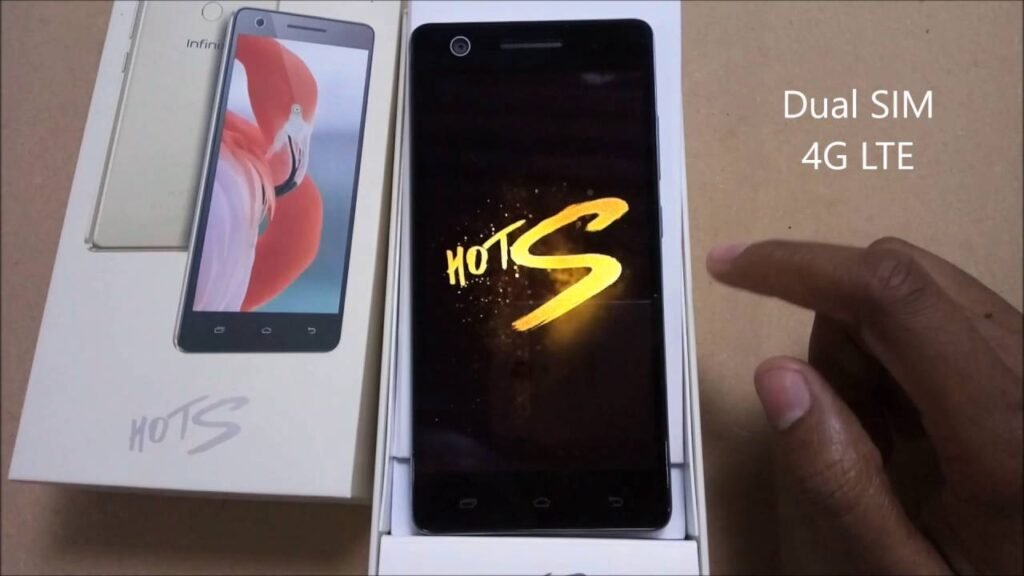
Introduction of Infinix Hot S X521
The Infinix Hot S X521 still gets search traffic for a good reason: it is not just a forgotten old handset, but a phone that remains relevant in the used-device ecosystem. People still look it up because they want a budget second-hand phone, a backup device, or a repairable handset with a compact body and a fingerprint sensor. In 2026, that is the real context for this model. It is no longer a fresh retail product; it is a legacy smartphone that lives on through classifieds, spare parts sellers, and content searches.
Overview of the Infinix Hot S X521
The Infinix Hot S X521 was introduced as the Hot S and is commonly listed with the model identifiers X521, HOT S, and X521_LTE. Launch-era and current device data place its announcement and release in June 2016, and it is now clearly a discontinued model. That means there is no active new retail life here. It is a second-hand phone, a parts-phone, or a nostalgic budget device in the used market.
What made the phone interesting in the first place was not raw power. It was the combination of a compact size, fingerprint unlock, LTE support, a selfie-friendly camera setup, and a design that felt more refined than many ultra-cheap phones of its era. That combination helped it stand out in a crowded budget category. Today, those same traits still shape how the device should be judged: useful for light duty, attractive for affordability, and limited by age.
A good way to summarize the Hot S X521 is this: it is a practical used phone with enough features to remain serviceable, but not enough modernity to compete with current midrange smartphones. In buyer terms, that makes it a value-and-condition story. The actual price you should pay depends far more on battery health, display condition, charging port quality, and cosmetic wear than on the original launch reputation.
Quick Specs Table
| Specification | Infinix Hot S X521 |
| Model name | Infinix Hot S |
| Model aliases | X521, HOT S, X521_LTE |
| Launch | Announced and released in June 2016 |
| Status | Discontinued |
| Display | 5.2-inch TFT, 720 × 1280, 16:9, about 282 ppi |
| Chipset | MediaTek MT6753 (28 nm) |
| CPU | Octa-core 1.3 GHz Cortex-A53 |
| GPU | Mali-T720MP3 |
| RAM | 2GB on many current spec pages; some older sources mention 3GB variants |
| Storage | 16GB |
| microSD | Supported |
| Rear camera | 13 MP autofocus with LED flash |
| Front camera | 8 MP |
| Video | 1080p at 30fps |
| Battery | 3000 mAh, non-removable |
| Charging | microUSB 2.0 |
| Sensors | Rear fingerprint sensor, accelerometer, proximity, compass |
| Connectivity | 4G LTE, Bluetooth 4.0, GPS, FM radio, 3.5mm jack |
| Body | 148.8 × 73.2 × 8 mm |
| Weight | Around 140 g |
| Colors | Pink, Gold, Blue, Gray, Black |
Design and Build
The design of the Infinix Hot S X521 is one of the model’s most noticeable strengths, especially when viewed through a 2026 used-phone lens. The handset was built to feel manageable in the hand, slim enough to look modern for its time, and light enough to avoid the bulky sensation that many older budget phones carried. With dimensions listed around 148.8 × 73.2 × 8 mm and a weight of roughly 140 grams, it sits in a comfortable category for one-handed use.
That size is important for modern buyers who are tired of oversized phones. A compact body can still feel like a genuine advantage, especially for people who want a backup device, a travel handset, or a phone for calls and messaging without the strain of a larger slab. The Hot S X521 is not tiny, but compared with many current devices, it is still fairly restrained and easy to carry.
The control arrangement is straightforward. Volume and power keys are placed on the side, the SIM tray sits in a familiar position, and the bottom edge carries the microUSB port and audio hardware. That kind of layout may not sound exciting, but it matters in everyday usability. Older phones often fail not because they are fancy but because they are awkward. The Hot S X521 avoids that trap by staying readable, conventional, and easy to handle.
Display
The display is a major point of search confusion, so it is worth handling carefully. The most consistent current spec pages list the Hot S X521 with a 5.2-inch TFT panel at 720 × 1280 resolution, giving about 282 ppi. That is a basic HD-class screen by modern standards. It is usable, practical, and fine for routine tasks, but it is not the kind of panel that will impress anyone used to today’s brighter, sharper, higher-refresh OLED screens.
For daily use, the screen is still adequate for reading articles, scrolling social feeds, sending messages, using maps, and watching casual videos. It delivers the kind of visual quality that was acceptable in the mid-2010s budget market. The panel is not built to wow users; it is built to function. That distinction matters because many old phone reviews accidentally sound more flattering than the real-world experience justifies.
There are also older launch-era descriptions that portray the display differently, with some pages using terms like IPS or even FHD. Because those descriptions conflict with more recent spec listings, the safest and most trustworthy editorial position is to acknowledge the inconsistency rather than pretending there is no contradiction. When a device has mixed historical reporting, it is better to tell readers that the web is inconsistent than to force one version as the absolute truth.
From a practical buyer’s perspective, the display is good enough if your expectations are grounded. It should not be treated as a cinematic screen or a premium visual canvas. It is a functional panel on an older budget phone. That makes it suitable for casual use, but not for users who care deeply about brightness, contrast, vividness, or modern display polish.
Performance
The Hot S X521 uses the MediaTek MT6753 chipset, built on a 28 nm process, paired with an octa-core Cortex-A53 CPU clocked at 1.3 GHz and a Mali-T720MP3 GPU. That hardware was serviceable in its time, but in 2026, it is clearly dated. The consequence is simple: the phone is fine for lightweight work, but it is not built for intense multitasking, modern 3D gaming, or heavy app switching.
Memory and storage are other key factors. Many current pages list 2GB RAM and 16GB storage, while some older references and launch-era materials mention 3GB variants in the same family. That kind of mismatch is common in older devices and regional variants. For content writing, it is better to note the conflict than to oversimplify it. For buying advice, the point is even more important: any version with lower RAM will feel more cramped in 2026, particularly with modern apps that demand more memory than before.
In practice, the Hot S X521 should be understood as a basic daily driver, not a productivity monster. It can still function as a second handset or light-use primary phone for a user with modest needs. However, it is not a device for people who expect fast app launches, smooth heavyweight multitasking, or modern gaming responsiveness. That is not a flaw in the context of its age; it is simply a realistic reading of the hardware class.
Camera
Cameras were one of the areas where the Hot S X521 made a stronger impression than many budget phones of its time. The device comes with a 13 MP rear camera with autofocus and LED flash, plus an 8 MP front camera. It also supports 1080p video recording at 30fps. On paper, that is a solid social-media-friendly setup for its generation, especially in the budget category.
The front camera is where the Hot S branding really made sense. The phone was clearly positioned with selfie use in mind, and launch-era reviews repeatedly emphasized the front-facing camera as a headline feature. An 8 MP selfie camera with flash support was a compelling proposition when the device was new. Even now, that camera configuration helps explain why search interest continues. People looking for a used phone often still care about front camera performance for video calls, social apps, and casual photography.
The rear 13 MP camera is more modest by modern standards, but it remains useful for basic documentation, notes, and daylight shots. Daylight performance should be the best-case scenario. That means outdoor images, well-lit indoor scenes, and casual product photos are the situations where the phone is most likely to produce acceptable results. In low light, as with most older budget phones, you should expect more noise, softer detail, and less consistent color accuracy.
Battery and Charging
The battery in the Infinix Hot S X521 is a 3000 mAh non-removable Li-Ion unit. In the mid-2010s, that was a respectable capacity for a compact handset with a 5.2-inch screen. In 2026, the number still sounds decent, but the bigger issue is not the capacity on paper. The real question is Battery Health.
Launch-era material indicated that the phone came with a 1.5A charger and could reach full charge in roughly 2 hours under typical conditions. That was fine for its time. Modern buyers, however, should not treat that as a promise for current used units. Battery wear, cable quality, charging port condition, and the health of the power management circuit can all change the real charging behavior.
Another thing worth noting is how mobile data affects consumption. Older budget phones tend to drain faster under constant 3G or 4G use, streaming, GPS navigation, or extended screen-on time. The Hot S X521 follows that general pattern. It is best thought of as a phone that can manage ordinary daily tasks, not a device designed for all-day heavy endurance in the way larger modern battery phones are.
Software and Update
The Infinix Hot S X521 launched with Android 6.0 Marshmallow. Some pages also reference XOS Chameleon as the software layer on top of Android, which reflects the brand’s interface approach during that period. In a historical sense, that makes sense. In a practical 2026 sense, the important point is that the software is old and support is effectively over.
When a phone reaches discontinued status and stays anchored to a much older Android version, the user experience changes in several ways. App compatibility becomes more limited. Security expectations become harder to meet. Some modern applications may run slowly, behave inconsistently, or require newer OS support than the device can provide. That does not make the phone useless, but it does change how it should be positioned.
The right framing for this model is that it belongs in the legacy Android category. It is not a modern device with a long update runway. It is a used handset for basic tasks, and its software age should be part of the buying decision. Anyone purchasing it should know exactly what they are getting: a dated but still functional phone for simple needs.
This is also where many sellers exaggerate. They may describe the phone in a way that sounds fresher than it is. That is why model verification matters. An accurate listing should mention Android 6.0, discontinued status, and the fact that the device is no longer part of an active support cycle. Buyers deserve clarity, not marketing fog.
Price and Availability
The current market situation is straightforward: the Hot S X521 is no longer a mainstream retail item. Current price pages treat it as discontinued, which means the active market is mostly used phones, old stock, refurbished units, or spare parts.
That does not mean it disappeared. It means the phone moved into a different marketplace. You can still find live classifieds activity for the model or for the broader “Infinix Hot S” search term, and accessory sellers still stock items such as batteries, LCD touch assemblies, back covers, and cases. That is a strong sign that the device remains relevant in the second-hand and repair economy.
This matters for content strategy because readers are usually not looking for a shiny new purchase page. They are trying to decide whether a used unit is worth buying, whether a damaged unit can be repaired, or whether parts are still available. The answer to those questions is usually “yes, sometimes,” but always subject to condition and seller honesty.
Avoiding a fixed-use price claim is smart here. Used pricing is extremely unstable and depends on local conditions, availability, and device condition. A cracked screen, failing battery, weak charging port, or incomplete accessory set can change the value very quickly. Regional differences matter too. In some markets, the phone is almost purely a parts item. In others, it may still circulate as a cheap everyday handset.
A better content approach is to explain the price drivers rather than forcing a single number. Battery health, screen clarity, charging behavior, fingerprint sensor functionality, rear and front camera operation, network compatibility, and cosmetic state all affect value. This is much more useful than presenting a brittle number that could become outdated immediately.
Pros and Cons
Pros
- Compact, comfortable body that is easier to handle than many larger phones.
- Rear fingerprint sensor, which was a notable feature in its class.
- 4G LTE support, microSD support, FM radio, and a 3.5mm headphone jack.
- Still visible in the used parts market.
- Good selfie identity for its era, especially compared with many basic budget handsets.
Cons
- Discontinued and based on an old Android version.
- Older chipsets and memory configurations limit modern performance.
- Used units may suffer from battery wear, charging problems, and display aging.
- Conflicting information exists around RAM and screen descriptions across sources.
- Not suitable for heavy gaming or demanding multitasking.
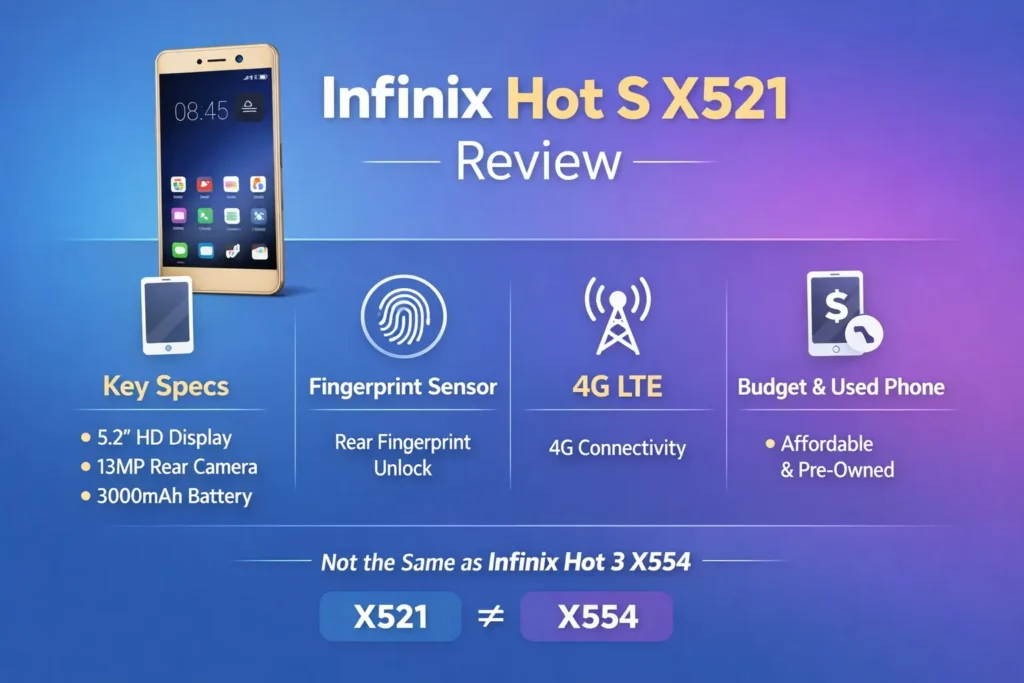
Comparison Note
This is one of the most important clarification points in the article. Many searchers and buyers confuse the Hot S X521 with the Hot 3 X554, but they are not the same device.
The Hot S X521 is the model associated with the Hot S branding, a compact body, a selfie-centered identity, rear fingerprint sensing, and a 2016 launch window. The Hot 3 X554 belongs to a different model line and should not be treated as a direct synonym or substitute. Device identifiers matter in used-phone markets because sellers sometimes list phones loosely, and that creates mistakes.
If you are buying used, the model code should always be checked on the settings screen, the rear casing, the box label, or the device’s system information. Do not rely on a generic title alone. The difference between X521 and X554 is not cosmetic. It can affect everything from specs to compatibility to resale value.
A smart article should make this distinction early, not bury it near the end. That way, users who came in with the wrong search term can correct themselves before making a purchase error.
Who Should Buy the Infinix Hot S X521?
The Hot S X521 is a reasonable choice for a very specific kind of user. It makes sense for someone who wants a cheap used phone for calling, messaging, browsing, WhatsApp, light video playback, and backup use. It also makes sense for people who prefer a smaller handset and appreciate the convenience of a fingerprint sensor and basic repair availability.
The Hot S X521 also works as a repair-friendly option if the price is low enough. If the screen is intact, the battery is healthy, and the charging circuit is stable, it can still be a serviceable Little Machine. That is a perfectly valid use case.
Who Should Skip It?
The Infinix Hot S X521 if you want modern gaming performance, current software support, premium cameras, or long-term OS reliability. Skip it if you expect a bright, modern, high-resolution screen with excellent contrast and a contemporary feel. Skip it if you want a phone that handles heavy multitasking without hesitation.
Also, skip it if the seller cannot prove the model, if the battery looks tired, if the charging port is unreliable, or if the phone has been repaired badly. On an older handset, poor condition can turn a bargain into a headache. The whole point of buying a used legacy phone is getting utility at a low cost. If the device needs too much work, the math stops being attractive.
In short, the Hot S X521 is not a bad phone for everyone. It is simply a phone for the right buyer and the right price.
FAQ
No. Hot S is X521, while Hot 3 is X554. They are different models.
No active retail status is shown now. Current pages label it discontinued, so buyers should treat it as a used or parts-market phone.
It launched with Android 6.0 Marshmallow.
Yes. Current spec pages list a rear-mounted fingerprint sensor.
It has a 3000 mAh non-removable battery.
Final Verdict
The Infinix Hot S X521 remains an interesting legacy smartphone because it sits at the intersection of affordability, compact design, repairability, and niche search demand. It was a meaningful budget device in its own era, and it still has value today as a used phone or a parts-friendly handset. Its strongest traits are clear: compact size, rear fingerprint unlock, 4G LTE, a selfie-oriented camera setup, and visible spare-parts support. Its weaknesses are equally clear: old software, dated hardware, limited memory by modern standards, and the natural wear that comes with age. That combination means the device is no longer a mainstream recommendation, but it can still be a smart buy under the right conditions.
