
Introduction
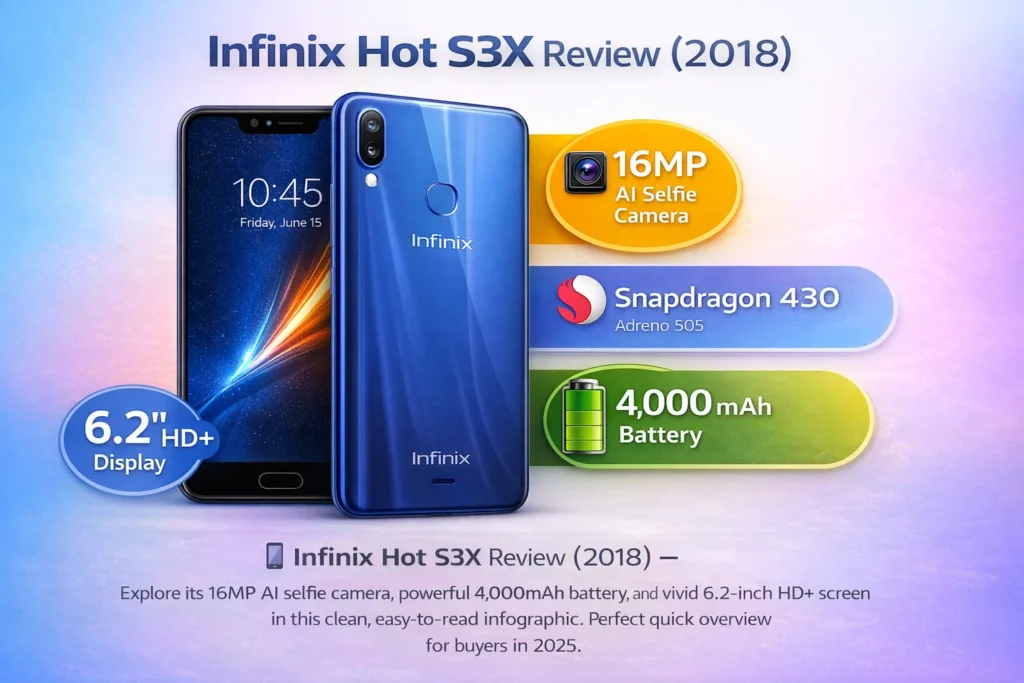
The Infinix Hot S3X is a budget selfie handset with a robust 16MP front imager, a capacious 4,000 mAh power cell, and a comfortable 6.2″ HD+ display. It excels at daylight selfies and endurance, but the Snapdragon 430 chipset and Android 8.1 operating environment make it limited for future-facing updates and demanding workloads. Best suited as an economical daily device or a secondary phone.
What’s new / Who it’s for
What’s new: Launched in 2018, the Hot S3X prioritized selfie performance and long battery endurance at a very low price point.
Who it’s for: Value-conscious buyers who mostly use social apps, love daytime selfies, and prefer long battery life; also, people seeking a cheap spare handset.
Design & build
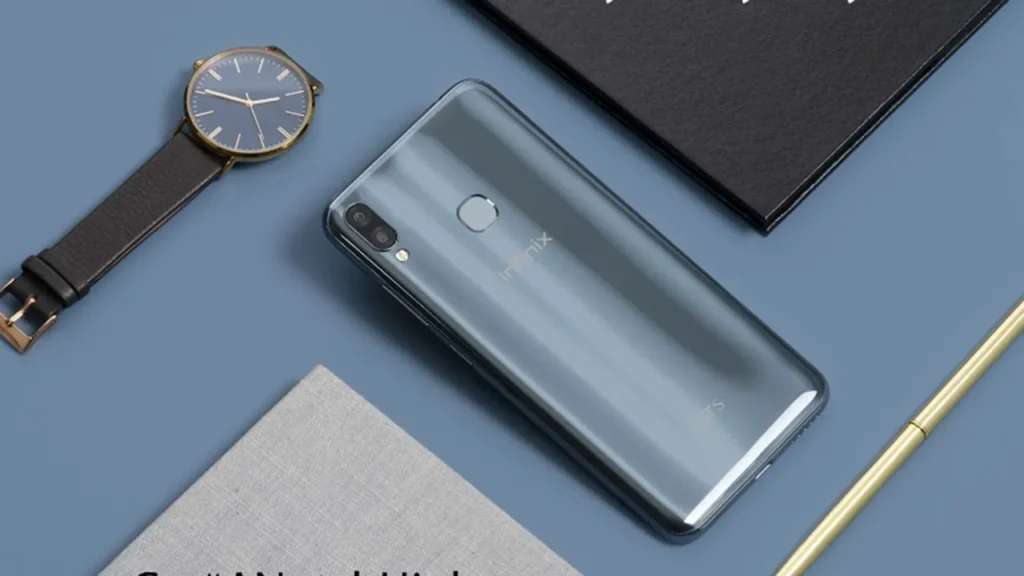
From an engineering and human-computer interaction perspective, the Hot S3X follows the pragmatic constraints of budget product design circa 2018. The device adopts the contemporary tall aspect ratio (19:9) with a small notch to maximize display area while keeping the chassis small enough for one-handed use. Materials are chosen for cost efficiency: a 2.5D front glass sits over a plastic frame and plastic back cover. The fingerprint sensor is rear-mounted above a modest camera island — a familiar layout that cuts manufacturing complexity.
Practical checklist for buyers: verify the exact colorway and trim for the market you’re buying in; small differences in finish and antenna placement exist across regions. Check for factory tolerances: minor gaps and flex can exist in low-cost assemblies — ensure the device has even panel fitment.
Display
Specification recap: 6.2-inch IPS LCD, 1500 × 720 (HD+). The pixel density is modest, producing a softer text rendering than contemporary FHD panels. For most social and multimedia consumption at typical viewing distances (30–40 cm), the perceived sharpness is acceptable; however, power users who read dense text, edit photos, or scrutinize small UI elements will notice aliasing and reduced clarity.
Color and tone: The panel has a slightly warm color temperature on average. Contrast ratios and peak brightness are serviceable for indoor environments; outdoor visibility under strong sunlight is constrained. The wide viewing angles of IPS reduce color shift for communal viewing.
Usage implications: For streaming short videos, social feeds, and web browsing, the screen suffices. For long document reading, e-book use, or high-definition video appreciation, prioritize a used phone with full HD. For UX designers or photography editors, the display won’t provide the color accuracy needed for serious adjustments.
Camera
The Hot S3X’s marketing emphasis is front-facing capture. In practical evaluative terms, the front 16MP module is the device’s highest value proposition.
Front camera
- Daylight: Produces bright, contrasty selfies with pleasing skin tones tuned toward social Media Aesthetics. The image processing leans toward punchier output, which often results in higher apparent sharpness and saturation than raw sensor data would indicate.
- Beautify & smoothing algorithms: Aggressive by default in the XOS camera app; these algorithms perform local texture suppression and tone mapping to create an image many users prefer for portraits. For accurate skin reproduction, disable or reduce the beautify strength.
- Low light: Lacks a hardware flash; instead uses the screen as a fill light. This technique provides visibility but does not supply the directionality or intensity of a dedicated flash, producing images with elevated noise levels and limited detail retention.
Rear camera
- Daylight: Acceptable captures with generally accurate color rendition but limited dynamic range. Detail level is appropriate for social posts and casual archiving.
- Portrait & depth extraction: The depth sensor enables bokeh effects, but segmentation errors and haloing around hair and complex edges are common in the class.
- Low light & video: Low-light performance is weak; video capture is serviceable at 1080p but lacks optical/electronic stabilization, so handheld clips can appear shaky.
Performance & benchmarks
SoC architecture: Qualcomm Snapdragon 430 — an entry-level octa-core SoC tuned for efficiency. CPU performance and GPU throughput are constrained relative to newer midrange chips. In terms of system modelling, the device fits a use-case graph dominated by low concurrency and light compute.
Memory and storage: 3GB or 4GB RAM tiers; storage options are 32GB or 64GB with microSD expansion. The memory bandwidth and available working set influence multitasking behavior — opt for 4GB where possible to minimize background app termination and page faults.
Everyday experience: Messaging, social networking, music streaming, email, and light web browsing fall comfortably within system capacity. Heavy multitasking, content creation workflows, and modern 3D gaming stress the SoC and produce perceptible UI lag and frame drops. Long gaming sessions increase thermal load and may trigger throttling.
Empirical rule-of-thumb: If your device usage includes multiple high-memory apps in parallel (e.g., Chrome with many tabs + Instagram + a music player + a messaging app), expect background process churn and app reload frequency — choose the 4GB variant or a newer model.
Battery life & charging
Specification: 4,000 mAh power cell — this is a competitive advantage in the budget segment of the era.
Real-world expectations: For a typical day of mixed usage (messaging, notifications, short streaming, light navigation), the handset comfortably achieves a full day of use, often stretching to 1.25–1.5 days under light activity. Screen-on time metrics typically range from 5 to 8 hours based on brightness, Cellular Workload, and background sync.
Charging profile: Charging over microUSB is slower than contemporary fast-charging solutions; the power delivery curve lacks high-wattage charging phases, so full replenishment takes longer. This affects rapid top-ups during short breaks.
Optimization heuristics:
- Adopt the 20–80% charging habit where practical to marginally improve cell longevity.
- Disable always-on background sync for battery-hungry, seldom-used apps.
- Use Wi-Fi instead of cellular data for heavy streaming when possible.
- Lower display refresh and brightness for extended SOT.
Software & updates
Baseline OS: Android 8.1 with Infinix’s XOS overlay. The overlay provides additional features and theming options, but also adds OEM apps and background services that can influence memory and battery. As of 2025, a 2018 device running Android 8.1 is unlikely to receive meaningful platform updates or consistent security patches.
Security & privacy implications: Running older OS versions increases exposure to known vulnerabilities and compatibility issues with newer apps that expect later Android APIs. If you plan to keep the handset for sensitive tasks (banking, two-factor apps), verify that critical apps still support Android 8.x and consider additional security hygiene such as limiting app permissions.
Comparison with rivals
When evaluated against contemporaneously used phones from Redmi, Tecno, and other mass market brands, the Hot S3X occupies a specific niche: selfie emphasis + battery longevity. Some rivals trade off the selfie sensor for a better SoC or FHD panel.
Comparative table:
- Selfie camera: Hot S3X (16MP) — strong; rivals vary (8–16MP).
- Rear camera: Hot S3X (13MP + depth) — serviceable; some rivals use superior sensors.
- Battery: Hot S3X (4,000 mAh) — favorable; rivals may be similar or smaller.
- Display: Hot S3X (HD+) — less sharp; rivals sometimes offer FHD.
- Performance: Hot S3X (Snapdragon 430) — entry-level; rivals may have newer SoCs.
- Software: Hot S3X (Android 8.1) — dated; rivals may have later Android versions.
Practical buying insight: If selfies and battery are priorities and you’re price-sensitive, the Hot S3X is a defensible choice. If you want longevity, security updates, or sharper displays, spend a bit more for a later-generation used device.
Should you buy it in 2025?
Buy if:
- You primarily use your handset for social apps and selfies.
- You require excellent battery endurance on a shoestring budget.
- You want a reliable backup phone for travel or emergencies.
Avoid if:
- You need an FHD display for content consumption or reading.
- You require timely Android security updates or longevity.
- You play modern, high-performance 3D games frequently.
Buying checklist:
- Prefer the 4GB/64GB configuration.
- Request or test battery health; if used, confirm SOT and charging cycles.
- Inspect the screen for dead pixels and touch responsiveness.
- Test front and rear cameras in daylight and low light.
- Confirm the micro-USB port and headphone jack function.
- Verify IMEI/serial for blacklisting and carrier locks.
- Buy from sellers who offer return policies or short warranties where feasible.
Pros & Cons
Pros
- 16MP front camera gives notably good daylight selfies.
- 4,000 mAh battery yields excellent longevity for the price class.
- Affordable in secondary/used markets.
- Lightweight ergonomics and simple UI for non-power users.
Cons
- Snapdragon 430 constrains performance for modern apps and gaming.
- HD+ display lacks the crispness of FHD panels.
- Ships with Android 8.1 — limited update path; potential security concerns.
- Charging is comparatively slow due to the microUSB architecture.
FAQs
A: Yes. The 16 MP front camera is one of the phone’s best features, especially in good light.
A: The 4,000 mAh battery usually gives a full day and sometimes 1.25–1.5 days for moderate users.
A: Yes. It has a microSD slot (check your specific model for tray configuration).
A: Casual games run fine. Heavy modern titles will struggle due to the Snapdragon 430.
A: It’s okay for streaming and social feeds, but the HD+ screen is softer than FHD displays.
Conclusion
Infinix Hot S3X is a pocketable budget selfie powerhouse with a 16MP front camera and a 4,000 mAh battery. Great for social users and as a spare device; avoid it if you need modern Android updates, fast charging, or heavy gaming capability.
