
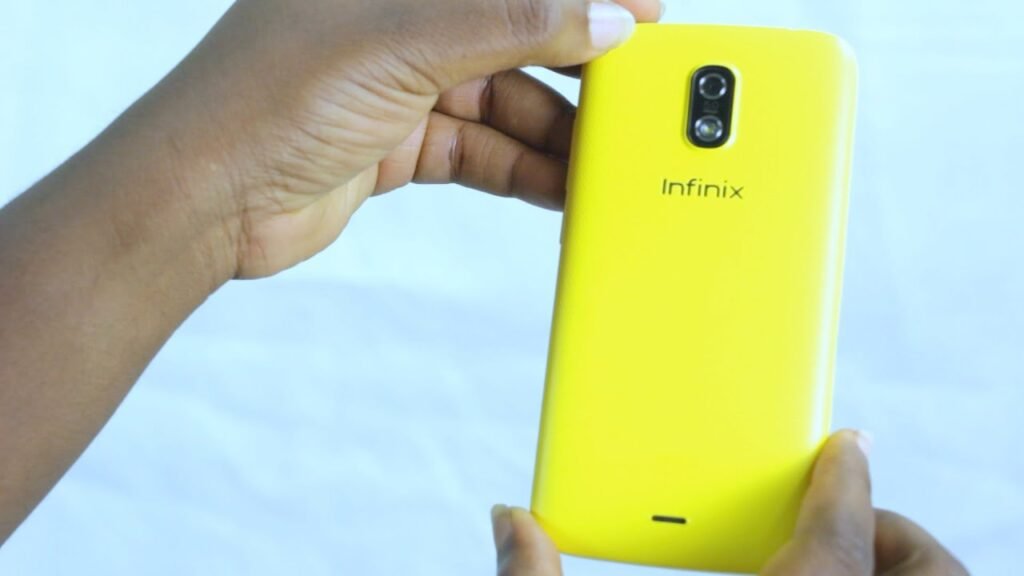
Introduction of Infinix Hot X507
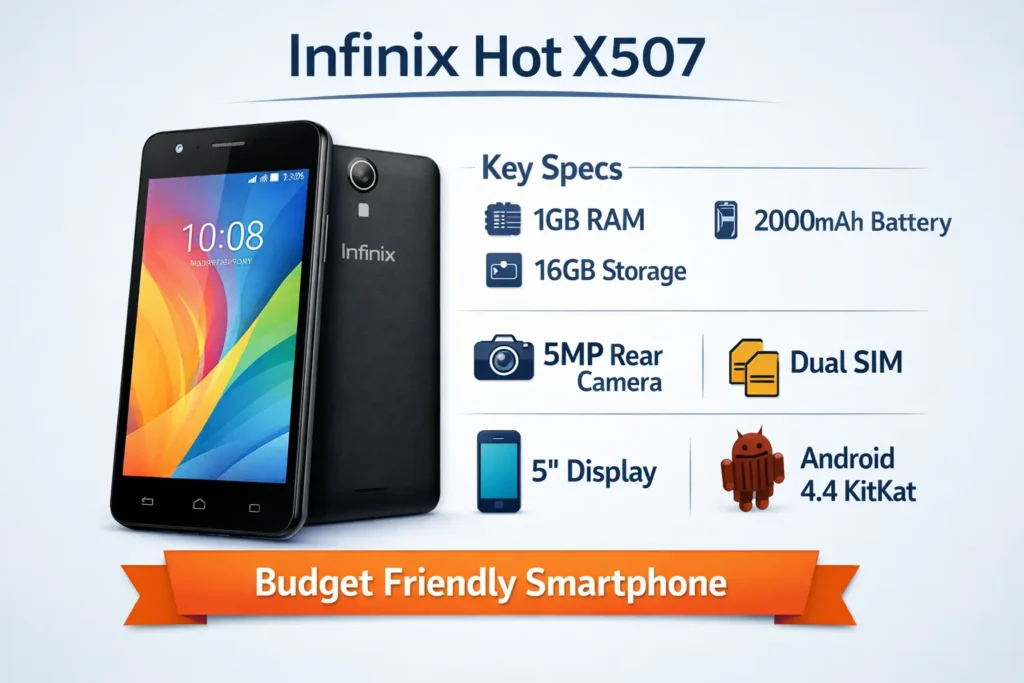
The Infinix Hot X507 belongs to the 2014 budget-phone generation. It ships with Android 4.4.2 KitKat, a 1.3GHz quad-core MediaTek MT6582 chipset, 1GB RAM, 16GB internal storage, a 5.0-inch IPS display, a 5MP rear camera, a 2MP front camera, and a 2000mAh battery. It supports 3G, but not 4G. Those facts already tell you a lot. This was never intended to be a powerhouse. It was made for affordable, everyday communication, light browsing, casual media, and basic app use.
What is the Infinix Hot X507?
The Infinix Hot X507 is one of Infinix’s earlier budget Android models. It was designed for users who needed a functional phone at a low price, not a premium device with cutting-edge speed or a flagship-level camera system. In the market it entered, value mattered more than glamour. Buyers wanted a decent screen, reasonable storage, dependable calling, and basic app support without spending heavily.
For its time, the Hot X507 offered a sensible balance. The 5.0-inch display was large enough to feel modern in 2014. The 16GB storage was a helpful advantage in the entry-level segment. The dual SIM support made it practical for people juggling work and personal numbers. The 2000mAh battery was not enormous, but it was serviceable for light to moderate use. The phone was built to be useful first and impressive second.
Today, however, the conversation changes. A 2014 budget phone is no longer a contemporary all-rounder. It is now better thought of as a used phone, secondary handset, collector item, or repair project. It can still work for very light tasks, but it is not a serious option for a modern app-heavy life. That is the honest answer behind the search query Is Infinix Hot X507 worth buying. The answer is yes only under narrow conditions: low price, simple needs, and acceptable battery condition.
Infinix Hot X507 full specifications
| Category | Details |
| Model | Infinix Hot X507 |
| Announcement | November 2014 |
| Network | 2G, 3G, no 4G |
| SIM | Dual mini SIM |
| Display | 5.0-inch IPS LCD, 480 × 854 pixels, about 196 ppi |
| Build | Plastic body, around 160g |
| OS | Android 4.4.2 KitKat |
| Processor | 1.3GHz quad-core ARM Cortex-A7 |
| Chipset | MediaTek MT6582 |
| GPU | Mali-400 MP2 |
| RAM | 1GB |
| Storage | 16GB internal, microSD up to 32GB |
| Rear camera | 5MP, LED flash, autofocus, digital zoom |
| Front camera | 2MP |
| Battery | 2000mAh Li-Ion |
| Connectivity | Wi-Fi, Bluetooth 4.0, GPS, microUSB 2.0, FM radio |
| Sensors | Accelerometer, proximity sensor |
These numbers form the technical backbone of the article, but the numbers alone do not tell the full story. The most important interpretation is simple: this device was built around modest hardware, and modest hardware has limits. 1GB RAM means multitasking is restricted. Android 4.4.2 means modern app compatibility is reduced. 480 × 854 resolution means the screen is functional, but not sharp by current standards. No 4G means the mobile data experience is dated relative to current expectations.
That is why a strong Infinix Hot X507 specs page should not just repeat the spec sheet. It should help the reader understand where the phone is still acceptable and where it will struggle.
Design and build quality
The design of the Infinix Hot X507 is straightforward, practical, and very much rooted in budget-phone thinking. It uses a plastic body, rounded edges, and a shape that was meant to feel comfortable rather than luxurious. At roughly 160 grams, it is light enough to handle easily. The dimensions also make it relatively compact compared with the oversized phones many users carry today.
This kind of design has a certain honesty to it. It does not pretend to be a premium glass slab. Instead, it aims to be approachable and easy to hold. In the 2014 budget segment, that was a meaningful advantage. Many users cared more about grip, portability, and durability than about shiny materials. A plastic shell also made the device less intimidating for people who dropped phones often or used them in rougher environments.
The removable back cover is another detail that matters. On older phones, replaceable backs often made maintenance easier. Users could open the device more easily, swap batteries in some variants, or inspect the internal condition without complicated disassembly. That kind of design feels dated now, but in its era, it was convenient.
Display
The Infinix Hot X507 has a 5.0-inch IPS LCD with a resolution of 480 × 854 pixels. By current standards, that is a low-resolution panel. But in 2014, it was still good enough for a budget handset, especially one focused on basic utility rather than visual refinement.
The screen size is one of its strengths. A 5-inch display feels manageable without being tiny. For reading messages, checking social apps, making calls, watching simple videos, and navigating menus, the size is practical. It hits a sweet spot between compactness and usability. That is part of why the phone was appealing when it launched.
The weaker point is clarity. With a pixel density of around 196 ppi, fine details are not especially crisp. Text is readable, but not sharply rendered. Images and icons can look a bit soft. If you compare it side by side with an HD or Full HD display, the difference is obvious. That is not a defect in the phone’s identity; it is simply the reality of its display class.
For everyday use, the screen is still serviceable. It can handle calls, messages, simple web browsing, and light app use without major trouble. However, if a user expects rich visual quality, precise typography, or modern media sharpness, the panel will disappoint. That is why a realistic Infinix Hot X507 display review should avoid hype and instead explain the balance between convenience and limitation.
The display is best summarized this way: it is large enough to be comfortable, but not sharp enough to feel modern.
Performance and gaming test
The Infinix Hot X507 performance story is built around the MediaTek MT6582 chipset, the 1.3GHz quad-core Cortex-A7 processor, the Mali-400 MP2 GPU, and 1GB RAM. When this phone was new, that combination was respectable for entry-level use. It was never a premium configuration, but it was adequate for basic smartphone tasks.
In daily operation, the phone could manage calling, texting, light browsing, simple apps, music playback, and a modest amount of multitasking. For its class, it was not unusable or frustratingly weak. Old-era reviews often gave it credit for doing more than expected in ordinary use. That matters because many budget phones from that period struggled to maintain stable performance even on simple tasks. The Hot X507 was good enough to feel usable for its audience.
Modern expectations, however, are much higher. Apps are heavier. Background services are more demanding. Social platforms consume more memory. Browsers are more resource-intensive. In that environment, 1GB RAM becomes a true bottleneck. Even if the chipset can still handle simple actions, the memory ceiling limits the user experience. You can open fewer apps, switch between tasks less smoothly, and expect more waiting.
That is the core point for the Infinix Hot X507 performance keyword. It is not about whether the phone was fast for 2014. It is about whether it feels fast now. The answer is no, not by current standards. It is suitable only for minimal usage.
Infinix Hot X507 gaming test
If the question is the Infinix Hot X507 gaming test, the answer has to be practical and honest. It can handle very light games and older casual titles. It is not a good match for modern 3D games, Graphically Heavy shooters, or anything that expects smooth frame delivery from aging hardware.
Light games may still launch and run acceptably if they are simple enough. But the experience will be constrained by old graphics hardware, limited RAM, and the general age of the platform. Long play sessions are not ideal. Load times may be slow. Frame drops may appear. Memory pressure can make the experience uneven. That is not speculation; it follows directly from the device’s hardware profile.
A useful way to think about it is this: the Hot X507 can still be a “casual game phone,” but only in a very narrow sense. It is not a serious gaming handset.
Camera
The camera setup on the Infinix Hot X507 is simple: a 5MP rear camera with LED flash and autofocus, plus a 2MP front camera. That is a very modest imaging system by modern standards, but it was normal for budget phones in the period when this device launched.
The rear camera is usable for straightforward snapshots, especially in good light. That is the key phrase: good light. In daylight, the camera can produce images that are acceptable for casual documentation, quick memories, or basic sharing. The front camera is fine for low-demand selfies and video calls, though it is not designed to impress.
Where the camera shows its age is in difficult lighting. Indoor shots can look soft. Low-light images can become noisy. Detail retention is limited. The dynamic range is narrow. Zoom is weak. These are the natural limitations of a small sensor and basic processing hardware. They are also the reason many old budget phones feel disappointing if judged by current social-media standards.
A strong Infinix Hot X507 camera review should therefore avoid pretending the device is a camera phone. It is not. It is a functional camera for basic use, and that distinction matters. Users who need consistent photo quality, clean night shots, or content-creation reliability should look elsewhere.
Camera expectations by use case
| Use case | Expectation |
| Daylight photos | Usable, basic quality |
| Indoor shots | Average to weak |
| Night shots | Weak |
| Selfies | Simple, okay for calls |
| Video | Basic recording, not modern-quality footage |
This is one of the major areas where competitors often lose trust. They stop at “5MP camera” and assume the number tells the whole story. It does not. The real-world result depends on sensor quality, software processing, lighting, and the age of the device. On the Hot X507, those factors place the camera firmly in the “adequate for casual use” group.
Battery life and charging
The Infinix Hot X507 uses a 2000mAh Li-Ion battery. That number may look small now, but battery capacity should always be read alongside the rest of the hardware. A phone with a modest screen resolution and efficient, low-end components can stretch a smaller battery further than a more demanding device.
In its own era, the battery was generally viewed as workable. It was not extraordinary, but it could serve typical users reasonably well. Light users could get through the day. Heavier users might need a recharge sooner. That balance made sense for a compact, budget-focused model.
The modern angle is different. Since the phone is now old, battery health becomes just as important as battery capacity. A 2000mAh battery that has aged for years may no longer behave like a fresh battery. If the unit has not been replaced, real endurance may be noticeably lower than launch-era reports suggest. That is a logical inference based on the age of the device.
A practical Infinix Hot X507 battery test interpretation looks like this:
- Calls and texts: generally manageable
- Light browsing: acceptable
- Music and simple apps: okay
- Long gaming or extended screen-on use: not ideal
- Used unit with degraded battery: likely needs replacement
For a used buyer, this matters a lot. A weak battery can turn a still-functional phone into a frustrating one. If you are considering this device, battery condition should be one of the first things you inspect.
Software and daily use
The phone runs Android 4.4.2 KitKat, which was fine in 2014 but is now very old software. That single detail has major implications. Even if the hardware were stronger, software age alone would limit the device. With both age and limited hardware combined, the restrictions become more obvious.
For simple daily use, the Hot X507 can still perform basic tasks. Calling, SMS, simple browsing, offline entertainment, and old-style app behavior are still within its comfort zone. But modern smartphone life is much more demanding. Many apps assume newer Android versions, more memory, and better background handling. Security expectations are also much higher now.
That means the phone is not a strong candidate for modern banking workflows, feature-rich social media use, or current productivity apps. Even where an app installs, performance and compatibility may be uneven. That is why the Infinix Hot X507 review has to be framed differently from reviews of current models. This is not about comparing it to a 2026 budget smartphone on equal footing. It is about recognizing that the software stack itself belongs to another era.
Old phones also tend to include helpful built-in utilities such as calendars, calculators, document tools, and FM radio. Those features sound minor now, but they mattered in earlier budget devices because they made the phone more self-contained. For a user who only wants a spare handset or a simple offline device, such extras can still be nice.
Price and availability
When new, the Infinix Hot X507 was positioned as a low-cost smartphone. Historical coverage placed it in the budget category, with older regional pricing examples appearing in different markets. Those figures are useful only as launch-era context. They are not a current retail benchmark.
Today, the better way to discuss the Infinix Hot X507 price is through used-device logic. Because the model is old, there is no meaningful “new” market value in the ordinary sense. Current price depends on several variables: physical condition, battery health, working charger, screen quality, storage condition, whether the port is intact, and whether the device is being sold as a functional spare or as a collectible.
That means the same handset could be worth very different amounts depending on condition. A clean, working device with a decent battery will naturally hold more value than a worn unit with a weak cell or damaged charging port. This is a normal pattern in the used-phone market. It is especially true for older phones that do not offer modern network support or current software.
So, for content purposes, the most honest approach is not to give a fake “current retail price” that will age badly. The wiser move is to explain that the phone is a very low-cost used item and that buyers should judge value by condition and intended use.
Buying guide for used units
If someone is considering the Infinix Hot X507 as a used phone, the buyer’s checklist should be practical and strict. Old devices can still be useful, but only if key parts are healthy.
Check the following before buying:
- Battery health and charging speed
- Charging port firmness
- Screen brightness and touch responsiveness
- Speaker and microphone quality
- SIM detection and call stability
- Storage health and system responsiveness
- Physical cracks, scratches, and cover fit
- Button feel and overall body condition
The battery matters especially because older phones often fail at the endurance level before they fail at the hardware level. A phone can still power on, but it can still be frustrating if the battery drains too fast. Similarly, a charging port that wobbles or disconnects easily can make the handset annoying to use, even if everything else seems fine.
A used Hot X507 makes sense only if the buyer understands its role. It should be treated as a backup, spare, light-duty, or experimental device. If the expectation is modern speed, modern camera quality, modern security support, or strong app compatibility, the phone will not satisfy.
That is the real meaning of a good Infinix Hot X507 used phone guide. It protects the reader from buying based on nostalgia alone.
Pros and cons
Pros
- The 5-inch screen feels comfortable and practical
- Dual SIM support is useful for everyday flexibility
- 16GB internal storage was strong for a budget phone in its era
- Battery capacity was acceptable for basic tasks when new
- The lightweight plastic body is easy to handle
- Simple and straightforward to use
- Replaceable back cover made old-style maintenance easier
Cons
- Only 1GB RAM
- No 4G support
- Very old Android version
- Low screen resolution by current standards
- Basic camera quality
- Limited gaming and multitasking ability
- Used units may have worn batteries
- App compatibility is limited to modern software
Who should buy it today?
This is one of the most important sections in the entire guide because the right audience determines the value of the phone.
The Infinix Hot X507 may still make sense for:
- People who need a very basic calling phone
- Users who only want light messaging and simple browsing
- Buyers looking for a cheap backup handset
- Repair enthusiasts and refurbishing hobbyists
- Collectors interested in early Infinix models
- Anyone who needs an old spare phone for occasional use
It is not a strong choice for:
- Gamers
- Camera-focused users
- Heavy social media users
- People who need 4G
- Users who expect modern Android behavior
- Anyone relying on demanding current apps
- Buyers who want a phone for long-term primary use
That distinction matters because many older phones can still be “usable” without being “good buys.” The Hot X507 sits in that space. It can still function, but only for narrow needs.
Infinix Hot X507 vs similar budget phones
When readers compare the Infinix Hot X507 vs similar budget phones, they are usually comparing it with other phones from the same generation rather than with today’s devices. In that older budget landscape, the Hot X507 had some real strengths.
Its 5-inch display, dual SIM support, and 16GB storage made it competitive at the price level where it was sold. Many budget phones in that period had less internal storage or weaker everyday usability. The Hot X507 offered enough practicality to stand out.
At the same time, later budget models improved in almost every area that now matters most: RAM, screen resolution, battery size, app support, data speed, and camera consistency. That is why the Hot X507 feels dated if you measure it against current expectations. The generation gap is simply too large.
The simplest way to explain the comparison is this:
- For its time, it was a decent budget option.
- For today, it is only a basic backup or collector device.
Is the Infinix Hot X507 still worth buying?
Here is the clearest answer to Is Infinix Hot X507 still worth buying:
It is worth buying only if the device is very cheap, in good physical condition, and intended for simple use. If you need it for calls, texts, and occasional light browsing, it can still make sense as a backup or secondary phone. If you want a modern smartphone experience, it is not worth buying.
That is the most balanced verdict because it respects the device’s age without dismissing its usefulness entirely. Some older phones still have a narrow purpose, and this one fits that pattern. But the use case has to be realistic. A phone from 2014 will not suddenly behave like a 2026 device just because it still powers on.
The best purchase decision depends on the buyer’s expectations. Low expectations and low price make the Hot X507 more acceptable. High expectations make it a poor choice.
FAQs
No. The Infinix Hot X507 supports 2G and 3G, but it does not support 4G.
It has 1GB of RAM.
The battery capacity is 2000mAh.
Only for very light or older games. It is not a good choice for modern gaming because it has an older chipset, 1GB RAM, and basic graphics hardware.
Yes. It supports dual mini SIM cards.
Final verdict
The Infinix Hot X507 was a sensible budget phone in its own time, but it is now firmly an older-device product. Its strengths were practical rather than flashy: a comfortable 5-inch screen, dual SIM support, decent storage for the era, and a usable battery when new. Its weaknesses are equally clear: low RAM, no 4G, an outdated Android version, basic cameras, and limited performance by modern standards. If your audience is searching for an Infinix Hot X507 review, the best article is not the one that just repeats the specs and then moves on. The best article is the one that tells readers what those specs mean in daily life. That is how you create a pillar page that feels more complete than competing content.
