
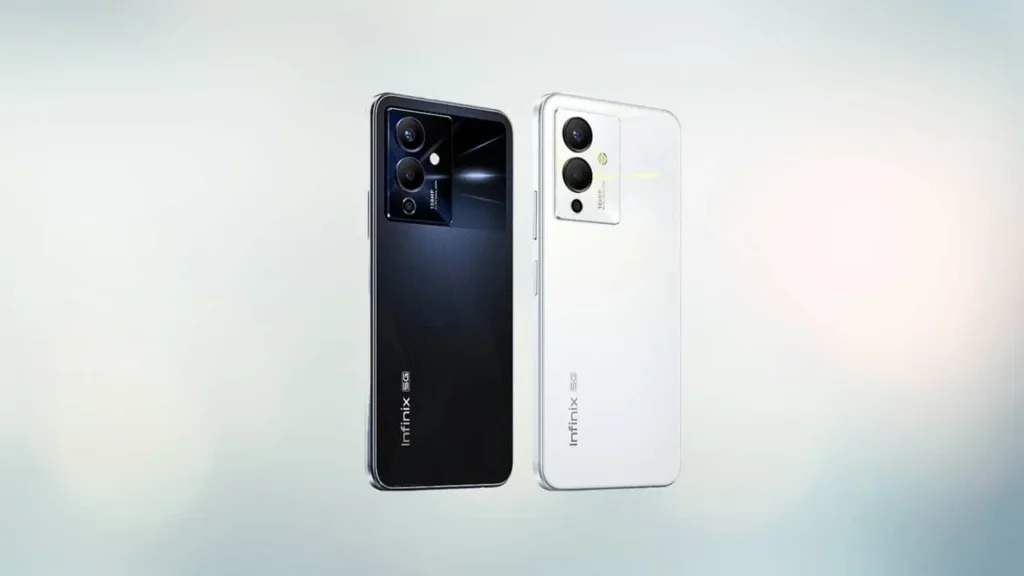
Infinix Note 12 5G
Infinix Note 12 5G review demonstrates a device that includes a 6.7″ AMOLED, MediaTek Dimensity 810 (5G) and a 5,000 mAh battery with 33W charging into a low-priced package. This is great as a media device, offering extended battery life, and it provides decent daylight shots at the price. However, the poor performance in low-light scenarios and the bloated software (XOS) make it too much of a one-trick pony.
What you need to know
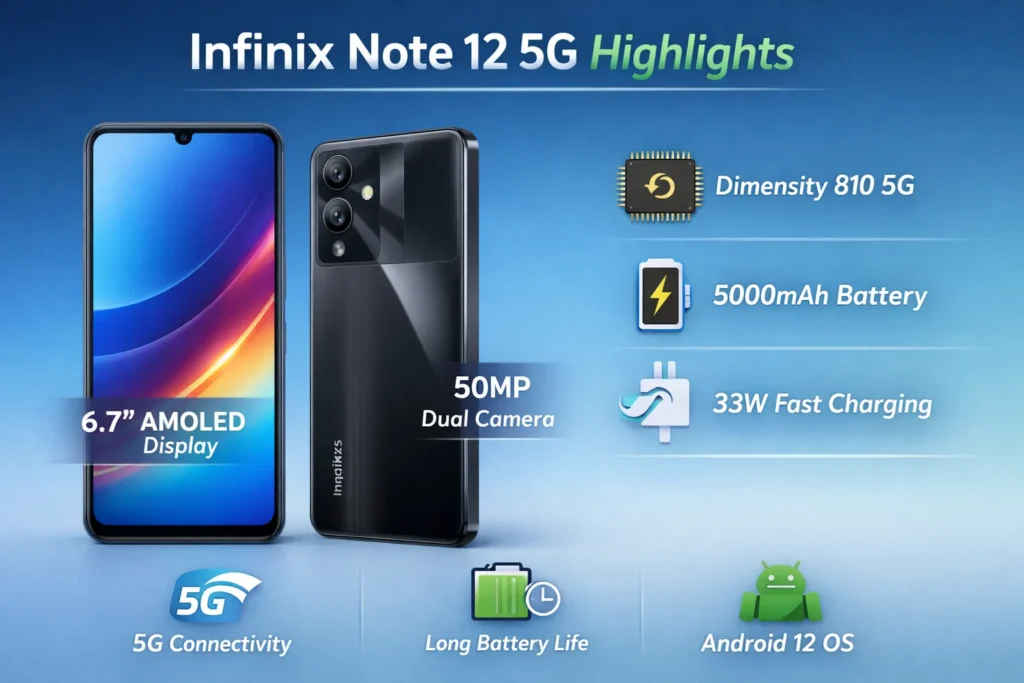
- Display: 6.7″ AMOLED, 2400×1080 (FHD+) — vivid colours, deep blacks.
- SoC: MediaTek Dimensity 810 (5G) — efficient mid-range 6 nm chip.
- RAM / Storage: Typical retail 6 GB / 64 GB (variants: 4/64, 8/128); microSD support on some SKUs.
- Rear cameras: 50 MP main + 2 MP depth (no ultra-wide on base SKU).
- Front camera: 16 MP in-display selfie.
- Battery & charging: 5000 mAh with 33W charging included.
- OS: Android 12 with XOS skin (build varies by region).
- Extras: Side-mounted fingerprint, stereo speakers (DTS on some SKUs), 5G support.
Design & Build
The Infinix Note 12 5G is a surprise: although it has a 5,000 mAh battery, it is relatively slim and light. The SD-like size and perfectly balanced weight distribution allow using it in a one-hand long-session (streaming, reading). This is commonly built of a plastic frame and back into which a glass surface is integrated (Gorilla Glass 3 on most SKUs). Buttons and ports are positioned where they should be – USB-C to charge the gadget; a 3.5 mm jack may or may not be there, depending on the region and SKU. The fingerprint scanner is placed on the side (fast and works in most situations), and the face unlock can be used.
Practical note: shoot hero images front, back, and at a 45° angle. Output retina PNGs (~2000 px) and provide meaningful ALT text optimised for the focus keyphrase: “Infinix Note 12 5G front view — 6.7-inch AMOLED”.
Display
The 6.7″ AMOLED panel is the phone’s strongest selling point. Against budget IPS rivals, it looks premium: deeper blacks, punchier colours, and excellent contrast for movies and social media content.
Tests you should run.
- Max nits (outdoor peak): shows usability in bright sun.
- sRGB / DCI-P3 coverage: colourimeter readings prove how the colourimeter is for photo/video work.
- Reflectance & contrast: measures how much surface reflection reduces visibility outdoors.
- PWM / flicker check: important for sensitive users.
Display: 6.7″ AMOLED, 1080×2400 (FHD+). Excellent for streaming — deeper blacks and richer contrast than IPS rivals. Expect vivid, punchy previews that look great on social feeds.
Performance
The MediaTek Dimensity 810 is a 6 nm mid-range chip focused on Efficiency. For browsing, social apps, and light gaming, it’s perfectly adequate. However, for sustained heavy loads (30-minute benchmarks or long gaming sessions), expect thermal throttling and reduced frame rates.
Tests to run and include
- Geekbench (single/multi) — compare with rivals (e.g., Redmi, Realme).
- GFXBench — short scene and long scene for thermal behaviour.
- 30-minute sustained CPU/GPU loop — capture throttling curve, temperature, and performance dips.
- Real gaming logs (PUBG / COD Mobile) — average FPS and 1% lows, with frame-time charts.
Example gaming methodology
- Set brightness to 50% (or a fixed 150 nits) to standardise tests.
- Enable airplstandardise remove network variability.
- Run a 30-minute session of PUBG on medium/HD and log temperatures and FPS. Repeat on rivals for apples-to-apples comparison.
Camera
Overview of the camera system
- Primary: 50 MP main sensor (daylight strength; detail when cropping).
- Secondary: 2 MP depth sensor (improves bokeh separation but not a substitute for a real wide or tele).
- Selfie: 16 MP in-display module.
Strengths: Solid daylight detail, pleasing colours on AMOLED previews, social-ready images.
Weaknesses: Aggressive NR and sharpening that can remove skin texture in low light; night shots are softer than class leaders. No ultra-wide on base SKU — framing limitations.
Sample gallery captions
- Daylight cityscape — crisp detail and strong contrast on AMOLED preview.
- Portrait close-up — natural skin tones; reliable edge detection.
- 2× crop — still readable detail, though sharpening halos are visible.
- Indoor daylight — colours hold well under warm LED.
- Golden hour — warm tonal boost, great for Instagram-ready frames.
- Night mode long exposure — brighter shadows but softer textures.
- Low-light street scene — visible noise reduction tradeoffs.
- Portrait bokeh — pleasing separation; background blur varies.
- Macro-ish close crop — good fine detail but limited focusing distance.
- Video 1080p60 walk test — EIS helps; avoid 4K for shaky handheld shots.
- HDR scene — highlights are retained fairly well.
- Streaming sample (AMOLED) — deep blacks and fantastic contrast for movies.
Recommended camera settings
- Mode: Night mode for scenes under ~3 lux.
- ISO: Auto (or keep ≤800 if manually adjustable).
- Shutter: 1/10–1/4s handheld with Night mode; use a tripod for longer exposures.
- Focus: Tap-to-focus; avoid digital zoom in low light.
- Pro tip: If RAW is available, export RAW and apply selective denoising/sharpening for better results.
Video & stabilization
- 1080p60 is the practical sweet spot — EIS does a decent job at smoothing walks and pans.
- 4K is possible but lacks the same level of electronic image stabilisation — handheld 4K will show more judders.
- For steady long pans, use a gimbal or stick to 1080p60 for best results.
Battery & charging
What to test
- SOT at 150 nits: video loop, web browsing, and gaming split (suggest 50% video / 25% web / 25% gaming).
- Charging curve: log 0→100% in 15-minute buckets (0–15, 15–30, 30–45…).
- Standby drain: overnight in aeroplane mode vs normal day usage.
Software & Updates
The Note 12 5G ships with Android 12 + XOS. XOS includes many extra apps and value-add features, but also some preinstalled content that many users consider bloat. For that, call out which apps are removable and how to do a quick cleanup during setup. Update policy is not always clearly stated by Infinix — verify region-specific support promises before publishing.
Connectivity & extras
- 5G support via Dimensity 810 — bands vary by market; include a band table per region on your page.
- Wi-Fi, Bluetooth, and basic sensors (accelerometer, gyroscope) are present.
- Extras: DTS stereo on some SKUs, side fingerprint, optional 3.5 mm jack (depends on region).
Competitors
Direct rivals in budget 5G space: Realme Narzo / Narzo series, Redmi Note series, Tecno Pova/Phantom, and Infinix’s own Note 12 Pro siblings. Use a comparison matrix for price-matched choices listing SoC, display type, battery, charger wattage, main camera, and price. Recommendation rule-of-thumb:
- If you prioritise display and battery, Infinix Note 12 5G.
- If you prioritise low-light photography, pick a rival with a larger, better low-light sensor or optical stabilisation.
- If you prioritise clean software and updates, consider brands that promise multi-year Android updates.
Full specs table
| Field | Specification |
| Model | Infinix Note 12 5G |
| Launch date | July 8, 2022 (market roll-out varied – verify region) |
| Display | 6.7″ AMOLED, 2400×1080 (FHD+), Gorilla Glass 3 on many SKUs |
| SoC | MediaTek Dimensity 810 (6 nm) |
| RAM / Storage | Typical: 6GB / 64GB; other SKUs: 4/64, 8/128 — expandable on some SKUs |
| Rear cameras | 50 MP (main) + 2 MP (depth) |
| Front camera | 16 MP (in-display) |
| Battery | 5000 mAh |
| Charging | 33W fast charge included |
| OS | Android 12 with XOS (10.x builds vary by region) |
| Weight / Dimensions | ~186 g; 164.7 × 76.9 × 8 mm (varies by source) |
| Extras | Side fingerprint, DTS stereo, 5G |
Pros & Cons
Top pros
- Large 6.7″ AMOLED — ideal for media.
- Long-lasting 5000 mAh battery.
- Affordable 5G via Dimensity 810.
- Slim, light feel for its battery size.
- Good daylight camera detail for the price.
- Expandable storage on supported SKUs.
- Competitive value vs similarly priced rivals.
Top cons
- Camera tuning is inconsistent in low light; weaker HDR in some scenes.
- XOS includes bloatware and an unclear long-term update policy.
- Some regions are limited to a single storage SKU.
- No official IP rating.
- The mid-range SoC will throttle under heavy sustained loads.
FAQs
A: If your priorities are a big AMOLED screen, long battery life, and affordable 5G, then yes — the Infinix Note 12 5G is a very good choice in its price band.
A: Yes — the phone ships with 33W charging in the box for most SKUs, delivering quick top-ups that complement the large battery.
A: MediaTek Dimensity 810 (5G) — a mid-range, power-efficient 6 nm chipset suitable for everyday use and light gaming.
A: 6.7″ AMOLED, 2400×1080 (FHD+) — vivid colours and deep blacks make it a standout display in the budget segment.
Final verdict
The Infinix Note 12 5G stands out as a value-focused smartphone that gets the fundamentals right where it matters most for its target audience. Its 6.7-inch AMOLED display is genuinely excellent for the price, delivering rich contrast and immersive visuals that make streaming, reading, and social media a pleasure. Paired with a power-efficient Dimensity 810 and a 5000 mAh battery with 33W charging, it offers dependable day-long endurance and the convenience of affordable 5G connectivity.
