
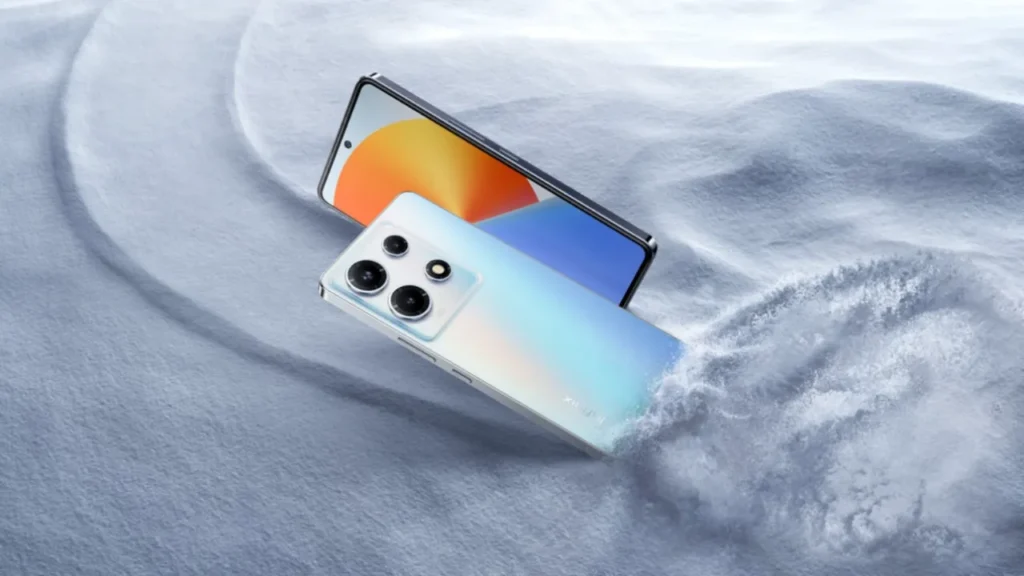
Introduction of Infinix Note 30 5G
The Infinix Note 30 5G is a value device that focuses on a large 6.78-inch 120Hz display, a 108MP main camera that is able to capture fine daytime detail, a long-lasting 5000mAh cell that can fast charge at 45W and 5G at an affordable price. It makes a great choice when you value the immersive consumption of media, high-resolution day photography, and a battery life of more than a day without spending too much money. Unless you demand an AMOLED panel with inky black color and or the best sustained gaming performance, then look to competitors.
What’s new — who this phone is for
This phone targets buyers who want:
- A big, smooth 120Hz display for watching videos, scrolling social feeds, and general responsiveness.
- A high-resolution 108MP main camera for exceptionally detailed daylight shots and flexible cropping.
- A large 5000mAh battery coupled with 45W wired charging for fast top-ups and healthy everyday endurance.
- Affordable 5G connectivity on a mainstream chipset.
Quick specs
| Item | Specification |
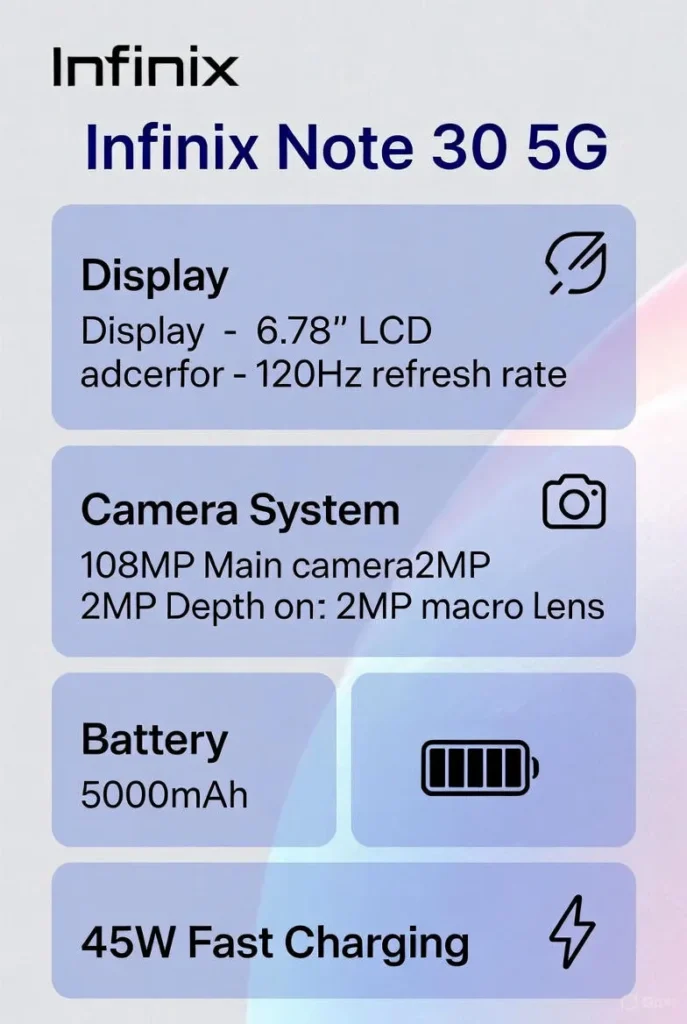
| Display | 6.78-inch FHD+ (1080 × 2460) 120Hz LCD, eye-care mode |
| Processor | MediaTek Dimensity 6080 (6nm) — 5G capable |
| RAM / Storage | Up to 16GB extended RAM (typical: 8GB + 256GB) |
| Rear cameras | 108MP main + 2MP depth/macro |
| Front camera | 16MP selfie |
| Battery | 5000mAh, 45W fast charging (bypass charging support) |
| Audio | Dual speakers, JBL tuning, Hi-Res audio certified |
| Software | XOS on Android 13 (market dependent) |
| Connectivity | Dual 5G SIM, Wi-Fi, Bluetooth, NFC (select regions) |
| Other | IP53 splash resistance (select markets), side fingerprint |
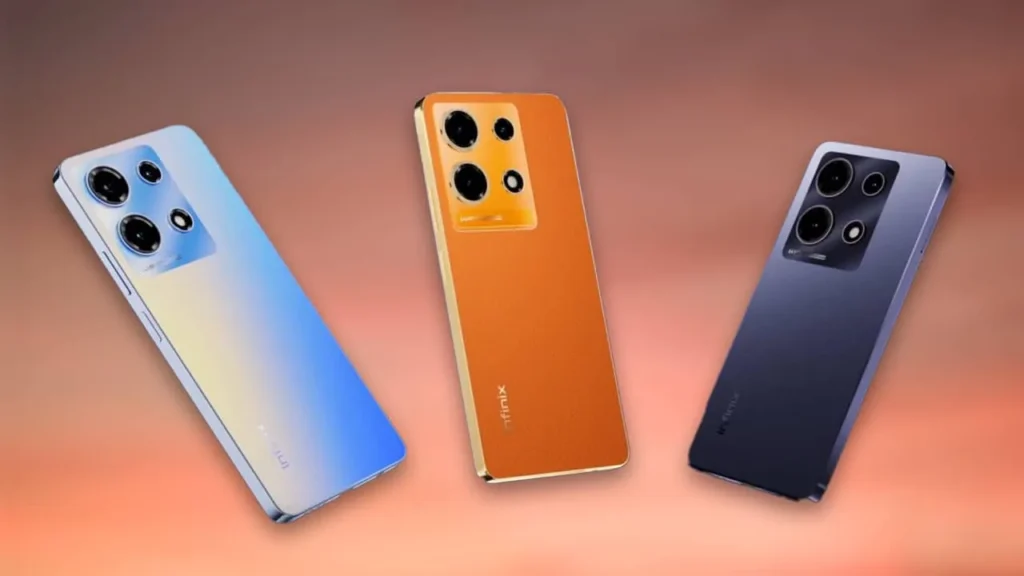
| Colors | Market dependent |
Design & display
Look and feel
The Note 30 5G follows current design conventions: modest bezels, a mostly flat frame for cleaner handling, and a back panel finish that varies between glossy and matte depending on the colorway. It’s a large phone and reads as such in the hand — comfortable for media and productivity, but not one-hand friendly for most users. Build quality is solid for the price bracket: sturdy enough, but not a premium-class metal/glass flagship feel.
What stands out
- The 6.78-inch 120Hz panel provides noticeably smooth animations and scrolling.
- Stereo speakers tuned by JBL give a punchier soundstage than typical single-speaker phones in the segment.
- IP53 splash resistance in some markets adds peace of mind for daily use.
Display quality — LCD vs AMOLED
The Note 30 5G uses an LCD rather than an AMOLED screen. That decision has tradeoffs:
Pros:
- 120Hz refresh delivers a fluid experience.
- Color tuning can still give lively, pleasant hues at moderate brightness.
- Typically, better cost efficiency helps keep prices down.
Cons:
- Blacks and contrast are inferior to AMOLED; deep blacks appear greyish.
- Peak brightness and sunlight legibility usually lag AMOLED rivals.
- Always-on or ultra-deep contrast tricks are unavailable.
Real-use tip: Use 120Hz for smoothness when you care about feel; switch to 60Hz to conserve battery during long days. Enable eye-care mode for late-night reading.
Performance & benchmarks
Everyday performance
The MediaTek Dimensity 6080 on a 6nm process handles daily tasks with ease: social apps, web browsing, media streaming, and light multitasking run smoothly. Extended (virtual) RAM helps keep more apps in memory Simultaneously, which improves multitasking responsiveness for users who keep many apps open.
Gaming & thermal behavior
Expect a solid casual gaming experience. For graphics-heavy modern titles, you’ll likely need to dial settings back to medium or low to maintain smoother frame rates. In long sessions, thermal throttling can appear and may reduce sustained FPS. For a real hands-on review, include a 30–60 minute gaming loop and log average and minimum FPS plus surface temperatures at timed intervals.
Suggested gaming test checklist:
- 30-minute PUBG/CoD session at medium/low graphics — record average and lowest FPS.
- 3-hour battery drain test while gaming to measure sustained stamina.
- Surface temperature readings at 15, 30, and 60 minutes.
Benchmarks
Many competitor pages skip long-duration tests. To stand out, include: single-core and multi-core CPU scores (Geekbench or equivalent), GPU/graphics tests (3DMark or similar), and exported FPS traces graphed over time.
Cameras
Camera hardware & shooting modes
- Main sensor: 108MP (likely employs pixel-binning to produce 12MP outputs with improved light sensitivity).
- Secondary: 2MP depth/macro — useful only in limited scenarios.
- Selfie: 16MP front camera.
Shooting modes include standard photo, night mode, portrait, and AI scene enhancements. Expect software to apply sharpening and sharpening-adjacent processing — sometimes noticeably.
Daylight performance
The 108MP sensor excels in daylight: high detail, good color rendering, and decent dynamic range in many scenes. This is where the phone shines — large pixel counts allow for heavy crops with retained detail.
What to include in your review gallery:
- Full-size daytime landscapes and close-ups.
- 2× and 5× crops to show the limits of detail and sharpening.
- Portraits that demonstrate edge detection and skin-tone rendition.
- Selfies shot in bright and indoor lighting.
Night & low-light performance
Night mode can recover shadow detail and improve exposure, but noise and less advanced denoising will be visible compared to premium sensors. Show side-by-side comparisons with rivals at the same exposure to give readers a practical frame of reference.
Weaknesses to call out
- The 2MP macro/depth camera is generally low-utility and produces soft, noisy macro frames.
- Occasional oversharpening and aggressive contrast tweaks can create halos or artifacts on edges.
Battery life & charging tests
Real-world expectations
With a 5000mAh cell, moderate users should comfortably see a full day and often more. Screen-on time (SOT) depends heavily on refresh rate and brightness; running at 120Hz and high brightness will reduce SOT relative to a 60Hz setting.
- Video loop test: controlled MP4 at 50% brightness — report hours until shutdown.
- PCMark battery test: a synthetic benchmark for apples-to-apples comparisons.
- 3-hour gaming loop: measure drain under sustained load.
- Charging curve: log timestamps at 0, 15, 30, 45, 60, 90 minutes, and track temperature.
Common expected charging profile:
- 0–15 min: 30–40%
- 0–30 min: ~60–70%
- 0–60 min: ~95–100%
(The actual profile will vary by firmware and charger; test in your region.)
Notes on charging tech
The phone supports bypass charging — that helps keep the device cooler while charging by directly powering the device and preserving battery lifespan. 45W charging is quick for a midranger, though it’s slower than flagship 80–120W systems.
Software, features & connectivity
Software & UI
Ships with XOS layered on Android 13 (region dependent). XOS adds features such as extended RAM, eye-care mode, gesture controls, themes, and utility apps. Expect some preinstalled third-party apps (bloat), which may vary by market.
Updates & policy
Infinix’s update cadence tends to include periodic security updates; long-term OS upgrade guarantees vary by region. If you have local vendor information, include exact update promises (months/years of security patches, number of Android version upgrades).
Connectivity & extras
- Dual 5G SIM capability via Dimensity 6080.
- NFC availability varies by market — call it out for the variant sold locally.
- Dual stereo speakers (JBL-tuned) are a media advantage.
- Side-mounted fingerprint reader for fast, ergonomic unlocking.
Pros & Cons
Pros
- Large 6.78-inch 120Hz display — smooth and immersive for media.
- 108MP main camera produces detailed daytime shots.
- 5000mAh battery with 45W charging delivers Strong Endurance and fast top-ups.
- Dual stereo speakers tuned by JBL for improved media audio.
- Excellent price-to-feature ratio in the midrange.
Cons
- LCD panel instead of AMOLED — weaker blacks and contrast.
- Dimensity 6080 is not designed for top-tier sustained gaming; heavy gaming requires tradeoffs.
- Night and low-light camera processing trails more expensive rivals.
- Region-dependent bloatware and inconsistent update guarantees.
Quick alternatives
| Phone | Display | Main camera | Chipset | Battery & Charge | Why pick it? |
| Infinix Note 30 5G | 6.78″ 120Hz LCD | 108MP | Dimensity 6080 | 5000mAh, 45W | Big display + detailed camera + long battery |
| AMOLED rival | ~6.5″ AMOLED 90–120Hz | 64–108MP | Mid Snapdragon / Dimensity | 4500–5000mAh, 33–65W | Brighter screen, better contrast |
| Gaming-focused rival | 120–144Hz LCD/AMOLED | 64MP | Gaming Dimensity / Snapdragon | 5000mAh, 65W+ | Better sustained gaming FPS & thermal management |
How to choose: pick the Note 30 5G if you want a big screen and camera detail for the money; pick an AMOLED rival for contrast and brightness; pick a gaming-focused model for prolonged high-FPS play.
Buying advice
- 8GB + 256GB is the sweet spot for most users — adequate RAM and roomy storage for media and apps.
- If you’re a heavy multitasker or use many camera/video apps, consider higher RAM configurations if available.
- Verify NFC, LTE/5G bands, and warranty support for your market before buying.
Photo & media briefs
- Hero shot: front and back in two colors (full-frame).
- Display comparison: side-by-side with an AMOLED competitor showing the same image to highlight contrast differences.
- Daylight gallery: 6–12 high-quality images with 2× & 5× crops.
- Night gallery: 4–6 night mode images compared with a rival in the same scene and exposure.
- Charging curve chart: 0→100% timestamps plotted as a curve.
- Gaming FPS & thermal chart: 30–60 minute FPS trace and surface temperature graph.
- Spec table: machine-readable and clipped for schema.
Camera deep dive
The Infinix Note 30 5G packs a 108MP main sensor that aims to deliver high-detail photos at a budget price.
Daylight results: Two-column layout — full image on left, 2× crop on right. Use bullet points for contrast, color, dynamic range, sharpening, and artifacts.
Low-light results: Night mode vs auto; include exposure data (ISO, shutter), and talk about noise vs detail.
Portrait & selfies: Edge detection analysis, skin tone rendering, and sample photos.
FAQs
A: Yes. The Dimensity 6080 chipset supports 5G, and the phone offers dual 5G SIM capability.
A: It supports 45W wired charging. Real-world times vary, but expect quick top-ups — many units hit roughly 0–60% in about 30 minutes; test your region for exact numbers.
A: The Infinix Note 30 5G uses a 120Hz LCD — smooth motion but not the deep blacks of AMOLED.
A: The 108MP main camera captures high-detail photos in daylight. Low-light performance is serviceable with night mode, but premium rivals often perform better.
A: With moderate usage, the 5000mAh battery typically lasts a full day and often longer. Heavy gaming at 120Hz will reduce runtime.
Conclusion
The Infinix Note 30 5G is a superb value offering for individuals who need a large 120Hz display, sharp daytime camera performance with a 108MP sensor, and extended battery life supported by 45W charging at a mid-range price. It is by no means the best pick among AMOLED enthusiasts or long-time high-framing gamers, yet as an everyday media device, a camera, and power execution, it offers a great deal of phone for the budget.
