
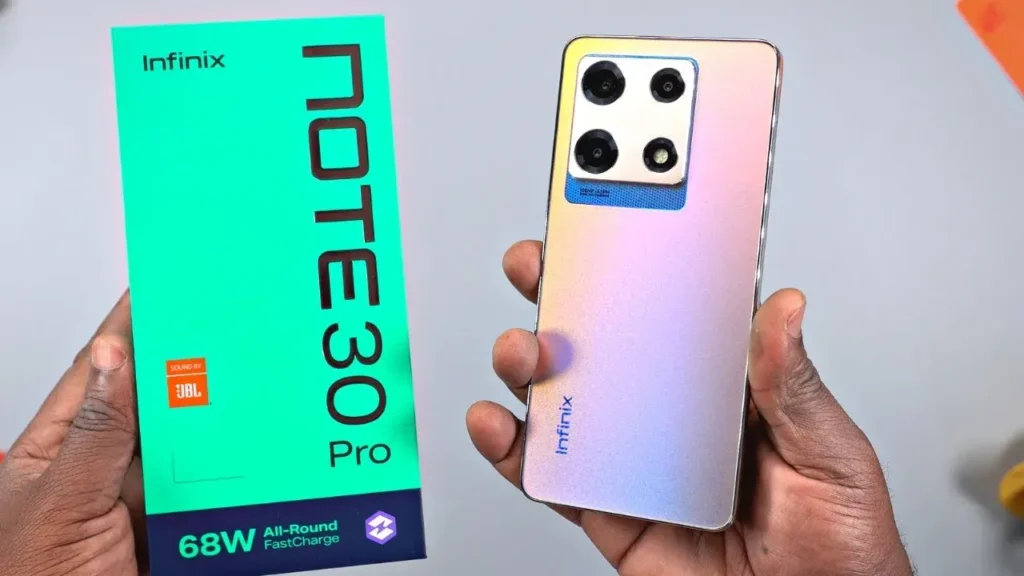
Introduction of Infinix Note 30 Pro
Infinix Note 30 Pro is an impressive mid-range smartphone that focuses on the quality display, long battery life, and all-around camera bundle in everyday photography. Infinix Note 30 Pro is a good competitor to other producers in its price range as it offers great value, reliable battery life, and performance in daily use.
Pros & Cons
Pros
- Bright, large display that makes multimedia and reading more enjoyable.
- Long battery life — designed to last a full day of heavy use for most users.
- Excellent value for price: features that often creep up into higher tiers.
- Modern design language with a premium look relative to the cost.
Cons
- Software skin (XOS) may ship with preinstalled apps that some users find unnecessary.
- Some competitors can outperform it in raw camera detail or in high-end gaming.
- Update cadence and longevity may lag behind major OEMs.
What’s in the box
- Infinix Note 30 Pro handset
- USB charging cable and wall adapter (fast charger in many packages)
- SIM-eject tool
- Quick start guide and warranty information
- Soft case and pre-applied screen protector (may not be included in every market)
Design & build quality
Feel and finish
The Infinix Note 30 Pro projects a contemporary aesthetic: a flat-edge frame, reasonably slender profile for its screen size, and a distinctive camera island without being ostentatious. Depending on the colorway, the rear surface alternates between a glossy sheen and a matte treatment that mimics glass. This finish gives the handset an upscale presence despite its pragmatic price.
Ergonomics and weight
Large-screen devices trade off single-hand usability for a richer visual experience. The Note 30 Pro is designed to remain balanced — buttons and the fingerprint reader are situated to be reachable for most users. For extended one-handed typing or gaming, two-handed operation remains more comfortable.
Durability
The physical construction is consistent with mid-range expectations: robust enough for everyday handling but not guaranteed to survive prolonged immersion or deep dust exposure. Consider a protective case and, if you plan outdoor use, a tempered-glass screen protector.
Display — what to expect
Size and type
Display technology is a pivotal selling point. Expect a large panel — generally within the 6.7–6.9 inch band — that could be AMOLED or a high-quality LCD variant, depending on the specific:
- Smooth refresh rate (commonly 90Hz–120Hz) for fluid animations.
- Full HD+ resolution for clarity on text and media.
- HDR playback capability on supported streaming apps.
Brightness & HDR
A high peak Luminance helps usability outdoors and improves HDR highlights in compatible content. The panel should be bright enough to comfortably read in strong ambient light and render dynamic range with reasonable fidelity.
Color & usability
Look for wide color gamut coverage (P3 or similar) for richer tones. Strong viewing angles and good subpixel rendering matter for photography and video enthusiasts.
Performance & chipset
What the chipset means
The system-on-chip (SoC) defines the device’s computational footprint. The Note 30 Pro is typically equipped with a mid-range silicon package that balances multi-core performance with energy efficiency.
Real-world performance
In everyday scenarios — messaging, social apps, streaming, web browsing — the phone performs smoothly. Heavy 3D titles will run, but you may need to dial back graphical fidelity for sustained high frame rates.
Thermal performance
Under sustained loads, expect the device to warm. Throttling can occur in prolonged benchmark runs or extended gameplay; for casual players, this is unlikely to be a deal-breaker, but power users should be mindful.
Memory, storage & real-world speed
RAM and multitasking
Available RAM configurations vary, but 8GB is a pragmatic baseline for efficient multitasking today. If you habitually keep many apps active, selecting the higher-RAM variant is sensible.
Storage and expansion
Faster UFS storage improves app launch times and large file transfers. If microSD expansion is supported, that’s a plus for users who stockpile photos and offline media.
Camera
The camera suite is a major purchase-deciding factor. Below is a detailed guide to how the Infinix Note 30 Pro‘s camera commonly behaves and the tests you should run if you’re producing a hands-on review.
Camera setup
- Primary sensor: high-megapixel main camera, often leveraging pixel-binning for improved low-light capture.
- Ultra-wide: allows wider framing for landscapes and group shots.
- Auxiliary sensors: macro or depth sensors are occasional inclusions; optical telephoto is less common in the segment.
Daylight photos
Under ample light, images tend to be crisp in focal areas with punchy saturation. The pipeline aims for pleasing contrast and HDR balancing across highlights and shadows.
Low-light photos
Low-light quality hinges on sensor size and software stacking. Night modes and multi-frame algorithms generally reduce noise and enhance perceived detail. Tripod-assisted long exposures will yield the best results.
Video
Check maximum supported resolution and frame rates — many mid-range phones provide stable 1080p capture, and some offer 4K at 30fps. Electronic image stabilization (EIS) helps handheld footage; optical stabilization (OIS) is a rarer premium feature.
Selfies
Selfie cameras skew toward social-ready output — brighter skin tones and modest retouching. Wide-angle front shooters accommodate group selfies, but watch for edge softness.
Battery life & charging
Battery size & usage
The battery performance is one of the Note series’ strengths. Typical users will observe a full day of heavy use and up to two days with conservative habits. Screen-on time will vary with display refresh rate and app mix.
Charging speeds and real tests
Fast charging is a convenient differentiator. Look for 0→50% and 0→100% real-world timings using the included adapter. Charging while gaming can increase temperatures and slow full-charge times.
Temperature and long-term battery health
Aggressive charging curves may cause heat accumulation. Observe charging temperature and consider avoiding intense workloads while topping up frequently to preserve battery longevity.
Software, XOS & updates
Out-of-box experience
XOS layers Android with custom features and visual tweaks. It can add functionality, and also includes third-party apps that some users treat as bloat.
Update policy
Infinix’s update assurances vary by model and region. Buyers who prioritize long-term OS and security updates should verify the official support policy before purchasing.
Tips to optimize XOS
- Uninstall or disable unwanted apps.
- Use a minimalist launcher for a cleaner home screen.
- Leverage built-in battery optimizers and app sleep features.
Connectivity & extra features
5G and bands
If you require 5G connectivity, confirm your regional SKU supports the bands your carrier uses. Regional variants often differ in modem configurations.
Audio & sensors
Stereo speakers improve media playback; a 3.5 mm jack is handy if present. Common sensors include gyroscope, accelerometer, and fingerprint reader (which may be side-mounted or in-display). NFC availability depends on the market.
Benchmarks & real-world tests
- Geekbench (single-core and multi-core)
- 3DMark or similar gaming stress scores
- Battery: video loop times and empirical screen-on time (SOT) for mixed usage
- Display: peak nits, color gamut coverage, and contrast metrics
- Thermals: sustained performance tests to reveal the throttling pattern
Camera
- Full-frame daylight shots and 1:1 crops
- Low-light handheld vs tripod comparisons
- Night mode vs auto shots
- Portraits with diverse backgrounds and lighting
- Tele or digital zoom crops at common multipliers (2×, 5×) if supported
- Ultrawide edge sharpness and distortion checks
- Stabilization tests at 1080p and 4K for motion scenes
- Selfie portraits and low-light selfies.
Comparison
| Phone | Display | SoC | Battery | Main Camera | Price (est.) |
| Infinix Note 30 Pro | Large AMOLED / 90–120Hz | Mid-range SoC | Strong (full-day+) | High-MP main + ultrawide | Mid-range |
| Rival A | Similar size | Slightly faster SoC | Comparable | Better telephoto | Higher |
| Rival B | Same refresh | Slower SoC | Better endurance | Similar | Cheaper |
FAQs
A: Battery life depends on use. For most users, the Infinix Note 30 Pro will last a full day of heavy use and up to two days with light use. Charging speed varies by the included charger.
A: Some regional variants support 5G. Check the specific SKU or the official spec page to confirm band support for your country.
A: The camera is strong in daylight and usable in low light with night mode. It won’t match flagship-level detail, but it gives good social-media-ready photos.
A: Multiple options are commonly available. Pick at least 8GB RAM for smoother multitasking and 128GB or larger storage for media.
A: Infinix offers software updates, but policies vary. Check Infinix’s official release notes or press release for exact information.
Conclusion
Infinix Note 30 Pro is a compelling choice in case you are seeking a modern, middle-range phone with a high-quality, eye-catching screen, reliable battery life, and a versatile camera setup to capture daily images. It carries some features that offer flagship user experiences at half the price.
