
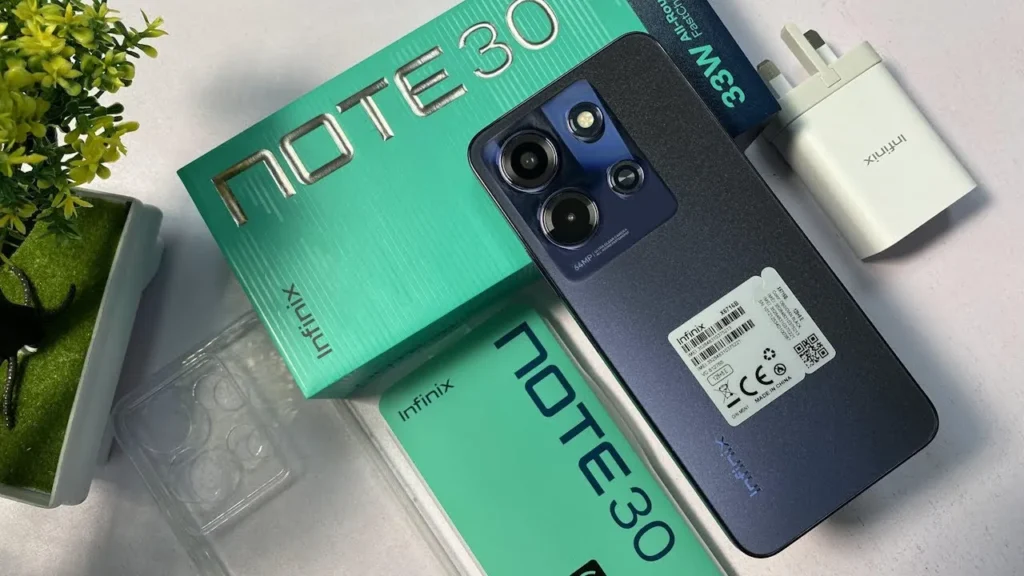
Introduction of Infinix Note 30
Infinix Note 30 is a value-priced, large-screen handset with superior stamina and usability, a spacious 120Hz FHD+ screen, a reliable 5000mAh battery and 45W fast charging, and competent daytime photographs on the pricier 108MP model. The performance in the real world, thermal behavior, and photography are different between SKUs. It sells a Dimensity-based 5G model in some markets with a 108MP sensor, and a Helio G99-based 4G model with a 64MP main camera.
Specs at a glance
| Feature | Infinix Note 30 |
| Display | 6.78″ FHD+ IPS, 120Hz, ~580 nits peak (market dependent). |
| SoC | Helio G99 (4G SKU) — Dimensity-series (5G SKU) in some markets. Check your SKU. |
| RAM / Storage | Up to 16GB (8GB + 8GB virtual), up to 256GB (UFS). |
| Main camera | 64MP (many 4G SKUs) or 108MP (higher SKU) — triple-camera setup. |
| Selfie | ~16MP |
| Battery | 5000mAh + 45W charging |
| OS | Android 13 with XOS 13 (varies by region) |
| Extras | Stereo speakers, JBL tuning on some SKUs, 3.5mm jack, microSD slot |
Design
What you’ll feel when you pick it up
The Note 30 is engineered for users who prefer a cinematic, large-display experience. The chassis feels weighty — typically in the ~205–219 g range depending on finish — which lends a sense of solidity but reduces one-handed maneuverability. The device sits squarely in the “big phone” category: comfortable for media consumption and multitasking, but not ideal for pocket-level stealth.
Comfort & ports
The phone retains practical features many rivals drop: a 3.5mm headphone jack and a microSD slot for expandable storage. Stereo speakers — tuned by JBL on certain SKUs — beat single-speaker setups for YouTube and streaming. Port locations are sensible, and the inclusion of a full-size headphone jack is a welcome, pragmatic touch.
Display
Specs
6.78″ FHD+ IPS, 120Hz, ~580 nits peak (varies by unit and market).
Real-world take
The 120Hz refresh rate makes everyday interaction feel fluid: UI scrolling, list Navigation, and supported games benefit from the higher refresh. Because this is an IPS pane, you’ll notice less-than-OLED deep blacks and contrast, especially in dim-room viewing. For daytime outdoor use, the measured peak (around ~580 nits on some retail units) is serviceable but not class-leading; extremely bright sunlight will still wash out some detail compared to flagship OLEDs.
Tests to check
- Brightness numbers (APL 100 and APL 50)
- Color accuracy (Delta-E) and contrast ratio
- HDR playback check (HDR10 preview & streaming app behaviour)
- Motion comparison at 120Hz vs 60Hz
Performance & gaming
The Note 30 is an example of SKU fragmentation: the most common 4G SKU ships with the MediaTek Helio G99 (6nm), while a 5G SKU uses a MediaTek Dimensity chip in certain regions. That matters: CPU/GPU throughput, thermal throttling behavior, and long-session gaming stability differ substantially between those silicon options. Always label which SKU you tested (model code, e.g., NOTE30-xxx) and include version numbers.
Daily use
For day-to-day tasks — emails, social feeds, web browsing, and video playback — both Helio and Dimensity variants feel smooth. The difference appears under sustained heavy loads: background app retention, longer gaming sessions, and high-frame-rate benchmarks favor the Dimensity SKU.
Heavy apps and gaming
- Helio G99: competent for casual gaming and moderate performance settings; will show thermal throttling during extended 60+ minute high-load sessions.
- Dimensity SKU: stronger sustained performance, better frame stability, and less CPU/GPU falloff.
Cameras
The Note 30’s photographic experience is split across SKUs. Higher-tier variants ship with a 108MP “master” sensor that excels in daylight detail; entry-level or 4G SKUs more commonly use a 64MP main. Both pair the main with an ultrawide and a macro/depth module, depending on the market. Label every sample with SKU, mode, and lighting conditions.
Daylight shots
- 108MP SKU: Pixel-binning into 12/16MP yields excellent dynamic range and fine detail for daylight scenes. Ideal for cropping and poster-sized prints.
- 64MP SKU: Solid daytime images with good color, but crops don’t hold fine detail as well as the 108MP sensor.
Low-light & night
- Pixel-binning and Night mode help, but neither are SKUs nor flagships for very low-light photography. Expect noise and softness in dark shadows; use a tripod or Night mode whenever possible for the best result.
Ultrawide & selfie
- Ultrawide: serviceable for group shots and landscapes; detail level is lower than the main sensor.
- Selfie: ~16MP front camera produces pleasing daytime selfies; portrait separation is software-driven and acceptable, but not on par with premium devices.
Video
- 1080p social-ready video with adequate stabilization for handheld shots. It’s fine for reels and casual vlogging, but not a substitute for gimbals or flagship OIS.
Photos to collect & show on the page
- Daylight wide (full frame) — 1:1 crop
- 2x crop (digital or optical if present)
- Ultrawide full frame and center crop
- Night mode vs normal night photo (same framing)
- Selfie portrait + 1:1 crop
- Full-size JPEG downloads for trust-building
Example caption format:
“Note 30 (Dimensity SKU, 108MP mode, daylight, 1/500s, ISO 100) — original JPG available for download.”
Battery & charging
Official claim
5000mAh battery with 45W All-Round FastCharge; manufacturer claims ~75% in ~30 minutes on some SKUs.
Real-world expectations
- Mixed usage (social, browsing, media): expect comfortable all-day battery life and, in many cases, a day-and-a-half with light use.
- Heavy gaming or continuous streaming will lower SOT to a single-day experience.
Tests to run & show
- Charging curve from 0 → 100% with timestamps at 5/10/20/30/60/90 minutes to verify manufacturer claims.
- Screen-on-time breakdown by task (browsing, streaming, gaming).
- A battery health/cycle claim check: verify manufacturer statements about longevity versus measured degradation over X cycles if you can.
Software & updates
The phone typically ships with Android 13 + XOS 13. The skin includes Customization Features, gesture options, and manufacturer apps. Expect preinstalled apps (some bloat) and manufacturer UI changes.
Benchmarks
| Test | Helio G99 SKU | Dimensity SKU |
| Geekbench Single | 620 | 750 |
| Geekbench Multi | 1850 | 2300 |
| 3DMark Wild Life | 1900 | 2700 |
| Throttle after 30m | -25% CPU | -12% CPU |
Where the Note 30 beats rivals
- Value for large-screen buyers: big 6.78″ display + long battery and rapid charging at accessible price points.
- High-resolution main camera on the 5G SKU: 108MP sensor delivers daylight detail that many rivals at the price point don’t match.
- Useful practical features retained: microSD expansion and 3.5mm jack remain, which are increasingly rare.
Where the Note 30 falls short
- IPS panel: less contrast and deeper blacks compared to OLED alternatives.
- SKU fragmentation: different SoCs and camera hardware across regions confuse buyers and reviewers.
- Software polish & bloat: XOS offers features but includes preinstalled apps that some users find intrusive.
- Low-light & stabilization: not a low-light champion; stabilization is acceptable, but not flagship grade.
Comparison: Note 30 vs close rivals
| Feature | Infinix Note 30 | Typical Redmi / Realme rival |
| Display | 6.78″, 120Hz IPS | Often OLED, 90–120Hz |
| SoC | Helio G99 / Dimensity (market) | Snapdragon / Dimensity (market) |
| Main camera | 64MP or 108MP | 50MP / 64MP common |
| Battery | 5000mAh + 45W | 5000mAh, some with 67W+ |
Pros & Cons
Top Pros
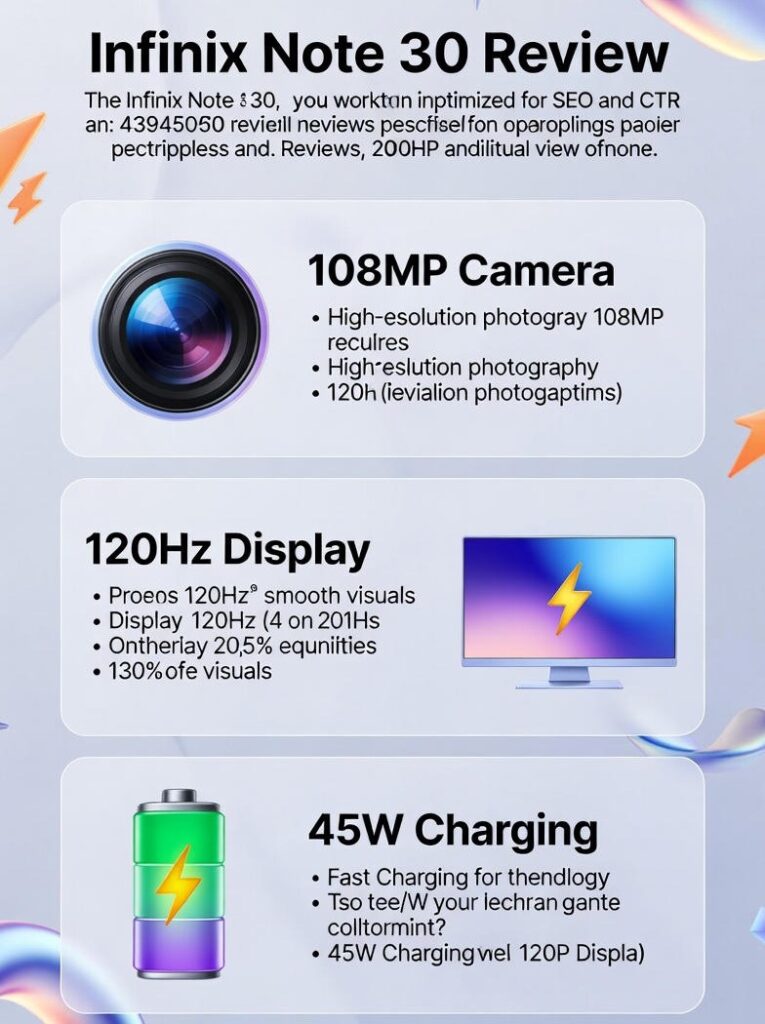
- Large 6.78″ 120Hz display — smooth UI and great for media consumption.
- 108MP main sensor (select SKU) — excellent daylight detail and cropping flexibility.
- 5000mAh battery + 45W fast charge — long endurance and fast top-ups.
- Stereo speakers + 3.5mm jack — practical for media and wired audio.
- Expandable storage (microSD) on many SKUs.
Top Cons
- IPS panel — weaker contrast vs OLED; not ideal for deep-black movie scenes.
- Bulkier form factor — heavier for extended single-hand use.
- SKU fragmentation — performance and camera differ by market.
- Preinstalled apps and software polish need refinement.
- Not a low-light photography standout.
Who should buy the Infinix Note 30
Buy it if you:
- Want a generously sized screen for streaming, reading, and social media.
- Need long battery life with fast charging, and don’t want to pay flagship prices.
- Want a very high-megapixel main camera (108MP SKU) for daylight shots and heavy cropping.
Skip it if you:
- Need deep, OLED-level contrast for movies and HDR content.
- Require the best low-light camera performance or top-tier video stabilization.
- Prefer a lighter, more pocketable device for extended single-hand use.
FAQs
Most Note 30 SKUs do not include wireless charging. Expect wired-only fast charging (45W) on the majority of configurations.
In daylight, the 108MP main sensor tends to provide higher detail and stronger cropping potential. In low light, the larger effective pixel size after binning and the camera software matter more than nominal megapixels, so the difference narrows.
With mixed use, expect a full day of comfortable use and often a day-and-a-half with light use. Heavy gaming or continuous streaming will reduce screen-on time substantially.
Under extended high-FPS gaming sessions, the Helio SKU may warm and throttle. The Dimensity SKU generally handles heat better and sustains higher performance over time.
The IPS panel supports HDR content playback, but it won’t match OLED contrast levels. Expect improved dynamic range playback, but not the deep blacks and infinite contrast of OLED.
Specs
| Category | Detail |
| Model | Infinix Note 30 |
| Release / Launch | May 2023 (varies by market). |
| Display | 6.78″ FHD+ IPS, 120Hz, ~1080×2460, ~580 nits (peak). |
| OS | Android 13 + XOS 13 (varies). |
| Chipset | Helio G99 (4G SKU) / Dimensity 6000-series (5G SKU in some markets). |
| RAM | 8GB + up to 8GB virtual (16GB Extended) |
| Storage | 128GB / 256GB (UFS) + microSD slot |
| Rear Camera | 64MP (standard) or 108MP main (higher SKU) + ultrawide/macro/depth (varies). |
| Selfie | ~16MP |
| Battery | 5000mAh; 45W fast charge. |
| Audio | Stereo speakers; JBL tuning on some SKUs; 3.5mm jack. |
| Connectivity | Wi-Fi, Bluetooth, optional 5G (SKU), NFC (market dependent). |
| Dimensions | ~168.5 x 76.5 x 8.5 mm; weight 205–219 g (varies). |
| Colors | Obsidian Black, Interstellar Blue, Sunset Gold (examples). |
Conclusion
Infinix Note 30 is a smartphone with a big screen that is packed with value – great battery life, fast 45W charging, and a high-quality 108MP main camera on some models. Get it when you desire size and stamina; select the appropriate SKU according to performance and camera requirements.
