
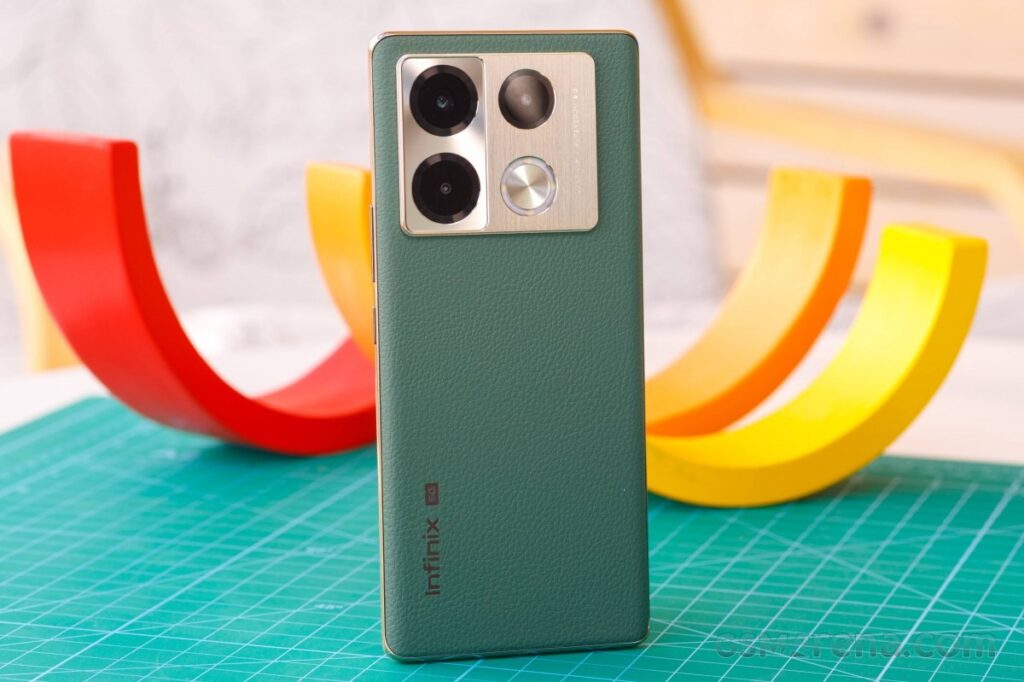
Introduction of Infinix Note 40 Pro+ 5G
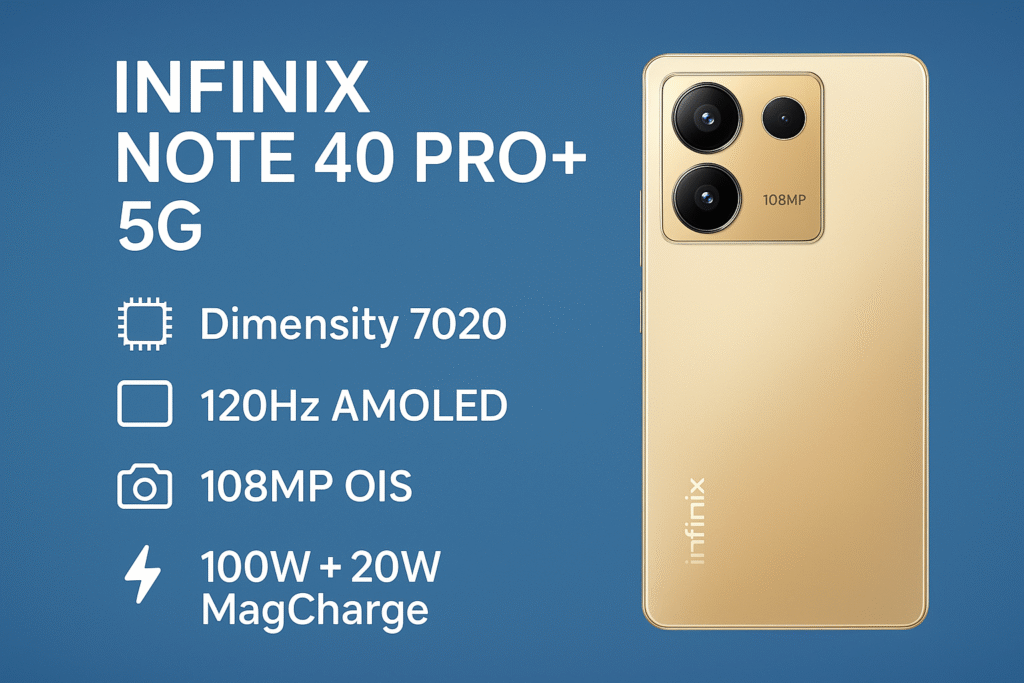
The Infinix Note 40 Pro+ 5G looks and feels like a pricier handset, with a 120Hz AMOLED display, a 108MP OIS camera, and blazing 100W wired + 20W Wireless MagCharge. Excellent value for style and charging — but display peak brightness, low-light camera performance, and sustained gaming keep it from being a true flagship.
What’s new — key specs at a glance
- SoC: MediaTek Dimensity 7020 (mid-range).
- Display: 6.78″ 120Hz AMOLED, curved edges, in-display fingerprint.
- Main camera: 108 MP primary with OIS.
- Battery & charging: 4600 mAh, 100W All-Round FastCharge2.0 wired and 20W Wireless MagCharge.
- Memory: Up to 24GB extended RAM (virtual RAM expansion).
- Speakers: Dual speakers, listed as JBL-tuned on the spec sheet.
Design & build
First impressions
Right out of the box, the Infinix Note 40 Pro+ 5G looks sharper than its price tag suggests. The curved glass, minimal bezels, and a polished rear finish give it a premium silhouette. Photographs don’t do the curvature justice — in hand, it reads like a step above-average midrange phone. If your editorial goal is to show why it “punches above its weight,” start with hero images that emphasize reflections on the curve and the camera island.
Feel and ergonomics
At roughly 190 g and with a slim profile, the phone is balanced and comfortable for long one-handed sessions. The curvature at the edges looks elegant but may cause occasional accidental touches if the user prefers flat panels. Build materials mix glass and high-grade polymer — visually, it matches glass-backed premium phones, even if some internal chassis parts are plastic.
Display
Specs and experience
The 6.78” 120Hz AMOLED delivers punchy color, deep blacks, and buttery scrolling. Animations feel smooth with the high refresh rate, and the curved edges amplify perceived immersion. For media consumption, the color saturation and contrast make movies and games look vibrant.
Measured performance & the outdoor caveat
Many reviewers agree: the panel’s color and contrast are excellent, but peak brightness is not class-leading. That’s important if you live in very sunny climates — outdoor legibility can suffer compared to rivals. Editors should run a brightness test and include Measured nit values plus side-by-side photos in direct sunlight. If you rely on phone visibility during midday outdoors, call this out clearly in the “skip if” section.
Camera
What the hardware promises
The main 108MP sensor with OIS is the headline: on paper, that should provide very detailed daytime photos and steadier video. There’s also an ultrawide, and depending on the region, there may be auxiliary macro/depth sensors. Selfie duty is handled by a 32MP front shooter.
Real-world results
Daylight: Expect sharp images with very good detail and usable crops. For social media posts and large prints, the main sensor holds up admirably for the price segment.
Low light & night mode: This is the phone’s modest Achilles’ heel. Night images are above average for midrange but inconsistent compared to flagship computational photography. Some low-light frames show noise, occasional over-aggressive sharpening, or color shifts. If camera performance in dim scenes matters most, consider a Pixel A-series or equivalent computational-phone alternative.
Video: Note that some reviewers report video mode limits in certain regions or firmware — sometimes capped at 1440p in specific recording modes. If your audience cares about max video resolution, explicitly test and publish the highest usable video quality and frame rates for each mode.
Camera testing
- Full-res RAW crops and 1:1 crops (day & night).
- Ultrawide vs main sensor comparisons on the same scene.
- Night mode A/B with a Pixel A-series and a Redmi rival.
- Short stabilization clips (walk & pan) to test OIS.
- Small spec table listing focal lengths, apertures, and video limits.
Performance & gaming
The Dimensity 7020 — what to expect
The MediaTek Dimensity 7020 sits firmly in the midrange. It handles daily apps, social feeds, multitasking, and casual titles without trouble. However, it’s not intended for ultra-competitive gaming at the highest settings. GPU-bound titles will show lower frame rates, and sustained performance will dip during long sessions.
Tests to include
- Geekbench single & multi-core.
- 3DMark or GFXBench GPU tests.
- 30-minute gaming stress test (e.g., PUBG/WZ/Call of Duty Mobile) with fps logging and surface temperatures.
- Thermal throttling graph showing frequency/clock drops over time.
- Note any software or variant-specific issues like Vulkan support differences.
Battery & charging
Charging hardware
The 100W All-Round FastCharge2.0 wired capability is a headline grabber at this price. Paired with 20W Wireless MagCharge, it’s rare in midrange phones. Wired charging will fill the 4600 mAh battery very fast; magnetic wireless charging adds convenience and positions the phone as more premium-feeling.
Real-world endurance
With its 4600 mAh cell and efficient AMOLED panel, battery life is good rather than class-leading. Light to moderate users should get comfortable with all-day use; heavy gaming lowers screen-on time. Many reviewers emphasize that the charging speed compensates for the moderate capacity: quick top-ups are a practical solution for power users.
Tests to show
- 0→100% wired charge graph (with % checkpoints every 5 minutes).
- Wireless MagCharge 0→100% curve (note tapering behaviour).
- SOT tests: mixed-use, video loop, gaming drain scenarios.
- Gaming while charging: monitor thermals and whether charge rate stalls.
Software, AI features & updates
XOS and extras
The phone ships with XOS on top of Android 14 and includes a suite of generative features — wallpaper creation tools, AI assistants, and photo-editing helpers. These features are enjoyable for casual users and can provide small daily conveniences.
Update policy & regional differences
Infinix’s update promises vary by market. If you publish for a global audience, state the region of the review unit and link to local support/update policy pages. Software lifespan is a consideration: buyers seeking long-term security and major OS upgrades should check regional guarantees before committing.
Speakers & audio
On paper, the phone lists dual loudspeakers tuned by JBL. In practice, loudness and timbral fidelity vary across reviews. Run a dB loudness test and combine it with a short subjective music playback assessment to present objective and subjective findings.
How it compares — quick rival map
Where the Note 40 Pro+ wins
- Design & look: Feels more expensive than its price.
- Charging: 100W wired + 20W wireless is rare in this tier.
- Daytime camera detail: Excellent for price point.
Where rivals do better
- Camera low-light and video: Pixel A-series and some Redmi/OnePlus phones often produce better low-light frames and video stabilization.
- Peak display brightness: A few rivals give better outdoor legibility.
- Sustained gaming: Devices with stronger GPUs (Dimensity 1080, or Snapdragon 7/8 series) maintain higher sustained FPS.
Comparison table
| Phone | Display peak (nits)* | SoC | Main camera | Battery | Price band |
| Infinix Note 40 Pro+ | Good (not class-leading) | Dimensity 7020 | 108MP OIS | 4600mAh + 100W+20W | Midrange |
| Redmi Note rival | Higher peak brightness | Dimensity 1080 / similar | 108MP or 64MP | 5000mAh + 67W | Midrange |
| Pixel A-series | Very good low-light | Tensor | 50MP computational | ~4500mAh | Upper midrange |
Who should buy the Note 40 Pro+?
Buy if:
- You want flagship looks on a midrange budget.
- You value ultra-fast wired charging and convenient magnetic wireless charging.
- You want a large 120Hz AMOLED and strong daytime camera detail.
Skip if:
- You need a best-in-class low-light camera or top-tier video performance.
- You play long, competitive sessions and need the highest sustained FPS.
- You spend lots of time using your phone in very bright sunlight and need extreme peak brightness.
Final score
- Design & Build: 9/10 — premium appearance and feel.
- Display: 8/10 — excellent panel, but peak brightness is a caveat.
- Camera: 7.5/10 — 108MP OIS yields detailed daylight shots; low-light is inconsistent.
- Performance: 7/10 — midrange SoC handles everyday tasks; not a gaming powerhouse.
- Battery & Charging: 9/10 — standout wired + wireless charging at the price.
- Value: 9/10 — large feature set at an attractive price.
- Overall: 8.3 / 10 — strong midrange option that leans toward “value king” if your priorities match its strengths.
Pros & Cons
Pros
- Premium curved design and polished finish.
- 120Hz AMOLED for smooth animation and deep blacks.
- 108MP main with OIS — excellent daytime detail.
- 100W wired + 20W Magnetic wireless — standout charging combo.
- Great value for headline specs.
Cons
- Peak display brightness is lower than some rivals, which affects outdoor use.
- Camera: good for the price but not a flagship; low-light inconsistency.
- Midrange SoCs limit sustained high-fps gaming.
- Speakers: listed as JBL, but real-world loudness varies.
- Regional availability & update policy vary — check your market.
FAQs
A: Yes — it supports Infinix’s Wireless MagCharge (20W).
A: MediaTek Dimensity 7020.
A: The phone supports 100W All-Round FastCharge2.0.
A: The 108MP main with OIS takes very good daytime photos for the price, but low-light and video capabilities fall short of flagship leaders.
A: If you want flagship looks and some of the fastest charging in the midrange, yes — but compare camera low-light needs and outdoor brightness against rivals first.
Conclusion
Title: Infinix Note 40 Pro+ 5G Review — Value King or Compromise?
Snippet: Looks like a flagship and charges like one — but camera low-light, display peak brightness, and gaming limits keep it from being the perfect all-rounder. Great pick if you want style and ultra-fast charging.
