
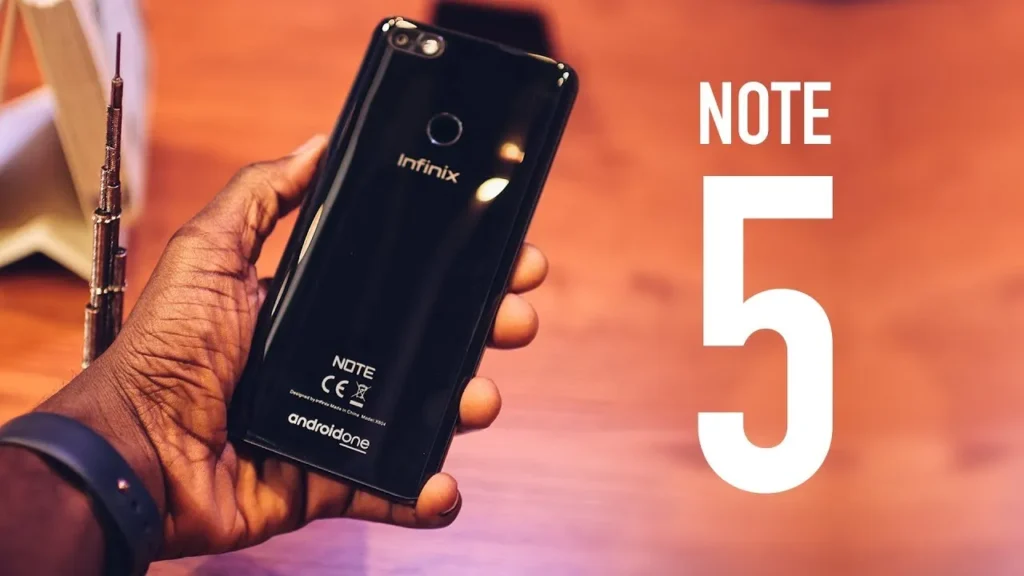
Introduction of Infinix Note 5
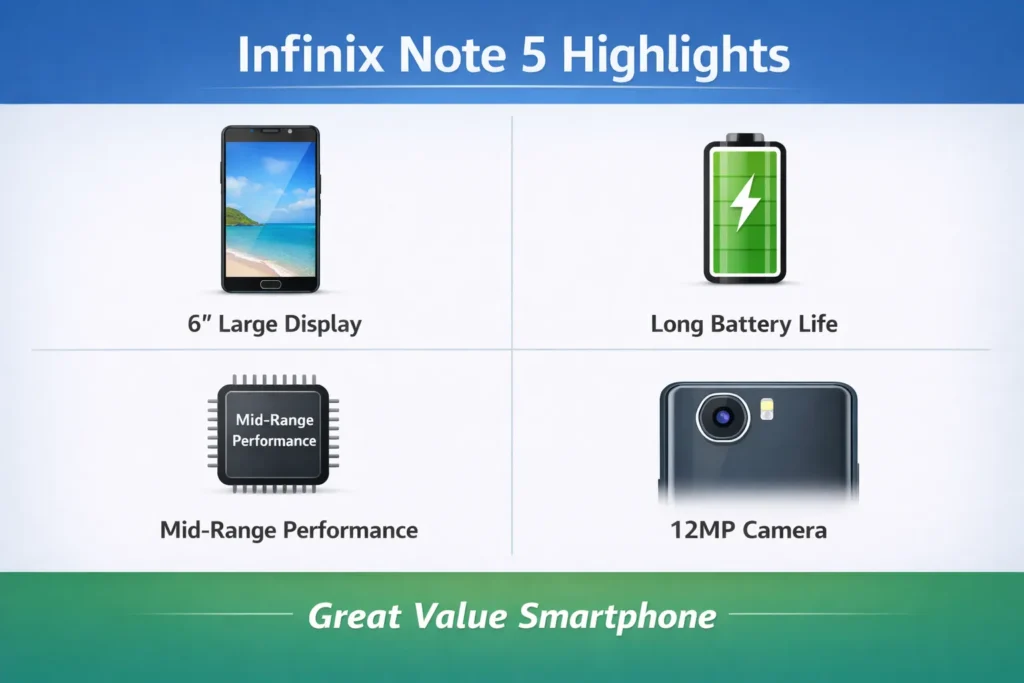
The Infinix Note 5 is a value-focused smartphone that prioritizes a large screen and extended battery endurance while keeping the price low. It’s ideal for media consumption, browsing, and everyday multitasking. For top-tier imaging or sustained high-end gaming, consider higher-priced alternatives — but for cost-conscious buyers seeking utility and longevity, the Note 5 delivers strong return-on-investment.
Key Specs
| Feature | Short detail |
| Display | Large screen optimized for media and reading — roomy and comfortable for long sessions |
| Battery | High-capacity cell aimed at 1+ day of typical usage |
| SoC (processor) | Mid-range chipset suitable for daily apps and light games |
| RAM / Storage | Multiple SKUs — pick higher RAM for smoother multitasking |
| Camera | Good daylight stills; mixed performance in dim light |
| Software | Android with Infinix XOS customizations |
| Price | Positioned in the budget/value tier |
Design & build
The Note 5 follows a design equation common to value phones: large front glass, narrow bezels, and a rear that may use plastic or glass-effect polymer. The objective is to feel substantial while keeping manufacturing costs low.
Key characteristics
- Comfort & ergonomics: The wide screen favors two-handed use for media and multitasking. One-handed reachability is reduced, particularly for users with smaller hands.
- Weight & balance: Slightly heavier than compact phones, which contributes to a solid in-hand sensation rather than a fragile one.
- Materials & finish: Expect plastic or glass-like polymer with a glossy or matte coating. Glossy finishes look premium but show fingerprints; matte finishes hide smudges better.
- Durability: Basic drop and scratch resistance — consider a TPU case and a tempered glass protector to reduce impact and abrasion damage.
Display
Why the screen matters: The screen is the primary interaction surface. A large display enhances entertainment, document reading, and productivity. The Note 5 is designed to maximize viewing real estate for content consumption.
Expected qualities
- Size & aspect ratio: Generous diagonal for movies and articles — pleasant for multitasking and split-screen use.
- Resolution & sharpness: Decent pixel density for everyday use; text and icons are clear for general consumption.
- Color & contrast: Vivid color reproduction tuned for social media and video playback rather than color-critical editing.
- Brightness & outdoor use: Sufficient for indoor and shaded outdoor use; direct sunlight can wash out contrast.
- Protective layers: Use a screen protector to avoid scratches; matte protectors can reduce glare and fingerprints.
Optimization tips
- Lower the refresh rate (if adjustable) and brightness for longer battery life.
- Enable adaptive brightness and dark mode for reading at night.
- Calibrate font size and display scaling to balance text density and readability.
Performance & gaming
Chipset class: The Note 5 uses a mid-range system-on-chip (SoC) that aims for a balance between power efficiency and day-to-day responsiveness.
What runs smoothly
- Social networking and messenger apps (Instagram, WhatsApp, Telegram).
- Streaming services (YouTube, Netflix) at standard bitrates.
- Web browsing and multitab reading.
- Productivity apps and lightweight photo editors.
What to expect
- A mobile titles at maximum graphics will require the device to reduce detail and frame rate.
- Intensive multitasking with many heavy background services will show memory pressure on lower-RAM SKUs.
Practical advice
- Choose a SKU with 4GB or more RAM for a noticeably smoother app-switching experience.
- Use Game Mode or Game Booster (in XOS) to prioritize CPU/GPU time for gaming sessions.
- Clear cached apps and uninstall apps you rarely use to reduce background load.
Battery & charging
Core expectation: The Note 5 is built around a large battery intended to last a full day of mixed usage for typical users.
Real-world usage patterns
- Typical standby and moderate active use: you can expect 1+ day or about 5–8 hours of screen-on time depending on brightness, connectivity, and app mix.
- Heavy use (continuous gaming, GPS navigation, hotspot): expect SOT to fall and possibly need a midday top-up.
Charging behavior
- May include a fast-charging adapter in the box, depending on variant/market. Charging from 0→50% is the most practical metric for daily use—this mid-range device usually offers Moderate Charging Speed rather than flagship rapid replenishment.
Battery savings checklist
- Toggle battery saver when under 20% to extend uptime.
- Turn off high-power radios (Bluetooth, NFC) when unused.
- Prefer Wi-Fi over mobile data when possible to conserve energy.
- Lower refresh rate (if available) and reduce background sync frequency.
Camera
The image system on the Note 5 performs well in bright conditions but shows limitations in low-light scenarios. Video capture is suitable for casual clips.
Photographic strengths
- Daytime scenes result in crisp, colorful photos with good exposure.
- Portrait mode blur simulates shallow depth-of-field decently in simple subjects.
Limitations to note
- Low-light and nighttime photography produce increased noise and reduced sharpness.
- Dynamic range in high-contrast situations can be limited, so highlights or deep shadows may lose detail.
- Edge detection in portrait mode can be imperfect around hair or transparent objects.
Video capture
- Good for stable, casual clips. Heavy motion may expose stabilization limits on some variants.
Practical camera tips
- Keep lens surfaces clean for maximum clarity.
- Use HDR for scenes with both bright and dark areas (sunset portraits with foreground subjects).
- For low-light scenes, stabilize the device (tripod or steady surface) and use longer exposures if the phone supports it.
- Use pro/manual modes when available to control ISO and shutter speed for creative shots.
Software & updates
What you get: The phone runs Android with Infinix’s XOS on top. XOS adds customization, gestures, and utilities, along with preinstalled apps.
What users tend to appreciate
- Extra features such as gesture navigation, game booster, and battery-saving modes.
- Theme customization and simple UI tweaks.
Points of caution
- Budget OEMs may provide fewer major Android version updates and less frequent security patches compared to flagship brands.
- Preinstalled apps (bloatware) are common — disable or uninstall what you don’t use to reclaim storage and reduce background activity.
Optimization steps after setup
- Go to Settings → Apps and disable unused apps.
- Update Play Store apps and XOS components for stability.
- Remove or restrict background permissions for apps that drain battery.
Connectivity, sensors & ports
Standard features
- Wi-Fi and Bluetooth for local connectivity.
- GPS + A-GPS for navigation and location-based services.
- 3.5mm headphone jack present on many variants — handy for wired audio.
- Fingerprint sensor (rear or side) and face unlock for biometric access.
- USB port: confirm if your model uses USB-C (preferred) or older micro-USB.
Practical tip: Favor USB-C models for improved charging speed and accessory compatibility.
Variants & buying tips
Common memory bundles: Expect options such as 3GB/32GB, 4GB/64GB, and 6GB/128GB (actual SKUs depend on market). Use these rules of thumb:
- 3GB / 32GB — Bare-minimum for light usage (texts, calls, light apps). Only pick this if budget constraints are tight.
- 4GB / 64GB — Best balance for most users: smooth multitasking and ample storage for apps and photos.
- 6GB / 128GB — For heavy apps, more future-proofing, and local media storage.
Storage expansion: If microSD is supported, use it for large media and backups, but note that microSD performance lags internal flash memory.
How to choose
- Pick adequate RAM first — it affects multitasking more than raw storage.
- Choose storage based on media habits — more local video/photos need more Onboard Space.
- Confirm whether the model includes a fast charger and USB-C cable in the box.
Infinix Note 5 vs competitors
| Phone | Best for | When to choose |
| Infinix Note 5 | Big screen, long battery, good value | You want a media-first phone with long endurance |
| Competitor A | Better imaging system | If photography is your priority |
| Competitor B | Stronger SoC for gaming | If gaming or heavy multitasking are top priorities |
| Competitor C | Faster update cadence and brand support | If software updates and long-term security patches matter |
Pros & Cons
Top Pros
- Large display — great for video, reading, and multitasking.
- Long battery life — reliable for daily use.
- Competitive pricing — strong value proposition.
- Useful XOS extras — handy features beyond stock Android.
- Multiple RAM/storage variants — choice for different budgets.
- Expandable storage (on supported SKUs) — flexible file management.
- Headphone jack available — convenient for wired listeners.
Top Cons
- Low-light camera performance is average — not a flagship shooter.
- Not ideal for high-end gaming at the highest settings — GPU/CPU limited.
- A rear or plastic build may feel less premium.
- Software update cadence may be slower than mainstream flagships.
- Preinstalled apps can reduce free storage until cleaned.
How to choose the right variant
- Set your maximum budget. Know your absolute ceiling.
- Prioritize RAM. 4GB baseline; 6GB for heavier multitasking.
- Decide on storage. 64GB is safe; 128GB if you store many videos.
- Check ports & charger. Prefer USB-C and included fast-charger.
- Review warranty & return policy. Buy from authorized sellers when possible.
Example: With a $150 budget, aim for 4GB/64GB for the best mix. If a 6GB/128GB SKU fits the price, choose that for longevity.
FAQs
A: If your chief goals are a generously sized screen and long battery life at a modest cost, the Note 5 remains a worthy choice in 2026 for budget-focused buyers.
A: For most buyers, 4GB RAM + 64GB storage is the optimal balance between performance and cost.
A: Many variants include microSD expansion. Use a microSD card for extra media storage, but keep in mind that transfer and read/write speeds on microSD are slower than internal flash.
A: Typical real-world use gives about a full day — commonly 5–8 hours of screen-on time depending on brightness and app mix.
A: The camera is dependable in daylight, crisp, well-exposed photos in good light. Low-light performance is average; use steady support or additional light for night shots.
Final verdict
The Infinix Note 5 is a strong value proposition for users who prioritize a large screen and reliable battery life at an affordable price point. It performs everyday tasks capably and delivers a comfortable media experience. If your priorities are the very best camera performance or the top-tier gaming throughput, consider investing more in a higher-tier model. For budget-minded consumers who want the most everyday utility per dollar, the Note 5 is an intelligent pick.
