
Introduction
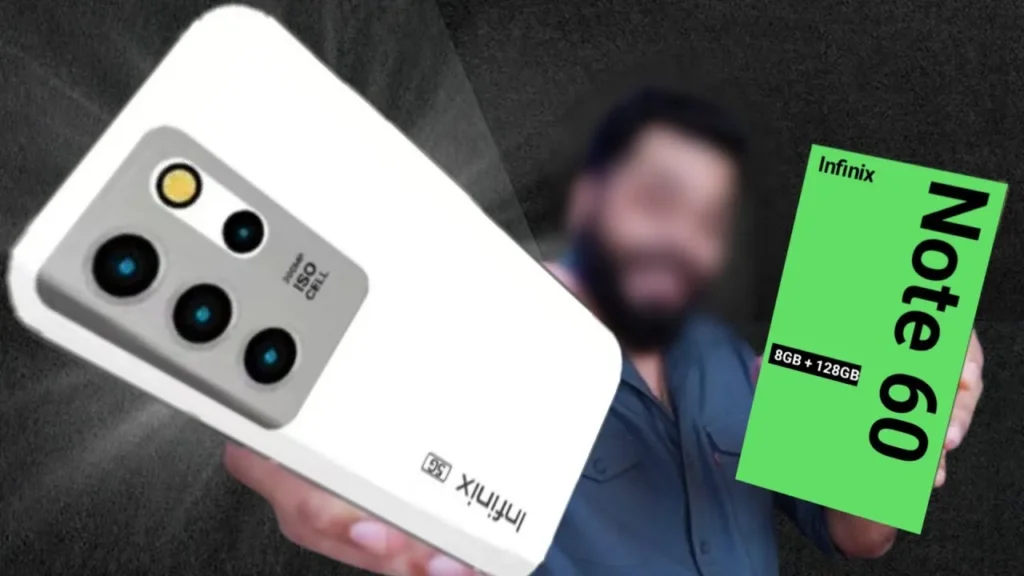
The Infinix Note 60 is a well-balanced midrange phone for people who prioritize a large, bright screen, long endurance, and good daytime camera results. It’s a top choice for media consumption and general multitasking. Heavy gamers or those who require strong long-term update guarantees should verify sustained thermal performance and the OEM’s update policy before purchasing.
What’s in the box
- Phone: Infinix Note 60 (single SKU or multiple variants depending on region)
- Charger: included wattage varies by market — confirm per-region box contents
- USB cable: Type-C (data + power)
- Silicone protective case: usually bundled
- SIM ejector tool
- Quick start guide & warranty card
Design & build
- Materials: back (glass or high-gloss polycarbonate), frame (plastic or metal), front (Gorilla Glass or generic cover glass)
- Weight: numeric (g) — measure and publish
- Thickness: numeric (mm) — measure and publish
- Color options: explicit names (e.g., Obsidian Black, Ocean Blue)
- Front protection: list brand/type where present
- IP rating: list or state “no official IP rating” if none
Display
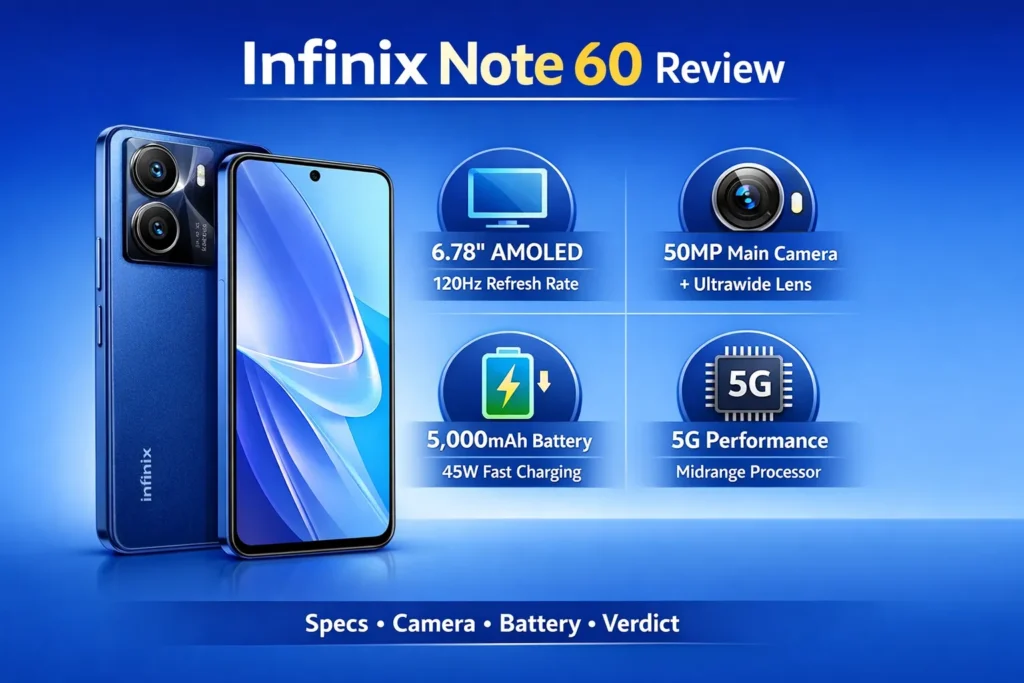
- Screen size: e.g., 6.7–6.8 inches
- Panel type: AMOLED / OLED / IPS LCD — state exact tech
- Resolution: FHD+ (e.g., 2400 × 1080)
- Refresh rate: 60Hz / 90Hz / 120Hz — include adaptive behavior if present
- Peak brightness: x nits (publish lab-measured and manufacturer claimed values)
- HDR: HDR10 / HDR10+ / none
Why these fields matter
- Bigger, higher-resolution displays improve readability and streaming experience.
- Higher refresh rates make animations and scrolling noticeably smoother.
- More peak nits mean better outdoor visibility.
Display spec table
| Feature | Expected / Example |
| Screen size | 6.78-inch |
| Type | AMOLED |
| Resolution | 1080 × 2400 |
| Refresh rate | 90Hz / 120Hz |
| Peak brightness | 800–1200 nits (typical for bright midrange AMOLED) |
| HDR | HDR10 (if supported) |
Performance
- SoC name & generation: (e.g., Dimensity 7xx / Snapdragon midrange) — detail CPU cores and GPU.
- RAM & storage options: e.g., 6/8GB RAM, 128/256GB storage
- Expandable storage: microSD support? If a hybrid or dedicated slot.
- Thermals: Does the phone throttle under sustained load? Provide measured temps.
- Practical performance notes: app switching, UI fluidity, and background task Retention.
Recommended tests
- Geekbench (single/multi): show test environment and firmware build.
- 3DMark or other GPU benchmarks: include score and test run date.
- Sustained gaming: 30–60 minute gaming loop (PUBG, Genshin—choose a title consistent with local expectations). Record average FPS, minimum FPS, and thermal behavior.
- App cold-start timing: open a set of 10 popular apps fresh to measure launch latency.
- Storage speed: AndroBench read/write numbers.
Cameras
Cameras are judged by objective samples and context-aware notes. Always include full-res images and 100% crops.
Spec fields to list
- Main sensor: MP, sensor model (if known), pixel size (μm), aperture (f/).
- Ultra-wide: MP, FoV, distortion notes.
- Telephoto/Macro: optical zoom or simulated macro details.
- Front camera: MP and special features (auto-HDR / wide-angle).
- OIS/EIS: stabilization technology for photo/video.
- Max video resolution: e.g., 4K@30fps / 1080p@60fps.
Test checklist
- Daylight wide: 3 shots — normal, HDR, and a 100% crop.
- Portrait: subject isolation, edge detection, and skin tone replication.
- Ultra-wide: distortion control and edge softness check.
- Low light: native mode vs Night mode; compare noise and detail.
- 2× / 3× crops: fromthe main sensor to evaluate detail retention.
- Macro: close-focus clarity.
- Motion: capture a moving subject to test AF tracking.
- Selfie & portrait selfie: skin tone and dynamic range.
- Stabilization test: walk while recording 1080p30 to test EIS/OIS.
Camera judgment language
- Daylight: good detail, accurate color, and solid dynamic range.
- Low light: Night mode recovers shadows but shows noise and smoothing.
- Ultra-wide: useful field of view but softer edges.
- Video: stable at 1080p; 4K is usable if available, but watch for heat in long takes.
Battery life & charging
- Battery capacity: e.g., 5,000 mAh — publish exact number.
- Charging: included charger wattage and supported max charging (e.g., 33W / 45W).
- Wireless charging: yes/no.
- Battery health tools: include whether the device exposes battery wear % in diagnostics.
Tests to run
- Video loop: fixed brightness (200 nits), Wi-Fi on, autoplay video until shutdown — report hours and minutes.
- Web browsing: automated script cycling news sites at a fixed refresh rate.
- Gaming burn: 60-minute gaming run, report % drop and temperature.
- Charging curve: time 0→10, 10→50, 50→80, 80→100, and note temperatures during charge.
Example summary sentence
“With 5,000 mAh and 45W wired charging, expect a full day of heavy use and a 0→100% charge often in roughly 60–80 minutes depending on firmware and thermal conditions.”
Software, updates & bloatware
What to report
- Android base version and XOS skin version at launch.
- List of notable preinstalled apps (bloatware) and whether they can be uninstalled.
- Security/OS update policy: number of promised Android version upgrades and monthly/quarterly security updates — verify with OEM or official site.
- UX quirks: gesture responsiveness, notification handling, and permission prompts.
Recommendation
Buyers should confirm updated guarantees. Phones with a clear, public update promise are better long-term investments.
Connectivity & sensors
Short, clear list of fields to publish:
- Cellular: 5G support? List bands or recommend checking SKU compatibility.
- Wi-Fi: Wi-Fi 6 / ax / 5 / dual-band details.
- Bluetooth: version (e.g., 5.3).
- NFC: useful for contactless payments — yes/no.
- GPS: GNSS support (GPS, GLONASS, Galileo).
- Ports: USB-C, 3.5mm headphone jack (present or absent)
- Biometrics: in-display fingerprint / side-mounted.
- Sensors: accelerometer, gyro, compass, proximity, and ambient light.
Comparisons
Provide a simple comparative table with 2–3 direct competitors in the same price bracket. Choose rivals that local buyers actually consider (Xiaomi/Redmi, Realme, Samsung A-series, POCO).
| Model | Display | SoC | RAM/Storage | Cameras | Battery | Price (local) |
| Infinix Note 60 | 6.7″ AMOLED, 90/120Hz | Midrange SoC | 8/128GB | 50MP main + ultrawide | 5,000 mAh, 45W | $xx |
| Rival A | 6.6″ LCD, 90Hz | Rival SoC | 8/128GB | 64MP main | 5,000 mAh | $xx |
| Rival B | 6.5″ AMOLED | Rival SoC | 6/128GB | 50MP | 6,000 mAh | $xx |
Who this phone is for
- Buy if: you want a large, bright display for binge-watching and social media; you value long battery life and a good main camera for daylight photography.
- Don’t buy if: you play heavy 3D games often and need sustained top-tier performance; you require multi-year Android version guarantees or an ultra-premium camera system.
Pros & cons
Pros
- Large, vivid display is great for media
- Long battery life with fast charging
- Strong daytime camera performance for the price
- Usually good value for money
Cons
- Possible thermal throttling under long gaming sessions
- Software update policy may be limited — verify before purchase
- Ultra-wide and telephoto lenses may be weaker than flagship rivals
FAQs
A: Battery life is perfect for mixed use — video streaming, social apps, and browsing. Expect a full day of use.
A: Many Note 60 SKUs support 5G, but bands differ by region.
A: The review model uses an AMOLED display in most markets.
A: Infinix usually provides security updates, but major Android version promises vary. Check the official update policy or OEM support page to confirm.
A: Many units offer microSD expansion via a dedicated or hybrid slot.
Final verdict
The Infinix Note 60 is a robust mid-tier product choice for customers who appreciate a spacious and high-quality screen, reliable battery life, and functional daylight camera functionality. It is a good phone that is media-oriented and a decent daily phone. When heavy sustained gaming performance or multi-year official Android upgrades are important to you, make sure to check the thermal performance of the chipset and the support of your area of residence for the updates.
