
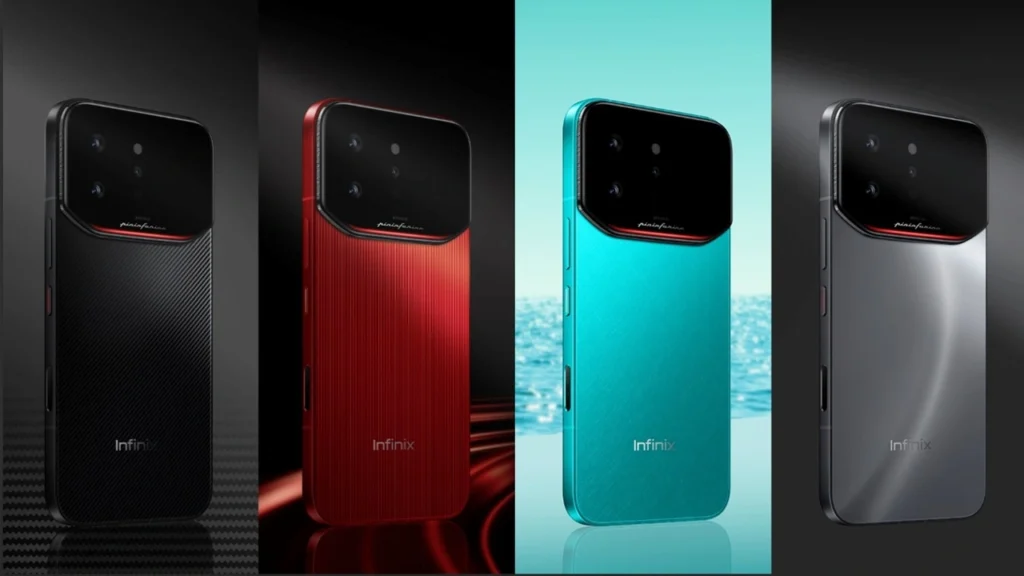
Introduction of Infinix Note 60
The Infinix Note 60 at the moment, the biggest challenge is not whether the Infinix Note 60 looks attractive on paper. The real issue is that the available live information is inconsistent. Infinix’s global landing page pushes a Snapdragon 7s Gen 4 5G story with a 144Hz 1.5K display and a 6500mAh battery with wireless support. The official Note 60 specs page points in another direction and surfaces MediaTek Dimensity 7400 Ultimate (5G). WhatMobile adds more detail and lists Dimensity 7400 Ultimate, AMOLED, 1208 × 2664, 144Hz, and 8GB RAM. PriceOye shows a preorder at Rs 84,999 for 256GB / 8GB. MSTEffects presents a very different configuration with Dimensity 7020, IPS LCD, 120Hz, and a 5200mAh battery.
If you want the practical answer, the Note 60 appears promising in the mid-range segment, but the market story is still fragmented. The safe move is to verify the exact seller page, the storage configuration, the chipset, the battery size, and the warranty status before payment. In short, this is a phone with strong potential and weak source alignment.
What is confirmed vs what is still inconsistent?
A pillar page on this topic must separate confirmed live signals from unstable or conflicting data. That is what makes the article useful to users and structurally stronger for search intent.
Confirmed on live pages
Infinix’s global landing page clearly promotes the Note 60 with Snapdragon 7s Gen 4 5G, a 144Hz 1.5K display, and a 6500mAh battery with wireless support. The official Note 60 Pro page also promotes Snapdragon 7s Gen 4 5G, 144Hz 1.5K Display, and 90W 6500mAh. Infinix’s global product lineup also places Note 60, Note 60 Pro, and Note 60 Ultra in the same family, which shows that the brand is positioning the Note 60 as part of a broader series rather than as a standalone handset.
Still inconsistent across pages
The official Note 60 specs page instead shows MediaTek Dimensity 7400 Ultimate (5G). WhatMobile also lists the Note 60 with Dimensity 7400 Ultimate, while MSTEffects shows Dimensity 7020, a smaller 6.7-inch IPS LCD, and a 5200mAh battery. That is not a minor wording difference. It is a completely different hardware story.
Live source comparison table
| Source | Chipset | Display | Battery / Charging | Storage / Price | What the page is doing |
| Infinix global landing page | Snapdragon 7s Gen 4 5G | 144Hz 1.5K display | 6500mAh with wireless | No price shown on snippet | Brand landing page with headline specs |
| Infinix Note 60 specs page | MediaTek Dimensity 7400 Ultimate (5G) | The specs page exists, but the snippet mainly confirms the chipset | The product disclaimer says specs depend on the actual product | No price shown on snippet | Official specs page with a different chipset message |
| WhatMobile Note 60 | Dimensity 7400 Ultimate (4 nm) | 6.78-inch AMOLED, 1208 × 2664, 144Hz | 6150mAh or 6500mAh; 45W wired; 30W wireless | Expected Rs 73,999; launch shown as Aug 31, 2026 | Detailed local listing with prelaunch-style data |
| PriceOye Note 60 | Not shown in snippet | Not shown in snippet | Not shown in snippet | Rs 84,999 preorder; 256GB / 8GB RAM | Commerce page with preorder pricing |
| MSTEffects Note 60 | Dimensity 7020 | 6.7-inch IPS LCD, 720 × 1600, 120Hz | 5200mAh; 18W wired; no wireless | 6GB / 128GB; about 110 EUR | Spec-heavy page with a very different configuration |
Infinix Note 60 Price in Pakistan
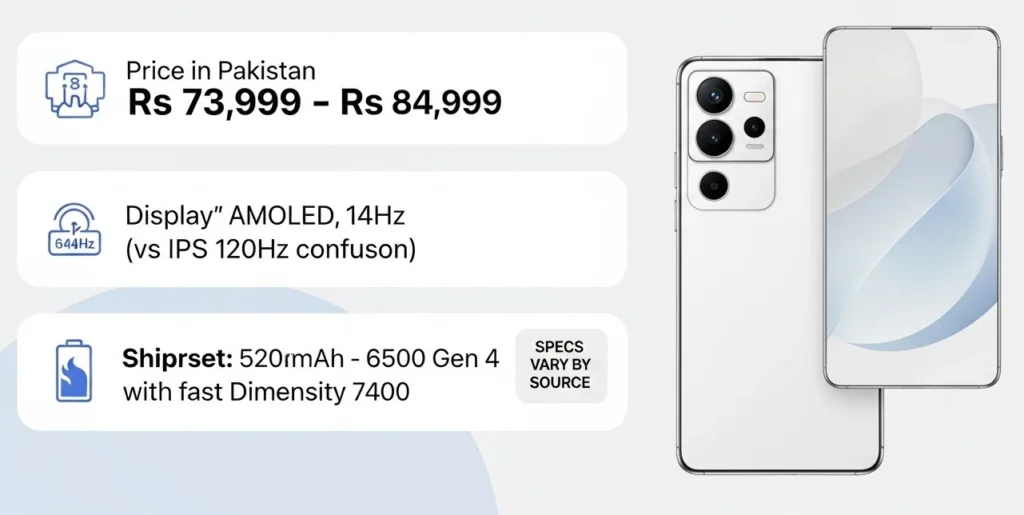
The biggest query around the Infinix Note 60 price in Pakistan is not simply the number itself. The larger question is what variant, what memory combination, and what specification package sits behind that number. PriceOye currently shows the Note 60 at Rs 84,999 as a preorder and lists 256GB storage with 8GB RAM. WhatMobile, meanwhile, lists an expected price of Rs 73,999 and says the phone is expected to launch on Aug 31, 2026, with an 8GB / 128GB variant mentioned on the page.
That difference is not cosmetic. It is large enough to change user perception, purchase timing, and even the value equation. A buyer looking for the most affordable entry point could assume one version is cheaper, while another buyer scanning a preorder page may assume the market price has already stabilized. In reality, the data suggests that the pricing environment is still unsettled.
A smart buyer should read these pages as directional signals rather than the final truth. A preorder price on one page and an expected price on another page can both be useful, but they should not be treated as interchangeable. The same goes for storage tiers. A 128GB variant and a 256GB variant can live in entirely different price brackets even when the model name is the same.
For people comparing the Infinix Note 60 price in Pakistan, the rule is simple: do not compare only the headline number. Compare the storage size, the RAM configuration, the warranty type, and the seller’s exact description. That is where the real value lives.
What this means for buyers
If a retailer says the Note 60 is available, ask which version is actually being sold. Is it 8GB / 128GB or 8GB / 256GB? Does the price include an official warranty? Is it a preorder, expected stock, imported unit, or local launch batch? These details can completely change whether the offer is good, average, or overpriced.
Infinix Note 60 Specs at a Glance
The Infinix Note 60 specs story is where the confusion becomes most visible. Infinix’s landing page says Snapdragon 7s Gen 4 5G, 144Hz, 1.5K display, and 6500mAh battery with wireless support. The official specs page instead shows Dimensity 7400 Ultimate. WhatMobile goes deeper and describes an AMOLED 6.78-inch display, 1208 × 2664 resolution, 144Hz refresh rate, 8GB RAM, and 128GB / 256GB storage. MSTEffects, however, gives a very different picture with Dimensity 7020, 6.7-inch IPS LCD, 720 × 1600 resolution, 120Hz refresh rate, and 5200mAh Battery.
Simple spec snapshot
Official landing page: Snapdragon 7s Gen 4 5G, 144Hz 1.5K display, 6500mAh with wireless.
Official specs page: Dimensity 7400 Ultimate (5G).
WhatMobile: 6.78-inch AMOLED, 1208 × 2664, 144Hz, 8GB RAM, 128/256GB storage.
MSTEffects: 6.7-inch IPS LCD, 720 × 1600, 120Hz, 5200mAh, 6GB / 128GB.
Design and Build Quality
The design story also changes depending on which live page you consult. WhatMobile lists the Note 60 with a glass front, aluminum frame, aluminum back, IP64 dust and splash resistance, an under-display optical fingerprint sensor, and an RGB notification light on the back. MSTEffects, by contrast, describes a glass front, plastic back, and frame, a 7.8 mm thickness, IP64 rating, and a noticeably different overall build profile.
That variation tells us something important: the public-facing Note 60 data is not locked into a single consistent hardware identity. So if someone searches for an Infinix Note 60 review, they are often trying to answer a deeper question than “Does it look nice?” They are trying to figure out whether the version sold in their region matches the premium-looking version in one listing or the more modest version in another.
From a design standpoint, the stronger listing sounds more refined. Glass and aluminum generally create a more premium impression, while plastic can be durable and practical but typically feels less upscale. Weight also matters in daily use. WhatMobile lists the unit at 199 g, while MSTEffects shows 193 g. That is not a huge gulf, but in hand feel, even a few grams can change how balanced or bulky the phone seems.
What buyers should look for in hand?
If a store demo unit is available, check the frame texture, the back panel finish, and the overall weight distribution. Ask whether the device feels dense, slim, or top-heavy. Those small physical cues often reveal whether the unit is closer to a premium mid-ranger or a more value-oriented build.
Display Quality and Refresh Rate
The Infinix Note 60 display is one of the most appealing parts of the pitch, but also one of the most controversial. Infinix’s global landing page says 144Hz 1.5K Display. WhatMobile adds detail and lists a 6.78-inch AMOLED panel, 1208 × 2664 resolution, 144Hz refresh rate, 2304Hz PWM, and a peak brightness rating up to 4500 nits. MSTEffects, however, lists an IPS LCD panel, 120Hz refresh rate, and a much lower 720 × 1600 resolution.
For a normal buyer, those are not interchangeable figures. An AMOLED 1.5K screen and an IPS HD+ screen live in different experience categories. AMOLED usually means richer contrast, deeper blacks, and a more vibrant visual presentation. A 1.5K panel suggests sharper text, cleaner detail, and a more premium viewing experience. By contrast, IPS LCD at 720 × 1600 is functional, but it is a lower-class display profile.
That is exactly why your pillar article should not speak in vague terms. It should state clearly that the display information is split and that the buyer should verify the exact version before purchase.
Practical display verdict
If your audience cares about streaming, social media scrolling, gaming visuals, and daylight visibility, the WhatMobile-style AMOLED 144Hz version is far more attractive on paper. If the local unit matches the MSTEffects-style IPS LCD version, then the overall value proposition becomes much more conservative. The display can shift the entire buying recommendation, because it changes the phone from a premium-looking mid-range contender into a more ordinary mainstream option.
Performance and Chipset
The Infinix Note 60 specs conflict most sharply in performance. The official global landing page says Snapdragon 7s Gen 4 5G, while the official specs page says MediaTek Dimensity 7400 Ultimate (5G). WhatMobile also uses Dimensity 7400 Ultimate and says the phone has 8GB RAM. MSTEffects instead lists Dimensity 7020 with a different display and battery arrangement.
That means a performance review should not pretend the chipset story is settled. A more intelligent approach is to frame the device as a mid-range phone family with inconsistent published configurations. In other words, the Note 60 appears positioned for regular multitasking, social apps, video streaming, and everyday gaming, but the exact performance tier depends on which source is accurate for the unit being sold.
Infinix’s broader lineup also matters here. The global product family includes Note 60, Note 60 Pro, and Note 60 Ultra, and the Note 60 Pro page itself promotes the Snapdragon 7s Gen 4 platform. That suggests the series is being marketed across multiple tiers, which may explain why some listings present more premium hardware than others.
What this means in simple English
If the device you buy matches the Snapdragon version, it should feel more capable in the mid-range performance conversation. If it matches the Dimensity 7400 Ultimate version, it still looks solid for everyday use, app switching, and casual gaming. If it turns out to be the Dimensity 7020 version shown on some pages, then expectations should be adjusted downward accordingly. The difference is not just technical; it affects real-world smoothness, gaming headroom, and long-term usability.
Camera Performance
The Infinix Note 60 camera section is mixed too, but there is still enough detail to build a useful buyer view. WhatMobile lists a 50MP main camera with OIS, an 8MP ultrawide camera, and a 13MP selfie camera. It also says the phone supports 4K video at 30fps and 1080p video at 30/60/120fps, along with an optical fingerprint sensor and other modern features. MSTEffects shows a more modest camera setup with a 50MP main camera, an unspecified secondary camera, and an 8MP selfie camera.
That difference changes the photo story significantly. A 50MP main sensor with OIS and an ultrawide lens is a much more versatile photography setup than a basic or unclear secondary-camera arrangement. OIS, or optical image stabilization, can help reduce blur and improve steadiness in lower light. An ultrawide lens gives users more flexibility for landscapes, group shots, and indoor framing. A stronger selfie camera also matters for video calls, social content, and casual creator use.
Camera buying verdict
If the retailer page you trust matches the WhatMobile details, the Note 60 could be a respectable camera pick for daylight photography, casual portraits, social media content, and more stable video capture. If the store listing matches the more basic MSTEffects configuration, then the camera becomes “adequate” rather than exceptional. That is an important distinction, because camera marketing often sounds more impressive than the actual module composition.
Battery Life and Charging
The Infinix Note 60 battery life story may be the clearest proof that the listings are not aligned. Infinix’s global landing page says 6500mAh with wireless support. WhatMobile lists 6150mAh or 6500mAh, 45W wired charging, 30W wireless, and bypass charging support. MSTEffects gives a much smaller 5200mAh battery with 18W wired charging and no wireless charging.
That spread is huge. A 6500mAh battery belongs to the endurance-focused category, meaning it is designed to support heavy daily use with more breathing room. A 5200mAh battery is still respectable, but it does not sit in the same stamina class. Wireless charging also changes the premium feel of the device. It is a comfort feature, a convenience feature, and in some markets, a strong differentiator.
Bypass charging is another feature worth noting. For gamers or heavy users, bypass charging can help reduce heat buildup during plugged-in use by routing power in a more efficient way. That adds another layer of appeal if the stronger listing is accurate.
Easy buyer takeaway
If battery life is your top priority, do not rely on the model name alone. Ask the seller to confirm the exact battery size and charging system. A buyer who wants long screen time, fast top-ups, and wireless convenience should not assume every Note 60 listing refers to the same device. The battery configuration may be the biggest real-world difference between versions.
Software, Connectivity, and Extra Features
WhatMobile lists the Note 60 with Android 16, XOS 16, NFC, IR blaster, Wi-Fi dual-band, Bluetooth 5.4, under-display optical fingerprint sensing, JBL-tuned audio, and IP64 protection. MSTEffects shows Android 15, XOS 15.1, Bluetooth 5.4, USB Type-C 2.0, a headphone jack, and FM radio.
This is one of those areas where smaller features carry real weight. Buyers often focus on the display and camera, but the smaller details frequently decide the day-to-day experience. NFC is useful for payments and fast pairing. An IR blaster gives the phone a remote-control utility. A headphone jack still matters to many wired-audio users. FM radio may appeal to some users in regions where it is still practical. The fingerprint placement also affects unlocking comfort and ergonomics.
The point here is not that one feature set is objectively better in every scenario. The point is that the overall utility profile changes depending on the exact variant. A fully loaded model feels more complete, while a leaner model can feel more basic even if it still performs acceptably.
Infinix Note 60 vs Note 60 Pro vs Note 60 Ultra
This is where your article can outperform thin competitors most clearly. The Note 60 page should not live in isolation. It should explain the family around it, because Infinix itself is pushing the lineup as a series.
The official global product list shows NOTE 60 Ultra, NOTE 60 Pro, and NOTE 60 together. The official Note 60 Pro page highlights Snapdragon 7s Gen 4 5G, 144Hz 1.5K Display, and 90W 6500mAh. The Note 60 Ultra is positioned above that with Dimensity 8400 Ultimate and a more premium, flagship-like presentation.
Simple comparison logic
Note 60: the base model, but with confusing public data.
Note 60 Pro: the clearer premium step, with Snapdragon 7s Gen 4, 1.5K display, and 90W charging.
Note 60 Ultra: the top-end direction, with Dimensity 8400 Ultimate and a stronger flagship-style pitch.
This comparison matters because many users will not stop at the base model. They will search for Infinix Note 60 Pro or Infinix Note 60 Ultra after seeing conflicting Note 60 pages.
The semantic SEO advantage is clear: when a reader arrives through one model name, they often want the family context too. That is especially true when product naming is similar, and the source data is unstable.
Who should buy the Infinix Note 60?
Buy the Infinix Note 60 only if you are comfortable verifying the exact seller listing before payment. The device looks appealing for people who want a modern-looking Infinix phone, a large display, and a mid-range price tier, but only if the version you receive matches the stronger set of listed specs.
At its best, the Note 60 appears to be a versatile everyday phone with good battery life, a high-refresh display, and a respectable camera profile. At its weakest, it looks like a more ordinary mid-range model with weaker materials, a smaller battery, and a much less premium screen type. That gap is why source validation is crucial.
Best for
Buyers who want a stylish Infinix Note phone at a mid-range price.
Buyers who are okay with waiting for final stock confirmation.
Buyers who like the idea of a 144Hz display and a large battery class, if the local unit matches the stronger listings.
Avoid it if
You want a fully clear spec sheet before buying.
You do not want to compare multiple listings.
You need a guaranteed final price and final variant today.
Quick buying checklist
Before you pay for the Infinix Note 60, check these four things:
Chipset name on the seller page. Infinix’s pages and retailer pages do not all match.
Display type. AMOLED and IPS LCD are very different experiences.
Battery size and charging. The listings range from 5200mAh to 6500mAh with different charging speeds.
Variant and price. One page shows Rs 73,999 expected, another shows Rs 84,999 preorder, and storage also changes.
FAQs
PriceOye currently shows the Infinix Note 60 at Rs 84,999 as a preorder for 256GB / 8GB RAM, while WhatMobile lists an expected price of Rs 73,999 and says launch is expected on Aug 31, 2026.
The live specs are inconsistent across sources. Infinix’s global landing page says Snapdragon 7s Gen 4 5G, 144Hz 1.5K display, and 6500mAh with wireless; the official specs page lists Dimensity 7400 Ultimate (5G); WhatMobile lists Dimensity 7400 Ultimate, 6.78-inch AMOLED, and 1208 × 2664.
On the stronger live listing, yes. WhatMobile lists a 6.78-inch AMOLED panel with a 144Hz refresh rate and 1208 × 2664 resolution. But another live page shows a much lower IPS LCD 120Hz 720 × 1600 setup, so the exact unit matters.
The battery size is not consistent across pages. Infinix’s landing page says 6500mAh with wireless, WhatMobile lists 6150mAh or 6500mAh, and MSTEffects shows 5200mAh.
Based on the official global pages, the Note 60 Pro is positioned higher. Infinix’s Note 60 Pro page promotes Snapdragon 7s Gen 4 5G, 144Hz 1.5K Display, 90W, and 6500mAh, so it is the clear premium pick in the series.
Final verdict
The Infinix Note 60 shows strong potential in the mid-range smartphone category, but the current market information remains inconsistent across sources. While some listings promise premium features like a 144Hz AMOLED display, powerful chipsets, and large batteries, others describe more modest hardware. This makes careful verification essential before making a purchase decision. Buyers should always confirm the exact variant, chipset, display type, and battery capacity offered by the seller. Overall, the Note 60 could be a solid value-for-money device if the stronger specifications are confirmed, but waiting for clearer official market details may be the safest and smartest buying strategy.
