
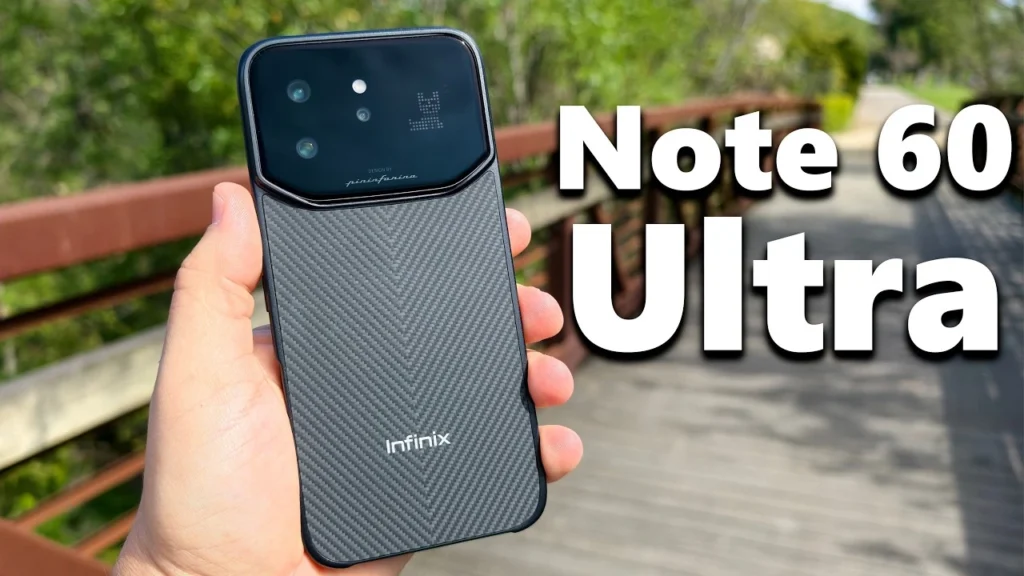
Introduction of Infinix Note 60 Ultra
The Infinix Note 60 Ultra is not the kind of phone that sells itself on a single headline. It is a layered product, a device built around a premium narrative, a strong visual identity, and a specification sheet that looks deliberately engineered to attract buyers who want more than the average mid-range handset. That is precisely why this page matters. In the current search landscape, the story around the Note 60 Ultra is fragmented. Official pages emphasize display, camera, battery, and charging; benchmark coverage fills in the gaps with chipset details; and review content adds a real-world layer that helps readers understand what the phone actually feels like in daily use. A good pillar article should not simply repeat isolated specs. It should translate them into buying logic.
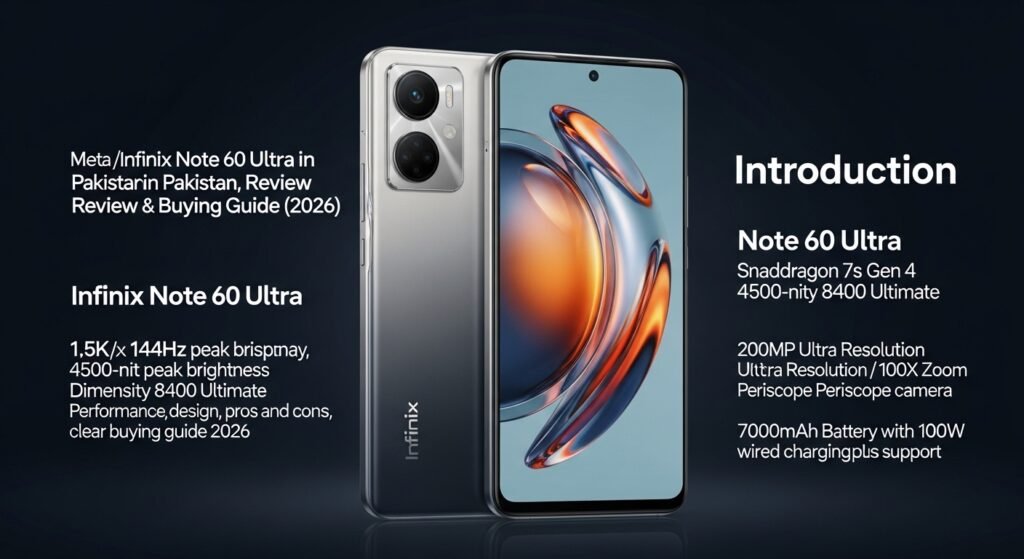
That is the role of this guide. It is written to solve confusion, reduce uncertainty, and answer the core question buyers are really asking: Is the Infinix Note 60 Ultra worth the money, and how does it compare to the rest of the lineup? The live messaging around the Ultra centers on a 1.5K 144Hz display, 4500-nit peak brightness, Dimensity 8400 Ultimate, 200MP Ultra Resolution / 100X Zoom Periscope camera, and 7000mAh battery with 100W wired charging plus wireless support.
At the same time, the market is noisy. The Note 60 Pro pages carry different battery and charging messaging, and that creates unnecessary overlap for readers who are trying to determine which model belongs to which category. Some pages lean heavily on the Snapdragon 7s Gen 4, 144Hz 1.5K display, and 6500mAh battery on the Pro side, while the Ultra pushes a more ambitious camera and battery angle.
Infinix Note 60 Ultra at a Glance
Before diving deeper, here is the high-level snapshot buyers need first.
The Note 60 Ultra is positioned as a premium upper-midrange smartphone with a display that is meant to look sharp and feel fluid, a camera system that is meant to stand out, and a battery setup that is meant to reduce charging anxiety. It also carries a design story that is unusual for the category because it leans on a co-developed aesthetic identity rather than generic styling.
| Key Area | What the live sources currently point to | Why it matters |
| Display | 6.78-inch 1.5K AMOLED, 144Hz, 4500-nit peak brightness | Better clarity, smoother motion, stronger outdoor visibility |
| Chipset | MediaTek Dimensity 8400 Ultimate | Strong upper-midrange performance for daily use and multitasking |
| Camera | 200MP Ultra Resolution camera, 100X Zoom Periscope | Strongest selling point for photography-focused buyers |
| Battery | 7000mAh | Big endurance advantage for heavy users |
| Charging | 100W wired charging, wireless support, official Ultra messaging mentions 50W wireless | Faster top-ups and more convenience |
| Software | Android 16, likely XOS 16 in benchmark coverage | Gives a modern starting point and future-facing feel |
| Design | Pininfarina co-developed the design | Adds style, brand value, and premium positioning |
| Pakistan Price | Expected Rs. 94,999 on WhatMobile | Helps local buyers judge whether it fits their budget |
This table matters because searchers rarely arrive with one clean question. They come with fragments: “How much is it?” “Is the battery good?” “Is the camera real?” “Is the Ultra better than the Pro?”, and “Should I wait or buy now?” A pillar article should answer all of those in one place, in plain language, without forcing the reader to decode marketing jargon.
Why the Specs Look Different Online
One of the biggest content opportunities around the Infinix Note 60 Ultra is the mismatch between live pages. Some sources are official, some are retail listings, some are benchmark references, and some are hands-on impressions. Each source type adds value, but each one also has a blind spot.
Official pages are polished and visually strong, but they are promotional by nature. They are built to excite, not to compare. Retail database pages such as WhatMobile are useful for local pricing and compact spec summaries, but they often feel like catalog entries rather than decision-making tools. Benchmark listings can confirm chipset, memory, and software clues, but they do not tell you whether the phone feels fast in everyday use. Review articles provide the most practical insight, but they may not fully settle pricing questions or regional variation issues.
There is also one correction that improves credibility and helps readers distinguish the models more clearly: the 90W / 6500mAh messaging belongs to the Note 60 Pro, not the Ultra. The Pro side is framed around Snapdragon 7s Gen 4, 144Hz 1.5K, and 6500mAh with wireless support, while the Ultra is being promoted with a more ambitious camera package and a larger battery profile. That distinction is central to the buying decision, because many shoppers will otherwise compare the wrong devices and arrive at the wrong conclusion.
Top 5 Live Pages and Their Weaknesses
A winning pillar page is not just a summary. It is a better answer. To outperform the current live pages, you need to understand what each one does well and where it falls short.
| Page Type | What It Does Well | Weakness You Can Beat | How Your Pillar Fixes It |
| Official teaser/launch pages | Strong branding, premium visuals, display, and camera messaging | They do not help buyers compare variants, prices, or value | Add a buying guide with clear decision cues |
| WhatMobile Pakistan listing | Clear expected price and compact spec summary | Feels like a database, not a decision page | Add context, verdicts, and use-case advice |
| Geekbench / leak coverage | Confirms chipset, RAM, and Android version clues | Still pre-launch and incomplete | Use it as evidence, then explain the implications |
| Notebook-style launch coverage | Broad launch context | More summary than conversion content | Turn the story into a structured buyer guide |
| Hands-on review | Real-world impressions on performance, camera, and battery | Does not fully solve pricing and regional confusion | Integrate review insight into a full pillar structure |
Infinix Note 60 Ultra Price in Global Context
For Pakistani buyers, the clearest live signal currently points to an expected price of Rs. 94,999 on WhatMobile, and the listing is still marked “Coming Soon”. That detail is important because price is often the first thing a buyer wants to verify. Search intent around the Infinix Note 60 Ultra price in Pakistan is extremely high-intent. People searching this term are not casually browsing; they are actively weighing whether to buy or wait.
WhatMobile also points to an expected 12GB / 256GB configuration and suggests color options such as Torino Black, Monza Red, Roma Silver, and Amalfi Blue.
On the global side, the brand is clearly trying to place the Note 60 Ultra above the usual mid-range crowd. The official story frames it as a more ambitious and design-conscious entry, tied to a premium launch narrative and a partnership with Pininfarina. That does not automatically make it a true flagship killer, but it does make the phone feel like it is reaching for a more elevated class than the average Note-series device.
Design and Build
The design story is one of the most distinctive things about the Infinix Note 60 Ultra. Infinix is not selling this as a plain slab phone with a strong chipset. It is selling it as a product with identity. That distinction matters. In a market where many phones look visually similar, design becomes a differentiator, especially for users who care about a premium presence in hand, on a desk, or in a meeting.
The co-development with Pininfarina gives the phone an automotive-inspired prestige layer. Pininfarina is known globally for sleek, aspirational design work, and associating a smartphone with that name instantly changes perception. Instead of looking like just another affordable device with a shiny back, the Ultra is positioned as a more expressive, style-forward machine. That sort of design branding can have a real influence on buyers who value aesthetics as much as they value specs.
The camera module is also part of the style language. The official messaging around the world’s 1st Uni-Chassis Cam Module suggests that the phone is trying to create a unique rear profile rather than follow the usual rectangle-on-a-backplate formula. A premium-looking camera island helps the phone feel more engineered, more deliberate, and more expensive than many competing devices in the same bracket.
According to the listing details, the phone is IP64 splash resistant, which is useful but should not be mistaken for full rugged protection. In simple terms, this means the phone has some protection against dust and splashes, but users should still treat it like a premium electronic device rather than a waterproof action tool. That balance is important to explain because many buyers assume “premium” automatically means “durable in every situation.” It does not.
What the design means for buyers
The design will matter most for buyers who want a phone that looks special, feels modern, and stands apart from the crowd. It may matter less to users who only care about budget efficiency or raw performance. The Ultra is clearly designed to attract people who appreciate a product that feels polished and desirable, not merely functional.
Display
The display is one of the clearest strengths in the whole Ultra package. The official messaging points to a 1.5K Ultra HDR cinematic display with a 144Hz refresh rate and 4500-nit peak brightness. Those numbers matter because they combine clarity, smoothness, and visibility into one feature set.
In practical terms, a 1.5K panel offers sharper text and more defined visuals than a basic FHD+ screen. The 144Hz refresh rate makes scrolling smoother and animations feel more responsive. Peak brightness at 4500 nits is especially useful in bright outdoor conditions or strong daylight, where low-brightness screens can become difficult to read. Together, these traits support a premium Everyday Experience.
Display verdict
If a buyer cares about screen quality, motion smoothness, and outdoor readability, this is one of the most persuasive reasons to consider the Note 60 Ultra. The display story is not just good on paper. It is one of the strongest reasons the phone feels premium in use.
Performance
The performance story is anchored by benchmark coverage pointing to the MediaTek Dimensity 8400 Ultimate, paired with 12GB RAM and Android 16. That combination gives the Ultra a strong upper-midrange identity. It is fast enough to feel responsive, modern enough to avoid dated behavior, and capable enough to support serious multitasking.
Benchmark figures reported in live coverage place the phone around 1,609 single-core and 6,762 multi-core in Geekbench references. Those numbers help frame expectations. They suggest a phone that should handle daily tasks, switching between apps, streaming, social use, productivity work, and many popular games without feeling sluggish. However, they also prevent overhyping the device as a pure elite-tier monster. It is powerful, yes. It is not necessarily trying to be the absolute fastest device in the premium universe.
That nuance is important. The “Ultra” name may suggest a top-of-the-line performance beast, but the real identity appears to be a more balanced formula: premium design, strong battery, impressive display, and solid upper-midrange speed. That is not a weakness. In fact, it may be the smartest positioning if Infinix is trying to keep the phone accessible while still making it feel special.
This is also where review insight becomes useful. Several live articles describe the phone as a device that punches above its weight in presentation, while still making pragmatic trade-offs. That makes sense. A phone can be compelling without being the most powerful in its class. Many buyers prefer an overall experience that feels premium rather than chasing a benchmark crown they will never notice in daily use.
Performance in simple English
For normal use, the phone should feel fast. For multitasking, 12GB RAM should help. For gaming, the chip looks strong enough to handle popular titles comfortably. The key takeaway is that the Ultra is designed to feel smooth and competent rather than merely spec-heavy.
Camera
If the display is the most visible strength, the camera is probably the most marketable one. Infinix is clearly treating the camera as the hero feature. Official pages highlight a 200MP Ultra Resolution camera, 100X Zoom Periscope, and the world’s 1st Uni-Chassis Cam Module. That is a bold story, and it gives the phone immediate personality in a market full of repetitive camera claims.
Retail and spec listings add more precision. The camera setup is described as a 200MP 1/1.4-inch Samsung HPE sensor, a 50MP Samsung JN5 periscope telephoto lens, and an 8MP ultrawide camera. That is a substantial imaging package. It is not just a marketing sticker. It suggests a phone that is trying to do more than basic social media photos and casual snapshots.
Hands-on content also supports the idea that the camera is more than just a headline. Review coverage has described the camera as one of the standout parts of the phone, indicating that the device does not only look good in a spec sheet. It also appears to deliver enough real-world value to impress early testers.
A camera like this matters for several reasons. It gives the phone a sharp identity. It helps justify the price. It makes the Ultra more attractive to users who like portraits, close-ups, zoom shots, and social sharing. It also helps the phone compete in a space where many models have competent cameras, but few have memorable ones.
What the camera angle means for readers
If someone wants a phone for photography, portrait shooting, long-range zoom, and creative use, the Ultra is clearly aiming in the right direction. If someone just wants a cheap device with an acceptable camera, this is not the best fit. This model is trying to win attention through imaging ambition.
Battery and Charging
The battery section is another major conversion point. Official Ultra messaging highlights a 7000mAh battery combined with 100W wired charging and wireless charging support. That combination is powerful from a buyer’s perspective because it addresses two common pain points at once: battery anxiety and charging inconvenience.
A 7000mAh battery is substantial. It suggests longer screen-on time, better endurance for travel, and fewer worries for users who stay away from chargers during the day. This is especially relevant for people who watch videos, use maps, scroll social media, take lots of photos, or spend extended periods away from power outlets.
The charging side is equally important. 100W wired charging is a premium feature because it reduces the amount of time the phone needs to spend plugged in. Wireless charging support adds convenience and raises the phone’s overall status in the market. Official messaging also points specifically to 50W wireless charging, while some pre-launch reporting mentioned lower figures. That means buyers should treat wireless charging details carefully and verify the final retail spec in their market.
The global story also mentions premium features like Global Satellite Calling & Messaging in the broader Ultra narrative. That is an intriguing capability, but because such features can depend on region, carrier support, and rollout rules, it is best treated as a feature to watch rather than a feature to assume universally.
Battery verdict
The battery and charging combination is one of the strongest reasons to care about the Note 60 Ultra. A large battery plus rapid charging is the sort of pairing that improves real life, not just spec sheet bragging rights. For many users, this alone could tip the buying decision.
Software and AI Features
The software story is also part of the device’s appeal. Benchmark and leak coverage point toward Android 16, likely with XOS 16 layered on top. That matters because buyers increasingly look for a device that feels current at launch rather than one that already feels outdated.
WhatMobile also suggests that the phone may receive three major OS updates, potentially extending support up to Android 19. If that policy holds, it gives the Ultra a better long-term profile than many devices in the same class. Long software support helps the phone remain useful for more years, which increases the perceived value of the purchase.
Some live details also mention eSIM support and two-way satellite communication in benchmark-related coverage. These are premium-style features that add to the phone’s futuristic image. They should still be treated with care, because regional variants can differ, and final market support can vary. Still, their presence in the live discussion strengthens the impression that the Ultra is aiming higher than a basic mainstream phone.
Why software matters
A phone with good hardware but weak software ages badly. A phone with modern software, better support expectations, and premium feature flags feels easier to recommend. The Note 60 Ultra has a strong software narrative because it starts from a modern platform and appears to be built with future-facing language in mind.
Pros and Cons
Pros
The Infinix Note 60 Ultra offers a genuinely attractive mix of strengths. It has a strong premium display, a large 7000mAh battery, fast 100W wired charging, wireless charging support, a camera system that includes a 200MP Ultra Resolution lens and 100X zoom periscope capability, and a design story linked to Pininfarina. It also appears to be backed by a capable Dimensity 8400 Ultimate chipset and 12GB RAM, which should support smooth everyday use.
Cons
The biggest drawback is confusion. The live ecosystem still mixes official details, teaser language, benchmark data, and regional retail information, which makes it hard for buyers to know which spec is final. Another possible concern is that the chipset, while strong, may not be class-leading, so the phone may win more on design and camera appeal than on pure performance dominance. A third issue is that the final price and feature availability can vary by region, which means some details still need confirmation before purchase.
Infinix Note 60 Ultra vs Infinix Note 60 Pro
This comparison is crucial because many users will naturally compare the Ultra with the Pro. That is where confusion often starts, and that is where a good article should bring clarity.
| Feature | Note 60 Ultra | Note 60 Pro |
| Chipset | Dimensity 8400 Ultimate | Snapdragon 7s Gen 4 |
| Display | 1.5K 144Hz Ultra HDR cinematic display with 4500-nit peak brightness | 1.5K 144Hz AMOLED with 4500-nit peak brightness on the Pro page |
| Battery | 7000mAh | 6500mAh on the Note 60 Pro / Note 60 messaging |
| Charging | 100W wired + wireless support | 90W on the Pro messaging |
| Camera | 200MP Ultra Resolution + 100X Zoom Periscope | Pro pages do not carry the same Ultra camera identity |
| Positioning | Design-led premium model | Strong mid-range / upper-midrange model |
The conclusion is simple. The Ultra is the more ambitious and more premium model. It is built to feel more aspirational, more feature-rich, and more distinctive. The Pro is still valuable, but it does not carry the same camera-first, design-led, premium battery story. For readers deciding between the two, this distinction may be the most useful part of the article.
Who Should Buy the Infinix Note 60 Ultra?
The Infinix Note 60 Ultra makes sense for buyers who want a big battery, fast charging, a premium display, and a camera system that tries to deliver more than the ordinary. It also fits users who care about design and want a device that feels more expressive than a standard budget phone.
It is especially suitable for someone who values the full experience: display quality, battery life, charging speed, camera flexibility, and visual appeal. That is where the Ultra earns its name. It is not simply about the biggest number in one category. It is about a complete package that feels elevated.
At the same time, this phone may not be the right choice for someone who only cares about the lowest possible price. Infinix has other devices that sit lower in the lineup, and those may be more practical for price-first buyers. The Ultra is a better fit for users who want more polish and are willing to pay for it.
FAQs
The current live Pakistan listing shows an expected price of Rs. 94,999, and the page still marks it as Coming Soon.
Yes. The official Ultra pages highlight wireless charging support, and the live Ultra messaging specifically points to 50W wireless charging. Some leak reports mention lower wireless figures, so the final retail spec should still be verified.
The live benchmark coverage points to the MediaTek Dimensity 8400 Ultimate with 12GB RAM and Android 16.
The official Ultra pages highlight a 7000mAh battery.
For overall premium positioning, yes. The Ultra has the stronger camera story, larger battery, faster charging, and a more design-led identity. The Pro is still strong, but its official messaging centers on Snapdragon 7s Gen 4, 90W charging, and 6500mAh, which puts it below the Ultra tier.
Final Verdict
The Infinix Note 60 Ultra is not simply another specification-heavy smartphone. Right now, the strongest live narrative around the Ultra is clear: a 1.5K 144Hz display, 4500-nit peak brightness, Dimensity 8400 Ultimate, 200MP Ultra Resolution / 100X Zoom Periscope camera, 7000mAh battery, and 100W wired charging with wireless support. That is an impressive package. If the final Pakistan price holds close to the expected figure, the Ultra could become a very compelling option for buyers who want style, battery life, and camera ambition in one device.
