
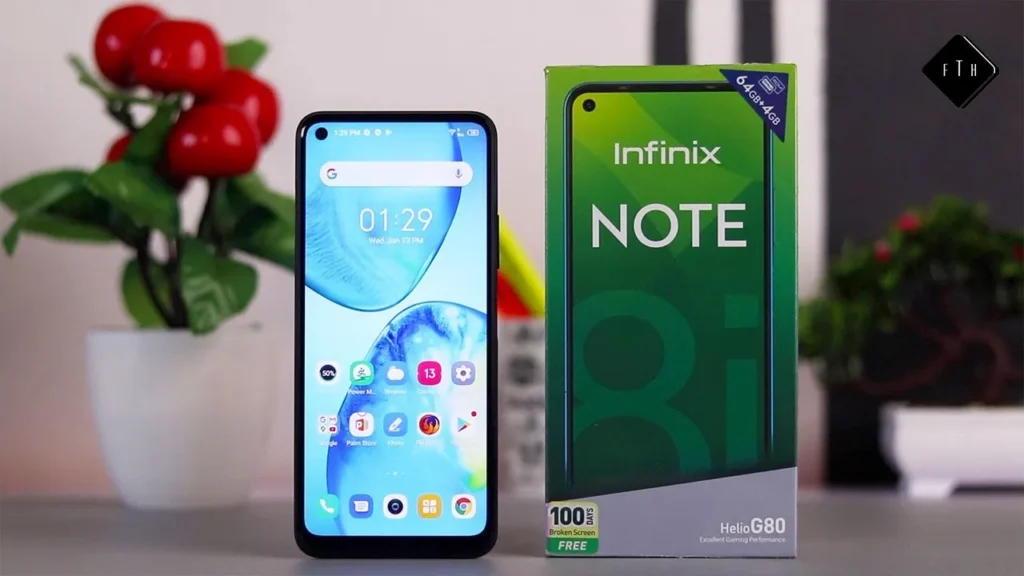
Introduction of Infinix Note 8i?
Think of the Infinix Note 8i as a compact deployed inference engine: a consumer device whose hardware architecture, I/O channels, energy envelope, and on-device software all determine how it behaves in real-world tasks. Released in late 2020, the Note 8i maps to a mid-tier inference node: large input tokens (big screen), limited model parameter budget (Helio G80 SoC), and plentiful energy allocation per inference (5200 mAh battery). It ships with Android 10 and Infinix’s XOS skin — essentially the runtime environment and middleware stack that orchestrates processes, manages memory, and schedules tasks.
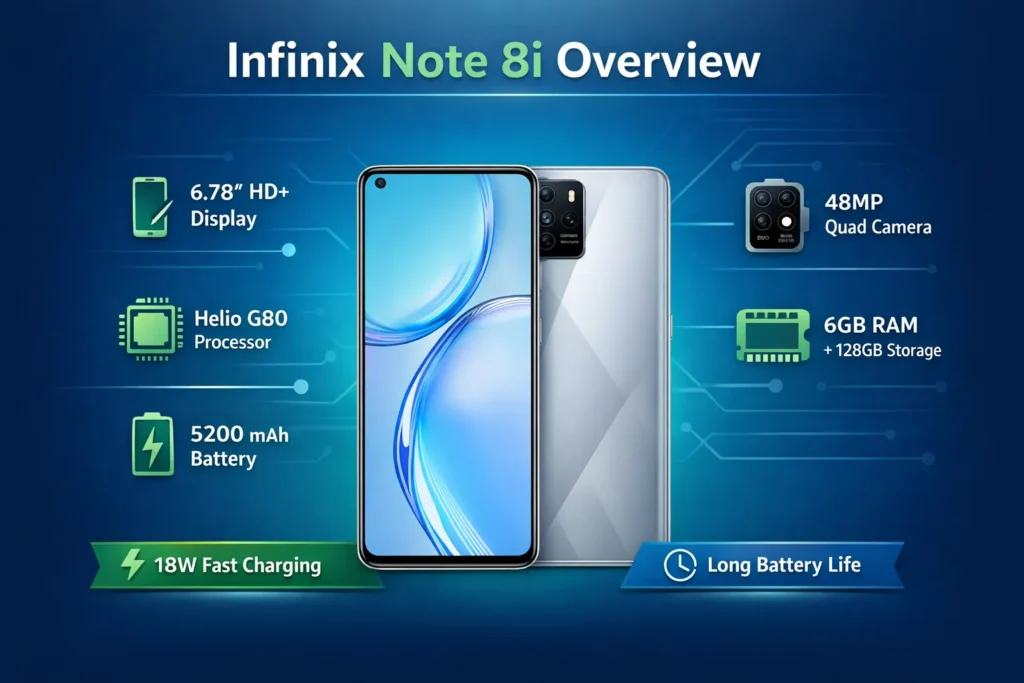
Key specs at a glance
Model name: Infinix Note 8i (X683) — inference device SKU
Display (input channel): 6.78-inch IPS LCD, 720 × 1640 px (HD+), ~264 ppi, peak ≈ 480 nits
Compute substrate (SoC/CPU): MediaTek Helio G80 — octa-core (2×2.0 GHz Cortex-A75 + 6×1.8 GHz Cortex-A55)
Accelerator (GPU): Mali-G52 MC2 — lightweight graphics accelerator for visual rendering and basic compute offload.
Memory / Storage (RAM/ROM): Typically 6GB RAM / 128GB storage; expandable via microSD (storage extension)
Imaging sensors (camera stack): 48MP main + 2MP macro + 2MP depth + 2MP AI lens (quad array)
Front-facing sensor: 8MP selfie camera
Energy reservoir (battery): 5200 mAh, supports 18W charging — large energy budget per session.
OS & runtime: Android 10 with XOS 7.1 skin — runtime + middleware layer that affects scheduling, background pruning, and update cadence.
I/O: USB-C, 3.5mm jack — standard peripheral channels
Biometrics: Side-mounted fingerprint scanner — local authentication module
Launch window: Announced/launched Oct–Nov 2020 (regional rollouts followed)
Design and display
Big display for media
The 6.78-inch IPS LCD is the Note 8i’s primary input/consumption window — analogous to a large input embedding dimension that makes visual data more comfortable to consume. Bigger screens give you more “token space” for UI elements, video playback, and multi-pane reading, but the resolution is HD+ (720p), so pixel density is relatively low versus Full HD competitors. That trade-off conserves energy (fewer pixels to drive per frame) and reduces rendering load, which in turn helps battery life — much like quantized or smaller models trade representational fidelity for efficiency.
Build and feel
The device predominantly uses polycarbonate for the frame and back in many markets — a cost-effective composite that keeps mass low while providing durability. The side-mounted fingerprint sensor acts like a hardware token authenticator: fast, reliable, and positioned for natural reach. Colorways such as Tranquil Blue, Ice Diamond, and Obsidian Black are essentially aesthetic skins for the same hardware profile.
Brightness and sunlight legibility
Peak brightness around ~480 nits provides solid indoor viewing and adequate outdoor readability in moderate sunlight. It won’t compete with flagship displays that exceed 800–1,000 nits, but its brightness budget suits typical daytime use. If you frequently use your device outdoors in peak sun, consider an FHD competitor with a higher peak nit rating.
Performance
Processor explained simply
The MediaTek Helio G80 sits in the mid-range class: its architecture is aimed at efficient, cost-effective inference rather than maximal throughput. Think of it as an efficient transformer-lite for mobile tasks: optimized for background task orchestration, UI rendering, video decoding, and moderate on-device ML (photo enhancements). For everyday operations — web browsing, social apps, messaging, streaming — latency is acceptable, and the system provides steady throughput.
For gaming, interpret the GPU and CPU cores as your device’s parallel compute lanes. Casual games run smoothly at medium settings; heavyweight, GPU-intensive titles will require lower graphics presets to keep frame rates stable. Expect thermal rise and some throttling in sustained high-load sessions.
Memory and storage
With 6GB RAM, the Note 8i maintains a modest working set, permitting several apps to remain cached. Heavy multitaskers who keep many tabs and background processes may notice background app reloads as the OS evicts dormant processes — similar to how a memory-limited model will evict cached activations.
Storage: 128GB is ample for daily users; a microSD slot provides a simple Expansion Pathway. For high-volume photographers or users of large media datasets, the expansion slot behaves like off-device storage accessible over slower I/O.
Real-world impressions
Day-to-day responsiveness is acceptable: app launches, scrolling, and media playback are generally smooth. Occasional app reloads are expected under heavy multitasking. During extended gaming sessions, you’ll observe thermal accumulation and performance rounding: the device warms and the scheduler reduces clock speeds to preserve hardware longevity and battery life.
Cameras
Camera hardware
The imaging pipeline comprises a 48MP main sensor (often outputting binned 12MP images for improved signal-to-noise), plus three 2MP supplementary sensors (macro, depth, AI lens). The selfie camera is an 8MP sensor. The multi-sensor array resembles a multi-modal dataset: a primary high-resolution channel complemented by auxiliary channels that add texture, depth cues, and close-focus details.
Daylight performance
Under ample light, the main sensor produces images that are shareable and aesthetically pleasing: adequate sharpness, natural color saturation, and suitable dynamic range for social media use. The ISP (image signal processor) applies tone mapping and sharpening similar to a preprocessing pipeline, but highlights and deep shadows can still clip — dynamic range isn’t the flagship class.
Low-light and night
In a low-light scenario,s the Note 8i performs acceptably but not outstandingly. Night mode helps by lengthening exposure and applying algorithmic denoising, but the output can look softer and noisier compared to higher-end devices with larger sensors, stronger ISPs, or hardware stabilization. For best low-light results: stabilize the device (tripod or steady surface) and use night mode.
Video capture
Video capture is suitable for everyday clips. The camera supports up to around 1440p@30fps on some SKUs, though common usage tends to be 1080p. Stabilization is basic; expect handheld shake. For steady footage, use gimbals or ensure a steady grip.
Camera sample checklist
To build an authoritative review dataset, collect standardized shots:
- Daylight wide shot (full-res JPEG)
- Portrait/subject separation with bokeh
- Macro close-up (2MP) full-frame
- Night mode / low-light shot (tripod + handheld variants)
- 2× / 4× crops at 100% for sharpness analysis
- RAW/EXIF files, if accessible, for forensic testing
Battery life & charging
Battery hardware and real life
The 5200 mAh battery is the Note 8i’s primary advantage. Consider this your device’s usable compute budget: a larger energy reservoir lets the phone sustain more inference cycles (streaming, browsing, gaming) between charges. Typical usage often yields a full day and sometimes approaches two days under light-to-moderate patterns (messaging, calls, social apps, occasional streaming).
Charging speed
The device supports 18W charging. It’s not in the ultra-fast class (30–80W found in some modern devices), so full recharges take longer, but the trade-off is a simpler thermal profile and better long-term battery longevity. Track the charge curve (percent vs minutes) for precise reporting.
Suggested battery tests to run
If you’re publishing a pillar article, include standardized tests:
- YouTube loop at 50% display brightness — measure hours to shut down.
- Web browsing SOT (screen-on time) with common social apps running.
- 30-minute gaming drain percentage (e.g., PUBG Mobile / Call of Duty Mobile).
- Full charge time and charging curve graph (measure % vs minutes).
These tests help quantify real-world endurance and the battery-to-performance trade-off.
Software and updates
The Note 8i launched with Android 10 and Infinix’s XOS 7.1 — the runtime and system skin that manages permissions, background tasks, and update mechanisms. Infinix’s support for older budget models historically tends to be limited relative to premium vendors: expect occasional security patches and bug-fix updates, but do not count on multiple Android major version upgrades. When reviewing a device, log the firmware build number and capture OTA changelogs for documentation.
Competitor
Use the table below as a quick comparative model card to place the Note 8i among peers.
| Feature | Infinix Note 8i | Realme Narzo 20 | Xiaomi Redmi Note 9 |
| Display | 6.78″ HD+ (~480 nits) | 6.5″ HD+ | 6.53″ FHD+ |
| SoC | Helio G80 | Helio G85 | Helio G85 / Snapdragon variants |
| Battery | 5200 mAh, 18W | 6000 mAh | 5020 mAh |
| Rear Camera | 48MP quad | 48MP triple | 48MP quad |
| Best for | Big-screen media & long battery | Massive battery users | Balanced value seekers |
Who should buy the Infinix Note 8i?
Ideal buyers:
- Students & media consumers: If you watch a lot of videos, read long-form articles, or use split-screen apps, the large 6.78″ display plus 5200 mAh battery is a compelling combination.
- Budget-minded buyers wanting size: For large-screen devices at a low price, the Note 8i delivers good value.
- Casual gamers: Play at medium settings; good for non-competitive sessions.
- Beginner photographers: Decent daytime shots for social sharing.
Who should not buy it:
- Users who prioritize display fidelity: If pixel density or color accuracy matters, seek FHD+ panels.
- Competitive gamers: For stable high-FPS competitive play, choose higher-tier SoCs.
- Long-term software-commitment buyers: If guaranteed Android major upgrades are essential, buy from brands that publish clear multi-year update policies.
Pricing & availability
The Infinix Note 8i launched in late 2020 and has seen regional pricing differences. For current prices, always snapshot retailer pages and record date_checked — prices vary by region, seller, and stock. As a historical reference, some markets listed a launch price around PKR ~26,999–28,000 in Pakistan; treat that as illustrative rather than current.
Pros & Cons
Pros
- Large 6.78-inch display — excellent for media and reading.
- 5200 mAh battery — long real-world endurance.
- 48MP main camera — good daylight images for the price.
- 6GB/128GB common configuration — strong storage/RAM for the budget tier.
Cons
- HD+ (720p) display — lower sharpness than FHD alternatives.
- Launched on Android 10 — limited major OS upgrade expectations.
- Not optimized for high-tier competitive gaming.
- Camera low-light and video stabilization are not class-leading.
FAQs
A: The Infinix Note 8i has a 6.78-inch IPS LCD with HD+ resolution (~720 × 1640).
A: It uses the MediaTek Helio G80 chipset (Octa-core).
A: It has a 5200 mAh battery and supports 18W charging.
A: A 48MP main sensor with additional 2MP macro/depth/AI sensors (quad setup).
A: No — it’s HD+ (720p). This lower resolution helps save battery and keeps costs down, but it’s less sharp than FHD displays.
Final verdict
The Infinix Note 8i is a pragmatic inference node for everyday mobile tasks: large-screen media, long battery endurance, and fair camera performance for daylight usage. It doesn’t compete with modern flagships on display fidelity or heavyweight compute, but as a budget-oriented device optimized for size and runtime endurance, it’s a solid buy—especially for users who value screen real estate and long battery life.
