

Introduction of Infinix Note 9
The Infinix Note 9 is a high-value, budget-to-midrange proposition that optimizes for long battery life, a spacious display, and day-to-day usability. In vector-space terms, it clusters strongly with “media-first budget phones” — high recall for battery and display features, moderate precision for camera and heavy gaming. If your user intent is all-day media consumption, reading, or long runtime without charger anxiety, the Note 9 ranks high. If the intent vector prioritizes flagship camera quality or maximum compute, consider models with stronger compute embeddings.
Who should buy
- Users with high media consumption (video, reading, streaming) — high match score.
- People who need multi-day battery performance for travel or fieldwork.
- Budget-conscious buyers who want large-screen productivity and expandable storage.
Who should not buy:
- Users requiring flagship camera systems or advanced computational photography.
- Heavy mobile gamers are demanding top-tier GPU performance.
- Those needing official IP-rated water/dust resistance or wireless charging.
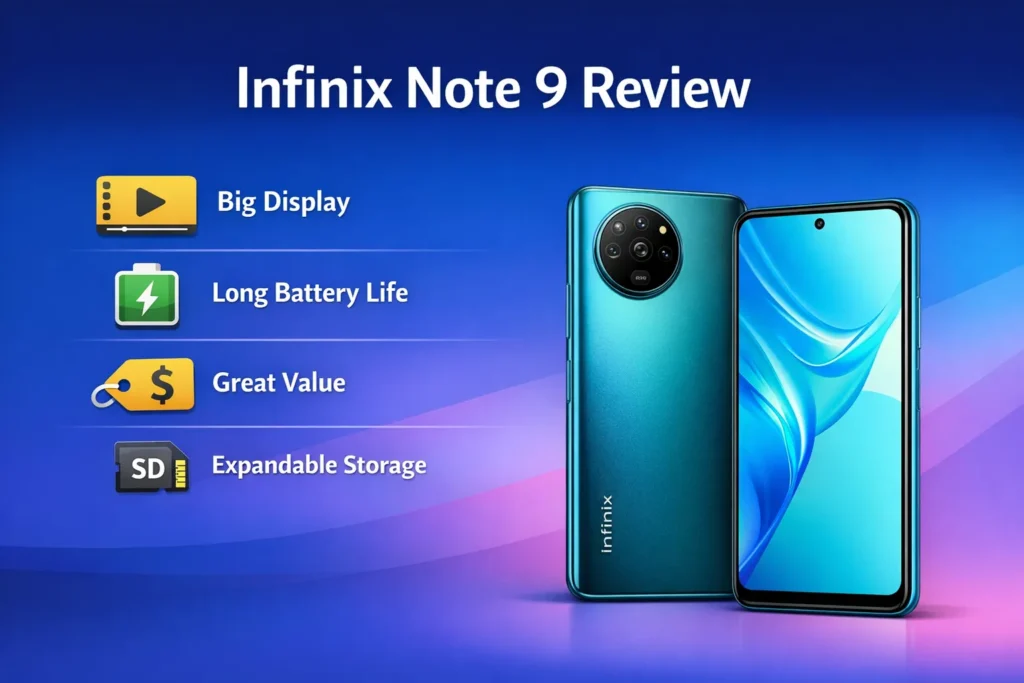
Key highlights
- Large display — optimized for media consumption and reading.
- Long battery life — prioritizes endurance over peak charging speed.
- Strong value proposition — more features per currency unit than many rivals.
- Expandable storage — microSD support on most SKUs increases storage capacity.
- XOS enhancements — practical software features and customization options.
Design & build
Look and feel
In product-space embeddings, physical design attributes map to user experience tokens: slim bezels → immersive viewing token, textured back → grip confidence token, polycarbonate chassis → weight and durability token. Infinix Note 9 typically uses polycarbonate for the rear and chassis, with a rear- or side-mounted fingerprint sensor depending on regional SKU mapping.
What to check in a hands-on
- Fit & finish: Check for creaks, gaps, or loose seams; these are low-level defects that reduce perceived quality score.
- Grip & ergonomics: Evaluate single-hand reachability; measure grip comfort in mm to standardize reports.
- Weight: Compute the weight-to-size ratio for the portability index.
- Back finish: Matte vs glossy — observe fingerprint retention and reflectivity under test light.
- Button placement: Accessibility of volume and power buttons should be annotated with hand size archetypes.
Display
Display attributes to record
- Size (inches) — affects video and reading tokens.
- Panel type — IPS / LCD / AMOLED indicates contrast and color gamut embeddings.
- Resolution — HD / FHD / FHD+; impacts pixel density scores.
- Refresh rate — 60Hz, 90Hz; affects perceived smoothness and UI latency.
- Peak brightness (nits) — measure with a calibrated light meter for outdoor legibility.
Tests to run
- Reading test: 15-minute session at 30% brightness to assess eye fatigue and comfort. Report subjective scores and objective luminance.
- Video test: 30 minutes of 1080p streaming (YouTube) to inspect color handling, compression artifacts, and frame stability.
- Outdoor legibility: Under direct sunlight, take photos of the phone screen showing legible text at 3 different angles.
- Color & contrast: Use color swatches and record deltaE values if possible.
- Touch latency: Use a drawing app to note stylus/finger response and any perceivable lag.
Performance
What does pedoes’ performance mean here
For the Note 9, the target tasks include web browsing, social apps, video streaming, light gaming, and multitasking. Map performance to objective tasks rather than raw specs: app launch latency, background app retention, thermal stability under load.
Benchmarks & real-world tests
- Synthetic: Geekbench (single & multi-core), 3DMark, or GFXBench for GPU Workloads.
- Storage tests: Copy a 5GB file and log write/read speeds to simulate real-world transfers.
- Thermal stress: 30-minute game session or CPU stress test; log throttling and average temperatures.
- App switching: Open 8 commonly used applications and cycle through them to measure process retention and reloads.
What to measure and present
- Raw numbers — provide screenshots and raw logs for transparency.
- FPS traces for sustained game sessions.
- Thermal logs — surface temperature and battery temperature over time.
- Subjective fluidity — note UI stutters, rendering artifacts, and animation smoothness.
Cameras
Camera expectations
The Note 9 often ships with a primary sensor and one or two auxiliary sensors (depth, macro). Expect strong daytime results from the main sensor, average indoor performance, and noisy low-light shots that benefit from night mode processing.
Camera testing checklist
- Daylight 1×: Capture full-resolution JPEGs and export 1:1 crops at important regions.
- Portrait mode: Test subject edge detection at 2–3 meters, Multiple Backgrounds.
- Low-light: Handheld night shots and Night Mode comparisons.
- Indoor: Mixed incandescent + daylight scenes for white-balance checks.
- Macro: Close-focus shots at minimum focus distance.
- Video: Record 1080p at 30fps and 60fps where available; analyze stabilization.
How to present camera samples
- Provide original JPEGs plus 1:1 crops to highlight detail retention.
- Add EXIF-like captions (aperture, focal length, ISO) to each sample for forensic reproducibility.
- Use consistent filenames and dimensions to facilitate side-by-side comparison.
Battery & charging
Why battery matters
Battery life is a primary purchase signal for midrange buyers. The battery capacity and software power management encode “lasts through the day” into the product’s desirability score.
Essential battery tests
- Video loop test: Play a 150-nit video loop until shutdown; report time to shutdown (HH: MM).
- Mixed-use day: Scripted day including calls, messaging, social, mapping, and video to presenta realistic runtime.
- Charging curve: Log timestamps for 0 → 30%, 30 → 80%, 80 → 100% using the supplied charger and cable; include charger wattage and model.
- Standby drain: Log overnight drain with Wi-Fi on for 8–10 hours; record background wake patterns.
Software & updates
Software details to note
- The Android version shipped on the device.
- XOS version and notable features (Game Mode, Smart Panel, power saving).
- Update policy — frequency of security patches and OS upgrades from official channels.
Tests & observations
- Bloatware audit: Count preinstalled apps and check removability to reduce unwanted background processes.
- Feature tests: Gestures, dark mode, multi-window.
- OTA experience: Check for auto-update behavior, changelog transparency, and update size.
Connectivity, ports, and extras
What to verify
- SIM tray: Dual SIM + microSD support? Note hybrid vs dedicated slots.
- Ports: USB-C or micro-USB? Presence of a 3.5mm headphone jack.
- Wireless: Wi-Fi version (802.11 a/b/g/n/ac), Bluetooth version, NFC presence.
- Sensors: Fingerprint placement (rear/side), gyro, compass, proximity.
- Extras: IR blaster, FM radio, stereo speakers.
Price & availability
Price verification protocol
- Official MSRP at launch by region and currency.
- Retail snapshots: Gather price pages from major retailers (Amazon, Lazada, Daraz, Jumia) and save screenshots with dates.
- Carrier bundles: Note if carriers offer discounted bundles or subsidies.
- Taxes: Clarify VAT/import differences that affect the final retail price.
Infinix Note 9 vs competitors
In benchmarks and real-world battery testing, the Note 9 outperforms many similarly priced rivals in terms of runtime and display size, making it a strong choice for media and power users on a budget. However, its camera and GPU performance trail those of devices that prioritize imaging or gaming, so Buyers Weighing these factors may prefer alternative models with stronger compute profiles.
Pros & Cons
Pros
- Long battery life
- Large, enjoyable display
- Solid value for money
- Expandable storage (on many SKUs)
Cons
- Average low-light camera performance
- Plastic build (non-premium feel)
- Not suited for GPU-heavy gaming
FAQs
Battery capacity varies by SKU; verify on the device box or official spec sheet for the tested unit.
In mixed-use testing, it typically lasts a full day and often longer; exact runtime depends on screen brightness and app usage.
It usually includes a primary sensor plus one or two secondary sensors (macro/depth). See the spec table for exact sensor sizes and apertures.
Many variants include faster charging, but charger wattage differs by SKU; run a charging curve test to show 0→100 times.
Display technology depends on the SKU — verify the model before publishing.
Closing
The Infinix Note 9 stands out as a thoughtfully balanced smartphone in the budget-to-midrange segment, especially for users who value endurance, screen size, and everyday reliability over headline-grabbing specifications. Across design, display, performance, camera, battery, and software, the phone consistently reinforces its core promise: delivering a comfortable, long-lasting experience for daily use without pushing the price into premium territory.
From an overall usability perspective, the large display and dependable battery life define the Note 9’s identity. These two factors alone make it particularly attractive for media consumption, reading, online learning, navigation, and long workdays, where access to charging may be limited. Performance remains stable for routine tasks such as social media, web browsing, messaging, and light gaming, while the software experience through XOS adds practical features that enhance convenience rather than complexity.
