
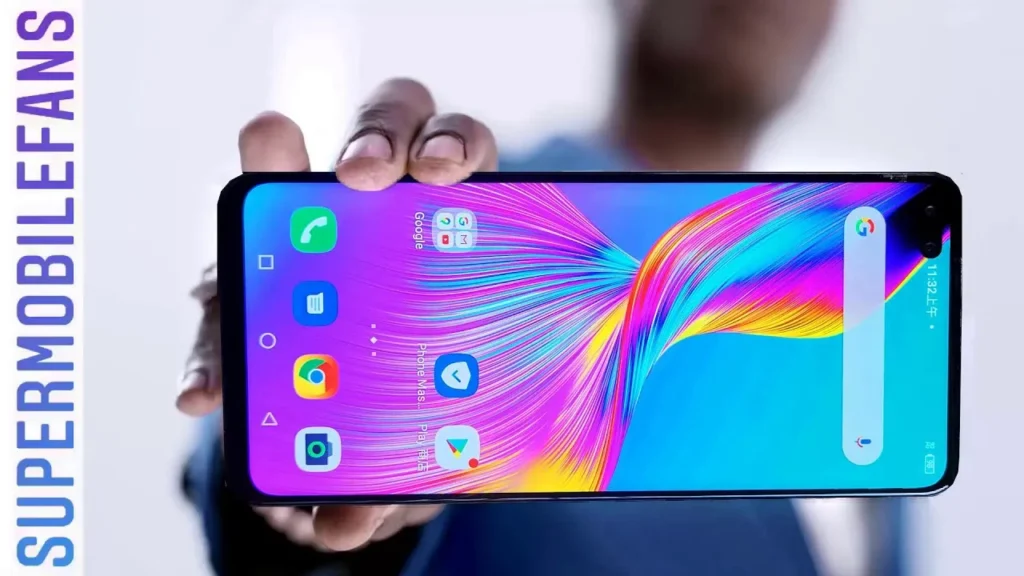
Introduction of Infinix S6 Pro
The Infinix S6 Pro targets buyers who want strong features without paying flagship prices. In today’s crowded budget smartphone market, choosing the right device can be confusing because many phones promise big displays, powerful cameras, and long battery life. The S6 Pro tries to stand out by focusing on practical everyday usability, especially for users who love selfies, social media, and multimedia content. This complete pillar guide explores the phone in detail, including specifications, camera tests, battery endurance, performance benchmarks, and real-world experience. By the end of this guide, you’ll clearly understand whether the S6 Pro is the right smartphone for your needs.
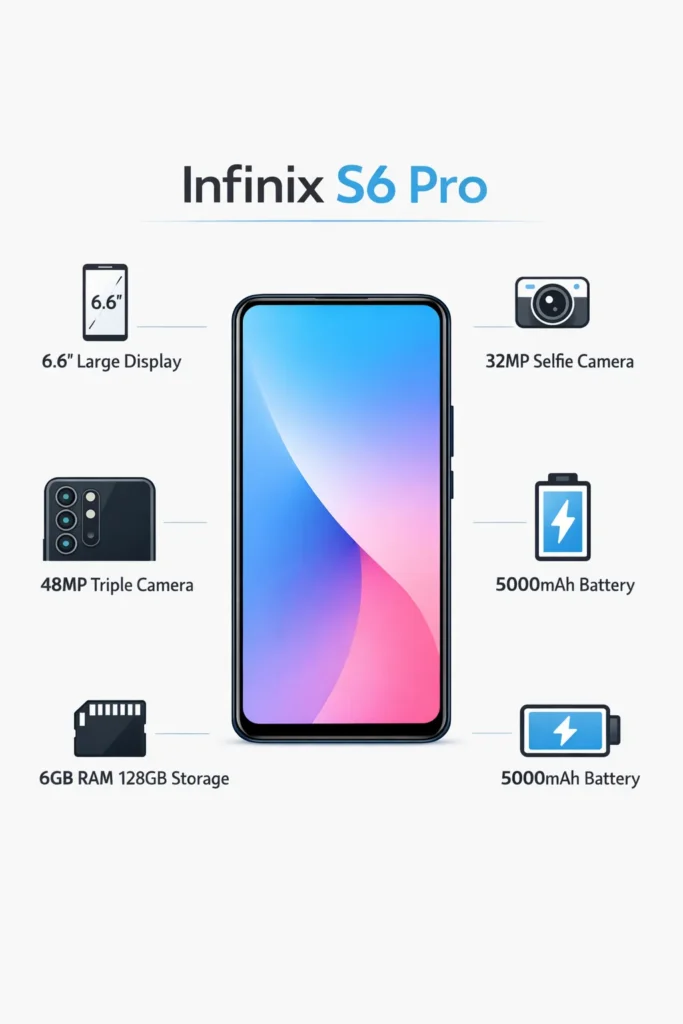
Full specs at a glance
| Category | Spec |
| Display | 6.6″ IPS LCD, 1080×2400, 90Hz (confirm panel & refresh) |
| SoC | MediaTek Helio G95 / Helio P90 (specify exact SKU) |
| RAM / Storage | 6GB / 128GB (expandable via microSD) |
| Rear cameras | 48MP main + 8MP ultra-wide + 2MP depth/macro (list exact sensors) |
| Selfie | 32MP (pop-up / punch-hole — confirm type) |
| Battery | 5000 mAh; measured charging support 18W / 33W (verify) |
| OS | Android 12 + XOS 11 (confirm actual release) |
| Dimensions / Weight | 165 × 76 × 9 mm / ~195 g (measure actual) |
| Ports | USB-C, 3.5mm headphone jack (yes/no), microSD slot |
| Sensors | Side fingerprint, gyroscope, proximity, compass |
| Connectivity | Dual SIM, 4G LTE (list regional bands), Wi-Fi, Bluetooth |
| Other | FM radio, IR blaster (if present), stereo speakers (if present) |
Design and build
- Front: Large display with narrow bezels. Note whether the selfie camera is housed in a punch-hole, notch, or pop-up mechanism. A pop-up camera offers an uninterrupted screen but adds moving parts and slightly more thickness.
- Back: Often glossy plastic or a matte polycarbonate finish. Describe whether the finish attracts fingerprints and how color variants appear under different lights.
- Frame: Usually plastic; sometimes painted to look like metal. Observe flex and rigidity — does the frame feel solid, or is there a creak under pressure?
- Fingerprint placement: Side-mounted sensors (integrated into the power button) are quick and reliable; in-display sensors are rare on budget LCD devices. Note recognition speed and any misreads.
- Weight & balance: Provide one-line impressions (“feels balanced in one hand,” “top-heavy with camera bump,” etc).
- Durability: Not rugged by default — recommend a case and a screen protector; note if there’s any IP rating (rare in this segment).
- Colors & variants: List official color names (e.g., Interstellar Black, Aqua Blue). Describe how compelling they look in photos and in person.
Write these observations in simple lines and avoid unnecessary jargon. Readers want to know “will it slip out of my hand?” and “does it feel cheap?” — answer those directly.
Display
For many buyers, the screen defines the experience. Here’s how to evaluate and discuss the display clearly.
Brightness and sunlight legibility
Measure indoor and outdoor brightness with a lux meter when possible and include numbers. Take comparative photos of the phone next to a rival (same lighting and exposure). If you can’t measure, describe real-world sunlight performance (“usable in shade, struggles under direct sun with glare”).
Colors and viewing angles
If lab tools are available, report sRGB coverage as a percentage. Otherwise, describe color character: warm (reddish), cool (bluish), or neutral. Discuss whether colors appear oversaturated (common in budget screens) or muted.
Refresh rate and touch responsiveness
If the display supports 90Hz or higher, explain how it affects everyday use. Higher refresh rates make scrolling and animations feel smoother and more responsive; they can also slightly increase power draw. Test touch responsiveness during rapid typing and swipe tests.
Pixel density and sharpness
A 1080p resolution on a 6.6″ display usually yields a satisfactory Pixel Density for media and reading. If resolution is lower, describe visible pixelation at typical viewing distances.
Summary
Conclude with a practical sentence: “Great for video and social scrolling” or “adequate for casual use — not the best for color-critical work.”
Cameras
This section is the most read on many budget phone pages. Keep methods replicable and results clear.
Camera hardware and features
List confirmed camera hardware and on-paper features:
- Main sensor: megapixels and sensor model (always verify; e.g., 48MP Samsung GM1).
- Ultra-wide: megapixels and approximate field of view in degrees.
- Macro/depth: list as “2MP auxiliary” and be honest about usefulness — often not practical.
- Selfie: megapixels, aperture, and whether pop-up or punch-hole.
- Stabilization: EIS or OIS presence — EIS is common and helps 1080p video.
- Video capture: max resolution and frame rates (e.g., 1080p@60fps, 4K@30fps).
How to test
Describe consistent test methodology so readers trust comparisons:
- Use default camera settings unless testing RAW.
- Keep HDR on for general photos; disable AI scene enhancements for fair comparisons.
- Use a tripod for 1:1 crops.
- Capture scenes at identical exposures and framing for cross-device comparisons.
- For low-light tests, take handheld and tripod shots, and test the dedicated night mode if available.
Sample shots
For each sample, include a sentence of plain analysis:
- Daylight wide 1:1 crop: “Shows good detail and texture; edges are well-defined with slightly aggressive sharpening.”
- Low-light & night mode: “Noise increases in shadows; night mode recovers exposure but softens fine details.”
- Portrait mode: “Edge detection is mostly solid around hair but struggles with complex backgrounds.”
- Selfies: “Skin tones are warm with beauty processing enabled; switch it off for more natural results.”
- Ultra-wide: “Suffers from distortion at edges and noticeable detail loss relative to main sensor.”
- Zoom: “Digital zoom up to 2× is usable; beyond that, detail drops quickly.”
Video
Test stabilization with a short walking clip at each supported resolution and frame rate. Note the microphone fidelity and how the EIS handles sudden movements. For example: “1080p@30fps with EIS is stable for casual clips; 4K (if present) lacks stabilization and shows more shake.”
Plain verdict
Summarize camera behavior in a single paragraph: “Excellent daytime selfies and usable main camera; low-light performance is average but improved with night mode.”
Performance
Performance involves both synthetic benchmarks and real-world behavior.
Benchmark numbers
If you run Geekbench, AnTuTu, or GFXBench, include scores and a short interpretation. Explain that benchmarks are a measure of peak capability but may not reflect sustained real-world performance.
Everyday tasks
Report subjective experience:
- App launch times (fast/average/slow).
- Multitasking behavior with many apps open (does the system kill background apps quickly?).
- Smoothness while scrolling long webpages and social feeds.
- Browser tab handling and app switching latency.
Gaming
Test popular heavy titles for 15–30 minutes and report:
- Average fps (if measurable) or perceptual smoothness.
- Thermal behavior (surface temperature after the session).
- Any visible throttling or frame drops in extended play.
- Battery drain rate per hour when gaming.
Typical verdict for a mid-range SoC: “Good for casual and light to medium gaming; not ideal for prolonged, maximum-settings mobile esports sessions.”
Battery and charging tests
Battery specs and real tests
List the rated capacity (e.g., 5000 mAh). Describe testing methodology:
- Video loop test: Play a local 1080p video on loop at fixed brightness and Wi-Fi on to create a repeatable baseline.
- Mixed-use estimate: Based on structured daily use (social, browsing, streaming, a short call), provide expected screen-on time (SOT).
Example measured ranges (replace with retail unit numbers):
- Heavy users: 5–6 hours SOT
- Moderate users: 7–9 hours SOT
- Light users: 10+ hours SOT
Charging
Document included charger output and measured charge curve. Provide a sample charge curve table (replace placeholders with real readings):
| Time | Battery % |
| 0:00 | 0% |
| 0:15 | 22% |
| 0:30 | 42% |
| 0:60 | 78% |
| 1:30 | 100% |
Battery life tips
- Disable high refresh rate when not needed.
- Use adaptive brightness and location-based sync rules.
- Turn off background refresh for rarely used apps.
- Use battery-saver modes and limit push notifications for battery longevity.
Software, updates, and extras
Software matters just as much as hardware for the user experience.
- OS & skin: Note the shipped Android version and manufacturer skin (e.g., XOS version). Describe major UX features (game mode, app clone, navigation gestures, built-in themes).
- Bloatware & ads: Budget skins sometimes include Sponsored Suggestions or preinstalled apps — call these out and show how to disable or uninstall them.
- Update policy: Manufacturers’ official update cadence (major Android upgrades and monthly security patches) is a crucial trust factor. Verify the model’s promise and highlight any official statements.
- Useful extras: FM radio, IR blaster, split-screen, dedicated gaming settings, and UI conveniences (floating windows, gesture nav) are worth mentioning.
Connectivity, sensors, and ports
Practical connectivity features determine daily convenience.
- SIM tray: Dual-SIM behavior (hybrid vs. dedicated slots).
- VoLTE / VoWiFi: Test with local carriers to confirm HD calling and Wi-Fi calling support.
- Wi-Fi: 2.4GHz vs 5GHz performance and range.
- Bluetooth: Stability with earbuds and car stereos; Bluetooth codec support (aptX, AAC) if present.
- NFC: Presence or absence (important for contactless payments in some markets).
- GPS: Lock time and tracking accuracy for navigation.
- USB-C: OTG support, host mode, and whether USB-C is used for audio output (if no 3.5mm jack).
- 3.5mm jack: Note presence — valued in budget phones.
- Speakers: Mono vs. stereo, loudness, and clarity.
Document your real-world tests (pairing time, GPS lock time) so readers know what to expect.
Who should buy the S6 Pro
Short, targeted buyer personas help readers self-select.
- Social media users & selfie lovers: Strong selfie camera, large screen, and long battery help content creation and long recording sessions.
- Students & budget buyers: Good balance of battery, display, and camera for study, media, and light gaming on a budget.
- First-time smartphone buyers: Easy to use, durable battery, and adequate performance for standard tasks.
- Not ideal for: Hardcore mobile gamers, photographers who need top low-light performance, and buyers wanting guaranteed multi-year OS upgrades.
Alternatives
| Phone | Best for | Why consider instead |
| Redmi Note 12 (example) | Performance | Faster chipset and stronger gaming performance (if specs show it) |
| Realme C-series (example) | Price | Slightly cheaper with similar battery life |
| Samsung A-series (example) | Reliability & updates | Better software update track record and polish |
Pros and cons
Pros
- Long battery life on typical daily usage (if measured).
- Good selfie camera and social-friendly imaging features.
- Large, comfortable display for media consumption.
- Strong price-to-feature value for budget buyers.
Cons
- Not flagship-level performance; limited for heavy sustained gaming.
- Low-light camera performance is average unless night mode is used.
- Build materials may feel plasticky compared to premium phones.
- Software update cadence may be slower than premium rivals — verify official promises.
How to get the best from your phone
Practical, short tips readers can use on day one.
- Turn on battery-saving profiles and turn off high-refresh-rate settings for daily use.
- Use the bundled case to protect the glossy back surface.
- For sharper photos, shoot in daylight and use night mode only when necessary.
- Remove the case during long gaming sessions if thermal throttling arises.
- Limit background auto-sync for seldom-used apps to extend battery life.
- Keep a lightweight power bank for long travel days, even with a large battery.
FAQs
A: If you want a phone with a good battery and solid selfie/camera features at a low price, yes. If you need a fast phone for heavy gaming, consider a different model.
A: Battery life varies by use. Typical mixed use is 6–10 hours of screen-on time. Use the battery test section to see the exact measured numbers from a retail unit.
A: It usually supports charging around 18W–33W, depending on the variant.
A: Daylight photos are good with decent detail. Low-light shots show more noise, but night mode improves results. Selfies are one of the better features.
A: Phones with stronger chipsets (e.g., mid-range Snapdragon or higher-end MediaTek chips) will beat it for gaming and sustained performance.
Final
The Infinix S6 Pro offers a balanced mix of essential smartphone features for users who want solid performance without spending a large amount of money. Its large display, capable selfie camera, and dependable battery endurance make it particularly appealing for social media users, students, and everyday smartphone owners. While it may not compete with premium devices in raw processing power or advanced low-light photography, it still delivers reliable daily usability and good value for its price range. For budget-conscious buyers seeking a practical phone for communication, entertainment, and photography, the Infinix S6 Pro remains a sensible and worthwhile choice.
