
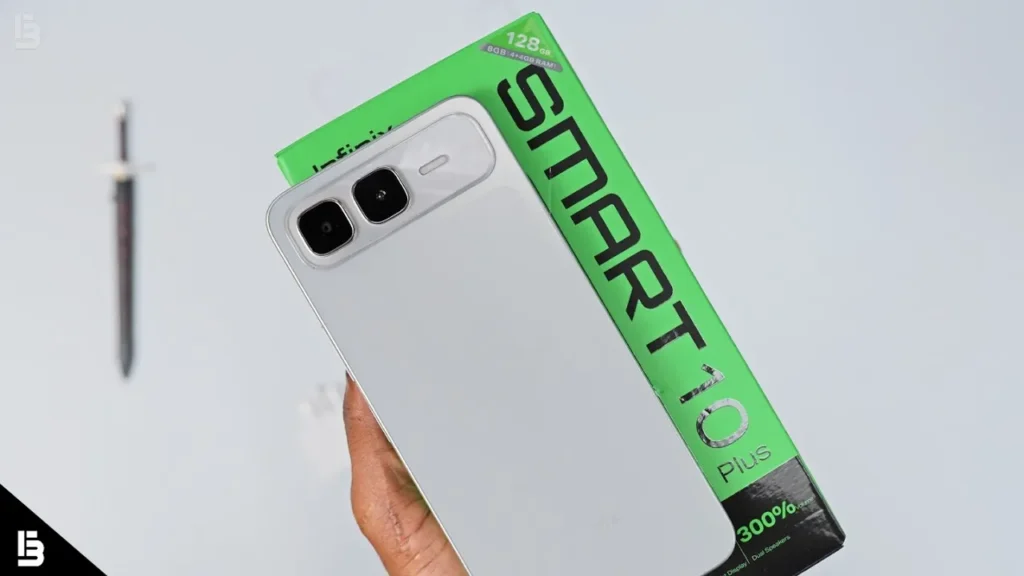
Introduction of Infinix Smart 10 Plus
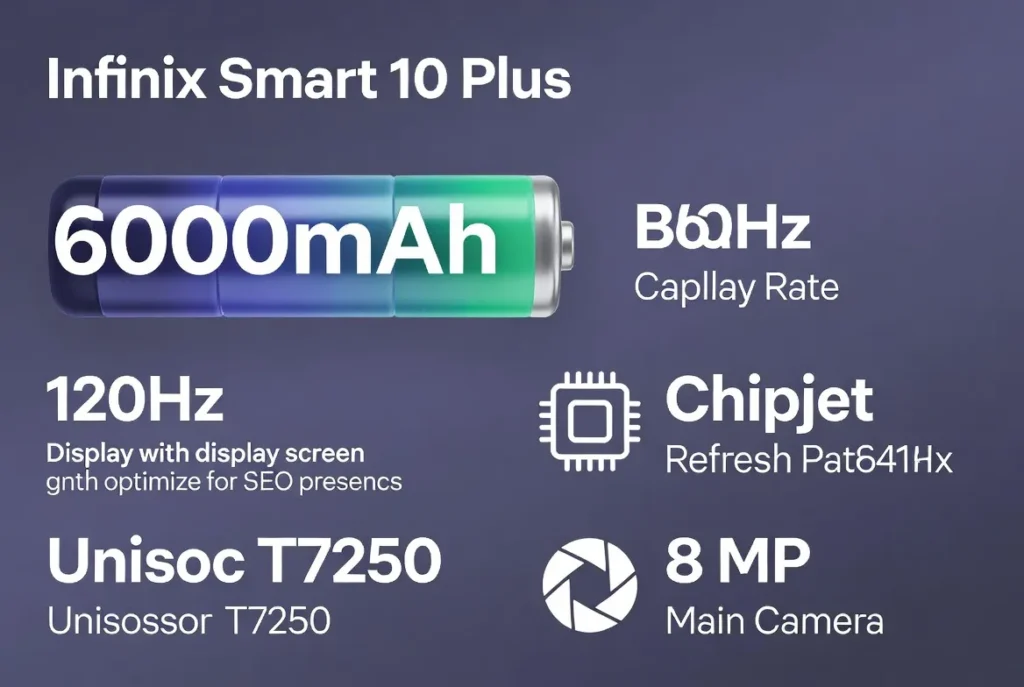
The Infinix Smart 10 Plus pairs a huge 6000mAh battery with a 120Hz panel and a budget Unisoc T7250. It’s ideal for multi-day use and smooth UI; avoid it if you want top-tier cameras or heavy, sustained gaming.
Key specs
- Model: Infinix Smart 10 Plus (X6725B)
- Release / Availability: Announced 2Q 2025; retail listings from mid-2025.
- OS: Android 15 with XOS 15.1
- SoC: Unisoc T7250 (12 nm)
- CPU / GPU: Octa-core CPU, Mali-G57 MP1 GPU
- RAM / Storage: 4 GB RAM (some regions 8 GB), 128 GB storage, microSD support
- Display: 6.67″ IPS LCD, 720×1600 (HD+), 120Hz refresh
- Rear camera: 8 MP main (+ supporting sensor; region variations)
- Front camera: 8 MP
- Video: Reported up to 1440p@30fps (region-dependent)
- Battery: 6000 mAh, 18W charging (included)
- Weight / Size: ~198 g; dimensions ~165.6 × 77 × 8 mm
- Colors: Sleek Black, Titanium Silver, Iris Blue, Ruby Red (region-dependent)
- Price: ~PKR 26,399 (4/128 GB) — prices vary widely.
Design & build
Ergonomics & materials
The Infinix Smart 10 Plus follows the expected budget-phone formula: a plastic shell, matte rear finish, and a raised camera island. Because of the 6000mAh battery, the phone is noticeably weighty (~198 g) but remains comfortable in the hand. Rounded edges and a slightly tapered frame make long holds easier.
Durability & comfort
There’s no official IP rating listed on basic spec pages, so treat the phone as splash-resistant at best. Buttons and ports are sensibly placed: USB-C for charging and data, plus a 3.5mm headphone jack, which remains a plus for budget shoppers.
Display
Main point: A feature in this segment that is really noteworthy is the 120Hz refresh, which makes the interactions and UI scrolls in this category much smoother than the 60Hz displays that are common on lower-end devices. The fact that fluidity is a significant subjective win.
Trade-off: The display is HD+ with a 6.67-inch display, which results in an approximate of about 260 ppi. The text and fine details are not as sharp as with FHD+ phones, but in the context of social media and video, as well as daily usage, the experience is satisfactory due to the high refresh rate.
Brightness and outdoor visibility
Infinix boasts of decent peak brightness – some of the listings show figures in the range of about 700 nits. Out-of-the-field testing is important: when the measured peak brightness is less than desired, all outdoor legibility criteria will be violated. Give us daylight; we should have visibility on shade and cloudy days, and the fine detail may be washed out by direct sun.
Color & calibration
This IPS panel gives natural colors and broad viewing angles. Expect punchy but not reference-grade calibration — great for casual media but not for precise color work. For most buyers, the color tuning is acceptable and feels lively.
Performance & benchmarks
The Unisoc T7250 is an entry-level to lower-midrange chipset. It handles daily apps, browsing, streaming, and light multitasking well. Heavy sustained workloads, Intensive gaming, or desktop-class tasks will push it beyond its limits.
Synthetic benchmarks
Benchmarks differ by region and RAM variant. Expect modest AnTuTu scores and Geekbench numbers that reflect low-midrange silicon. These synthetic results align with real-world performance: smooth for UI and lighter apps, strained under heavy CPU/GPU loads.
Real-world performance & thermal behavior
In daily use, the UI benefits from 120Hz, making animations feel faster. App launching and switching are adequate, but app reloads will happen with heavy background activity, especially on the 4 GB RAM variant.
Under prolonged tasks, the SoC may warm up and throttle — expect moderate heating during long gaming or benchmark runs. This is normal for this class of processor.
Gaming: PUBG / Free Fire — what to test
If you test gaming for your article, include:
- A 30-minute run of PUBG Mobile / Free Fire at default and low settings.
- Average, minimum, and max FPS logs.
- Battery percentage lost in that session.
- Surface temperature change before/after.
Cameras
Camera hardware on retail listings is modest — an 8 MP main sensor in many regions. Don’t expect flagship-level detail. Good daylight shots depend on Infinix’s processing and tuning; low-light remains a weakness.
Daylight & portraits
Daylight: expect good exposure and lively color, but not razor-sharp detail. Cropping will reveal softness. Portrait mode will be software-driven; expect decent subject separation on simple backgrounds but edge-detection errors in complex scenes.
Low-light & night mode
Low-light performance is the phone’s weak point — noise and smoothing reduce fine detail. If Infinix includes a Night mode, it will likely clean up noise at the expense of texture. Compare low-light photos with a competitor to give readers context.
Video performance
Retail specs list up to 1440p@30fps in some listings. Record a sample to evaluate stabilization and detail. Don’t expect advanced OIS; stabilization will be basic. For stable video, use steady hands or a gimbal.
Battery life & charging tests
The 6000mAh battery is the phone’s top-selling point. For many buyers, battery endurance outweighs camera or peak performance.
- Mixed-use run-down at 120Hz and at 60Hz, including browsing, social apps, streaming video, and notifications.
- Idle overnight drain.
- Screen-on-time averages (SOT) across both refresh modes.
- Charger curve: 0–50% and 0–100% timings using the included 18W charger.
- The battery drops after a 30-minute gaming session.
Software & Updates
Out of the box, the phone runs Android 15 with XOS 15.1. Check for preinstalled regional apps — some are removable, others can only be disabled.
Infinix’s update policy varies by region and model. If OS update longevity is important for your audience, verify Infinix’s support statements and add a short FAQ about update expectations.
Price
Example: Pakistan (4/128 GB) listings in mid-2025 showed around PKR 26,399, but local Promotions, bundles, and stock will change that.
Infinix Smart 10 Plus vs rivals
| Phone | Battery | Screen | SoC | Camera | Best for |
| Infinix Smart 10 Plus | 6000 mAh | 6.67″ 120Hz HD+ | Unisoc T7250 | 8 MP | Battery life & smooth UI |
| Motorola G06 Power | 6000 mAh | ~6.5″ 60Hz | Entry-level | Modest | Clean software + battery |
| Samsung Galaxy A07 | 5000 mAh | 6.5″ 60Hz | Samsung entry SoC | Better brand support | Software + brand trust |
| Poco M7 / Xiaomi budget | 5000–6000 mAh | 90–120Hz | Sometimes stronger SoC | Decent | Better gaming value (when SoC is stronger) |
Pros & Cons
Pros
- Huge 6000mAh battery — real multi-day endurance for many users.
- 120Hz display — very smooth UI for the price.
- Competitive price per battery capacity.
- Side fingerprint, USB-C, 3.5mm jack — practical features many users want.
Cons
- HD+ resolution on a 6.67″ screen — softer text and less sharpness.
- Unisoc T7250 — entry-level for heavy gaming.
- Modest camera hardware (8 MP) — poor low-light performance.
- 18W charging — slow full-charge times for a large battery.
Who should buy this?
Buy this if:
- You want multi-day battery life and prefer a phone that lasts through heavy days.
- You like a smooth UI experience thanks to 120Hz without paying a premium.
- You need a reliable device for media, social, messaging, and light gaming.
Skip this if:
- You prioritize camera quality or professional-level photos.
- You demand very high-brightness and very sharp FHD+ displays.
- You need guaranteed long-term OS update commitments — check the regional policy.
Specs table
| Item | Detail |
| Model | Infinix Smart 10 Plus (X6725B) |
| Release date | Announced 2Q 2025; retail availability mid-2025 |
| OS | Android 15, XOS 15.1 |
| SoC | Unisoc T7250 (12 nm) |
| CPU | Octa-core (Unisoc T7250) |
| GPU | Mali-G57 MP1 |
| RAM | 4 GB (some regions 8 GB) |
| Storage | 128 GB (expandable via microSD) |
| Display | 6.67″ IPS LCD, 720×1600, 120Hz |
| Rear camera | 8 MP main (+ supporting sensor — region variations) |
| Front camera | 8 MP |
| Video | Up to 1440p@30fps (reported) |
| Battery | 6000 mAh |
| Charging | 18W (included) |
| Ports | USB-C, 3.5mm headphone jack |
| Weight | ~198 g |
| Dimensions | ~165.6 × 77 × 8 mm |
| Colors | Sleek Black, Titanium Silver, Iris Blue, Ruby Red |
| Price (example) | PKR 26,399 (4/128 GB example listing, mid-2025) |
FAQs
A: If your priorities are long battery life and a 120Hz display at a tight price, the phone is a very sensible buy in 2025.
A: With mixed daily usage at 120Hz, expect about 1.5–2 days on average; switching to 60Hz will extend runtime further.
A: No. The Smart 10 Plus targets 4G LTE bands in its regional models. If 5G is a must, look at other options.
A: It ships with an 18W charger. Charging a 6000mAh battery will be slower than phones that support high-wattage fast charging.
A: Primary listings show 4 GB / 128 GB as the main SKU; some markets offer 8 GB variants.
Conclusion
The Infinix Smart 10 Plus is a no-frills, no-fluff low-cost phone that focuses on battery life and easy interface with a 120Hz screen. It is an excellent option when you are interested in long working hours and satisfactory daily performance, but do not want to pay much money for high-quality cameras or quick charging. Other phones will suit the buyers whose priorities are photography, 5G, or sustained gaming.
