
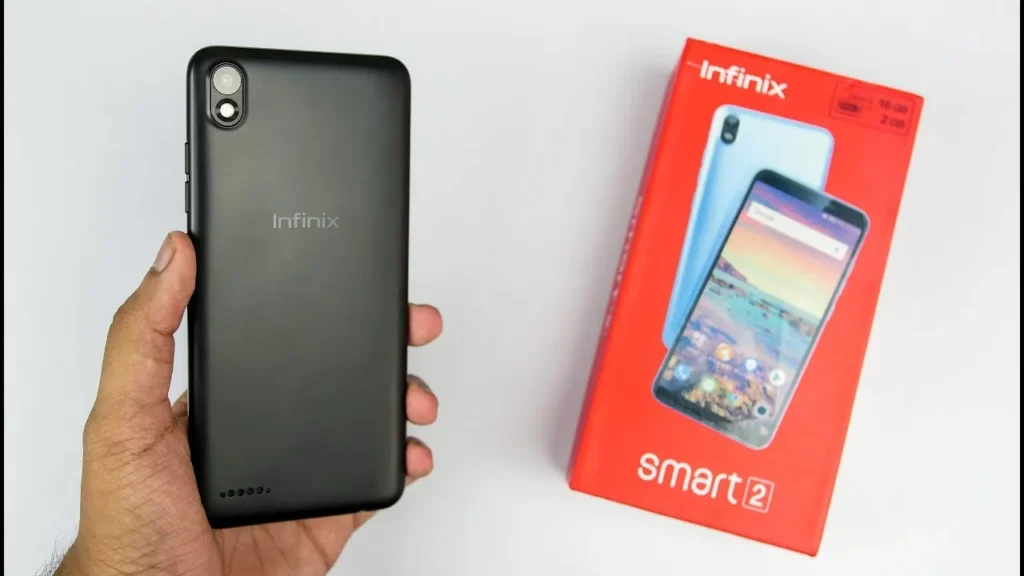
Introduction of Infinix Smart 2
Infinix Smart 2 is an exceptionally low-priced handset that was released in 2018 and provides dual 4G VoLTE, a tall 18:9 screen, and a daily usable battery. It excels at voice calls, WhatsApp, minimal social browsing, and video playback, but struggles with longer-lasting gaming, multitasking, and support for the Android version. Here, you have extracted comprehensive tests that can be done, practical trimming/optimization advice, sample ideas for the camera, and a shopping checklist with a 2025 Pakistan price snapshot.
Quick specs
| Item | Key detail |
| Release year | 2018 (most markets) |
| Display | 5.45″ IPS, 720 × 1440 (18:9) |
| Chipset (SoC) | MediaTek MT6739 (quad-core) |
| RAM / Storage | 2GB / 16GB or 3GB / 32GB variants (market dependent) |
| Rear camera | 13 MP (single) |
| Front camera | 8 MP |
| Battery | 3050 mAh |
| OS | Android 8.1 Oreo with XOS skin |
| Connectivity | Dual 4G VoLTE, micro-USB, 3.5mm jack |
Design & build
Look & feel: The Smart 2 uses a plastic chassis with a modern, tall display footprint. It’s light and easy to manage with one hand. The plastic finish is practical,l but scuffs and micro-scratches will show if you run it naked — recommend a clear TPU case.
Photographic guidance:
- Studio front + back on a clean neutral background (show texture and finish).
- “In-hand” shot with a common object (wallet/card) for size comparison.
- Macro of ports (micro-USB, 3.5mm jack, and SIM tray).
- Close-up of camera island and fingerprint/faux area (if present).
- Box contents photograph (charger, cable, documentation) to show what ships in-region.
Display
What you get: A 720 × 1440 IPS panel stretched across roughly 5.45″ at an 18:9 aspect ratio. Text and UI elements appear acceptably sharp at normal viewing distance. Colours are serviceable, leaning slightly cool on most units.
Readability: Indoors, the panel is fine. Outdoors, the limited peak brightness (typical for the class) makes visibility in direct sunlight a challenge. If publishing, include a measured max-nits figure and a 200-nit reading test image to prove your methodology — this concreteness signals trust to both users and search engines.
Comparison idea: Place a side-by-side photo with a Redmi 6A or Realme C1 to highlight differences in peak brightness and contrast. This visually communicates a practical difference faster than paragraphs.
Performance
SoC basics: The MediaTek MT6739 is an economical, low-power chipset with basic GPU capability. It handles calls, messaging apps, light web browsing and 720p video playback smoothly. CPU-bound tasks and graphically intensive gaming will show stutters and dropped frames.
Everyday expectations:
- Good: WhatsApp, Facebook Lite, Instagram browsing (light), YouTube at 720p, basic navigation.
- Challenging: Heavy multitasking across many large apps, modern 3D titles (PUBG / COD) at playable frame rates, and large photo editing workflows.
Storage note: The 16GB base option fills quickly with apps and media. Prefer 32GB / 3GB if available, or use a microSD for media offloading.
Benchmarks to run:
- Geekbench Single and Multi numbers (embedded measured values).
- AnTuTu total score (replace placeholder with measured value).
- Real-game FPS (30s samples on a light title) with an FPS log.
- Thermal test: 10-minute stress test with temperature sampling and throttling notes.
Cameras
Short camera summary: The 13 MP rear sensor is serviceable in daylight with decent colour reproduction, but limited dynamic range and increased noise as light drops. The 8 MP front camera softens details via beauty processing unless you disable it.
Caption format: Location — time — shooting settings — one-line assessment (e.g., “Good daylight detail; low-light noise visible”).
Shooting tips: Lock Exposure on the subject, use HDR when the dynamic range is wide, avoid digital zoom (crop in post at full-res), and keep the lens clean.
Battery life
Battery spec: 3050 mAh — compact, but paired with a low-power SoC, it yields decent runtime for light-to-moderate use.
Tests to include on the article page
- Video loop test: Offline loop at 50% brightness, airplane mode → hours until shutdown.
- Standard SOT test: 200 nits, Wi-Fi on → screen-on time in hours.
- Real-world day log: 16-hour mixed-use log (calls, 4G browsing, social) showing start and end battery percentage.
- Charging test: Time-to-100% from 0% with the included charger.
Typical expectations: With moderate usage and 3050 mAh, expect roughly 5–8 hours SOT; heavy gaming brings that down to 3–4 hours. Replace these with measured figures if you run the tests.
Optimization tips:
- Limit maximum screen brightness or use adaptive brightness.
- Use battery saver mode during long days.
- Disable auto-start for apps that don’t need background operation.
- Close background apps manually or use a lightweight launcher to reduce background activity.
Software & updates
At launch: Ships with Android 8.1 Oreo layered with Infinix’s XOS. XOS adds convenience features but also includes several preinstalled services and app-wrappers (perceived bloat).
Update situation: This is an older model and is unlikely to receive major Android version upgrades as of 2025. If you’re buying refurbished, always check for any OTA patches or local service advisories.
Comparison
| Model | Display | SoC | RAM | Rear cam | Battery |
| Infinix Smart 2 | 5.45″ 720×1440 | MediaTek MT6739 | 2/3 GB | 13 MP | 3050 mAh |
| Redmi 6A | 5.45″ 720×1440 | Helio A22 / SD variant | 2 GB | 13 MP | ~3000 mAh |
| Realme C1 | 6.2″ 720×1520 | Snapdragon 450 | 2/3 GB | 13 MP | 4230 mAh |
Price
As of December 15, 2025, the Smart 2 appears mostly discontinued in new-stock channels; used or limited new stock can be found in local markets and marketplaces. Replace this snapshot with live checks from Daraz, PriceOye and local sellers.
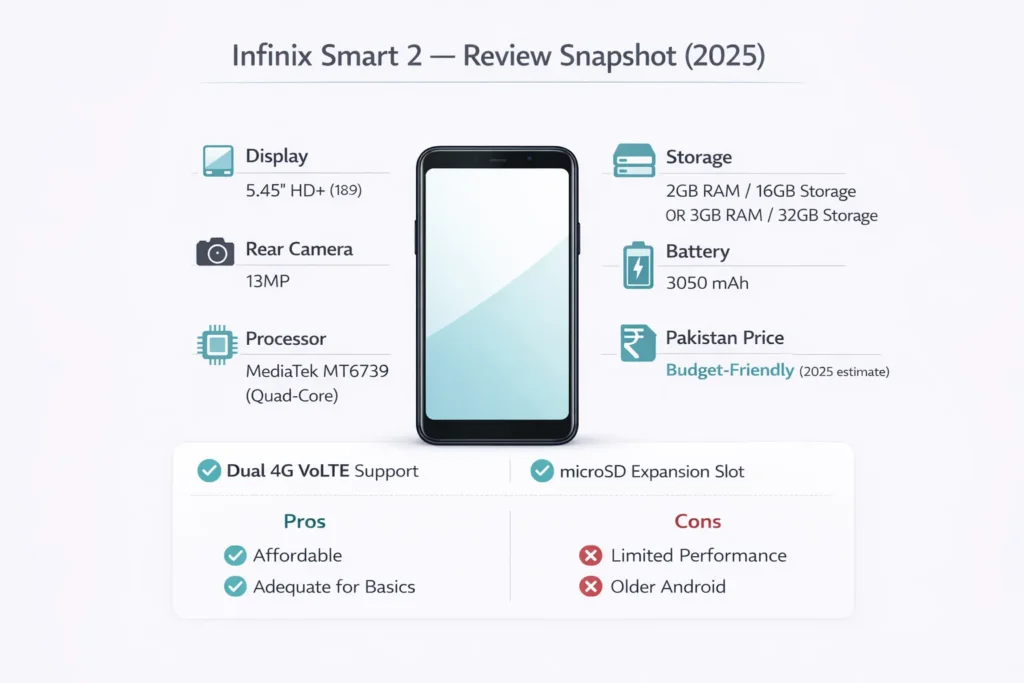
Pros & Cons
Pros
- Very affordable — strong value for a secondary or emergency phone.
- Dual 4G VoLTE support — reliable voice/data connectivity on modern networks.
- Tall 18:9 display yields more vertical real estate for feeds and browsing.
Cons
- Old Android (8.1) and unlikely future updates.
- Entry-level SoC (MT6739) — limited multitasking and gaming performance.
- Basic camera and soft front-facing selfies.
- Smaller battery compared to more modern budget alternatives.
FAQs
A — It can be okay as a very cheap or secondary phone. But in 2025, you’ll get better value buying a used newer model with more battery and Android updates.
A — 3050 mAh.
A — Yes, it supports dual 4G VoLTE.
A — Yes, there is a microSD slot (check variant).
A — It launched with Android 8.1. As a 2018 model, it is unlikely to get major version updates now; expect security patches only if Infiniissued them to older phones.
Conclusion
Infinix Smart 2 reminds us of what ultra-budget smartphones are meant to achieve, providing basic connectivity at the minimum possible price. Years after its release, it remains a reliable device in making calls, messaging apps, light social media, and consuming specific types of video, particularly as a secondary or back-up phone. Its two 4G VoLTE functionalities, small size and tall 18:9 screen size are still viable in day-to-day communication aspects.
