
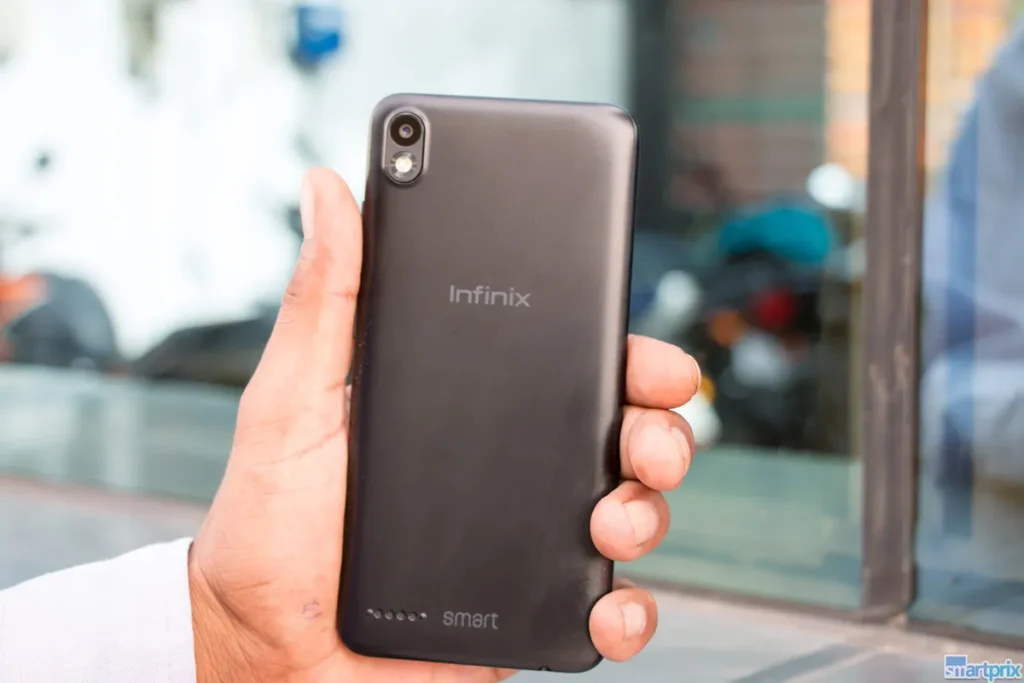
Introduction of Infinix Smart 2 HD
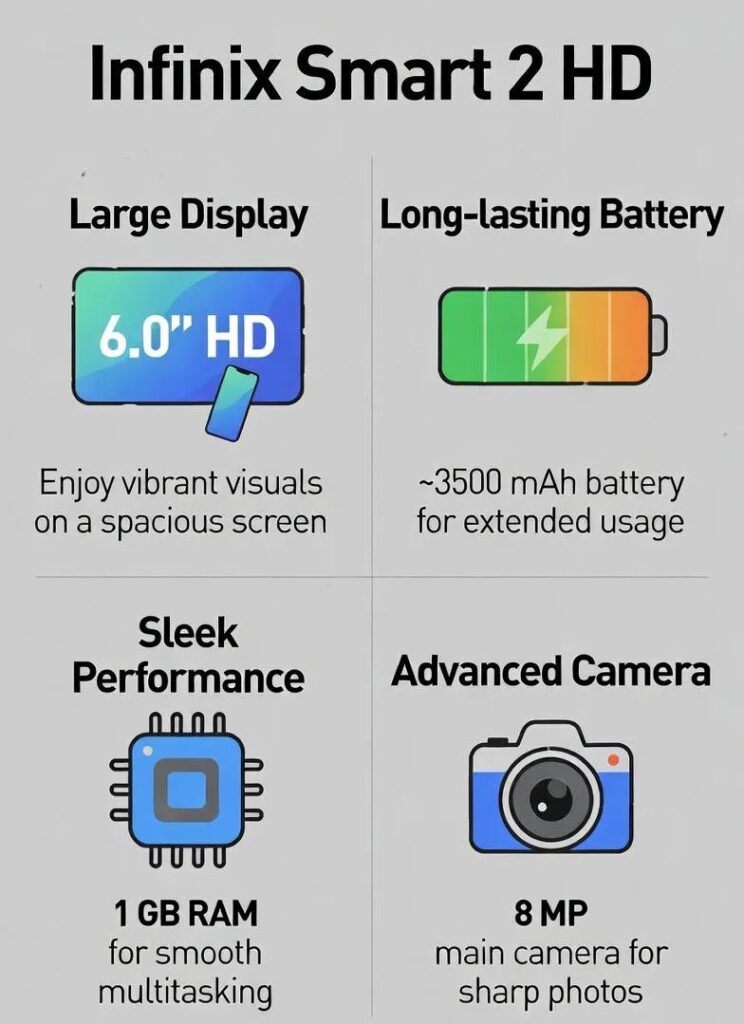
The Infinix Smart 2 HD is an ultra-budget, large-screen smartphone aimed at first-time buyers and basic users. It delivers a big 6.0″ display and respectable battery endurance for the price, 1 GB of RAM, and an entry-level MediaTek chipset, which imposes clear limits on multitasking, app-switching, and gaming. Buy it only if your needs are simple — calling, WhatsApp, light browsing,g and video playback — and you want the lowest cost possible.
Quick specs at a glance
- Display: 6.0″ IPS LCD, 720 × 1440 (HD+) (18:9)
- SoC: Entry-level MediaTek quad-core (~1.3 GHz)
- GPU: Mali-class (entry level)
- RAM / Storage: 1 GB RAM / 16 GB storage (microSD slot)
- Rear camera: 8 MP (single)
- Front camera: 8 MP (varies by SKU)
- Battery: ~3500 mAh (HD SKU) — some non-HD variants list ~3050 mAh
- OS: Android with XOS skin
- Ports: Micro-USB, 3.5 mm headphone jack
- Connectivity: 4G/LTE (region dependent), Wi-Fi b/g/n, Bluetooth
- Sensors: Accelerometer, proximity, ambient light (typical)
Design & build
The Smart 2 HD is a budget plastic handset. That doesn’t mean it’s flimsy — it’s engineered to be lightweight and to keep costs down — but don’t expect premium glass or metal.
Feel & ergonomics
- Smooth plastic back (glossy or textured variants exist). The glossy finishes look clean in photos but attract fingerprints; textured backs hide smudges better.
- Buttons are basic and tactile, with acceptable travel and click feedback.
- Lightweight for a 6.0″ display; extended one-handed typing is possible, but the phone is better handled with two hands for long sessions.
Fit & finish
- Expect typical budget-class tolerances: small gaps around removable backs on some units and a flexible rear cover on devices with user-removable batteries or cheap shells.
- No IP water/dust rating — caution near moisture.
Display
The 6.0″ HD panel is the headline feature here — a large canvas for social media, video, and reading that’s rare at such a low price.
Resolution & sharpness
- 720p on 6.0″ gives a pixel density that’s acceptable for reading and social media. Fine for YouTube and casual browsing, but not for fine detail or close-up image editing.
Color & tone
- Tends to skew warm out of the box with slightly saturated mid-tones. Not color-accurate for professional work but perfectly serviceable for everyday content.
Brightness & outdoor visibility
- Usable outdoors at max brightness, but not the brightest panel you’ll encounter. Strong sunlight will wash colors and reduce contrast — a common compromise at this tier.
Performance
Short version: Handles basics well; heavy multitasking and modern games suffer.
What the chipset & RAM mean in practice
- Entry MediaTek chip + 1 GB RAM = smooth phone calls, WhatsApp, Facebook Lite, and light browsing.
- App switching will often force background apps to reload. Expect web pages to re-render if you jump between many tabs or apps.
App examples
- Smooth: WhatsApp, Facebook Lite, standard YouTube app (watching videos), simple 2D games (Candy Crush).
- Struggles: Chrome with many tabs, Instagram with multiple stories loaded, modern 3D titles like PUBG / Call of Duty (poor frame rates and stuttering).
Benchmarks to run
- Geekbench (single & multi) to show raw CPU performance.
- AnTuTu for a composite score and CPU/GPU breakdown.
- Short 10-minute gaming session to record average FPS and frame drops.
Thermals
- Mild surface warming under load — acceptable. No severe thermal throttling expected, but sustained heavy loads will reduce performance.
Cameras
Daylight
- Center detail is acceptable, and images are usable for social platforms. Colors are slightly saturated, which is visually pleasing for casual use.
Indoor
- Noise increases and fine detail drops. Bright indoor lighting will yield usable images, but low-lit rooms will produce grainy shots.
Low light/night
- Expect heavy noise, slow shutter blur, and loss of fine detail. No dedicated night mode or Computational tricks here — results are average at best.
What to include in a camera gallery
- Full-size daylight landscape with EXIF caption.
- Indoor group shot.
- Night shot taken handheld and, if possible, on a tripod for comparison.
- 1:1 crops showing sensor detail and noise.
Editing & EXIF notes
- Include ISO, shutter speed, aperture, and whether HDR was enabled. This helps readers understand trade-offs and what to expect from the sensor.
Typical camera
- Default camera app shots with HDR OFF and ON comparisons, and front vs rear comparisons where relevant.
Battery life & charging
Main point: Battery life is one of the Smart 2 HD’s strengths, especially on the HD SKU with ~3500 mAh.
What to test
- Video loop at 150 nits until shutdown: a repeatable battery metric.
- Mixed-use day test: a combination of calls, social apps, short videos, and browsing to measure realistic screen-on time.
- Charging: time from 0 → 100% using the included charger (expect standard micro-USB speeds).
Expected results
- Light users: one and a half days easily.
- Moderate users: a full day with screen time in the 4–6 hour range, depending on settings.
- Charging: No fast charging; Micro-USB at standard rates will take longer than modern USB-C PD phones.
Note on variant differences
- Some SKUs advertise ~3050 mAh — always confirm the printed capacity on the box or the label.
Software & updates
Out of the box
- Ships with Android layered with Infinix’s XOS skin. Expect preinstalled Infinix utilities and a handful of third-party apps.
User experience
- The interface is simple but includes bloatware you may want to disable to reclaim storage and memory.
Updates
- Budget models like this typically receive limited OS upgrades. Expect security patches and minor updates, but not major Android version jumps.
Tips
- Disable unused preinstalled apps to free storage and reduce background activity.
- Consider a lightweight launcher to reduce memory pressure and achieve a cleaner UI.
Connectivity and sensors
- Ports: Micro-USB charging and a 3.5 mm headphone jack — a plus if you rely on wired audio.
- Network: 4G/LTE on most SKUs; verify band compatibility for your market (e.g., Pakistan).
- Wi-Fi: b/g/n only (no ac).
- Bluetooth: basic version suitable for headsets and low-bandwidth accessories.
- Sensors: accelerometer, proximity, and ambient light sensor are typical; a fingerprint scanner is usually absent.
Comparisons
1. Slightly higher price — better RAM/multitasking
Search for older Redmi or Tecno models with 2–3 GB RAM (often available used). They’ll handle multitasking and app switching much better.
2. Same budget — better camera (used market)
Older midrange phones (e.g., older Samsung Galaxy A-Series or older Motorola models) sometimes appear used at similar prices and offer better sensors.
3. Battery-first alternative
If battery life is the priority, look for phones advertising 4000 mAh+ cells — some brands at this tier offer bigger cells for marginally higher cost.
Simple comparison table
| Feature | Infinix Smart 2 HD | Alternative A | Alternative B |
| RAM | 1 GB | 2–3 GB | 2–4 GB |
| Battery | ~3500 mAh | 3000–4000 mAh | 4000+ mAh |
| Camera | 8 MP | 13–16 MP | 12–48 MP |
| Best for | Basic use | Multitasking | Battery lovers |
Pros & Cons
Pros
- Large 6.0″ HD screen for media.
- Very affordable price point.
- Good battery life on HD SKU.
- Headphone jack included.
Cons
- Only 1 GB RAM — frequent app reloads and slow multitasking.
- Entry-level MediaTek SoC — limited for gaming.
- Basic camera performance, especially in low light.
- Micro-USB (no USB-C) and limited Wi-Fi support.
FAQs
Only if you want a very cheap, large-screen phone for basic apps. For better performance, look at used phones with 2–3 GB RAM.
The HD SKU usually lists around 3500 mAh; check your box. Some variants list ~3050 mAh.
Most units ship with 1 GB RAM and 16 GB storage.
Most SKUs support 4G/LTE; verify band support with the seller or official page.
It can run low-graphics or older versions, but performance will be poor — not recommended.
Final verdict
The Infinix Smart 2 HD is a reasonable choice when you need the minimal price with the maximum screen size and high battery capacity. It does not belong to the persons who require the smooth multitasking, contemporary 3D gaming, or the high-quality photography in low-light conditions. It is logical when you are purchasing a first phone gift to a person who uses no more than basic applications, or you require a reliable second phone. For everyone else, consider slightly older used midrange phones with 2–4 GB RAM — they’ll feel faster and more future-proof.
