
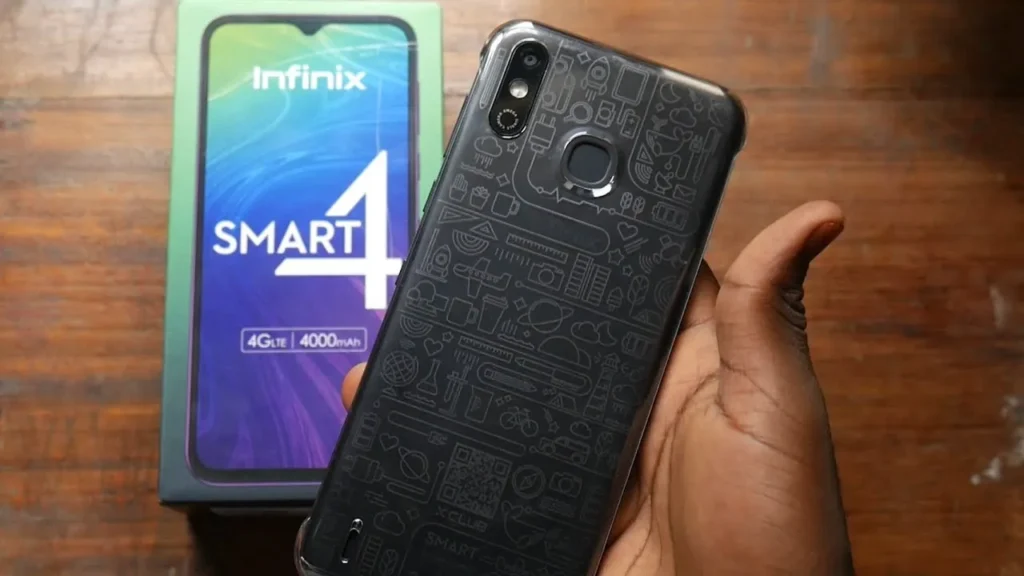
Introduction of Infinix Smart 4
The Infinix Smart 4 phone is an economical option and a practical phone to use in making calls, sending messages, using social apps, and watching videos. It combines a huge 6.6-inch screen with a low-end MediaTek Helio A22 chip, 2GB of memory, 32GB of storage, and a 4000 mAh battery. The combination provides reliable daily use for light users, students, and as a secondary device, but is not suitable for heavy gaming, multitasking, and photography enthusiasts who require great detail in dark environments.
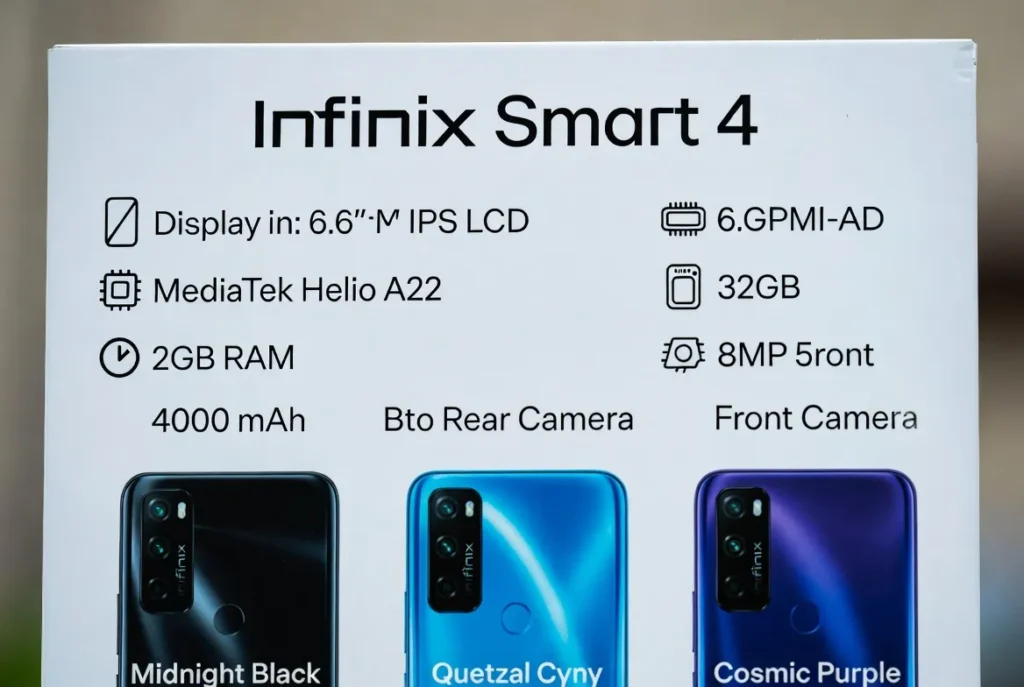
Key specs
- Display: 6.6-inch IPS LCD, 720 × 1600 (≈266 ppi)
- Processor: MediaTek Helio A22 (MT6761), quad-core 2.0 GHz
- Memory & Storage: 2GB RAM, 32GB storage (microSD slot up to 256GB)
- Rear camera: 8MP main + QVGA secondary, dual-LED flash
- Front camera: 5MP selfie
- Battery: 4000 mAh, non-removable
- OS: Android (shipped with Android 9 + XOS skin)
- Other: Rear fingerprint scanner, microUSB port, 3.5mm headphone jack, Bluetooth 5.0, FM radio, Dual SIM (dual-standby)
- Weight & dimensions (typical): ~183 g, ~8.3 mm thick
Design & Build
Look and feel
The Infinix Smart 4 has a low-cost aesthetic plastic back and frame and a glossy finish in any colour, such as Midnight Black, Quetzal Cyan, and Cosmic Purple. The rear has a predictable but clean design with the camera being mounted vertically above a circular fingerprint reader.
Ergonomics
The 6.6-inch screen size does not make the phone difficult to hold due to the relatively light weight (~183 g). The 8.3 mm thickness keeps it comfortable in pockets. The plastic construction helps avoid the fragility of glass but also means the device feels economical in the hand — not premium, but perfectly functional.
Durability & protection
There’s no official Gorilla Glass or IP rating. For day-to-day life, a tempered glass screen protector and a TPU case are strongly recommended to prevent scratches and absorb shocks.
Display
Size & resolution
The 6.6-inch IPS LCD will provide you with a large screen to watch movies, scroll social feeds, and read. The resolution is HD+ (720 x 1600), which compromises the density of pixels in favour of battery performance and price. The text and icons are, however, readable enough to use daily, but they will not be as sharp as mid-range and flagship displays.
Colour and viewing angles
Colours are mostly precise, and viewing angles are excellent for an IPS panel. The screen is skewed more towards natural colours with a slight increase in saturation to give images a livelier look on the screen itself.
Touch & protections
Touch responsiveness is suitable for routine tasks. There’s a water-drop notch for the selfie camera; however, manufacturers don’t list Gorilla Glass protection, so use a screen protector if you care about scratches.
Real-world tip
If you consume lots of video outdoors, test a display in person before buying, because viewing comfort under strong sun varies between units.
Performance
What the Helio A22 means
MediaTek Helio A22 is an inexpensive quad-core chipset. The Smart 4, coupled with 2GB of RAM, is optimised for the activities of a simple phone: calling, WhatsApp, light social media feed, YouTube, and simple web surfing. It is not constructed to multitask a lot or to process heavy loads.
App experience
Apps like Facebook, Instagram, TikTok, WhatsApp, and Gmail open and run normally. Expect the system to keep fewer apps in memory; switching between many open apps will cause reloads. For a user who runs a handful of apps at once, this feels reasonable.
Gaming
Casual and 2D games (Candy Crush, Subway Surfers, Temple Run) are smooth. In heavier 3D games (PUBG Mobile, Call of Duty Mobile), you will have to reduce the graphics settings to low and tolerate frame drops and stuttering. Thermal control is conservative – when the gaming is long, the phone gets hot, and the chipset can decide to lower the performance to allow the heat to cool.
Everyday reliability
For ordinary, daily use — messaging, maps, streaming, photography for social sharing — the Smart 4 performs competently. If you run heavy background services, dozens of tabs, or multiple social apps with heavy media sharing simultaneously, you’ll notice the device’s limits.
Camera
Hardware summary
- Main rear camera: 8MP
- Secondary rear: QVGA (depth/assist)
- Selfie: 5MP
- Dual-LED flash for low-light assist
Daylight images
In good, bright conditions, the 8MP main camera produces acceptable photos with decent colour and contrast. The sensor and the image-processing pipeline favour slightly boosted saturation, so images look punchy on the phone. For casual social sharing and snapshot memories, results are fine.
Detail & dynamic range
Don’t expect the fine detail of higher-resolution sensors. Images can be softer when zoomed or heavily cropped. High-contrast scenes may confuse the sensor; use HDR mode if available to preserve detail in shadows and highlights.
Low-light performance
In low light, noise rises, and detail falls off quickly. The small sensor size and aperture limit light gathering. Night images are usable only for essential documentation — not for gallery-worthy shots. Using the flash helps for close subjects; otherwise, look for brighter ambient illumination.
Portrait & secondary sensor
The QVGA secondary sensor assists depth estimation for background blur but is not a substitute for a dedicated higher-resolution depth module. Portrait shots can produce basic background separation, but edge detection may occasionally be inaccurate.
Selfies & video
Selfies from the 5MP front camera are acceptable for social media and video calls, but lack great detail. Video recording is limited — some sources list 1080p at 30fps for short clips — but stabilisation is minimal, and footage is best kept short.
Battery & charging
Capacity
A 4000 mAh battery is a sensible capacity for a phone with an HD+ screen and an efficient entry-level chipset. This combination favours longer runtimes than you might expect from the body size.
Real-world runtime
With typical light to moderate use (calls, messaging, social apps, an hour or two of video), the phone should comfortably last a full day — commonly around 5–7 hours screen-on time across typical usage patterns. Actual numbers depend on display brightness, network conditions, background sync frequency, and whether you game.
Software & updates
Update expectations
As an older, entry-level model, significant Android version updates are improbable beyond what Infinix provided during its supported window. Security updates may be limited. For long-term software support and security patches, consider devices aimed at longer update support or newer models.
Re-flashing & firmware
If you need to recover a bricked phone or roll back to stock firmware, Community Firmware Sites and official Infinix service pages sometimes host stock ROMs and firmware. Light flashy– be guided by good fellows. An authorised service centre should be used in case of discomfort.
Connectivity & extras
Cellular
Supports 4G LTE on typical bands. If you rely on a specific carrier, check exact band compatibility before buying.
Wi-Fi
802.11 a/b/g/n (Wi-Fi 4) — reliable for home and office networks; not the latest Wi-Fi 6 but perfectly adequate for normal browsing and streaming.
Bluetooth
Bluetooth v5.0 — good for stable connections and efficient power use with wireless earbuds and speakers.
Extras
- FM radio (useful for data-free audio)
- 3.5mm headphone jack (still essential for many users)
- Rear fingerprint scanner for fast, secure unlocking
- Dual SIM with dedicated microSD slot — convenient for travellers and users needing extra storage without sacrificing the second SIM slot
Benchmarks
Official benchmark numbers vary by site, but the Helio A22 paired with 2GB RAM places the Smart 4 squarely in the entry-level bracket. Expect:
- CPU-single core: low scores compared to modern mid-range chipsets
- GPU: modest 2D performance sufficient for casual gaming; heavy 3D titles will be bottlenecked
- Memory: 2GB RAM limits multitasking; app reloads are common
Pros & Cons
Pros
- Large 6.6″ screen for media and browsing.
- A 4000 mAh battery gives reliable one-day use.
- Very affordable — strong value for basic needs.
- Practical extras (3.5mm jack, FM radio, expandable storage, rear fingerprint).
Cons
- Only 2GB RAM — limited multitasking and app retention.
- microUSB charging — slower than USB-C fast charge solutions.
- Basic camera with weak low-light performance.
- Older OS version at launch and limited long-term updates.
FAQs
A: The common configuration is 2GB RAM with 32GB storage.
A: 4000 mAh. Expect one day of regular use with light to moderate workloads.
A: It can run light games fine, but heavy 3D games will need low graphics settings and will not be smooth. For an improved gaming experience, a phone with a stronger SoC and more RAM is recommended.
A: Yes — it supports LTE bands typical for many regions.
A: Yes — rear-mounted fingerprint reader.
Conclusion
In case you are value-conscious and want a bigger screen, reliable battery pack, and simple daily use, Infinix Smart 4 is a viable purchase, at least when the price is within reach locally, and your seller is a reputable brand with a warranty. When you can spend a little more, you can upgrade to a model with at least 3GB of RAM and USB-C to make the purchase future-proof.
