
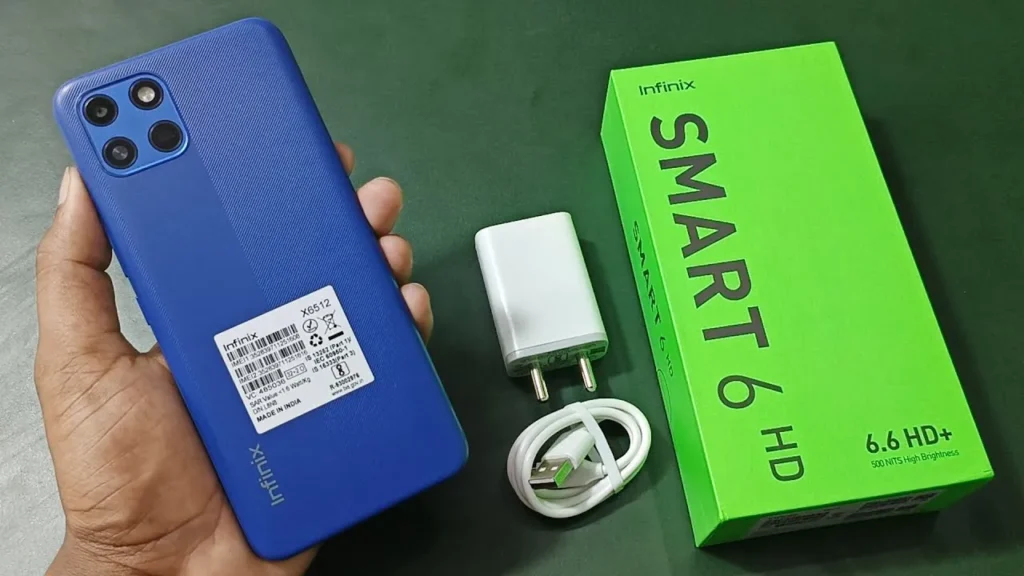
Introduction of Infinix Smart 6 HD
The Infinix Smart 6 HD is a super-budget phone optimized for extended battery endurance and a large 6.6″ display — excellent for calls, messaging, and streaming, but constrained for demanding gaming, multitasking, and low-light photography.
Buy this phone if you want:
- The best battery life you can get at this price (5000mAh).
- A large display optimized for video consumption and long-form reading.
- A very inexpensive daily driver for voice, WhatsApp, and light apps.
Don’t buy this phone if you want:
- High-frame-rate heavy gaming or rapid multitasking (many SKUs ship with 2GB of RAM).
- Sophisticated low-light photography results.
- Long-term software update guarantees.
Key specs
Model: Infinix Smart 6 HD
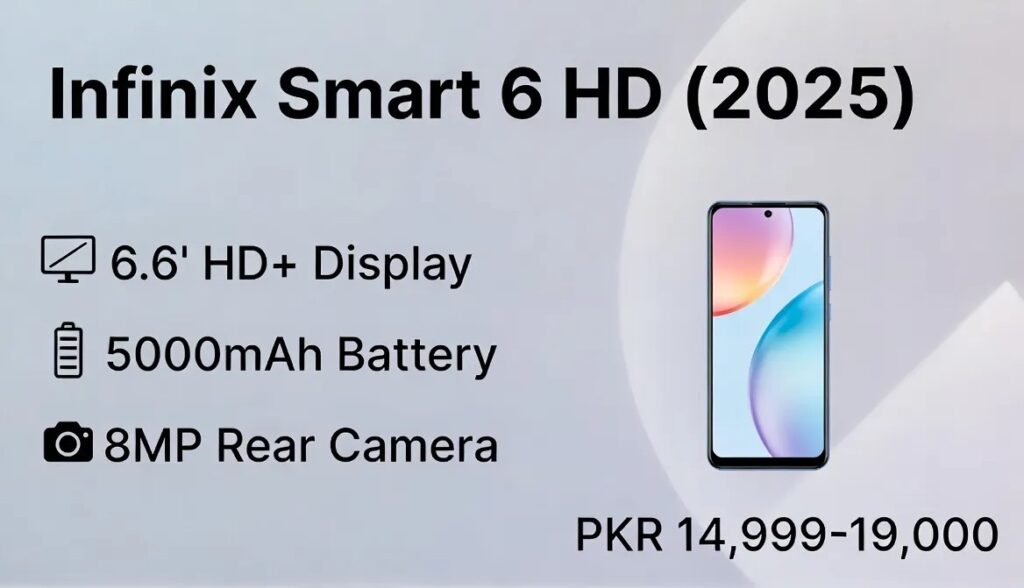
Display: 6.6″ HD+ (720×1600) IPS, manufacturer-claimed ~500 nits
SoC: Entry-level Unisoc / MediaTek family (reported variants: Unisoc SC9863A or MediaTek Helio A22)
RAM / Storage: 2GB / 32GB (some markets: 3GB / 64GB)
Rear Camera: 8MP primary + QVGA/AI sensor + Dual LED flash
Front Camera: 5MP
Battery: 5000mAh (HD SKU generally lacks fast-charge)
OS: Android 11 (Go edition) with XOS skin
Release: Originally announced in July 2022 (availability depends on market/region)
Typical Price (Pakistan example, date-stamped): PKR 14,999–19,000 (prices fluctuate; always display price with snapshot date)
Design & display
Build and feel
In consumer-device parlance, the Smart 6 HD is a pragmatic plastic unibody. The design signals durability and frugality rather than premium finishing: matte plastic back, discrete camera module, and a textured frame typical for this segment. Tactile sensation favors lightness and grip over weighty assurance. For buyers, this means a phone that resists slips and doesn’t attract fingerprints easily — but it’s not a showcase device.
Screen
From an objective feature-token perspective, the 6.6″ HD+ IPS panel maps to large visual real estate with modest pixel density. At 720×1600 on a 6.6″ diagonal, the pixel-per-inch is low compared to midrange displays, so fine typography and micro-detail will appear softer at close reading distances. Practically, for the target user scenarios (video streaming, social feeds, reading long-form text), the trade-off is favorable: a large canvas, lower GPU/SoC load, and improved battery economy compared to higher-resolution panels.
Brightness & outdoor use
The ~500-nit claim will help in shaded outdoor scenes but will likely struggle in direct sunlight. Colors tend to be faithful but not vivid — lower saturation and contrast than AMOLED panels. Expect default color profiles that prioritize natural skin tones over punchy HDR-like color.
Performance & chipset
Think of the SoC + RAM as the inference engine for your daily usage model. The Unisoc SC9863A or Helio A22 are low-parameter compute modules — they have limited Parallelism and modest memory bandwidth. Paired with 2GB of RAM, the system is optimized to run “lightweight models” (basic apps, background trimming, low-res video decoding) but will show inference latency when asked to run “heavy models” (3D games, large multi-tab browsing, camera processing with complex ML filters).
Everyday usage
- Excellent: Voice calls, WhatsApp, SMS, light web browsing (single-tab), and streaming video at 480–720p. These are low-latency, low-memory tasks and fit comfortably in the device’s capacity envelope.
- Poor: Heavy multitasking, large app warm-starts, modern 3D games. 2GB RAM is the main bottleneck: background process eviction is frequent, and context-switching latency between apps is noticeable.
Benchmarks
To make the evaluation reproducible and comparable, capture both synthetic and human-centric metrics:
- Synthetic: UL/3DMark CPU & GPU median scores; PCMark Work median if available.
- Practical: App cold-start times (seconds to open apps such as WhatsApp, Chrome, YouTube), Chrome page load times (median of 10 pages), and a low-detail gaming session with FPS capture (e.g., PUBG Lite or Asphalt at lowest settings).
- Background retention table: open six apps in sequence, switch away for 60s, return, and note which apps reload.
Camera
Hardware
- Rear: 8MP main sensor + auxiliary QVGA sensor + Dual LED flash.
- Front: 5MP selfie camera.
Daytime photos
In abundant light, the 8MP sensor yields usable social-media-ready images. Expect decent color balance and acceptable exposure in most daylight conditions. However, micro-detail and edge sharpness will be weaker compared with midrange sensors — this is visible in 100% crops. Image processing tends to be conservative: Infinix’s pipeline prioritizes smoother noise profiles rather than aggressive sharpening.
Low-light & night
This is the primary weakness. The small sensor area + limited optics, and lack of advanced multi-frame noise reduction (or slow, high-quality night modes) produce noisy images, compressed detail, and narrow dynamic range in low-luminance scenes. The dual LED can assist with very close subjects, but is insufficient for well-lit, natural-looking nightscapes.
Portraits & close-ups
Software-driven portrait (bokeh) effects are available, but edge detection can be rough. For everyday social portrait selfies, the results are passable; for critical photography or prints, you’ll want a better sensor and optics.
Battery & charging
This is the device’s most salient strength. From a systems perspective, the combination of a low-res display and an efficient low-power SoC plus a large battery produces high endurance scores.
Realistic expectations:
- Light users (calls, messaging, low screen time): 1–2 days.
- Moderate users (some streaming, browsing): a full day with headroom.
- Heavy users (continuous video, gaming): likely requires a top-up before day’s end, but still ahead of many similarly priced competitors.
Tests you should run and present
- 90-minute streaming drain: Wi-Fi, 50% brightness, continuous streaming (e.g., YouTube at 480p) — document percentage drop and extrapolate Screen-On Time (SOT).
- PCMark Work test: publish the median score if available to benchmark objectively.
- Charging curve: measure 0→50% and 0→100% times. The HD SKU typically lacks fast charging, so the curve will show a steady, linear fill — capture timestamps and build a plotted curve for readers.
Software & updates
OS experience: Ships with Android 11 (Go edition) and Infinix’s XOS. Android Go is optimized for low-RAM devices with smaller memory footprints for bundled apps and reduced background resource usage.
UX considerations:
- Expect some preinstalled apps and a lightweight launcher. Android Go helps alleviate RAM pressure but cannot fully substitute for additional physical RAM.
- Tips to improve experience: enable lighter UI modes, turn off animations, and disable background auto-sync for power-sensitive apps.
Updates & security: Infinix’s update cadence varies by region. Historically, budget Infinix devices receive limited major OS updates and some security patches, but promises are less robust than premium brands.
Real-world tests you should include
To produce a differentiated review that outranks competitors, include original, repeatable tests:
Display
- 100% crop of a high-detail image on-screen.
- Sunlight readability shot against a midrange phone.
Performance
- App cold-start times (report median of three runs).
- Background retention matrix: open WhatsApp → Chrome → YouTube → Camera → Instagram → Gallery, wait 60s, return and record reloads.
- Low-detail gaming FPS capture during a 10-minute session.
Camera
- Full-res day landscape with 100% crop.
- Indoor low-light with and without flash.
- Selfie portrait with edge detection crop.
- Include EXIF details and short notes about camera modes.
Battery
- 90-minute streaming drain with percent drop.
- Charging curve with timestamps and annotated graph.
Software & UX
- Time to first boot, initial free storage out of the box, and microSD expansion test.
- Re-create a “real user day” log: start at 8:00, record usage, Location Services, screen time, and battery level at 21:00.
Pros & Cons
Pros
- Very strong battery life for the price (5000mAh).
- Large 6.6″ display suitable for video and reading.
- Extremely affordable; easy to find in many regions.
- Lightweight Android Go helps the device remain usable on constrained RAM.
Cons
- Common SKUs ship with only 2GB RAM, severely limiting multitasking.
- Low-light camera performance is weak.
- HD SKU typically lacks fast charging.
- Ships with Android 11 and uncertain long-term update support.
Alternatives
If you’re able to add a modest budget, the following models normally give a noticeable uplift in SoC performance or camera quality:
- Infinix Smart 6 (non-HD) — check SKU differences; sometimes has better SoC/RAM trade-offs.
- Xiaomi Redmi 12C usually offers a stronger SoC and improved camera at a small price increase.
- Realme C-series / Tecno Spark — shop locally: often provide better RAM options or faster SoCs at similar prices.
Buying advice
- Check the exact SKU before you buy: SoC and RAM frequently differ across regions. The “HD” suffix refers to display resolution, not necessarily performance.
- Prefer the 3GB RAM variant if it’s only slightly more expensive; the extra RAM dramatically improves day-to-day UX.
- Use microSD for extra storage — it’s a practical workaround for limited internal storage.
- Buy a case — the plastic back scratches, and a thin, clear case prevents cosmetic wear.
- Plan for overnight charging if you push the battery; expect standard charging speeds on the HD SKU.
- Seller choice: prefer reputable marketplaces with good seller ratings; date-stamp price listings you present to readers.
FAQs
A: No. The entry-level SoC and 2GB RAM mean it can only handle very light games at low settings. Not recommended for heavy gamers.
A: The 5000mAh battery typically lasts 1–2 days on light to moderate use. The exact runtime depends on the screen brightness and the apps used.
A: The HD variant usually does not list fast charging. Expect normal charging speeds — test and show the charging curve to be certain.
A: Typical listing range shown by local aggregators is PKR 14,999–19,000. Prices change, so include a date-stamped price snapshot on your page.
A: Compare the SoC and RAM for the specific SKUs. The HD tag refers to the screen resolution; the main difference that matters is RAM/SoC variant — pick the one with more RAM and the better SoC.
Conclusion
If battery life and a large screen are your primary priorities on a tight budget, the Infinix Smart 6 HD is a viable option. If you want stronger performance or better camera results, consider stretching your budget for a 3–4GB RAM device or a phone with a stronger SoC.
